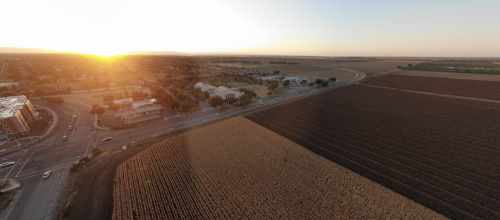
Davisite Banner. Left side the bicycle obelisk at 3rd and University. Right side the trellis at the entrance to the Arboretum.
  • Bike Parking is Complicated?

    YoloBypassDRAFT

     
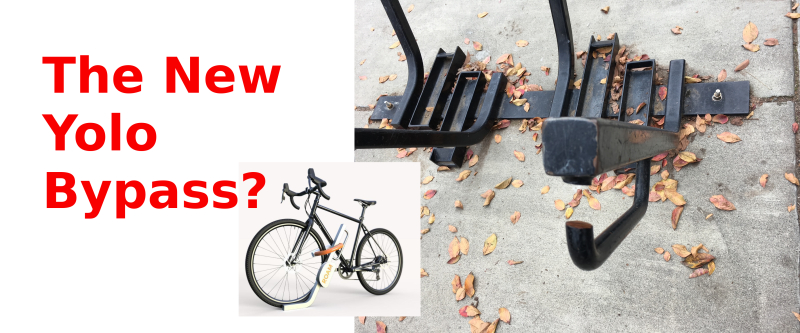
    Using a battery-powered common angle grinder, Darell Dickey works with the Davis Police Department to cut locks from abandoned bikes found in the city. He knows first hand that the soft metal of the Lightning Bolt racks is often easier to cut than the locks themselves. ROAM's creators claim that the lock takes 2500% more time to cut than a – presumably typical – U-lock. If ROAM eventually provides full coverage in Davis and UC Davis – note that there is no plan to equip racks on private property – and people really want a bike, won't they simply take a predictably short amount of time to cut the city racks?  (Inset photo from ROAM brochure attacked to Staff Report. Right hand photo taken in Davis in Fall 2017.)


    Tomorrow on UC Davis campus and at the monthly meeting of the Bicycling, Transportation and Street Safety Commission (BTSSC) a new shared public bicycle lock will be introduced, followed by pilots and local research…

    I'VE not seen the lock in use and the presentation doesn't contains imagery that's clearly actual photography – and not the much more helpful video – but for now have comments and questions for the lock developers, City and UCD partners….

    • The BTSSC and other complementary bodies have not created a new strategy for bicycle security, have not asked to do so, and have not been asked to do so.
    • City of Davis Staff are implementing new programs using City property without Council approval.
    • The locking system seems over-complicated, dependent on smart phones, Cloud-connectivity and electrical power supply (both on the locks and system servers) to function properly, or at all.
    • It’s not clear that the City and UC Davis c
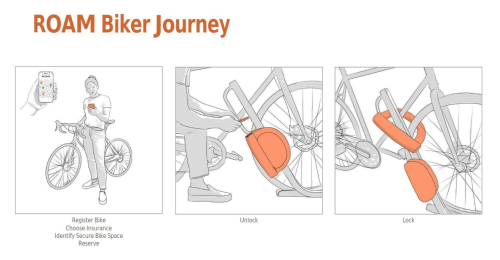
      Roam1

      From ROAM's brochure, attached to the Staff Report

      ampus will end up having the same program, or if one body might accept it and the other not. (Despite the reality of the City-Campus Mobility District, transportation engineering and planning, organization and promotional activities and infrastructure standards of the City and Campus are mostly formally separate aside from cooperation on, for example, Unitrans and the Reimagine Russell visioning project. There's a plan to allow shared e-scooters on campus but not in the city — a big mistake in user-friendly transportation policy.)

    • The promises of resistance to defeat and plans for distribution seem exaggerated, and it’s possible that the City would have to pay for it despite being instrumental in development of a commercial product. If the project goes forward, its users in Davis should not have to pay for the system though user fees, or indirectly. The City is looking into this, but it's not clear if the ROAM creators will take responsibility for it, or other sources will be sought.
    • The system does not work with non-Lightning Bolt (LB) racks (unless there’s a variant for other modern types).
    • Aside from the system used on UCD campus, it’s only for racks on City property, this leaves out a tremendous number of LB-equipped parking spaces, many of which present significant opportunity for theft due to lack of supervision or supplemental security (e.g. bicycle rooms). It’s important to note all of these properties are in fact semi-public and still required to observe local regulations for bicycle storage.
    • It’s not clear if the system will actually be available on semi-public property. In some cases this will mean that ROAM-equipped and non-equipped racks will be in close proximity. This seems to be a direct contradiction of the “everyone” claims of the concept’s authors.
    • If the system IS available for use on semi-public property but only via opt-in, i.e. by choice of the property’s managers or owners, it may further widen the gulf between the haves and have nots in bicycle parking in Davis, as there are a significant number of (improvised) parking spaces at commercial properties and residences which have no racks, LB or otherwise. This is in direct contradiction of the authors' claimed benefits and violates equity principles for Davis as lower quality bicycle-parking is likely over-represented at more modest rental properties (This would be solved starting with a truly-equitable policy of the City, initiated by the Council and discussed and prepared for actualization by recommendation of relevant Commissions, e.g. the BTSSC and Social Services.) There's also no explicit mention of DJUSD properties – i.e. users such as students at primary and secondary schools, even as a future goal (yes, inclusive of the magic "everyone"). Bicycle theft on these campuses is a huge problem that the administration is not solving. The theft of  a bicycle can be traumatic for people in this age group, especially if their family has difficulty replacing it. Why isn't this community involved at the first stage? Isn't there considerable value in the user experience of a younger person who might have difficulty with some over-complicated systems?
    • City Staff promised new bicycle parking regulations as long as two years ago, but nothing has come of it (only the registration program which is mostly the work of an outside entity, and ROAM). Five years ago, the City initiated a plan to improve bicycle parking at Davis Depot, and eventually added longer lockers, which fit the long-tail type of cargo bicycle. Five years ago the City declined to pursue acquiring facilities that would accommodate larger cargo bikes or bikes with  trailers for Davis Depot. Prior to the pandemic there were some ideas about adding over-sized bicycle parking in the one of the under-utilized buildings at the Depot, but nothing's come of it.
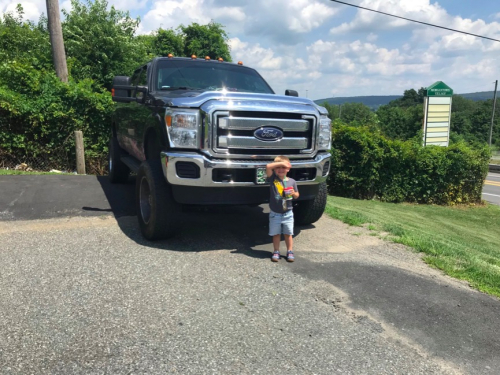
     

    273615950_1541649452881847_7777620194860680555_n

    There's secure parking for this vehicle at the train station… (Image: Urban Cycling Institute on Facebook)
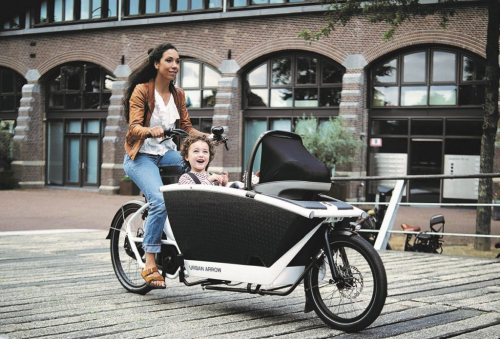
    Bike-Europe-Pon-Takesover-Urban-Arrow-1024x695

    … but not this one (Image: Urban Arrow)

    The Bike Lock design:

    What makes it take “25 times” more time to breach than…. what? A cable lock, a top-of-the-line U lock? My chain and lock combo takes at least 3 to 4 minutes to cut in the field with an angle grinder  – ROAM takes 90 minutes?

    It’s “Cloud Connected”: What happens when it can’t connect for any number of reasons, as other systems can’t sometimes? Does it become unusable?

    Right now the “Lightning Bolt” locks take less time to cut than the more expensive hardened locks. The main reason it’s not happened a lot is likely due to the psychological disincentive of damaging city or university property, as opposed to personal property. Will existing racks be modified to be more resistant to quick cutting?

    Presumably the alarm sound comes from a small hole etc that’s also protected from water intrusion – have their been tests to seal this without setting off the alarm?

    If the QR code on the lock is damaged how can the user disable the lock?

    If the user loses their phone or its battery is dead, how the can the user disable the lock?

    How many regular bicycle users don’t have mobile phones?

    Is there a way for people who don’t have mobile phones to use the system?

    What supplies the power to the locks? A separate battery on each holding piece that requires a swap for a recharged battery? How often does it need to be recharged?

    Have there been tests where a unit’s alarm and lights were activated in the present of people not connected with the project? If so, what was their reaction?

    All the visuals in the attached promotional brochure are visualizations – no photos. Presumably some exist as they are being introduced BEFORE the BTSSC meeting and before its members formally-reviewed it. 

    *****

    I went through the entire staff report and interleaved comments and questions. It's long and it's here.


     

    Davisite logo

    Did you enjoy reading this article? Then subscribe to the Davisite for free and never miss a post again.

  • Toward a Fossil Free UCD

    Fossil free UCD

    UC Davis, long recognized as a leader in environmental sustainability, is taking a bold first step to confront the sizable carbon emissions that result from its own daily operations and contribute to the climate crisis. The campus has officially announced that it is drawing up concrete plans to electrify both of its campuses with the goal to eliminate the use of fossil fuels.

    In October 2020, an informal group of UCD students, faculty, staff, and alumni met with Chancellor Gary May and other campus officials to press for a commitment to go fossil-fuel free, eventually resulting in the creation of a new Campus Advisory Committee on Sustainability. Branding itself Fossil Free UCD, the group met with Chancellor May again in December 2021 and presented a petition signed by over 1300 UCD affiliates, including more than 260 faculty, 795 students, and 135 alumni. The petition called for the Chancellor and other UC Davis leaders to commit to ending the use of fossil fuels as a source of energy for UCD’s campuses by 2030, and to develop a plan for doing so in 2022. 

     As members of this group, we are motivated by three ideas: 1) the urgency of acting now to try to avert the worst local and global consequences of global heating, including wildfires, extreme rainfall, extreme heat, hurricanes, drought, flooding, sea level rise, damaged ecosystems, species extinction, and changed disease vectors, 2) UCD’s core missions of education, research, and service to local and global communities and its longstanding commitment to environmental sustainability, and 3) UCD’s power and obligation to lead and inspire others to decarbonize rapidly.  Other universities are also taking steps to eliminate fossil fuels in this way, including Stanford, Oberlin, and Ball State.

    (more…)

    Davisite logo

    Did you enjoy reading this article? Then subscribe to the Davisite for free and never miss a post again.

  • Nonprofits: Apply for a Soroptimist grant

    (From press release) Soroptimist International of Davis is accepting applications from local nonprofit organizations for Community Grant funding for 2022.

    In 2022, the club has $5,000 budgeted for Community Grants of up to $2,500 each. Nonprofit organizations that align with the Soroptimist mission are encouraged to apply. The deadline is March 8. Awards will be distributed in late spring. 

    Grant applications are evaluated for their alignment with the Soroptimist mission, vision, core values, community impact and feasibility. Any organization, including previous recipients, is encouraged to apply. Soroptimist is a global volunteer organization that provides women and girls with access to the education and training they need to achieve economic empowerment. Applicants are asked how the requested funds would address the needs of women and girls in Yolo County, and support Soroptimist core values of gender equality, empowerment, education and diversity.

    SI Davis has several fundraisers a year, and reinvests all of its profits in its programs and projects. These include Live Your Dream: Education and Training Awards for Women, and Dream It, Be It: Career Support for high school girls. It also funds high school scholarships, anti-trafficking efforts, and these Community Grants to nonprofits.

    Applicants will receive notice by May 1 of their application’s status. To apply, visit https://www.sidavis.org/grants. Questions may be directed to Lisa Adda, Community Grants chair, at lm_adda@yahoo.com.

    (more…)

    Davisite logo

    Did you enjoy reading this article? Then subscribe to the Davisite for free and never miss a post again.

  • Developers deploy paid operatives

    SpaffordandLincolnNote: The following comments made at the City Council's Feb 1, 2022 meeting.  The City Council, as expected, decided to proceed with putting the project on the ballot for voters to decide. 

    By Rik Keller

    I have provided a graphic illustrative of the corrupt local political environment. [Mr. Keller requested that this graphic be displayed during his comments, but unlike a pro-DiSC comment, his graphic was not displayed].  It shows self-promotional information from the local lobbying firm Spafford & Lincoln. In the bottom right corner you can see that they claim credit for deploying and managing 1,000+ operatives. As some of you may be aware, most of their business is done for the biggest special interest in town: real estate developers.

    Developers spend hundreds of thousands of dollars on campaigns to try to push their projects down our throats. This money flows through Spafford & Lincoln and then who knows where? There’s no regulation. It’s a dirty money slush fund.

    One of their strategies is to pay operatives to call, and to organize other callers who often know nothing about the project, some of whom probably don't even live in Davis. It’s a classic “astroturf” maneuver. Ask yourself: how many times have you experienced these meetings being spammed and being played by these operatives reading from their scripts?

    (more…)

    Davisite logo

    Did you enjoy reading this article? Then subscribe to the Davisite for free and never miss a post again.

  • Why is DiSC back?

    Note: The following comments made at the City Council's Feb 1, 2022 meeting.  The City Council, as expected, decided to proceed with putting the project on the ballot for voters to decide.

    DISC overview shot

    By Roberta Millstein

    DiSC is back. But why is it back? Is it any better than the project that voters rejected just a little over a year ago?

    It has no new features. Indeed, the developer initially deleted a bunch of features from the proposal and, after pushback from the Planning Commission and others, has now added some of them back in. But at best that only restores the status quo to the previously rejected project.

    It is a reduced project, but half of huge is still huge. It’s the size of one Cannery instead of the size of two Canneries.

    It’s still a freeway-oriented and car-oriented project that will massively impact traffic on Mace Blvd, I-80, and adjacent Mace Ranch surface streets. As a consequence, the greenhouse gases from the project will shred the City’s already weak carbon neutrality commitment. Nothing the developers can do on site can change that, since most of the climate change impact would be from commuters to and from the site. Vague promises of possible transportation improvements don’t change this climate killer either.

    (more…)

    Davisite logo

    Did you enjoy reading this article? Then subscribe to the Davisite for free and never miss a post again.

  • A Treeless DiSC?

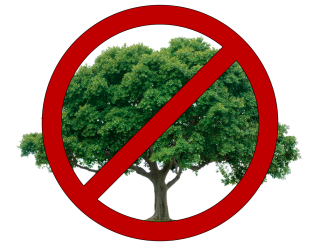
    Trees2Developer Proposes Baseline of Zero Trees Planted in New DiSC Development

    The below letter was sent to the Davis City Council regarding a lack of commitment to planting trees in the massive new development. The Davis City Council takes up DiSC 2022 at the Feb. 1 meeting. You can find the agenda here. The agenda contains information for how to view the meeting and offer public comment. The DiSC proposal can be found here.

    ________________

    Dear Davis City Council,

    The below letter is informed by my work on the Tree Commission and on the Tree Commission subcommittee on DiSC 2022, but represents my own point of view, though others on the Tree Commission may share it.

    Initially I was encouraged to hear the DiSC project was adopting a goal of planting 1,500 trees as the Tree Commission recommended. Then I read the actual language of the proposed baseline feature,
    "The Project will add no less than 1,500 new trees to the City’s urban forest to sequester carbon, improve mental health, deter the heat island effect, and provide shading. If less than 1,500 trees are planted onsite, Developer will ensure that the remainder will be planted elsewhere in Davis."
     
    This baseline feature actually commits to planting zero trees in the project itself. The Baseline has no baseline. The language is carefully crafted to commit to only adding trees to "the City's urban forest." The language allows for every single tree to be "planted elsewhere in Davis." The baseline features make no commitment to any number of trees in the project itself. That is totally and completely unacceptable. The vast majority of these 1,500 trees, if not all of these trees, need to be planted in the DiSC project itself.
     
    The ground for planting a tree is the hardest part to come by for planting a new tree, if the developer doesn't commit to planting these trees in the project itself, there is little prospect of planting 1,500 trees elsewhere in the City of Davis anytime soon. The DiSC Baseline Features and Development Agreement provide no mechanism for planting trees "elsewhere in Davis" and no enforcement for assuring trees are planted and maintained elsewhere. That is a further reason why committing to zero trees actually planted in the project is entirely unacceptable.

    (more…)

    Davisite logo

    Did you enjoy reading this article? Then subscribe to the Davisite for free and never miss a post again.

  • 2022 Virtual Celebration of Abraham

    Hope in difficult times     flyerHope in Difficult Times: An Interfaith Conversation

    (From press release). The Celebration of Abraham, which is the only interfaith organization guided by the laity in Davis and Woodland, will hold another virtual celebration this year, Sunday February 6, 2022, 3 pm-4:30 pm. We deeply miss gathering with everyone in person and look forward to doing this again as soon as we can do so safely.

    We recognize that the pandemic, environmental destruction, and political unrest continue to affect our well-being and therefore our ability to sustain ourselves as we face these challenges. For this year’s theme, “Hope in Difficult Times: An Interfaith Conversation,” we have chosen three young leaders to offer guidance grounded in their faith traditions: Leah Julian, Rabbinical Student; Tara Rogers-Soeder from the Davis United Methodist Church; and Omar Abdel-Ghaffar from Muslim Davis Engagement and Interfaith Network (DEIN). Our speakers will explore how we can live with hope without turning away from the difficulties that we face in our individual and collective lives. After hearing from the three speakers, we will invite attendees to discussion breakout rooms to share their thoughts.

    Randy Farris will again lead us in singing Children of Abraham. We will raise donations for the International Rescue Committee. To sign up for the free event hosted on Zoom, please go to  http://bit.ly/COAHope. This link is case sensitive. You can also sign up by going to our website at http://www.celebrationofabraham.net.

    Davisite logo

    Did you enjoy reading this article? Then subscribe to the Davisite for free and never miss a post again.

  • DiSC 2022: Same Old Choices

    Im-with-herBy Larry D. Guenther

    On Tuesday, the City Council will decide whether or not to put DiSC 2022 on the ballot again. DiSC 2022 is a new version of the project on the outside of the Mace Curve that was voted down in its last iteration. It is now about half the size of the previous project. One of the Council’s goals is economic development. Another of the Council’s goals is Carbon Neutrality by 2040. In our current development paradigm, these goals are contradictory. That’s because our current development paradigm is centered around the automobile and commuting workers.

    Approximately three quarters of our community’s total Green House Gas Emissions (GHG’s) come from transportation (78% projected for DiSC) – and the lion's share of that is single-occupancy vehicles; i.e. commuters. Hence the problem. DiSC is designed for commuters – it is designed in the current paradigm. The EIR for the DiSC project says that this project alone will increase the City’s total GHG’s by 4%. The EIR also states that this project will not allow the City to reach its carbon neutrality goal. These are not statements from opponents, this is from the project’s EIR.

    There is scientific consensus that if the average global temperature increases by 1.5°C, our environment (that is to say, ‘we’) will suffer extreme and irreversible negative consequences. There is also scientific consensus that the average global temperature has already increased by 1°C. Additionally global GHG’s – the primary cause of increased temperatures – are still rising. This project would continue that trend.

    (more…)

    Davisite logo

    Did you enjoy reading this article? Then subscribe to the Davisite for free and never miss a post again.

  • Seven California Community Power Members Contract for 69 Megawatts of Long Duration Energy Storage

    Project marks first major procurement milestone for CCA Joint Powers Agency

    Participating CCAs
    Participating CCAs

    (From press release) At the January 19 California Community Power (CC Power) board meeting, members of the Joint Powers Agency voted to enter into an energy storage service agreement with REV Renewables for 69 megawatts (MW)/552 megawatt hours (MWh) of long-duration energy storage.

    The REV Renewables Tumbleweed project will be a CAISO grid-connected, lithium-ion battery storage resource located near Rosamond, in Kern County, California, with an expected online date of 2026.

    “Long-duration energy storage is a vital resource, needed to amplify the value of renewable power and accelerate California’s shift to a clean, reliable and affordable grid,” said Girish Balachandran, California Community Power board chair and Silicon Valley Clean Energy CEO. “This first project is an exciting milestone that shows how CCAs work together to advance our shared goals in the transition to a carbon-free grid.”

    The California Public Utilities Commission Mid-Term Reliability Procurement order (Decision 21-06-035) requires all CPUC-jurisdictional load-serving entities, including CC Power members, to procure from energy storage facilities capable of discharging for a minimum of eight hours. This project satisfies approximately 55% of the long-duration storage compliance requirements of the participating members.

    (more…)

    Davisite logo

    Did you enjoy reading this article? Then subscribe to the Davisite for free and never miss a post again.

  • Leaf blowing is also a habitat and a labor issue!


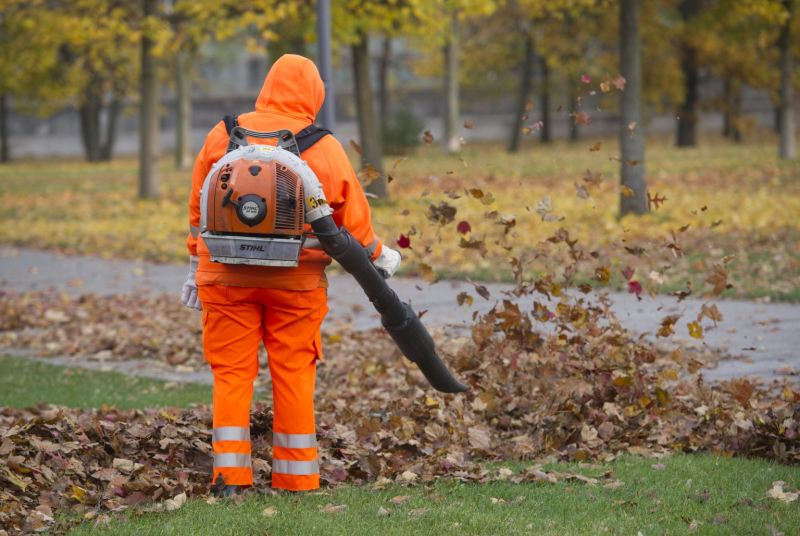
    Progress is progress, but perhaps lost in the progress to reduce the harm caused by leaf blowers to creatures large and small – with university degrees, naked, multi-legged or winged – is the need to make sure that changes in practice don't interfere with the ability of property maintenance workers to make a living and to improve their work environment, wages and skill sets… all while improving nature in our corner of the Universe.

    This evening the City Council will take the long-awaited next step to study the use of leaf blowers in Davis. The agenda item should start on or after 7:20pm.

    First of all I appreciate the findings of the Natural Resources Commission, though I wish their recommendation was for an earlier complete phase out than 2024. A major fault, however, is that the recommendations do not apply to commercial areas. The problem seems obvious: Pollution caused by gas blowers or stirred up by electric blowers affects adjacent properties – which may be residential, part of the proposed eventual ban – and really everywhere because of, you know, air.

    Another way to look at it is that we currently ban leaf blowing when AQI reaches 1oo if that threshold is crossed by just before 7AM – and then there's no decision for a ban for another 24 hours no matter how many firestorms spring out of hell during the interval – based on an air monitor that's outside of the City, just south of West Village. But then it's okay for your commercial neighbor to blow 20 feet from your open window with your asthmatic child.

    That doesn't make sense and it's perhaps I am not explaining it clearly… but I make no apologies: The proposal, though an improvement on the current state of things, is too complicated and therefore hard to enforce. By the way, commercial properties are also the residences of numerous animals who simply happen not to be human.


    Yards are Habitat!

    Leaf blowing makes yard clearance of what's perceived as waste far too easy. This kills habitat for creatures small and larger ones that eat them.It depletes trees of food. It makes it easy to put yard waste in the street, including bike lanes, even though the latter is not allowed. This threatens children on bikes. Leaf blowing is dangerous for children and other living things. It's been city guidance for years to let leaves degrade where they fall, or alternatively compost them on site. (Clean those concrete paths with a broom and a rake, very clever!)

    The choice is simple: Phase out all use of all leaf blowers, allow leaf vacuums IF they don't also pollute, and ban gas-powered equipment. Do this all as soon as possible.

    There's also a recommendation from the Recreation and Parks Commission based on their perspective which is that gas blowers work better than electric blowers so there needs to be more money for lots of batteries and such like — but the way I see it is like this: In relation to air quality and the state of living environment in the city, the NRC has clear priority over Rec and Parks. It's a mistake to consider them equal – or equally relevant – Commissions on this issue.


    It's time to bring a labor angle into this, friends!

    There's more Commission missions about the emissions missing from these missives: About labor. All these guys – mostly guys – disproportionately Latino – who need jobs, jobs that are good for them, get better and give them more in healthy challenges and pay.

    The leaf blowing survey results in the staff report and Commission recommendations detail the nuances of companies and how they work and what tools they use. It's not really explained why some use manual tools and some use electric – aside from the AQI-based bans. But to make things simple let's say that banning the use of blowers increases the amount of work needed, and expenses. With a deep ecological perspective it's simple to say that the people that benefit most from this – owners of properties – are simply entitled. The leaf blowing solution is artificial. 

    It's not pleasant work. We need to humanize it. The goals here likely to keep the same number of people employed and to increase wages, while we improve the environment. It has to be this. We can't settle for less.

    Our aim must be to improve the skill sets of workers, by having them care in a more nuanced way for yards… to plant, to collect acorns, to add habitat for bees… to build boxes and other structures for on-site composting.

    We don't have a labor commission, but we do have a Social Services Commission. Perhaps also Utilities or Fiance and Budget have a role to play? Overall – and clearly – this is an equity issue and it can't be solved only through input from Natural Resources and Parks and Rec. But to be clear, it's up to the workers themselves to decide what they want.

    The Council needs to go forward on the best recommendations made so far but then send this work back to these additional commissions and the citizens for more input and wisdom. We have a tremendous number of experts in related disciplines at UC Davis who will want to help. We have labor experts in the county and region who have to help.  It's not simply a matter of copying best practice from other progressive cities, but improving upon it!

    Davisite logo

    Did you enjoy reading this article? Then subscribe to the Davisite for free and never miss a post again.