Less than a week ago, I wrote an article here about the $10 million dollars that Eric Jones, congressional candidate in CA’s District 04, had dumped into his own campaign. That contribution made headlines across the district as the largest contribution ever made in a CA congressional campaign, an amount that, together with large-donor out-of-district donations to Jones campaign, put him at #10 in spending across the entire country (remembering that there are 435 seats open and an unknown number of candidates running for those seats).
But little did any of us know about another contribution, just surfaced on the FEC site, from Jones: $4,800,000.00 on October 1, for a grand total of $14,864,133.10 — yes, almost $15 million dollars. There is no other way to see this but as this recently-resigned Silicon Valley venture capitalist, former partner at Dragoneer Investment Group, trying to buy a congressional seat.
$10 million was eye-popping. At $15 million, your jaw should be on the ground and your head should should be swiveling on its neck (and don’t ask me what comes after that).
Fellow citizens of District 4: Californians have a proud history of rejecting multi-millionaires and billionaires trying to buy their way into positions of power, knowing that these people do not have the interests of ordinary citizens in mind.
Vote for Mike Thompson, born and raised in our district, who is hardworking, honorable, and trustworthy.
Here is the screenshot from the FEC showing the Oct 1 donation and his year-to-date total:
My involvement in evaluating and commenting on the merits of proposed development projects began in the mid-1980s when I joined the environmental commission of a rapidly expanding city in San Diego County. I later worked for a Bay Area business association, where I identified the pros and cons of development proposals, and then helped launch housing and commercial projects for the Sacramento Housing and Redevelopment Agency.
My career culminated as Senior Environmental Analyst for the Sacramento County Department of Airports for 13 years, where I studied the potential aviation impacts of housing proposals near airports. During the past nine years I have spent countless hours evaluating and suggesting improvements to proposed developments in my role as Davis planning commissioner.
This background means it takes an extraordinary proposal to garner my unqualified support. For the reasons summarized below, that project is Willowgrove, Measure W on the November 3 ballot. If approved by Davis voters, Willowgrove will transform 232 acres in northeast Davis into 1,250 homes of various types: single-family dwellings, townhomes, condominiums, and deed-restricted affordable apartment units for lower income households.
Wife of Jones’s former Dragoneer partner dumps in $5 million
By Roberta Millstein
With quarterly updates at FEC.gov, we have new information about just how many more millions Eric Jones and his supporters have dumped into his campaign to try to buy a seat in Congress in District 4.
Jones himself has now added $4,700,000.00 to the $5,364,133.10 he had already spent, for a total of $10,064,133.10. That is a massive amount of money for a congressional campaign, especially one that is (at least in name) a Democratic candidate vs another Democratic candidate — Mike Thompson is the incumbent.
Edited to add: An article in the Davis Enterprise states, “this makes Jones’ contributions the largest self-funding for a U.S. Congressional race in California history. It is also the sixth most self-funding spent on any race in California history.”
Here is a screenshot from FEC.gov showing his previous $5.3 million in “contributions” to his campaign:
Chapter Two: Super PAC Spending for Ads, Mail, Social Media, etc.
LESSON TWO: OTHER OUTSIDE ACTORS IN DISTRICT 4 PRIMARY
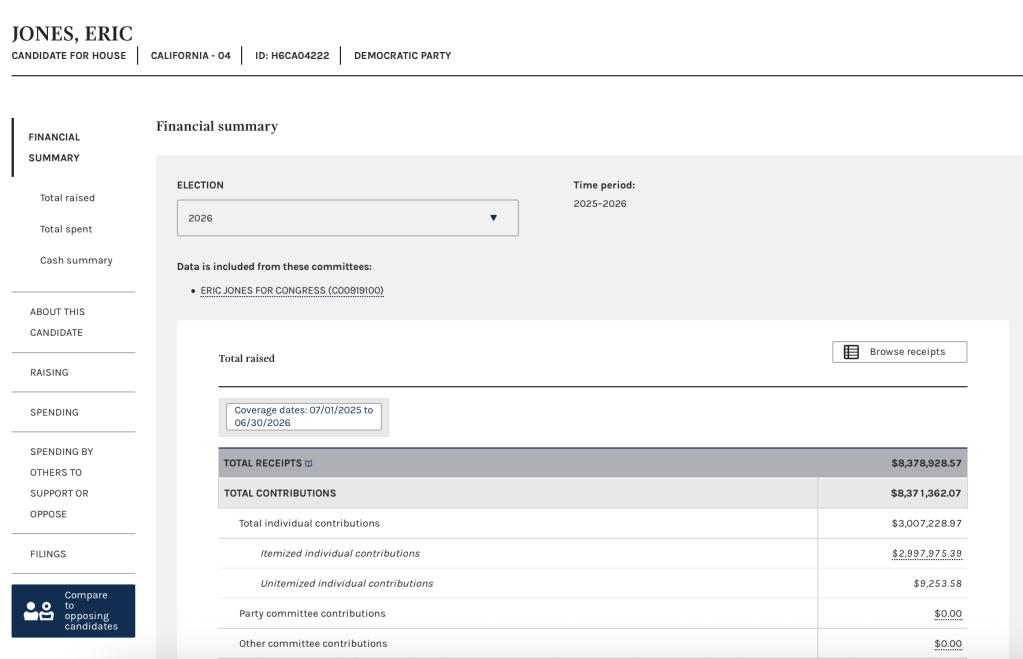
Step One: Start back at the basic FEC.gov website, scroll down as before and click on “House of Representatives candidates” and then when that page opens up, scroll to the left-hand column and enter in the “Candidate Name” box, “Jones, Eric” and click on the drop-down entry for “Jones, Eric” without any middle name. Scroll to the right into the main frame and click again on the link for “Jones, Eric.” You should now see this page:
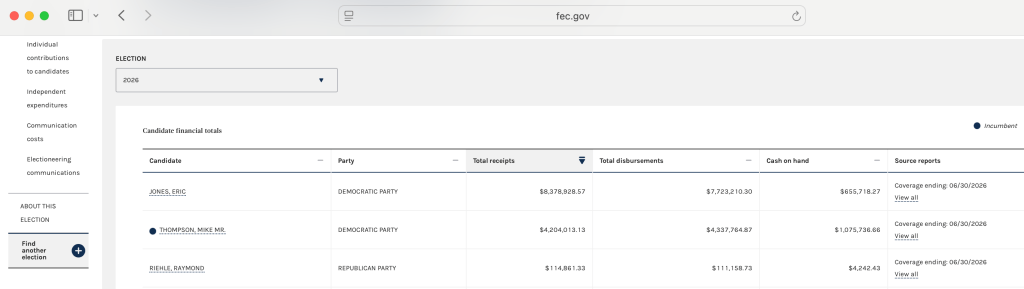
Step Two: Scroll down in the left-hand column and click on the dark blue link “Compare to opposing candidates” and you will bring up the following screen that shows all the candidates who ran in the June Primary for California Congressional District 4 and each candidate’s fundraising totals as of June 30, 2026.
Preface & Recap on Chapter One: Contributions & Expenditures in 4th C.D.
[Note: Chapter 2 follows this short preface and recap]
By F.E.C. Nerd
Hopefully, you have taken the lessons learned from Chapter One and have done some exploration on your own. It will be helpful to have those research skills honed because new additional disclosures will be forthcoming very soon. Those will cover the period from July 1, 2026, through September 30, 2026. That’s three whole, long months of fundraising and spending. I also want to point out a couple other customizable search methods you can try.
Step One: Log into your favorite Internet browser. Then go to:
Step Two: Scroll down the page towards the bottom and click on the link for “House of Representatives Candidates.”
Step Three: So that you know how to search for any House candidate use the search box — “Candidate Name or ID” in the upper left corner. Type in: “Jones, Eric”. A drop-down list of several “Jones” candidates will appear. Select the one for “Jones, Eric H6CA04222”. That will take you to the link for Eric Jones’ campaign reporting.
Step Four: Scroll right to get into the main display and click on the “Jones, Eric” link that is active. This will take you to where we start to get to the substantive data.
Step Five: Scroll to the left and click on the dark-blue box “Compare to opposing candidates.”
This will bring up another page of data (as shown below) for the main three candidates in the June Primary. Mike Thompson finished first, but Eric Jones narrowly bested Raymond Riehle, for second place and onto November’s General Election run-off. We will return to this screen again as we do our research.
Note the data under “Cash on hand” as of 6/30/2026. Note that Eric Jones reported just $665,718.27. That is nowhere near enough to buy all the TV ad-time to run his AI-generated ads attacking his opponent. So, we can expect some large contributions to be reported when the 7/1/26 – 9/30/26 disclosures are filed later this week.
Step Six: Click on “Jones, Eric” and then once the page loads, click on the button on the right “Browse Receipts” and get the drop-down search categories in the left-hand column. We spent some time in Chapter One, Lesson Two searching these, but I wanted to point out another type of search.
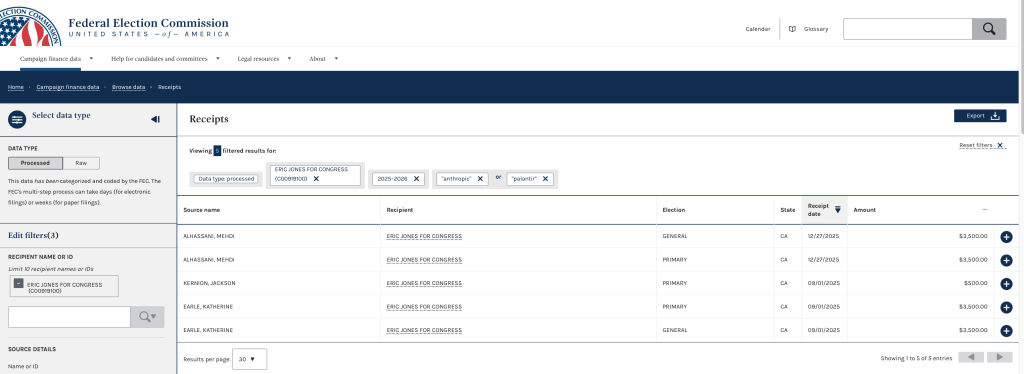
Step Seven: Scroll down in the left-hand column and at “Employer” let’s insert a couple names instead of the more general terms “inc” and “llc” that we used in Lesson Two. Enter “Anthropic” and click the right > button and we find that donors affiliated with Anthropic contributed a total of $7,500 all of it on 9/1/2025 — 8 days prior to Eric Jones filing his Statement of Candidacy.
Now enter “Palantir” in the search box . (Palantir showed up in one of our previous searches of contributors as being a client of one of the venture capital firms whose personnel were donating to Eric Jones’ campaign). Click on the right > button and we see that one of Palantir’s personnel contributed the double-maximum ($7,000) to Eric Jones on 12/27/25. Palantir works with ICE.
This will take you directly to the Homepage of the Federal Election Commission (FEC) and its webpage that permits browsing of candidates’ financing. This is the official repository of federal election campaign finance information relating to Federal office candidates. Campaign reports are filed electronically and the information reported can be directly accessed here.
Step Two: Scroll down the page towards the bottom and click on the link for “House of Representatives Candidates.”
Step Three: The next page that appears lists all House candidates in order of totals raised for this election cycle. The list is topped by AOC, with Hakeem Jeffries and Mike Johnson both near the top. However, if you scroll down to the 18th-ranked you will see Eric Jones with $8.3 Million. Where did all this money come from?
CHAPTER ONE: Digging into the Details About Federal Candidates’ Supporters — Looking Beyond the Hype, Hyperbole, and Total B.S.
By F.E.C. Nerd
The U.S. Supreme Court’s Republican appointees negated virtually all of the campaign finance reform laws at the federal level over the past several decades. (Buckley v. Valeo; Citizens United; National Republican Senatorial Committee v. Federal Election Commission.) They have left us with little protections against the excesses of extreme campaign spending by powerful monied interests in an attempt to literally “buy elections.”
There are some campaign contribution limits, but thanks to the court cases, there are many ways to circumvent those limits. What is left is campaign finance disclosure. We voters must use that one remaining tool to inform ourselves. So, I write this to help the reader with practical guidance to assist in determining the sources and likely motivations of the big-money players in our current election cycle.
I’ve been overwhelmed by the deluge of TV ads by Eric Jones, the challenger in our home district (California Congressional District 4). Sometimes the same tedious AI-generated ad appears on my TV screen as many as four times in a single program!! Not to mention, the wholly unsolicited SPAM texts from someone I haven’t given my number, or permission to fill my inbox. Plus, the paid canvassers delivering doorhangers despite my “No Soliciting” sign. So, I ask myself, WHERE IS ALL THAT MONEY COMING FROM? Perhaps you are wondering the same thing.
Here’s how to find the answers from the authoritative source — not some “never-heard-of-it- before” on-line website or slick campaign ad. Because my goal is to help you to ferret out the truth and then allow you to reach your own conclusions based upon the unvarnished facts, you do not need to “trust me” in terms of viewpoint. Just do your own research and decide for yourself. Ballots have just been mailed, early voting begins in the next few days and the candidates have debated on TV. (See here for the video of the debate, in case you missed it):
12th Edition of our local Davis ballot, summarized to save you time!
By Alan Hirsch
Dear Neighbor,
This 6-page flier’s goal is to save you time as you make your voting decisions. This is my 12th neighborhood flier. I am not a candidate or a party, and I don’t work for any candidate. It is just me, with help from a neighbor, Victor Libet. This flier flows from my long-time hobby of observing council and city commission meetings
This time the ballot is for 12 offices plus Judge retention. There are 14 Propositions, 12 state propositions, and two local propositions: a Los Rios Bond & Davis Housing Prop “W”.
I’ve done research, including interviewing many of candidates, talking to campaign staff and talking to other council/DJUSD observers. I also have suggestions on where to get more information. I suggest reading the local opinions and news articles at DavisVanguard.org and Davisite at www.Davisite.org. Sadly, The Enterprise doesn’t add much value though Calmatters authored articles are helpful on state races and propositions. LWV gives good summary and pros/cons of proposition but not who’s behind them and the spin in the arguments. The BlueVoterGuides.org does an excellent job here.
NOTE: This election, I think your focus should be items marked “?” which are 3 Props& 3 candidate races. My “progressive biased” endorsements are in bold and indicated by “*”
(From press release) In a televised debate hosted by KCRA on Wednesday, 4th District congressional candidate Eric Jones declared “I’m not from here.”
Jones, a venture capitalist, has claimed he moved to the 4th district in 2021 but in fact voted in San Francisco until 2025 and purchased his $4 million Napa home with a mortgage that described it as a second home. His shocking admission came at the end of a half-hour televised debate where Jones faced questions about his venture capital firm’s investments in companies fined hundreds of millions of dollars for harming consumers, his reversal on policy positions including his suggestion to sunset all federal programs including Medicare and Social Security, and whether he is truly a resident of the community he wants to serve in Congress. In his closing statement, Jones said, “I’m not from here”
Jones’ admission is in stark contrast to Congressman Mike Thompson, who was born, grew up, and still lives in our district. Thompson, a combat veteran and member of the powerful Ways and Means Committee in Congress, dominated the debate.
“Eric Jones couldn’t have said it better: he’s not from here, and he doesn’t know the needs of our community. While Eric furnishes his third home in Napa with half a million dollars worth of designer furniture, Mike Thompson has been showing up and delivering for our District to lower costs for families, protect our democracy, and put an end to this forever war that’s raising prices,” said Thomas Dowling, Mike Thompson for Congress Campaign Manager.
Congressman Thompson is a member of the House Ways and Means Committee, which has jurisdiction over health care, tax, trade, Social Security and income security issues. Congressman Thompson is the Ranking Member of the Tax Subcommittee and a senior member of the Health Subcommittee. He is also a member of the fiscally responsible Blue Dog Coalition and a combat veteran. To learn more about Congressman Mike Thompson visit here.
[Note: this letter first appeared in the Davis Enterprise, here. However, they did not have room to print the first paragraph, which the author asked to be included here].
Eric Jones has been touting his strict opposition to ‘corporate PACs’ over the course of the entire campaign. But Super PACs are worse than corporate PACs, because corporate PACs limit individual donations to $5,000, whereas Super PACs have no limit on individual donations. So Eric Jones, while sanctimoniously abjuring corporate PACs and attacking Thompson for accepting some donations from them, himself not only benefited from his (barely) former partners’ $3.9 million Super PAC, but also personally donated $10,000 to a Super PAC in support of the campaign of one of his tech cronies.
Eric Jones claims to be a progressive congressional candidate who wants to get money out of politics, but his actions speak much louder than his words.
Eric Jones was a big venture capitalist — a partner at Dragoneer Investments — until only one month before he declared for office. He received the vast majority of his outsized war chest from his network of AI/Crypto/tech-related executives and their financiers and his own venture capital fortune. He is also supported by a $3.93 million Super PAC largely funded by his long-term fellow Dragoneer venture capital partners/spouse. Dragoneer is a huge investor in tech and artificial intelligence.