

By Eileen M. Samitz
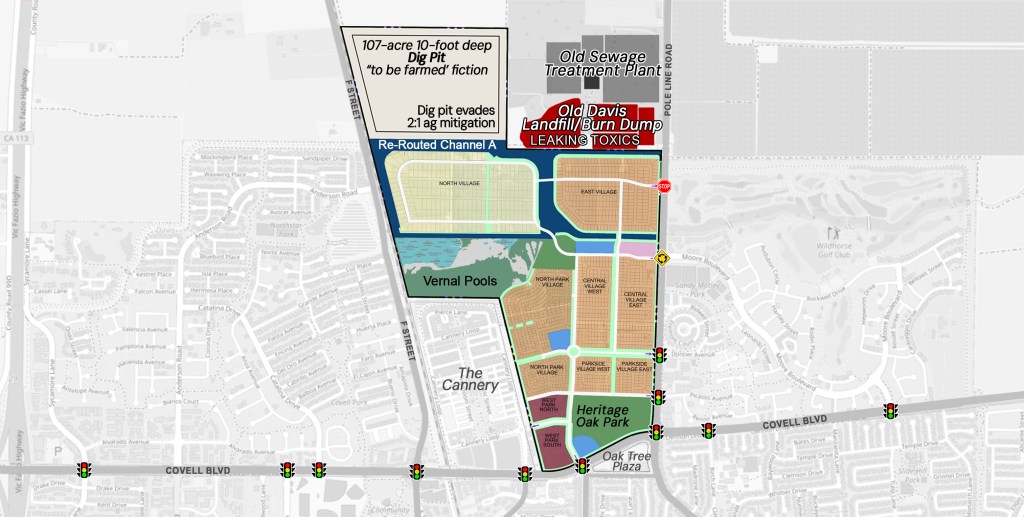
The Village Farms project, with 1,800 housing units on 498 acres at Covell Blvd. and Pole Line Road, is the largest residential project ever proposed in Davis with the worst impacts. It would take at least 15 years for the buildout, meaning many years of added congestion from construction traffic.
An earlier version was proposed in 2005 as Covell Village, and Davis voters wisely rejected it because of toxics, the 200-acre floodplain, massive traffic, enormous infrastructure costs, and unaffordable housing. Twenty years later, Village Farms has all the same problems and more.
The site is seriously handicapped. That is why the current developer, John Whitcombe, and partners including Tandem Properties, acquired the original 386-acre parcel at a bankruptcy auction for a mere $3.2 million. The original Crossroads developers abandoned it because of toxics, floodplain, and unmitigable traffic. Yet, the current developer is again trying to push it through despite the health, welfare, and safety issues, and unaffordable housing.
Massive traffic and other impacts
Village Farms would bring more than 15,000 additional car trips PER DAY to the Covell and Pole Line Road vicinity, with backups along the already congested Covell Blvd. corridor and Pole Line Road. There would be Level of Service F, “unacceptable” per traffic studies, on many streets, and dangerous cut-through traffic. Covell Blvd., Picasso, and Donner would all have traffic lights with inadequate distance between them, preventing effective “stacking” of cars, regardless of signal timing.
Unaffordable housing and an abysmal affordable housing “plan”
Village Farms plans to have 80% market-rate housing, which would be unaffordable. The BAE Village Farms fiscal report states that medium-density housing would be $740,000 and low-density housing would be $1,340,000, meaning at least a $6,000 to $9,000+ monthly house payment for mortgage, taxes, insurance, CFD, and other fees. This will not help schools because it is unaffordable for families with young kids. Further, the timeline for Village Farms is far longer than the School District’s short timeline.
The affordable housing “plan” is abysmal. The developer is not building 360 affordable units, but may possibly build only 100 affordable apartments in the last phase 10+ years down the road. This is due to a huge LOOPHOLE in the Development Agreement, which says the City “may” ask the developer, rather than “shall” ask. The City is likely to wind up with ZERO affordable units since the developer will have built 90% of the project by then and could walk away.
It is notable that the three other large projects, Palomino Ranch, Bretton Woods, and proposed Willowgrove, are committed to building all of their affordable housing with nonprofits, but Village Farms is not. Also, the developer has only dedicated 16 acres for affordable housing, while the Municipal Code requires 18.6 acres.
Toxics from the adjacent Old City Landfill/Burn Dump
Village Farms is adjacent to the unlined Old City Landfill/Burn Dump and Sewage Treatment Plant, which has never been cleaned up, nor is there a plan to clean it up. High levels of carcinogenic PFAS “forever chemicals” and other toxics are leaking to Village Farms. For 30 years, this dump was a massive burn pit for unregulated waste, likely leaving carcinogenic residues such as dioxins, yet the EIR did not test for them. There is a need for a 1,000-foot exclusionary buffer, methane testing, and protections near the Old Davis Landfill/Burn Dump and Sewage Treatment Plant.
Soil toxics at the children’s park
Village Farms has ultra-high toxaphene and elevated lead levels at the proposed Heritage Oak Park, where children would play. There is still no clear Department of Toxic Substances Control-led cleanup plan with binding standards, sequencing, and oversight. If the City is going to put a park near known contamination, the enforceable remediation plan must come first.
200-acre FEMA floodplain
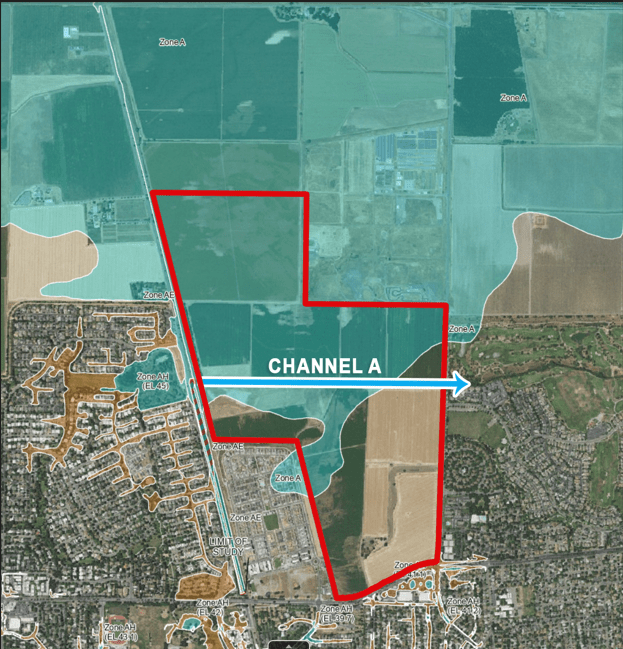
Village Farms has an enormous 200-acre FEMA Hazard Zone A floodplain (see image below), primarily north of Channel A. A fundamental planning principle is to never build on a floodplain this large. State legislation discourages such approvals because the state cannot be expected to bail out cities that build in major flood-hazard areas, especially with climate change and more atmospheric rivers. Surrounding neighborhoods, including Wildhorse, would also face increased flood risk. There is no verified flood-control plan, yet the developer implies there is.
FEMA’s current moratorium affects the assumed floodplain-relief pathway. Village Farms and the City are assuming FEMA will provide timely relief, but buyers, lenders, and insurers will not accept wishful thinking.
A serious flood-control failure occurred in Davis in the 1990s. The City had to buy Howat Ranch because the Mace Ranch flood-control plan failed. Howat Ranch flooded and sued, and the City settled by purchasing the 760-acre ranch. With Village Farms, neighborhoods like Wildhorse could flood, and the City could not buy its way out of a disaster like this.
Channel A rerouting, habitat destruction, and dig-pit “agriculture”
The planned rerouting of Channel A is being sold as “flood control,” but appears insufficient to replace what nearly 500 acres of agricultural land currently absorbs. It would remove hundreds of trees, devastate channel habitat, and require massive earthmoving, including ONE MILLION cubic yards of soil from the former Urban Agriculture Transition Area, to become a massive dig-pit site.
The project now claims this 107-acre, 10-foot-deep dig-pit crater will instead be designated “agriculture,” which is absurd. This dig pit and secondary detention basin are urban uses, not agricultural uses. This convenient relabeling deprives the City of the required 2:1 agricultural mitigation for an urban use. The designation must be corrected back to UATA, and the City’s own 2:1 mitigation requirement must be enforced.
The “analysis, hydraulic modeling, and other elements of the DEIR may significantly underestimate downstream hydrologic impacts” as commented by UCD Geosciences professor and flood-control expert Dr. Nicholas Pinter Ph.D. There is also an obvious water-pollution risk where contaminated groundwater can mix with Channel A from below, and storm events can carry contaminated water and sediments from the dig-pit basin to Channel A from above. That runoff moves east through Wildhorse, wetlands, the Vic Fazio Wildlife Area, the Yolo Basin, and eventually the Sacramento River. These foreseeable pathways demand serious analysis and enforceable protections before certification. This concern was raised by hydrologist Dr. Steve Deverel Ph.D. who monitored the Frontier Fertilizer Superfund site cleanup in Mace Ranch for over 25 years.
There was a late-stage proposal for a semi-permeable channel “liner” intended to block contaminated groundwater. However, there is no guarantee this would work, and worse yet, this liner is not mentioned in any City documents and therefore cannot be enforced. So, this is not a solution to potential groundwater contamination of Channel A runoff.
Endangered vernal pools and habitat destruction
The vernal pools are at risk due to the rerouting of Channel A, which would disrupt the hydrology that the vernal pools and endangered Vernal Pool Tadpole Shrimp rely on for survival. Hundreds of trees would be torn out, destroying valuable Channel A habitat and impacting the threatened Swainson’s Hawk. There is much skepticism about the developer’s commitment to protecting these vernal pools is uncertain because the vernal pools were disced just a few weeks before the Village Farms EIR process began.
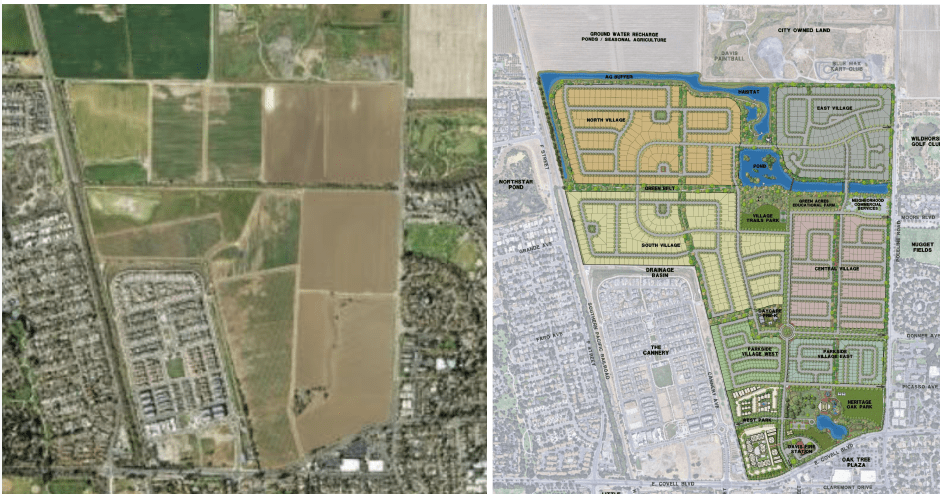
In addition, the Village Farms developer’s original “Proposed Plan” (see image below) was to pave over the vernal pools. This changed only because the endangered species of Vernal Pool Tadpole Shrimp were found. Yet, the project tries to take credit for, and feature the vernal pools habitat area.
Infrastructure costs and unsafe access issues
The Pole Line Road and F Street bicycle/pedestrian grade-separated crossings are still described with “if feasible” language, offering no certainty. So far, the City is requiring the developer to pay a maximum of only 20%, but further negotiations could reduce that to only 6.7% of these multi-million-dollar grade-separated crossings, imposing the remaining 80% to 93.3% costs on the community, per Development Agreement Attachment L-1. The same developer has failed to deliver his Nishi project, grade-separated crossing, or housing. What makes us think he would deliver TWO grade-separated crossings at Village Farms? Further, the developer would only pay a “fair share” of off-site roadway “improvements” necessitated by the project.
Village Farms false narrative campaign strategy
Village Farms developers have spent over $780,000 so far on their campaign, using an expensive public relations company and hired political operatives used for the developer’s Nishi campaigns. They recruited and hired UCD students, deeming them interns, generally paying them $500 – $1,750 to make calls, canvass neighborhoods, and post “Yes” soundbites on social media. State law requires paid campaign workers to disclose their affiliation when posting on social media, a regulation their campaign has been ignoring.
This is reminiscent of the “Pizzagate” incident in 2005 during the “Yes” on Covell Village (Measure X) campaign in 2005 when the campaign team of the same Village Farms developer (John Whitcombe) were caught offering free pizza coupons with “Yes on Covell Village” literature to lure UCD into voting for the project. The County Clerk determined this to be illegal. In addition, the Covell Village “Yes” campaign also had a campaign worker who was a poll judge who was caught lobbying voters at a polling station for “Yes’” votes. The County Clerk also determined this to be illegal. These Covell Village election incidents were deemed a low-point in Davis’s history. Davis Wiki documents these incidences at: https://localwiki.org/davis/Pizzagate and for more information, including the original Davis Enterprise article, is on-line at NoOnMeasureV.org on the ”History” page at https://noonmeasurev.org/village-farms-project-problems/history/.
Further, there was widespread theft of No on Measure X lawn signs back during the Covell Village campaign, which has also been reoccurring with the No on Measure V lawns signs, with an uptick in signs being stolen in recent weeks. Since “No on Measure V” is a grassroots campaign relying on citizen donations, this has been a burden on the campaign to replace the signs.
The Yes on Measure V campaign has also been using a false narrative that existing residents, particularly homeowners, were trying to keep out new residents. Nothing could be further from the truth because we opponents want good planning, not an aberrant project like Village Farms.
Good, responsible planning: the “Reduced Footprint” alternative
In contrast to false accusations of being anti-growth, the No on Measure V campaign has advocated from the beginning for a “Reduced Footprint” project, similar to the Covell Village EIR environmentally superior alternative. Even the County Planning Department asked the City to include a reduced footprint alterative in the EIR, but the City Council ignored the input.
This alternative would build only below Channel A, distance the housing from toxics and the massive floodplain, reduce traffic, protect the vernal pools with a conservation easement, and build 900 to 1,000 housing units. It would significantly reduce impacts, make a safer and more rational plan, and avoid City liability.
The Reduced Footprint alternative could be built faster, and the housing would be cheaper because there would be no need to reroute Channel A or move ONE MILLION cubic yards of soil to fill the massive floodplain. Most importantly, the City would avoid liability from toxics exposure and flooding risks.
Also, the vast majority of No on Measure V proponents strongly support the well-planned 1,250-unit Willowgrove project on the November 2026 ballot. It is one of the best projects ever proposed in Davis for a multitude of reasons including that they have an approved tentative map ready to build, and have an affordable housing builder to build all of their affordable housing. The City also has over 2,700 housing units in the pipeline and a certified Housing Element until 2030, so there is no need to rush Village Farms.
Village Farms is a seriously flawed project that needs to be rejected and re-planned. Davis deserves better than this train wreck of a project. We can get there by voting NO on Village Farms on June 2nd.
Please join us in voting NO on Measure V. For more information, please see NoOnMeasureV.org, or contact us at citizens@dcn.org or (530) 756-5165.
Eileen M Samitz is a former Davis planning commissioner and the campaign coordinator and treasurer of the No on Measure V campaign.
Other members of the No on Measure V campaign include: Elizabeth Coolbrith, John Cooper, Bob Dovi, Britt Ferguson, Mike Harrington, Jean Jackman, Ziv Lang, Margie Longo, Vijay Kumar, Bob Marr, David McGlocklin, Bob Milbrodt, Sharon Montooth, Rena Nayyar, Dapo Okupe, Nora Oldwin, Nancy Price, John Privara, Susan Rainier, Liz Reay, Michael Reynolds, Amanda Sanchez, Lisa Thomas, Jim Watson, Eugene Wilson



Leave a Reply