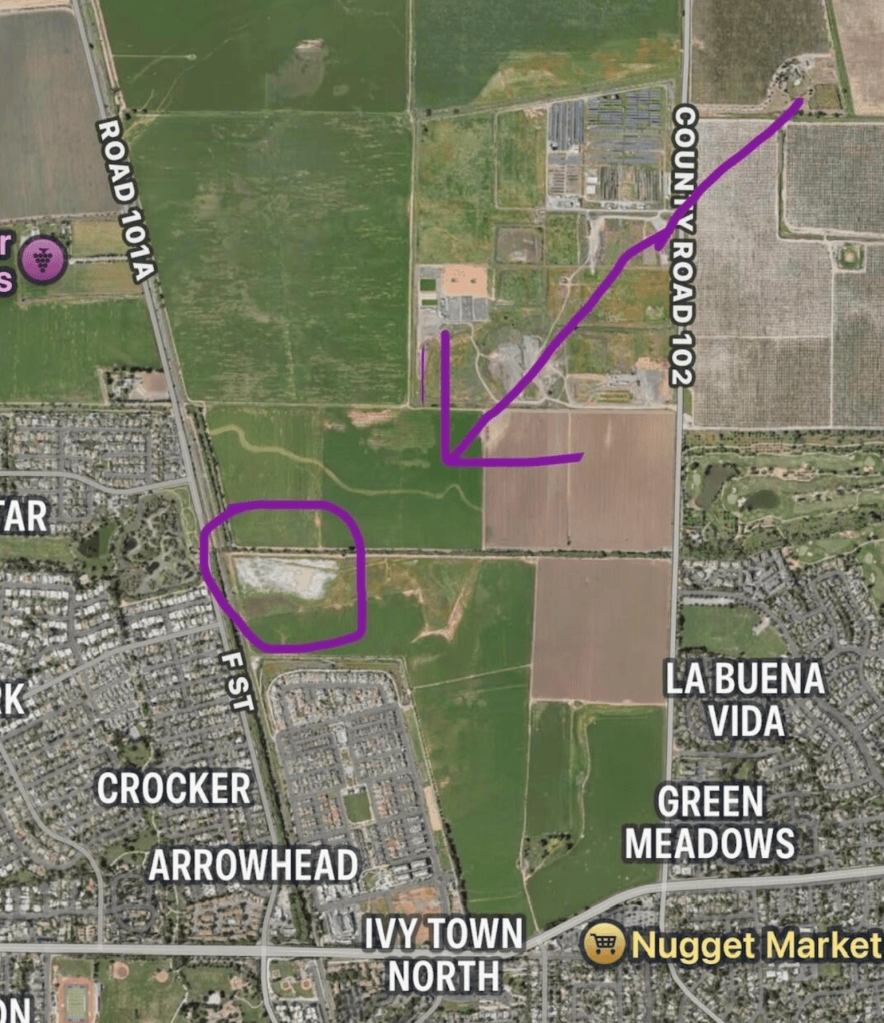
Davisite Banner. Left side the bicycle obelisk at 3rd and University. Right side the trellis at the entrance to the Arboretum.

Category: Land use

  • Where are we? Where are we going? 

    By Matt Williams

    Davis has a history of building only large footprint, rich amenities homes on large lots.  As a result, as a community we have excluded the vast majority of the Davis workforce (a workforce that educates our children and provides us with the suite of services that provides us our high quality of life) from the opportunity for home ownership.

    The numbers tell the story.  Since 2004, Davis added 1,261 units of high-priced, detached, single-family homes on large lots for the economic elite, and at the same time has built zero (or close to zero) small-footprint, low-priced, owner-occupied homes for its citizens with modest economic/financial resources. 

    We are all to blame for this classist approach to owner-occupied housing, and it calls into question the motto on so many lawns that Davis Is For Everyone

    There has been very little leadership from either the citizens or our elected leaders illuminating our classist pattern of (A) catering to the elite while (B) throwing our workforce under the bus, and (C) providing no proactive guidance to developers on project concepts that could be providing “Missing Middle” housing designed and priced for the members of the workforce, rather than the elite.

    (more…)
  • Village Farms: Too Big, Too Many Impacts, Costs and Unaffordable Housing

    By Eileen M. Samitz

    The Village Farms project, with 1,800 housing units on 498 acres at Covell Blvd. and Pole Line Road, is the largest residential project ever proposed in Davis with the worst impacts. It would take at least 15 years for the buildout, meaning many years of added congestion from construction traffic.

    An earlier version was proposed in 2005 as Covell Village, and Davis voters wisely rejected it because of toxics, the 200-acre floodplain, massive traffic, enormous infrastructure costs, and unaffordable housing. Twenty years later, Village Farms has all the same problems and more.

    The site is seriously handicapped. That is why the current developer, John Whitcombe, and partners including Tandem Properties, acquired the original 386-acre parcel at a bankruptcy auction for a mere $3.2 million. The original Crossroads developers abandoned it because of toxics, floodplain, and unmitigable traffic. Yet, the current developer is again trying to push it through despite the health, welfare, and safety issues, and unaffordable housing.

    Massive traffic and other impacts

    (more…)
  • Mutual Housing needed $8.4 million from the City of Davis to build 69 affordable units, yet claims that Village Farms can do 360 affordable units with just $6 million from the developer

    The math destroys their own claim

    By David J. Thompson

    Mutual Housing needed an $8.4 million subsidy from the city to get a 69 unit project built in South Davis. The same format applied to the 360 units affordable units at Village Farms would need a city subsidy of $44,005,518.25.  And the developer is putting in $6 million and Mutual Housing affirms that it will work. Can it, do the math?

    On May 29, 2026, Mutual Housing of California wrote an OpEd in favor of the Affordable Housing at Village Farms entitled “We Know What it Takes”. They do, but it is their reality that is the opposite of what they say is in their OpEd.

    Mutual Housing claims they have developed 6 projects in Davis when they have done only 2.

    On the first of the two (New Harmony) Mutual Housing needed a subsidy of $8,434,391 from the City of Davis to get 69 units built in South Davis. That was $122,237 subsidy per each of 69 units.  Without that subsidy, New Harmony would never have been built.

    The same format applied to the 360 units affordable units at Village Farms would need a city subsidy of $44,005,518.25.

    Mutual Housing should be telling the citizens of Davis that $6 million from the developer will not be enough.

    Memo to Davis City Council from City staff:

    (more…)
  • Clarifying Affordable Housing commitments (or lack thereof) in Village Farms

    By David J. Thompson

    Almost every day a Village Farms supporter (like Alan Pryor) makes unsubstantiated boasts about VF’s affordability features.

    However, in particular only the words in the Baseline Project Features have legal standing. Those listed components are only changeable by the city or the developer except by a citywide vote. The Development Agreement between the City and the developer can be changed without having to go to a citywide vote.

    As to Section 4 Affordable Housing there are only 9 lines in Section 4 of this 9-page legal agreement. There are no guarantees as to the pricing of any affordable for sale units nor any mention of them at all. 

    The false claims by VF supporters might win votes for the project but they are an empty promise of 1,000 homes starting at $400,000 to $500,000. If we had a commitment from the developer or the city of how many units will be in this sales price range that would be useful, but we do not. So the boasts of VF supporters are not substantiated but the reader is fooled. 

    That wording is nowhere to be found in either the Baseline Features or the Development Agreement.

    (more…)
  • Response to Alan Pryor concerning Mutual Housing’s support of Measure V

    By David J. Thompson

    In today’s Vanguard (May 29,2026), there is an OpEd by Mutual Housing in support of the Village Farms project: “We Should Know: Village Farms Gives Affordable Housing Its Best Chance,” by Craig Adelman, CEO of Mutual Housing.

    Early this morning Alan Pryor, a frequent poster on behalf of Village Farms supported the OpEd stating among other items that:

    “Mutual Housing is the largest and most respected affordable housing developer in Northern California – and in Davis.”

    Both facts promoted by Alan Pryor in this statement are simply not true. I say that as over 40 years an advocate, funder and co-developer of affordable housing in not only Davis but throughout California and five other western states.

    Here is the remainder of my response to Mr. Pryor in today’s Vanguard:

    (more…)
  • Twelve Davis teachers in support of Measure V

    [Doug Buzbee emailed the following to the Davisite for posting]

    Dear Neighbor,

    We are Davis teachers, and we are lucky to teach in this wonderful community. But our schools are in trouble. Every year, we have fewer and fewer new students. It’s gotten to the point that unless something changes, we will struggle to sustain the quality schools that Davis expects and deserves.

    Because of declining enrollment, the Davis Joint Unified School District announced potential plans to close two elementary schools and possibly a junior high school.

    Make no mistake – the ripple effects of school closures would be felt across our town, and not just by families with students. Deep-rooted school communities would be dissolved, surrounding neighborhoods would become less desirable, biking to school would become harder, car traffic would increase, teachers would be let go, and the list goes on.

    Those of us who teach at these threatened schools face a simple question from our students: why is this happening? The answer is clear – Davis has not done enough in recent years to make it possible for young families to move here.

    This is why we are supporting Measure V on the June ballot.

    (more…)
  • Davis needs to do better at protecting its sensitive and endangered species

    There is still a chance to preserve and restore habitats to help native species recover, including at Village Farms

    By Kathryn Calderala

    Environmentalism – Still a dirty word for some. A category Davis has a long history of claiming to embrace when the results show otherwise. As one example (and there are many); Davis used to be the proud stewards of a healthy population of Western Burrowing Owls – those pint-sized, ground dwelling owls perched on fence posts and signs. Almost everyone I have met since I moved here told me how they used to see owls everywhere. Yet now the species is almost gone from the county (no, they are not at Wildhorse anymore). They are considered extirpated – no longer nesting here and we are lucky to see a handful of individuals trying to overwinter in the area before moving on. Mostly they have been done in by the strange apathy that pervades the area.

    If a pint-sized owl – that lives underground and has more charisma than most species – can’t be a priority, what hope do all the other dwindling native species have? The California Tiger Salamander – an icon of the state. The Vernal Pool Tadpole Shrimp – a straightup throwback to prehistoric design, trundling around like mini horseshoe crabs. The Western Spadefoot Toad – a cat-eyed chunk of toad that smells like peanuts when they are mad. If we, as a community, cannot rouse ourselves enough to fight for the underdogs, what hope do we have for the future?

    (more…)
  • I Did Not Endorse Measure V

    By Rena Nayyar

    I have recently learned that, without my knowledge or permission, I have been put on an endorsement list for Yes on Measure V (Village Farms).  How did this happen?  I have actively opposed Measure V (Village Farms) from the beginning because of its many problems even though I am a teacher in Davis concerned about school closures. 

    I have spoken in opposition to the Village Farms project due to its many impacts at multiple city and school board meetings, the local Sierra Club group, and to the Davis Teacher’s Association.  I have even helped table at the NO booth at the Farmer’s Market, and donated to the No campaign.  So, how could my name have possibly been put on an endorsement list?  How many other “endorsers” are also unknowingly on this Yes on Measure V list as well?  

    (more…)
  • Village Farms – Much To Do About (Developer Double-)Crossings

    Original visual used by Yes on V of Village Farms to North Star bridge, now deleted.

    by Tuvia ben Olam DBA Todd Edelman

    l lived in the Czech Republic for about seven years – where I did similar mobility curmudgeon work as I do here, BUT everyone from local district mayors to engineering company bosses liked me because my father is Slovak and I’m Jewish… but mostly because I was an activist with constructive ideas. Imagine that!

    In the Czech Language the term for “communication” generally encompasses systems and technology for things like the Internet and physical transportation infrastructure, for example…. bridges!

    In that framework or lens I offer now a hopefully somewhat fresh look at bridges and the communication about bridges connected with projects of the Seven Generational Families of Davis (Henceforth: The Seven).

    Still, the obvious place to start is Promenade (Formerly Known as Nishi)…

    I’m binging GoT right now. That’s all.

    The Bridge of Friendship between The Seven and Union Pacific

    In a May 16th Op-Ed for the Davis Vanguard – its title is the basis for mine for this article – The Seven’s Sandy Whitcombe refers to the claim of Measure V opponents that “… Union Pacific Railroad (henceforth: UP) is holding up a grade-separated crossing”. She then says she wishes that the opponents “…asked us first…” about it.

    Well, back in December 2017 during my first meeting on the Bicycling, Transportation and Street Safety Commission (BTSSC – the predecessor to the Transportation Commission), the then Assistant City Manager Ashley Feeney told us that City had a good relationship with UP and it would likely be possible to have a level crossing between Arboretum Drive and Nishi. Later on, as the proposal moved through Council’s approval step in County annexation and then towards the popular vote, the documents for the project referred to a “grade-separated crossing” but the main imagery I recall – and could find in a search – was an undercrossing. 

    Visual by Promenade (Nishi) proponents from 2017 or so.

    (more…)
  • Village Farms Flood Analysis Is Behind the Times

    Ponding at the Wildhorse Agricultural Buffer during winter storm.

    By Marjorie Longo

    Water doesn’t care about property lines—it flows wherever the land takes it. That’s why flood studies shouldn’t stop at property lines. However, the Village Farms flood analysis mostly focuses on the project itself and a few broader downstream areas (https://www.cityofdavis.org/city-hall/community-development/development-projects/village-farms-davis). It does not show detailed results for existing neighborhoods—the places where people actually live, drive, and may need emergency access. Where are the post-Village Farms flood maps for Wildhorse, North Davis, or the streets south of Covell?  A few extra inches of water during a storm can mean the difference between a dry home and a flooded one, or between a passable road and a blocked evacuation route.

    While the Village Farms flood analysis provides numbers for farmland and shows water pooling on the Wildhorse Golf Course and Wildhorse Agricultural Buffer, it doesn’t answer the key question residents have: what happens on my street?  When the next atmospheric river is dumping on Davis, runoff spreads broadly over our flat topography. And inches of extra flood water add thousands of dollars of damage to flooded homes and can mean the difference between muddy flood water in your home or not.

    (more…)