Davisite Banner. Left side the bicycle obelisk at 3rd and University. Right side the trellis at the entrance to the Arboretum.
  • Nothing says “Happy Hanukkah!” like a Menorah in the Loo at Trader Joe’s

    (An Open Letter to Trader Joe’s)

    To the Management of Trader Joe’s in Davis,

    Of all the important things Davis Jews should be concerned about, this isn’t on the top-ten list. However, Trader Joe’s has placed a wall painting in the Davis store restroom depicting a menorah, with the words “Happy Hanukkah!” and the Trader Joe’s logo. It appears as part of a decorative series of prints otherwise unrelated to religion, holidays, or cultural identity.  The menorah depiction does not belong in the print series, and most certainly it does not belong in the bathroom.

    In years past, I would have laughed at the naivety of such a decision and rolled my eyes. But times have changed for Jews in Davis, and worldwide, over the last few years. Calls for the death of Jews and the destruction of Israel have been shouted publicly on campus and in town. The morning after the Bondi Beach Massacre, a large swastika was spray painted on a silver utility box on 5th Street. Before October 7th, 2023, there was, for most of my lifetime, a sense of acceptance and safety for Jews in Davis and in much of the USA. Today that is shattered.

    With Jewish identity increasingly treated as suspect, conditional, or abstracted into slogans and symbols detached from actual people, the casual handling of Jewish symbols feels dismissive. The tokenism of a people can lend to an atmosphere of hostility. With echoes of the toxic anti-Jew bigotry of 20th-Century Europe growing again in western culture, we cannot casually laugh-off a bathroom menorah today, even as we can laugh at the absurdity.

    The murderous incidents in Washington D.C., Boulder, Manchester, and Bondi Beach, and this month’s arson of a historic synagogue in Mississippi, last burned by the Ku Klux Klan 60 years earlier, illustrate how the world has changed. Not so much in the news are the numerous non-fatal hostile incidents against Jews that were much rarer before October 7th, 2023, and the vast changes Jews have felt to their acceptance and safety in society.

    The menorah is not just an artistic graphic like the rest of the art series in your loo. It is a religious and cultural symbol, and for many Jews there are long-standing norms, explicitly taught, about where such symbols belong and where they do not. Public bathrooms are not neutral spaces for such symbols, not just in Judaism but in many religions and cultures. What makes this placement stand out is the casualness. The menorah appears to have been treated as interchangeable with abstract or whimsical themes, folded into a design series where meaning was secondary to visual variety. This flattening of a Jewish symbol lacks cultural sensitivity.

    Perhaps one solution would be bringing symbols and images from several major world religions into the bathroom, to make it fair! It is worth asking, for each religion, how this would land. What if there were a crucifix mounted above the toilet? Or a painted portrait of the Prophet Mohammed (which, in many Muslim traditions, is itself considered offensive) on the wall? A Buddha stuck in the ceiling vent? Radha and Krishna dancing on the bathroom sink? Would any of those have made it past an internal review without anyone pausing to ask whether this was appropriate? Would those have been waved through as just cheerful, inclusive décor?

    Almost certainly not.

    Jews I have shown the bathroom menorah to have expressed a variety of reactions, from laughing out loud hysterically, to “Oh my!” to “No way!” to “That’s not A.I.?” to “What were they thinking?”.  What no Jew said was, “how nice of them for respecting our people by placing a menorah print in the bathroom”.

    Trader Joe’s is known for its attention to detail, often charmingly so. This feels like a case where no one stopped to ask the most basic question: does this placement make any sense? The fact that the menorah print did make it through suggests the assumption that Jewish symbols are sufficiently benign, decorative, or flexible that placement does not really matter. That assumption is common. It is also wrong.

    This is an easy fix, but it is reasonable to ponder why this was not caught before the print was placed on the bathroom wall in the first place. Thank you for applying the same care in this matter going forward that Trader Joe’s is known for. I look forward to a bountiful display of Jewish foods, wares, and symbols out on the display floor for the upcoming Passover and the next Hanukkah.

    Sincerely,

    Alan C. Miller, Davis

    Davisite logo

    Did you enjoy reading this article? Then subscribe to the Davisite for free and never miss a post again.

  • Rebuttal to Village Farms Flood Control Claims

    By Rena Nayyar

    This is a response to a recent article by one of the Village Farms partners regarding the project’s proposed flood control. The article makes the claim that Village Farms will be “better protected from flooding than most of Davis.” That claim is just marketing. The Village Farms EIR does not support this claim. Links to city documents are at https://www.cityofdavis.org/city-hall/community-development/development-projects/village-farms-davis

    The article didn’t cite any sources showing a track record for their “sound, proven engineering design principles” that would be employed to reduce flood risk.  The “hundreds of pages of engineering analysis related to the impact of extreme storm events to the project…demonstrate that Village Farms Davis will be better protected against flooding” is exaggerated as these involve modeling based on assumptions and not actual plans for how this will be implemented. In fact, the flood and stormwater strategy is still being assembled piecemeal, after the circulation of the Draft EIR.  It is meaningless for them to praise the merits of a plan in flux. Village Farms is not a simple “raise the pads” project. It relies on a complex coordinated stormwater and grading strategy across a huge site in a flat floodplain basin with known downstream flooding problems. In that kind of environment, there are lots of failure scenarios. This problem requires completed project level planning that has not yet been done. 

    In the Final EIR response to comments on page 2-10,  liners are being proposed for Channel A to try to prevent the contaminated groundwater including PFAS “forever chemicals”  from mixing with the Channel A runoff water. When the City starts talking about Channel A “liners” and isolation measures to prevent stormwater from interacting with groundwater– those are major changes. This is a sign that the system is being engineered around problems that were not resolved when the public reviewed the Draft EIR. 

    Since the flood plan is so incomplete and not yet approved, the project’s flood story may require future changes, for example in maps (Final EIR page 3-12).  On page 4-83 the Final EIR says that because the drainage patterns of the area will change, “a design-level drainage report shall be submitted to the City …for review and approval” when the first tentative subdivision map is submitted.  Similarly, the response to Comment 217-54, page 2-996 says
    “the preparation of a final Stormwater Control Plan, …cannot be prepared at this time ” and “the appropriate time for a Stormwater Control Plan will be when a tentative subdivision map has been prepared”. 

    (more…)
    Davisite logo

    Did you enjoy reading this article? Then subscribe to the Davisite for free and never miss a post again.

  • No Certification of the Village Farms EIR  

    By Eileen M. Samitz

    The City Council will soon be making a decision with serious consequences of whether to certify the Village Farms EIR. It is critical that they deny certification. This EIR is seriously inadequate and flawed, and certifying it would expose the City to liability while surrendering the City’s leverage to correct course on this disastrous project.

    Background

    A similar version of Village Farms, Covell Village, was rejected by Davis voters 60:40 in 2005 for many of the same reasons this project and its EIR must be rejected now. The developer, John Whitcombe (Tandem Properties partner) bought the 386-acre parcel in bankruptcy due to the many obstacles making it impractical to develop (originally costing $11 million) for a mere $3.2 million. The site has long been handicapped by an enormous floodplain, unmitigable traffic, access issues, extraordinary infrastructure costs, and toxics from the adjacent unlined Old City Landfill and Sewage Treatment Plant.

    Aberrant, Chaotic, Rushed Process

    The Village Farms “process” has been aberrant. The developer demanded that the City push his project ahead of other projects being processed. The City caved and has been accommodating him ever since, to the detriment of the community. The apparent objective has been to rush this “legacy” project onto the ballot, but the EIR and key documents still contain a plethora of “to be determined,” and “if feasible” language.

    Public meetings were rushed through the holidays, when many residents were unavailable to comment. In backwards order, the City Council held a workshop the day before the Planning Commission was asked to recommend certification of a Final EIR that did not yet exist. Never in Davis’s history has the Planning Commission been asked to recommend certification of an EIR before it was complete, yet staff pressured for that recommendation anyway. That’s not transparency, it’s corner‑cutting. The City has prioritized a June 2026 ballot timeline over the community’s right to a fair, thorough CEQA process.

    Village Farms: Serious Impacts, Costs, and EIR Inadequacies

    Massive traffic

    Village Farms would add at least 15,415 car trips PER DAY, from 1,800 housing units on the 498‑acre site, the largest residential project ever proposed in Davis. This is likely an underestimation because it assumes substantial public transit use. Covell Boulevard and Pole Line Road, already heavily impacted, would be gridlock, degrading streets to Level of Service “F”. Cut-through traffic would impact many neighborhoods of cars trying to avoid this congestion.

    (more…)
    Davisite logo

    Did you enjoy reading this article? Then subscribe to the Davisite for free and never miss a post again.

  • Village Farms will actually be better protected against future flooding than much of Davis

    By Doug Buzbee

    In a recent Op-Ed in the Enterprise (“Commentary: Why a planning commissioner voted no on Village Farms, Jan 2, 2026” [or see longer version on the Davisite here]), Greg Rowe stated he opposed the Village Farms Davis project claiming the site had excessive flood risks.

    He stated that because part of the proposed project site is currently in a 100-year Flood Zone as mapped by the Federal Emergency Management Agency (FEMA) and because climate change will bring more extreme weather events in the future, we simply should not build anything at all in that part of the project.

    While flood risks are real and climate concerns are valid, Mr. Rowe’s comments ignore the fact that proven engineering solutions will be implemented at Village Farms Davis to remove it from the mapped 100-year flood zone, and furthermore, provide protection against a more severe 200-year flood event.

    Village Farms Davis is actually designed to meet higher flood protection standards than significant portions of the rest of Davis, including many older neighborhoods developed before modern flood-protection standards, and over 400 acres within the city limits that still remain within the 100-year flood plain – including swaths of residential West and Central Davis.

    Let me explain.

    (more…)
    Davisite logo

    Did you enjoy reading this article? Then subscribe to the Davisite for free and never miss a post again.

  • 3rd Annual Paint for a Purpose on FEB. 7 

    Guests are led in creating a painting at Make It Happen for Yolo County’s Paint for a Purpose fundraiser last spring. Tickets are now on sale for this year’s event on Feb. 7.

    To raise funds for Yolo County transition age youth

    Fundraiser to benefit nonprofit Make It Happen for Yolo County 

    (From press release) Tickets are on sale for the 3rd Annual Paint for a Purpose happening Feb. 7 and benefiting nonprofit Make It Happen for Yolo County, which provides under-resourced transition age youth – many moving out on their own after foster care or homelessness – with furniture, household goods and essential items needed to establish a first home. Local artist Joanne Andresen will lead guests in creating a painting as they enjoy beverages, light fare and door prizes. The event will take place 2:00-5:30 p.m. at the Unitarian Universalist Church of Davis, 27074 Patwin Road in Davis. Cost per ticket is $75, and tables of four are available for $300. Seating is limited. To purchase tickets: www.MIHYolo.org.

    “This event is such a beautiful opportunity to gather as a community to create artwork while also supporting the resilient youth in our community who are moving out on their own with very few resources,” said Cathi Schmidt, executive director, Make It Happen for Yolo County. “Paint for a Purpose will help us raise valuable funds to ensure every youth we serve this year has the items and support they need to create a home and successful path into adulthood.”

    (more…)
    Davisite logo

    Did you enjoy reading this article? Then subscribe to the Davisite for free and never miss a post again.

  • The most recent Village Farms Affordable Housing Plan

    [The following letter to the Davis City Council was shared with the Davisite for posting]

    January 12th, 2025
    To. Mayor Neville and Council Members
    Fr. David J Thompson
    Re. The most recent Village Farms Affordable Housing Plan

    The latest iteration of the Affordable Housing Plan for Village Farms is still missing critical elements. Therefore, it should not be accepted by the City Council.

    * I Have placed the Regional Housing Needs Allocation (RHNA) numbers in a table at the end of this article. Clearly, Davis is most deficient in creating Very Low Income (VLI) and Low Income (LI) units

    As an interested observer, it has been difficult to keep up with the numerous changed affordable housing plans for VF brought forward at the very last minute.

    • I encourage the City Council to require the VLI and LI affordable housing plan to be specifically set in VF as close as possible to Covell Blvd. Please switch the MOD site to the most northerly of the three parcels. All the major competitive sources of funding for affordable housing are based upon a points system. Usually, each applicant scores 100 points and the winning applicants are those applicants which gain more in tie breakers. High points are for example given for categories with a quantified proximity to existing bus routes and to shopping centers with a supermarket. These points are critical specifically to the projects set aside for the categories of Very Low Income (VLI) and Low Income (LI). These projects will have a far better chance of being funded when set adjacent to Covell Blvd.
    • Another point to make is that the specific sites to be designated for VLI and LI should be large enough (min 4 acres) to be built in two phases. The second phase will score higher when added to an existing phase because of increased scale and reductions in management, administrative, legal, architectural fees and in building costs. A community building and offices built in phase one will not be needed for phase two. This also frees up land in phase two to be used for income earning additional housing units rather than the additional non-earning expenses of a community building. Otherwise, each smaller site will have to have a community building and separate staffing and duplicate costs for the expense categories listed above. Every saved penny per unit wins additional award points in the competitions.
    • If I am correct there will be no for sale single family units affordable to 80%-120% income category. This is a measureable weakness in the range of affordable housing products in the present application.
    (more…)
    Davisite logo

    Did you enjoy reading this article? Then subscribe to the Davisite for free and never miss a post again.

  • Returning to Abraham: Reflections in Courage

    (From press release) The Celebration of Abraham was founded after 9-11 with the mission of creating a welcoming tent for all people in our community to nurture a sense of compassion, respect, and appreciation and to foster learning and understanding among the three Abrahamic traditions. In 2003 the Celebration of Abraham assembled for the first time. We met in Woodland, at Holy Rosary Catholic Church. This year the Celebration is excited to announce that we will again meet in Woodland, on Sunday, February 1, 3-5 PM, at the new beautiful Woodland Mosque and Islamic Center at 613 East Street in Woodland with the theme “Returning to Abraham: Reflections in Courage.” As we face these challenging times, we felt a need to return to the strengths our religious traditions can provide.

    Our speakers will be Rabbi Leah Julian, Director of Education and Youth, Congregation Bet Haverim; Father John Boll, Diocese of Sacramento, (retired); and Imam Riaz Ahmed Qadri of the Woodland Mosque and Muslim Center. As they present the stories of Abraham’s faith and courage, we will provide everyone with cards so that they can write down the questions talks raise for them. After the presentations, our speakers will address the questions that participants have raised. We will then spend time in table discussions on how we might individually address the challenges, uncertainties and fears we are facing.

    As in previous years, we will share in a ritual hand washing and sharing gluten free bread. Each year, the Celebration collects a free will offering for a non-profit that provides needed service to our community. This year we are collecting for Joshua’s House, a hospice home for the unhoused in Sacramento. The program will close with
    Randy Ferris leading us in an Acapella version of “Children of Abraham.”

    To help us plan, we hope you will preregister at https://celebrationofabraham.net. Please dress modestly (arms and legs covered) as we will be at the mosque, a sacred space.

    Draft of table question

    The speakers from the Jewish, Christian and Muslim traditions have presented stories of how Abraham courageously met challenges in the face of fear, uncertainty and sacrifice. Consider when you have faced a situation that required courage or trust? What helped you through it?

    Davisite logo

    Did you enjoy reading this article? Then subscribe to the Davisite for free and never miss a post again.

  • How City Council Upended the Village Farms EIR Alternatives Analysis

    By Greg Rowe

    The California Environmental Quality Act (CEQA) requires an Environmental Impact Report (EIR) to examine the potential impacts of a range of reasonable alternatives to the proposed project and evaluate the comparative merits of the alternatives. Under CEQA, the purpose of studying alternatives is to allow meaningful analysis and comparison of alternatives that could reduce significant environmental impacts as compared to the proposed project.

    The alternatives must be feasible, meet most or all of the project objectives, and avoid or substantially lessen one or more of the project’s significant impacts. Alternatives are generally evaluated in a qualitative manner rather than to the same degree of exactitude as the proposed project. A “no project” alternative is always included. The “no project” alternative for a project that would develop vacant land would in most cases be the “Environmentally Superior Alternative (ESA),” but not building the project would fail to achieve any of the project objectives.

    As a result, the alternative that best avoids or mitigates the most impacts is typically identified as the ESA, but the lead agency (the City of Davis in this case) is not obligated to substitute this alternative for the proposed project. In fact, because alternatives are generally analyzed qualitatively, a lead agency could not approve an alternative consistent with CEQA unless that alternative was also analyzed at the project-specific (i.e. detailed) level, such as the Biological Resources Preservation Alternative (BRPA) for the Village Farms project.

    Alternatives are selected after the project’s impact analysis has been completed and the project’s potential impacts to the environment are known.  This is a logical sequence because it is impossible to know if an alternative would produce fewer impacts if the potential project’s impacts are not yet  revealed, just as a doctor cannot consider alternative treatments for a patient before the ailment and its source are known.

    In my experience working with EIRs since 1984, once the impact analysis has been completed, there typically will be a meeting among the EIR consultant, the client (in this case, the City of Davis) and potentially the project proponent (in this case, the developer).  For a project such as Village Farms, the EIR consultant and city planning staff would use their professional experience and knowledge of the area and CEQA to devise a range of reasonable alternatives, with which the project proponent may or may not concur. In other words, the selection of alternatives is an objective process based on impartial judgment and professional experience. It should not influenced by political or financial considerations.

    A knowledgeable but now retired land use consultant once told me that in his long experience, impacts to biological resources, traffic, and air quality tend to be the primary factors that influence the identification of alternatives. Typical alternatives might include any or all of the following:

    • The same footprint or area but with fewer units (meaning lower density).
    • A smaller physical footprint but with the same number of units, which would typically avoid impacts on sensitive biological resources on the property.
    • A reduced project area footprint that includes the same number of housing units, but with a different mix of housing types.   
    • A lower number of housing units on a smaller footprint.   
    • Developing the project at an entirely different location, if acquiring such land for an alternative is feasible.
    (more…)
    Davisite logo

    Did you enjoy reading this article? Then subscribe to the Davisite for free and never miss a post again.

  • Tomorrow: ICE Protests in Davis and Woodland Alongside National Events

    Hosted by Indivisible Yolo

    (From press release)

    WHEN/WHERE:
    TOMORROW: Saturday, Jan. 10
    • 11:30am-1:00pm: Heritage Plaza, 710 Main Street, Woodland
    • 1:00-2:00pm: Davis Central Park, 401 C Street, Davis

    WHAT:
    Residents from across Yolo County will gather in Woodland and Davis for ICE Out For Good protests against ICE and the recent murder of Renee Good in Minneapolis along with all lives lost to ICE violence. The events will take place alongside protests across the country and will include protest signs, speakers and more.

    On Wednesday, Renee Good, an American citizen, was killed by Immigration and Customs Enforcement (ICE) in Minneapolis, Minnesota. This killing is part of a broader pattern of unchecked violence, impunity and abuse carried out by federal immigration enforcement agencies against members of our communities. Indivisible Yolo is joining a coalition of groups across the country for a coordinated Ice Out For Good Weekend of Action to demand accountability, honor the life lost and make visible the human cost of ICE’s actions.

    (more…)
    Davisite logo

    Did you enjoy reading this article? Then subscribe to the Davisite for free and never miss a post again.

  • Davis Planning Commissioner Explains His “No” Votes on Village Farms

    [Note: a shorter version of this article appeared in today’s Davis Enterprise. This longer version gives additional details and background for Commissioner Rowe’s votes.]

    By Greg Rowe

    Introduction

    The planning commission’s marathon December 17 meeting concluded with two recommendations to city council for the proposed Village Farms development: certify the project’s Environmental Impact Report (EIR); and approve the project for a Measure D election.  It is expected that by January 20, Council will consider those recommendations and decide whether to place the project on the June ballot.  (January 20 is the last meeting date when Council can meet the County’s deadline for June ballot measures.) Voter approval would be followed by a general plan amendment, pre-zoning, and annexation of the site from Yolo County.   

    I voted against certifying the EIR because of what I am convinced are serious procedural irregularities, based on working with the California Environmental Quality Act (CEQA) since 1984. I likewise declined to support the project because I am convinced its location within a flood hazard zone would compromise the safety of Davis residents within Village Farms.   

    What is Village Farms?

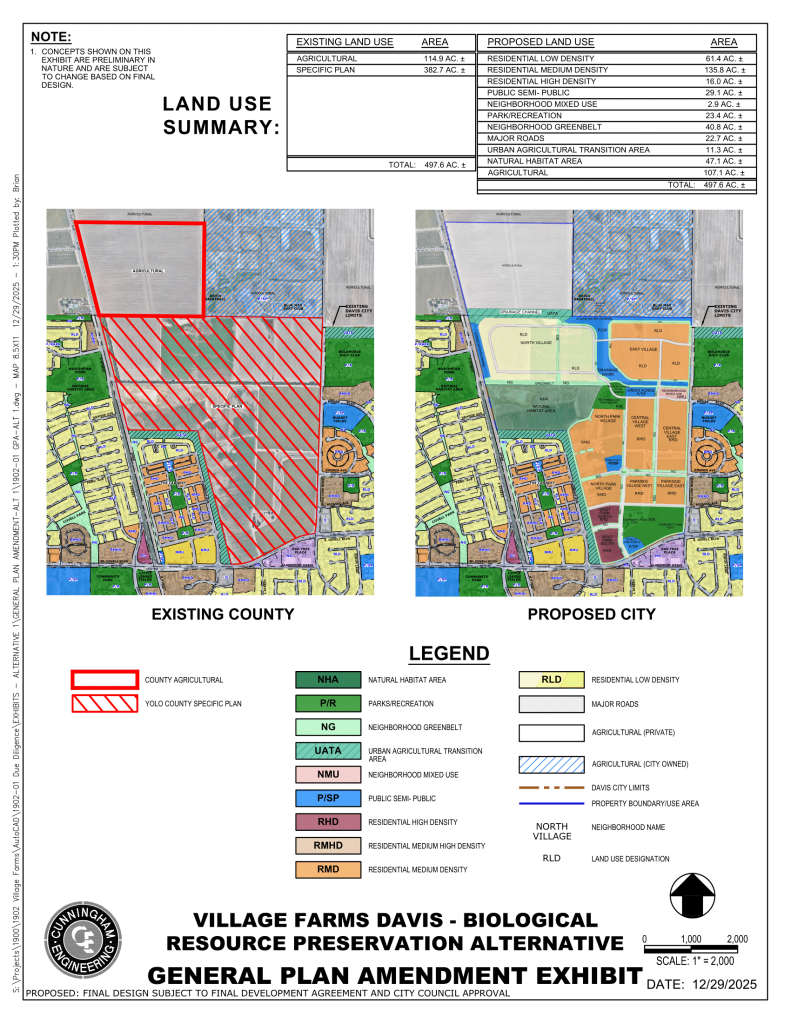
    The developer proposes to build 1800 market rate and affordable homes of various types, ranging from apartments to single-family detached homes. There would also be parks, open space, a protected 47-acre wetland habitat, a site for pre-K daycare, and a small land dedication to the City of Davis for public facilities. The property comprises 497 acres situated at the intersection of Pole Line Road and Covell Blvd, extending westward along Covell and north along Pole Line to the Blue Max Kart Club and Davis Paintball.  

    The proposed project would border The Cannery neighborhood, wrapping around that community on its north side and extending northward along the east side of F Street.  A major City of Davis drainage course (“Channel A”) flows west to east through a portion of the Village Farms site. The developer has stated that grading and infrastructure installation would take about two years, and buildout would occur in four phases lasting an additional 15 years. Pursuant to the draft Development Agreement (DA) between the developer and the City, the developer would install grade-separated bicycle and pedestrian crossings of Pole Line Road and F Street.     

    Climate Change and Floods

    The Central Valley has long experienced devastating floods, as described in historian Robert Kelley’s seminal 1998 book, Battling the Inland Sea.  The risk of flooding is now much greater because of a warming climate and a higher population that would be exposed to flooding caused by large and intense storms.

    (more…)
    Davisite logo

    Did you enjoy reading this article? Then subscribe to the Davisite for free and never miss a post again.