Davisite Banner. Left side the bicycle obelisk at 3rd and University. Right side the trellis at the entrance to the Arboretum.

Category: Education

  • Twelve Davis teachers in support of Measure V

    [Doug Buzbee emailed the following to the Davisite for posting]

    Dear Neighbor,

    We are Davis teachers, and we are lucky to teach in this wonderful community. But our schools are in trouble. Every year, we have fewer and fewer new students. It’s gotten to the point that unless something changes, we will struggle to sustain the quality schools that Davis expects and deserves.

    Because of declining enrollment, the Davis Joint Unified School District announced potential plans to close two elementary schools and possibly a junior high school.

    Make no mistake – the ripple effects of school closures would be felt across our town, and not just by families with students. Deep-rooted school communities would be dissolved, surrounding neighborhoods would become less desirable, biking to school would become harder, car traffic would increase, teachers would be let go, and the list goes on.

    Those of us who teach at these threatened schools face a simple question from our students: why is this happening? The answer is clear – Davis has not done enough in recent years to make it possible for young families to move here.

    This is why we are supporting Measure V on the June ballot.

    (more…)
  • Who Pays the Price in Davis Schools?

    By Jasmine Pettis

    At a time when Davis Joint Unified School District (DJUSD) is asking families to consider closing neighborhood schools, one question remains unanswered: Have District leaders fully examined their own spending before asking the community to absorb the consequences?

    The answer appears to be “no”. Recent salary data shows that DJUSD’s superintendent received more than $427,000 in total compensation in 2024, with several central office administrators earning well over $200,000 annually. At the same time, the District is discussing the drastic step of school closures as a necessary response to budget pressures.

    DJUSD families have been told in Board Subcommittee meetings that there is “no fat left to trim.” That claim doesn’t hold up.

    The two realities of rising administrative compensation and proposed school closures demand scrutiny. Allow me:

    (more…)
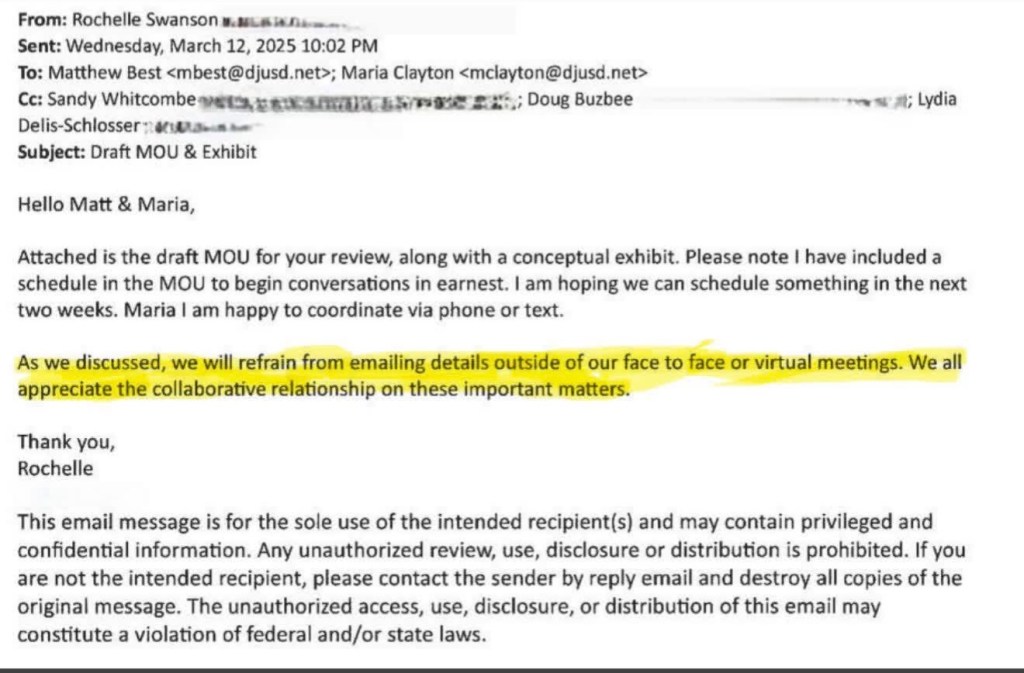
  • Lack of transparency in the relationship between DJUSD and Village Farms developer

    Screenshot

    By Elizabeth Coolbrith

    I am a parent with two children in DJUSD schools, and I’m sharing this focused update because Davis voters deserve to see some specific information that hasn’t been laid out clearly in one place. This goes to the heart of transparency and illuminates an aspect of the relationship between DJUSD leadership and the Village Farms developer. Now that these documents are public, I feel a responsibility to share them.

    Two pieces stand out:

    First, there is long‑term developer funding of DJUSD entities tied to Village Farms developer John Whitcombe and Tandem Properties, who have been major funders of DJUSD through the Tandem Foundation. Public records show roughly $40,000 a year in donations to Davis schools for over 20 years, totaling close to $500,000 as of 2023. These generous donations are legal. But they can create the appearance of a very close, ongoing financial relationship between this developer and the district.

    Second, newly released public records include an email from the Village Farms development team asking DJUSD to keep Measure V communications off email.

    (more…)
  • Give students stronger representation on the UC Board of Regents

    Support ACA 18

    By Raymond de Vente

    In a public university system that manages a $53.5 billion annual budget, oversees three national labs, and educates nearly 300,000 students, you would expect those students to have a real say in how things are run. Currently, they do not.

    That is why Californians should pay attention to ACA 18, a new Assembly Constitutional Amendment moving through the state legislature. Authored by Assemblymember Jessica Caloza (D-Los Angeles), this measure would finally fix a long-standing democratic deficit at the heart of the University of California.

    Here is the current reality: Under the California Constitution, the UC Board of Regents, the powerful body that governs the entire system, includes just one voting student representative. One vote for almost 300,000 minds. While the constitution currently authorizes the Board to appoint student members, it does not guarantee meaningful representation. After a year of serving as a non-voting “designate,” a single student finally gets a vote. For a system this massive, that is not representation; it is a token gesture.

    (more…)
  • Davis Deprives Younger Adults of Longterm Housing: Population Demographics

    by Hiram Jackson

    Introduction

    Davis has followed a policy of restrictive growth since 2000 when Measure J passed, which allowed city voters to approve of new projects on the margins of the city.  Since then, Breton Woods, designed for older (55+ years) residents, and the Nishi project, designed for UC Davis students, both passed in 2018. 

    Apart from that, every other proposed project, which notably would have been available for younger adults less than age 54, has been rejected.  This quarter century drought on peripheral developments for younger adults has consequences in our current demographic makeup.

    City of Davis census data show a local declining young adult population

    From 2000 to 2020 U.S. Census data show that Davis grew from about 60,000 to 66,000, an annualized growth rate of about 0.5%.  Within that time the population of 20- to 29-year-olds, which includes mostly UC Davis students, grew by about 2500.  The population of Davis adults aged 50 and older grew by 8,000, reflecting good health and the desirability of our community.  Meanwhile, the number of young adults aged 30 to 49 has shrunk by 2,000 during the same period (See Census chart). 

    Figure 1 – City of Davis Population – 2000 v. 2020 U.S. Census

    This last age cohort, specifically, includes parents who are likely to enroll students in the local public schools.   Based on the 2020 U.S. census, the 30 to 49 age cohort is proportionally larger, statewide and nationally, than either the Baby Boomer or older Gen X population, demonstrating that the Davis decrease is anomalous in not accommodating this age cohort.

    (more…)
  • Trump administration drops its attack on the University of California

    By Roberta Millstein

    This is a quick followup to two earlier articles.

    In “Trump’s Attacks on the University of California (and higher education more generally)” I explained how the administration’s “Demand” letter sought a $1.2 Billion “settlement” from UCLA for allegations of civil rights violations related to antisemitism and affirmative action. 

    Then, in “Coalition of faculty unions prevails against Trump’s attacks on the UC,” I explained that the U.S. District Court in the Northern District of California granted the Plaintiffs in AAUP v. Trump, including the Davis Faculty Association, a preliminary injunction — that by temporary court order, the federal government is prohibited from holding federal funds hostage in an effort to coerce the University of California into imposing policies that would violate our First Amendment rights.

    That temporary court order is now permanent in the wake of the Department of Justice dropping its appeal of the federal court order.

    As Brian Lynch explains, the order:

    …doesn’t just unwind what the government already did to UCLA — it sets the rules for what the government can’t do going forward to any part of the UC system.

    He continues:

    The modified order, filed February 13, 2026, does two remarkable things. First, it forces the government to follow the law before it cuts university funding. Second — and this is the real teeth — it means that if the government freezes or restricts UC funding without completing every required procedural step, the university can go straight to court and seek enforcement of the injunction. The government would be in violation of a federal court order, and the remedy is immediate. Universities don’t have to start from scratch with a new lawsuit; the injunction is already in place.

    Note the word “universities” — not just UCLA, not just the UC, but universities. Thus, Lynch points out “this injunction is a roadmap for every university currently facing the same playbook.”

    This strikes a major blow against Trump’s attempts to illegally control the free speech and operation of universities in the U.S. Are you listening, University of California? Thanks to your faculty, students, and staff who risked speaking out, you don’t have to capitulate to Trump’s demands anymore. I — and many others — urge you to stop.

    This is a BFD. And it shows that fighting back can work.

  • Avid Reader Author Event for _Exploring the Berryessa Snow Mountain National Monument Region_, March 19

    Announcing a free Author Event at the Avid Reader for Exploring the Berryessa Snow Mountain National Monument Region, Thursday, March 19, 6:30-7:30 PM, with Davis co-author Bob Schneider, 617 2nd St, Davis.

    Written by Marc Hoshovsky, Peter Schiffman, Bob Schneider, and Tim Messick, Exploring the Berryessa Snow Mountain National Monument Region is a newly released guidebook that helps you explore and learn about this extraordinary yet under-recognized region in our own backyard. Located in the northern Coast Ranges between the Central Valley and the Pacific Coast, this region has world renowned geology, extraordinary biodiversity, and rich cultural history, a story unlike any other in California. It is a wild expanse of steep canyons, ancient subduction zones, uplifted ocean crust, extraordinary biological hotspots, and traditional home to many Native peoples—all within a short drive of the Bay Area and Sacramento. In one day’s drive, you can get sweeping views of Clear Lake from Bartlett Mountain Summit, pick up rocks formed on the ocean floor, drive through spectacular wildflower displays in Bear Valley, see tule elk and bald eagles, and soak in historic Wilbur Hot Springs. 

    (more…)
  • Yolo County Nonprofits Host Civic Engagement Pizza and Movie Night on Feb 17

    (From press release) Yolo County residents can join “Pizza and a Movie Night” on Feb. 17 from 5-8 p.m. at Woodland Community College to learn more about civic engagement. The free event is sponsored by AAUW of Davis, Indivisible Yolo and the Yolo County Leage of Women Voters, and includes pizza and a 90-minute documentary from 2024 called “The Deciders.”  The event also will include small-group discussions where attendees will learn more about their role in governing policy, the importance of voter registration and timely ballot return, and opportunities for advocacy in 2026 elections. Discussion leaders will answer voter registration and election participation questions.

    Seating is limited with priority registration offered to students at Yolo County high schools and Woodland Community College. For more information and to register: http://bit.ly/49sOy8L.

    “We all share the same goal of taking the important message of active civic engagement in democracy directly into our community,” said Michelle Famula, president, Yolo County League of Women Voters. “Together we support a democracy in which every eligible voter has the desire, right, knowledge and confidence to exercise their voting rights.”

    The event will center around the film, which showcases how active voices in a working-class community impacted government policy and improved lives. Organizers say they especially hope to engage youth newly registered to vote, busy working households, college students and recently arrived county residents to help ensure higher voter turnout in the fall.

    (more…)
  • A UC Davis professor calls for violence against Jews — and keeps her position

    Screenshot is from Professor Jemma DeCristo’s posting on X (formerly Twitter) in October 2023. It was deleted within a few days of its original posting.

    [This article was originally published by the SF Chronicle and then the Times of Israel. It is re-posted here with permission of the author].

    By Reuven Taff

    On Jan. 10, a synagogue in Jackson, Miss., was torched — a stark reminder that antisemitism is not just words in a hateful social media post but continues to be a threat with real-world consequences.

    But just as last month’s Hanukkah massacre at Australia’s Bondi Beach exposed with brutal clarity the consequences of unchecked antisemitic incitement, the events in Jackson should provide further evidence that there’s a connection between violent attacks and the rampant, incendiary online rhetoric directed at Jews. History has shown that ignoring such threats risks emboldening perpetrators, normalizing antisemitism and making Jewish communities less safe.

    This context makes UC Davis’s handling of American Studies professor Jemma DeCristo’s now-deleted Oct. 10, 2023, social media post on X all the more alarming.

    Just three days after Hamas’ deadly rampage that killed at least 1,219 people and the kidnapping of 251 hostages, DeCristo wrote that

    “one group of ppl we have easy access to in the US is all these zionist journalists who spread propaganda & misinformation … they have houses w addresses, kids in school … they can fear their bosses but they should fear us more.”

    Her words were accompanied by emojis of a knife, a hatchet and three drops of blood.

    That post left Jewish students, faculty and families scared, isolated and angry — yet the university’s response, after a nearly two-year investigation, amounted to little more than a slap on the wrist.

    (more…)
  • What happens when you build primarily high-end housing?

    By Roberta Millstein

    Two recent articles about Vacaville, our neighbor to the south, caught my eye. Both have to do with what has happened to Vacaville in the wake of building more high-end (i.e., expensive) housing.

    The first article was in the SF Chronicle, “This Bay Area exurb is full of McMansions — and may be the ‘next frontier’ of the housing crisis.” Here is an excerpt:

    Unlike Vallejo, which has yet to fully recover from its 2008 bankruptcy filing, Vacaville has signs of a suburb on the rise: a burgeoning biotech presence, a median household income in the low six figures, several new higher-end subdivisions. But the more people flock to this bedroom community for cheaper housing, the more its rental prices veer toward San Francisco levels. Over the past half-decade, Vacaville’s share of cost-burdened renters has swelled more than any other Bay Area community. 

    “If you’re a renter in Vacaville, there’s so many different market forces working against you,” said Robert Eyler, an economics professor at Sonoma State University. “Until you’re actively looking for a rental there, it’s hard to understand just how bad it is.”

    Some priced-out renters have been surprised to learn that Vacaville has no problem greenlighting construction. It’s the type of projects that’s the issue. 

    According to Vacaville’s official housing reports, it completed around 2,900 residential units between 2015 and the end of 2021, more than double what it had targeted. That was enough to put Vacaville among the top 10 Bay Area cities in overall housing production. 

    But the bulk of the building has been for large single-family homes. Along Vacaville’s southern edge, construction crews are working on a 2,400-acre development called Lagoon Valley, which will include more than 1,000 houses spanning 14 distinct neighborhoods, retail and office space, a golf course and a community event center. 

    Meanwhile, Vacaville has long ranked toward the bottom of Bay Area communities in producing multifamily homes. Housing projects such as townhomes, duplexes and triplexes, often called the “missing middle,” make up less than a 10th of the city’s housing stock. 

    Then an article in The Reporter, “Vacaville Council rejects DIF recommendations,” caught my eye. In the context of rejecting recommendations from a 2025 Developmental Impact Fees Nexus Study, Lisa Vorderbrueggen of the BIA Bay Area stated, “Vacaville has added housing yet student enrollment is declining, a clear sign that middle-income families are being priced out.”

    I leave the relevance for the upcoming discussions about Village Farms as an exercise for the reader.