Davisite Banner. Left side the bicycle obelisk at 3rd and University. Right side the trellis at the entrance to the Arboretum.

Author: Roberta Millstein

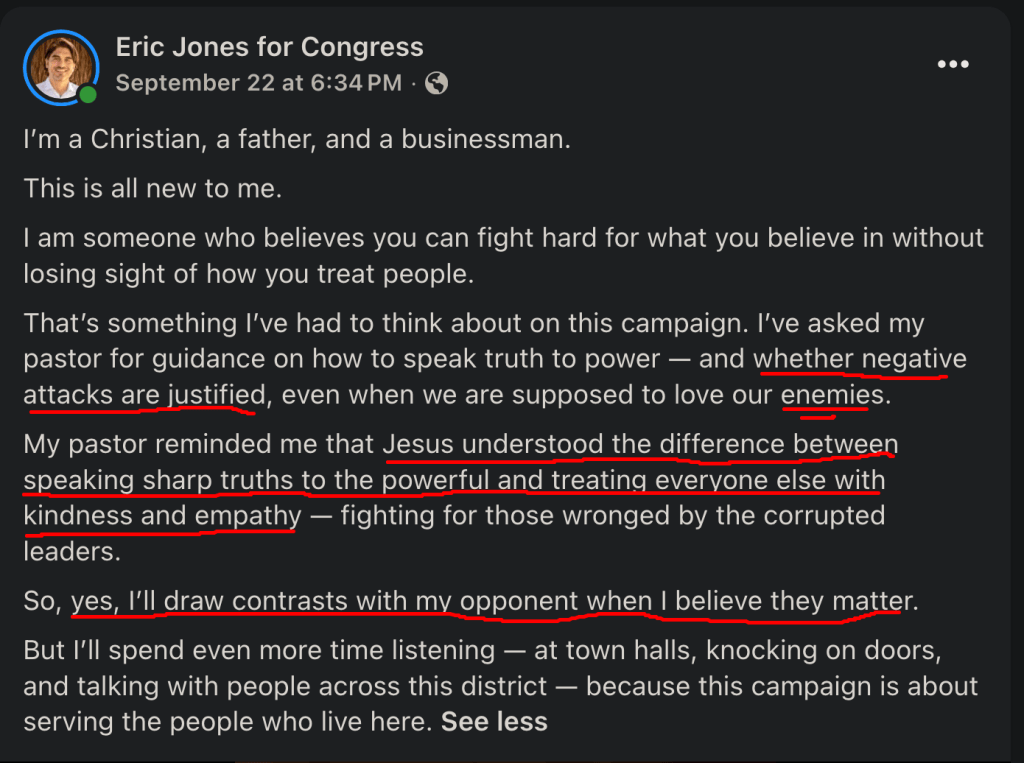
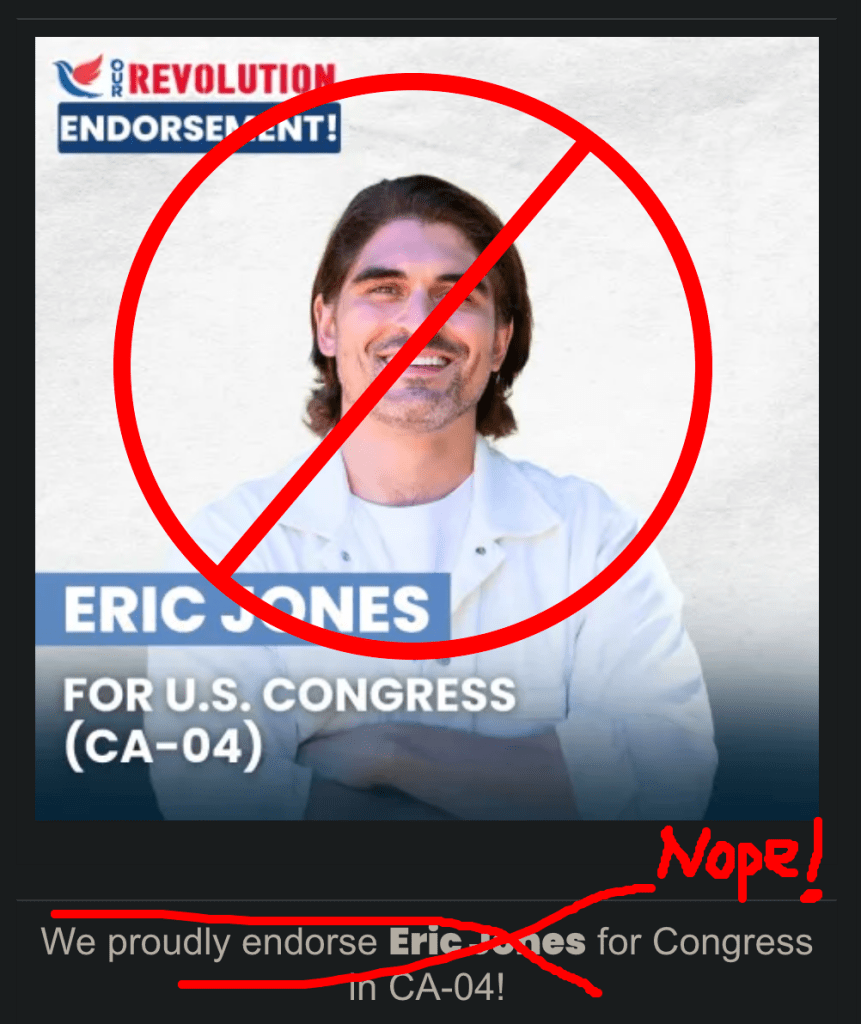
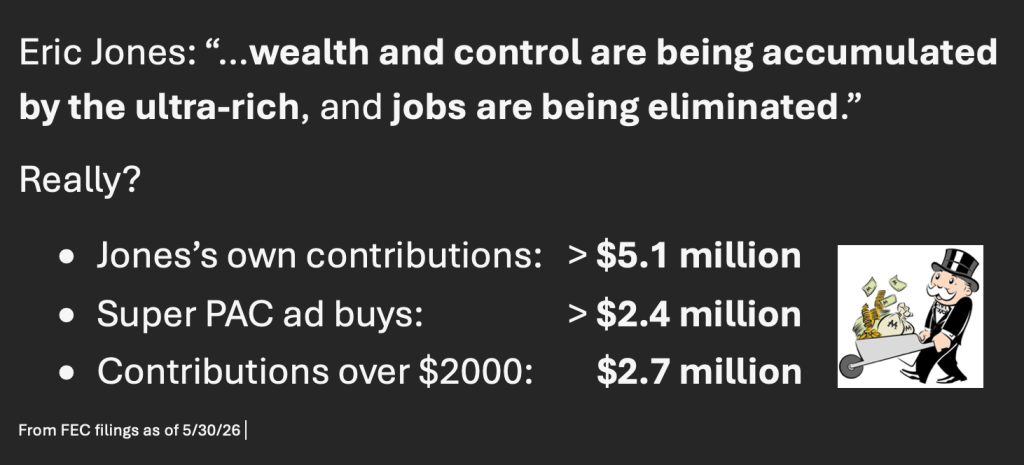
  • Who is Eric Jones, the candidate seeking to unseat Mike Thompson in Congress?

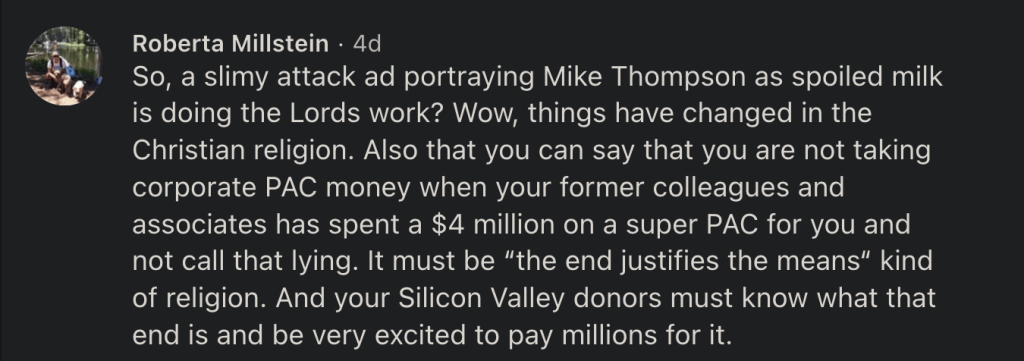
    And who is funding his campaign?

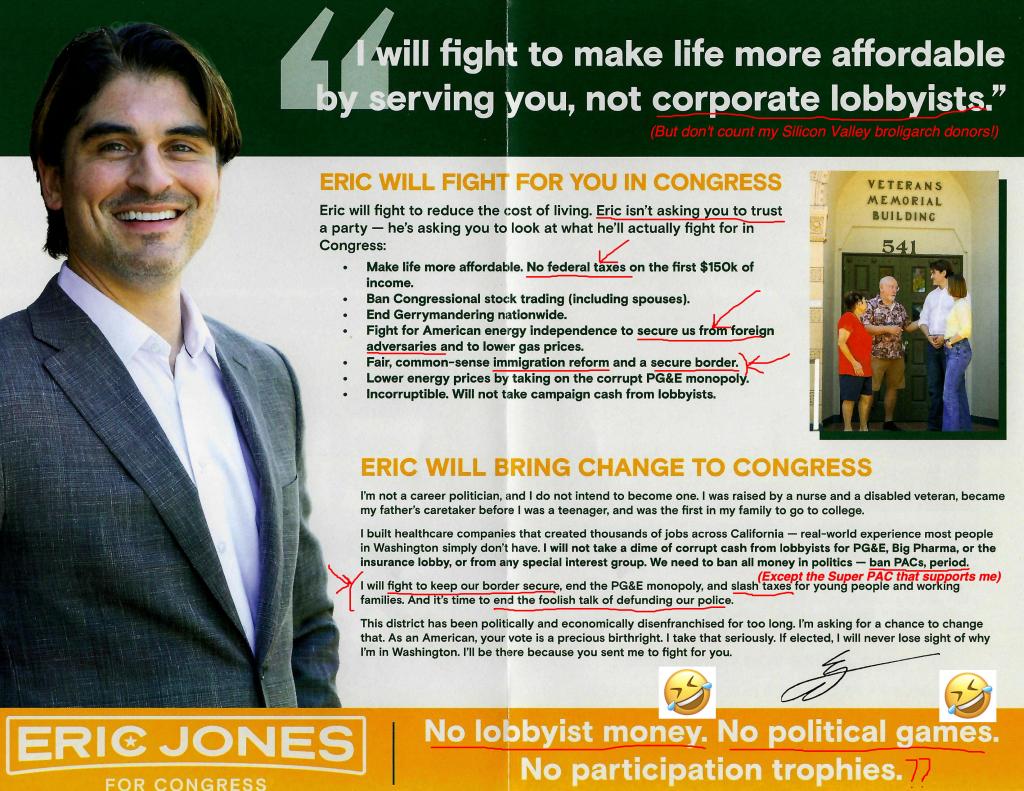
    Four mailers and a canvasser handout…. so far.

    By Roberta Millstein

    With the increasingly regular appearance of glossy mailers from Eric Jones’s campaign seeking to replace Mike Thompson as the representative for Congressional District 4 (which includes Davis), I thought it might be helpful if I shared what I have learned about Jones’s background.  I haven’t seen anything inaccurate per se in those mailers or in his ballot statement,[1] but what is there seems quite partial and thus misleading with respect to both his background and who is funding his campaign.

    To be clear, I am not a reporter and have never pretended to be.  What follows is all widely available information (I will footnote all of my sources) and I don’t think Jones is trying to hide any of it.  But he’s not really mentioning it either, and I think it might be relevant for at least some voters.

    Let’s start with Jones’s background because that sets the stage for his donations.  Jones graduated with an economics degree from Yale University and worked at JP Morgan in 2012.[2]  Shortly thereafter, he left JP Morgan for Dragoneer Investment Group; his LinkedIn page says that he was a “Dragoneer Investment Group Partner, Healthcare and Internet” for 12 yrs 7 mos, 2013 – Jul 2025.  Not long after that, in September 2025, he declared his candidacy.  His LinkedIn page also says that he is a Founder of the American Dream Institute, 2024 – present and a Principal of The Rachel and Eric Jones Foundation, 2021-present.  The year 2021 is also the year he (partially) relocated from San Francisco to Napa, making him eligible to run in what is now (since Prop 50) District 4.[3]  Jones has never held public office and still has a home in San Francisco’s Pacific Heights.[4]

    (more…)
  • Letter: Katie Porter is the fighter we need

    [Note: This letter first appeared in the Davis Enterprise online on Apr 6 and in print on Apr 12]

    Davisites, let’s throw our support behind Katie Porter for CA Governor — now, when we can really make a difference.

    California has a “top two” primary, meaning that the top two candidates from the June election will be the candidates we vote on in November. Right now, there are so many Democrats in the race that there is a serious risk of splitting the vote so badly that we will end up having a choice between two Republicans.

    We cannot let this happen. Thus far most candidates, even those with low polling numbers, won’t drop out. So we have to coalesce around one of the Democrats.

    I urge that we coalesce around Katie Porter.

    Porter is most known for her fiery whiteboard talks, holding corporate CEOs accountable, especially with regard to health care and big pharma. As a US congressperson, she passed laws that reined in the greed of the health care industry.

    She has a strong environmental record and will fight to expand clean energy and defend our clean air laws. She has pledged to protect our wildlands, open spaces, and oceans.

    She will work for federal funding for housing and to foster CA businesses.

    She has been endorsed by the United Nurses Associations of California/Union of Health Care Professionals, the Orange County Employees Association, Senator Elizabeth Warren, and California’s Amalgamated Transit Union.

    Porter will bring the fight that we need in these difficult political times. Please write a letter or send a donation now to register your support.

    Roberta Millstein

  • An exchange over misleading Village Farms promises about affordable housing

    Greenwald concedes Village Farms could result in little or no affordable housing being built

    By Roberta Millstein

    I want to let readers know about some followups to my two previous posts about the toothless promises concerning Affordable Housing and affordable-by-design housing in Village Farms, which we will vote on in June as Measure V. One is that I meshed the two articles into one, did some more editing, and submitted the new article to the Davis Enterprise, where it appears, here. Now the analysis of affordable housing in Village Farms, which rests in large part on understanding the difference between Baseline Features and Development Agreements — and which “promises” appear where — is all in one place.

    The second thing I want to highlight is a response of sorts to my DE article from the Davis Vanguard, here. What I find interesting about this response is that at each point David Greenwald actually agrees with what I say about the promises of affordable housing. Indeed, there really is no other interpretation — it’s in black and white that the affordable housing is so flexible that the project could end up with little or no affordable housing at all. And he agrees that our city councils have a history of giving in to developers. Quoting from Greenwald’s article (my emphasis added):

    (more…)
  • The ballot arguments in favor of Village Farms are extremely misleading about affordable-by-design housing

    Arguably, they are downright deceptive

    By Roberta Millstein

    In a previous article, I explained how it is only the Baseline Features of a project that are guaranteed to be built.  I further explained that the Affordable Housing that Village Farms claims to provide is not part of the Baseline Features, i.e., the features that we will vote on as part of Measure V — it seems to be, but then by referring to the Development Agreement where it says only that the City “may elect to request Developer to construct the units” (emphasis added), it becomes clear that there is no guarantee of Affordable Housing at all. (Please refer back to that article for details).

    In this article, I will explain that the “commitments” to affordable-by-design housing that proponents tout in their ballot arguments and elsewhere are similarly ephemeral.  Voters should be aware that the project may not include much affordable-by-design housing at all.

    First, let’s clarify.  In California, capital ‘A’ Affordable Housing has a specific legal definition, with classifications based on income as a percentage of Area Median Income (AMI).  In order to qualify to occupy an Affordable Housing unit, one has to fall into the requisite income class.

    But “lower case ‘a’”, affordable-by-design (also called “missing middle”) housing has no such income restrictions.  Anyone can purchase it, regardless of income.  However, as the name suggests, the point is that certain types of housing are likely to be less expensive, and thus more affordable: duplexes, triplexes, cottage courts, and multiplexes are examples.  They are still “market rate” — they will cost whatever the market will bear — but the hope is that they will be affordable to those who do not qualify for Affordable Housing but who do not earn enough money to purchase larger, single-family homes.

    So, what do the Village Farms proponents promise? 

    (more…)
  • What are the guaranteed parts of the Village Farms project?

    Looking at Affordable Housing in particular

    By Roberta Millstein

    With the for and against ballot arguments for Village Farms and their rebuttals posted to the County’s website (as Measure V), and the campaigns starting to ramp up, I thought it was important to highlight what are technically known as the projects Baseline Features. These are available as part of the “Full Text of Measure V” on the County’s website, and I encourage Davisites to take a close look at them, but I wanted to point out a couple of things first.

    Most important to note is what it means to be a Baseline Feature. As the text of the Measure itself clarifies:

    Beyond the Baseline Project Features there are other additional requirements for the Project, including but not limited to, the mitigation measures set forth in the Village Farms EIR, and the Development Agreement that, while important to the Project, are not Baseline Project Features and may be modified with the approval of the City after the appropriate public process (emphasis added).

    Another way of saying this is to point out that only the Baseline Features are guaranteed parts of the project. Anything else can be changed with a vote of the City Council — and here one should keep in mind that membership of that future City Council could be somewhat or even substantially different from today’s City Council. Thus, anything that is not a Baseline Feature is not a guaranteed part of the project.

    And even then, it’s important to read the Baseline Features carefully, as some of us learned when Bretton Woods was able to jettison its promised memory care facility. Let me give an example that is tied to one touted feature of the project that is of great interest to many voters: Affordable Housing.

    The rebuttal to the argument against Measure V states that the project will have “360 units serving very low to moderate income households.” But is this true?

    (more…)
  • Rebuttals to for-and-against ballot arguments are now available

    Roberta Millstein

    In an earlier article, I posted the for and against arguments for the Village Farms project. The rebuttals to each of these arguments are now available on the County’s website, and I have pasted them below. Village Farms is subject to a Measure J/R/D vote of all Davis citizens and has been assigned as Measure V.

    Here is the rebuttal to the argument in favor of Village Farms that will appear on our ballots in June (the rebuttal to the argument against follows after that):

    (more…)
  • Ballot arguments for and against Village Farms now available

    By Roberta Millstein

    This post is to just let people know that the arguments for and against the Village Farms project are up on the County’s website. The rebuttals to the for and against arguments are due by March 3; I will post them at some point afterward. Village Farms is subject to a Measure J/R/D vote of all Davis citizens and has been assigned as Measure V.

    Here is the argument in favor of Village Farms, i.e., in favor of Measure V, that will appear on our ballots in June (the argument against follows after that):

    (more…)
  • The City’s handling of the noise ordinance: The good and the bad

    By Roberta Millstein

    The City’s handling of the proposed noise ordinance was good in some respects and quite bad in others.

    First, the good: At Tuesday night’s meeting, led by Mayor Donna Neville, the council agreed that the noise items weren’t an ordinance clean-up item and that they deserved a true staff report and separate consideration.  The noise ordinance (Chapter 24) items were pulled from the Consent Calendar and Item 4B’s noise ordinance “clean-up” will come to the council at a later date.

    I am grateful to the Council for hearing the Davis citizens who emailed and gave public comment concerning the noise ordinance.  (Previous Davisite articles about the proposed changes can be found here and here). 

    Now for the bad: This should have never been on the Consent Calendar in the first place, which is for noncontroversial items that do not need discussion.  I’m not quite sure how or why it was put there, or why the Council passed it unanimously at its “first reading” (Tuesday was the “second reading”), but to me it’s a continuation of a “trust staff implicitly” mentality.  I hope that this is a sign that the Davis City Council recognizes that it (the Council), not staff, is the responsible party who we voted for and that oversight is needed.

    Another concern is the way that comments emailed to Councilmembers were handled.  I received a reply from Barbara Archer, the City’s “Public Information Officer,” asserting (in essence) that the concerns I raised were not valid.  There are several problems with this:

    (more…)
  • Proposed changes to noise ordinance need to be sent back to the drawing board

    [The following email was sent to CityCouncilMembers@cityofdavis.org]

    Dear City Councilmembers,

    I am writing concerning Item 4B for tonight’s City Council meeting — specifically the changes to Davis’s noise ordinance. The changes would eliminate the concrete, objective measurement of too much noise — a decibel level — and replace it with the subjective determination of which sounds are “ordinary and reasonable.”  Left unclear is who is to make this determination, when such people would be available, and on what basis they would decide.

    As I understand it, the objective standard of a decibel level is being removed not just from public playgrounds, parks, and schools, but also from the regulations concerning sounds from animals, power tools, and vehicle repairs.  Thus, these proposed changes will affect every citizen in Davis.

    And let’s be clear.  This is a quality of life issue, yes, but it is more than that. Loud sounds have demonstrated physical and psychological harms on people and animals.  This is a public health issue.  Speaking personally, I find loud noises extremely debilitating. I can’t think properly, much less get any work done.

    Also, these changes will have people keeping their windows closed and using their A/Cs, unnecessarily wasting energy — and then still not really preventing exposure to the worst sounds.

    Yet despite the potential for serious harm, these considerable changes are poised to be passed without a staff presentation, without input from commissions, and without discussion of concerns raised by Davis’s citizens.

    I urge you to send this proposal back to the drawing board.

    Thank you.

    Sincerely,

    Roberta Millstein
    Davis citizen

  • Trump administration drops its attack on the University of California

    By Roberta Millstein

    This is a quick followup to two earlier articles.

    In “Trump’s Attacks on the University of California (and higher education more generally)” I explained how the administration’s “Demand” letter sought a $1.2 Billion “settlement” from UCLA for allegations of civil rights violations related to antisemitism and affirmative action. 

    Then, in “Coalition of faculty unions prevails against Trump’s attacks on the UC,” I explained that the U.S. District Court in the Northern District of California granted the Plaintiffs in AAUP v. Trump, including the Davis Faculty Association, a preliminary injunction — that by temporary court order, the federal government is prohibited from holding federal funds hostage in an effort to coerce the University of California into imposing policies that would violate our First Amendment rights.

    That temporary court order is now permanent in the wake of the Department of Justice dropping its appeal of the federal court order.

    As Brian Lynch explains, the order:

    …doesn’t just unwind what the government already did to UCLA — it sets the rules for what the government can’t do going forward to any part of the UC system.

    He continues:

    The modified order, filed February 13, 2026, does two remarkable things. First, it forces the government to follow the law before it cuts university funding. Second — and this is the real teeth — it means that if the government freezes or restricts UC funding without completing every required procedural step, the university can go straight to court and seek enforcement of the injunction. The government would be in violation of a federal court order, and the remedy is immediate. Universities don’t have to start from scratch with a new lawsuit; the injunction is already in place.

    Note the word “universities” — not just UCLA, not just the UC, but universities. Thus, Lynch points out “this injunction is a roadmap for every university currently facing the same playbook.”

    This strikes a major blow against Trump’s attempts to illegally control the free speech and operation of universities in the U.S. Are you listening, University of California? Thanks to your faculty, students, and staff who risked speaking out, you don’t have to capitulate to Trump’s demands anymore. I — and many others — urge you to stop.

    This is a BFD. And it shows that fighting back can work.