Chapter Two: Super PAC Spending for Ads, Mail, Social Media, etc.
LESSON TWO: OTHER OUTSIDE ACTORS IN DISTRICT 4 PRIMARY
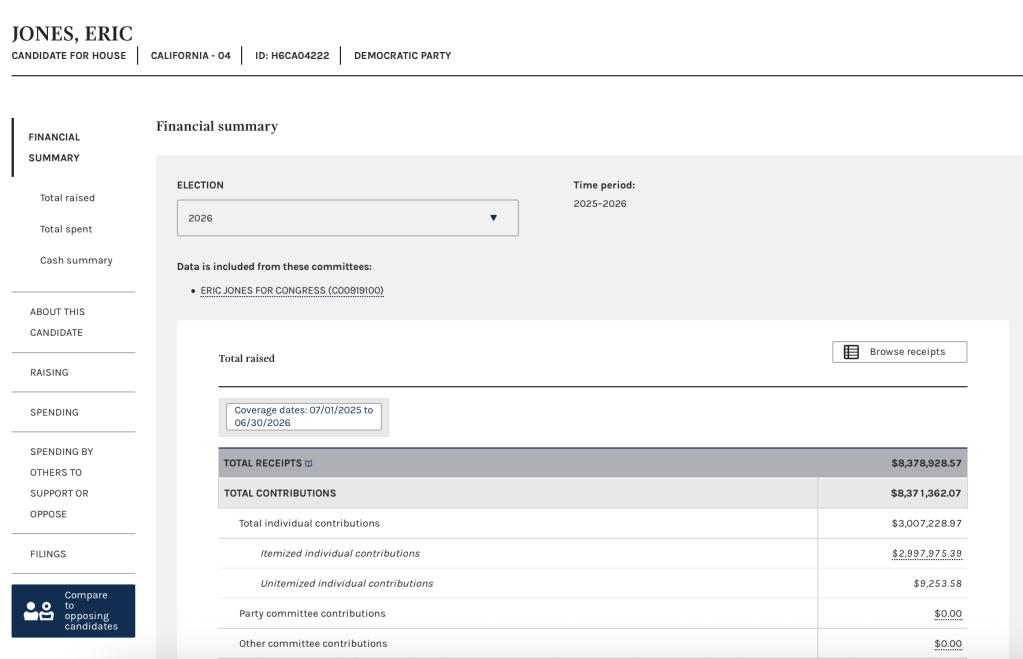
Step One: Start back at the basic FEC.gov website, scroll down as before and click on “House of Representatives candidates” and then when that page opens up, scroll to the left-hand column and enter in the “Candidate Name” box, “Jones, Eric” and click on the drop-down entry for “Jones, Eric” without any middle name. Scroll to the right into the main frame and click again on the link for “Jones, Eric.” You should now see this page:
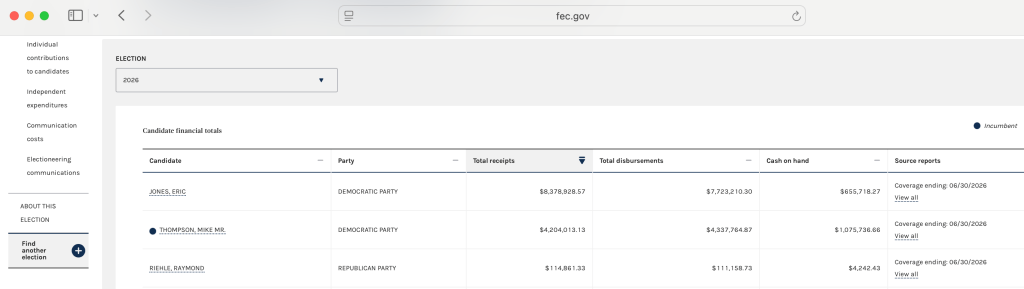
Step Two: Scroll down in the left-hand column and click on the dark blue link “Compare to opposing candidates” and you will bring up the following screen that shows all the candidates who ran in the June Primary for California Congressional District 4 and each candidate’s fundraising totals as of June 30, 2026.
Preface & Recap on Chapter One: Contributions & Expenditures in 4th C.D.
[Note: Chapter 2 follows this short preface and recap]
By F.E.C. Nerd
Hopefully, you have taken the lessons learned from Chapter One and have done some exploration on your own. It will be helpful to have those research skills honed because new additional disclosures will be forthcoming very soon. Those will cover the period from July 1, 2026, through September 30, 2026. That’s three whole, long months of fundraising and spending. I also want to point out a couple other customizable search methods you can try.
Step One: Log into your favorite Internet browser. Then go to:
Step Two: Scroll down the page towards the bottom and click on the link for “House of Representatives Candidates.”
Step Three: So that you know how to search for any House candidate use the search box — “Candidate Name or ID” in the upper left corner. Type in: “Jones, Eric”. A drop-down list of several “Jones” candidates will appear. Select the one for “Jones, Eric H6CA04222”. That will take you to the link for Eric Jones’ campaign reporting.
Step Four: Scroll right to get into the main display and click on the “Jones, Eric” link that is active. This will take you to where we start to get to the substantive data.
Step Five: Scroll to the left and click on the dark-blue box “Compare to opposing candidates.”
This will bring up another page of data (as shown below) for the main three candidates in the June Primary. Mike Thompson finished first, but Eric Jones narrowly bested Raymond Riehle, for second place and onto November’s General Election run-off. We will return to this screen again as we do our research.
Note the data under “Cash on hand” as of 6/30/2026. Note that Eric Jones reported just $665,718.27. That is nowhere near enough to buy all the TV ad-time to run his AI-generated ads attacking his opponent. So, we can expect some large contributions to be reported when the 7/1/26 – 9/30/26 disclosures are filed later this week.
Step Six: Click on “Jones, Eric” and then once the page loads, click on the button on the right “Browse Receipts” and get the drop-down search categories in the left-hand column. We spent some time in Chapter One, Lesson Two searching these, but I wanted to point out another type of search.
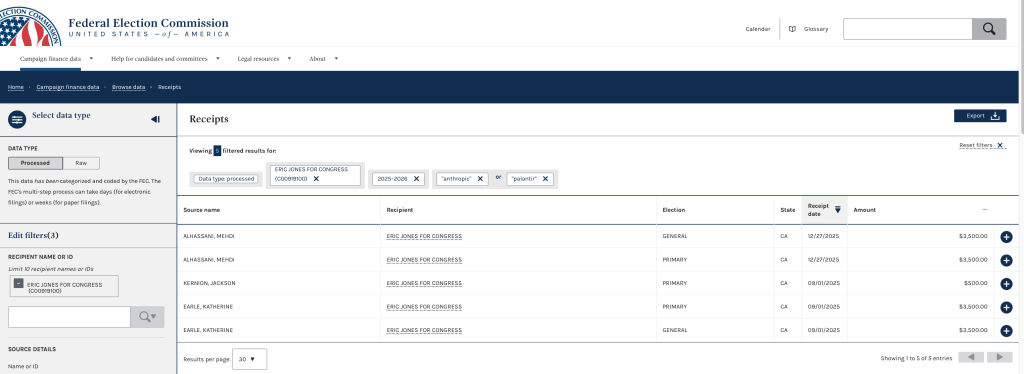
Step Seven: Scroll down in the left-hand column and at “Employer” let’s insert a couple names instead of the more general terms “inc” and “llc” that we used in Lesson Two. Enter “Anthropic” and click the right > button and we find that donors affiliated with Anthropic contributed a total of $7,500 all of it on 9/1/2025 — 8 days prior to Eric Jones filing his Statement of Candidacy.
Now enter “Palantir” in the search box . (Palantir showed up in one of our previous searches of contributors as being a client of one of the venture capital firms whose personnel were donating to Eric Jones’ campaign). Click on the right > button and we see that one of Palantir’s personnel contributed the double-maximum ($7,000) to Eric Jones on 12/27/25. Palantir works with ICE.
What if you learned that he had, in a very short amount of time, flip-flopped his views on important issues such as data centers and Medicare for All? What if you found out that he had distributed two versions of the same flyer on the same block of the same street, one for Republicans and one for Democrats?
Citizens of Congressional District 4, the candidate described above is Eric Jones, recently resigned from Dragoneer Investment Group. He would represent the interests of out-of-district tech oligarchs — resisting needed protective regulations at every turn — rather than the interests of ordinary citizens, whether Republican or Democratic.
Jones has misrepresented Congressman Mike Thompson’s record, according to Lofgren
(From press release) In a letter to the editor published in the Napa Valley Register, Congresswoman Zoe Lofgren dispelled one of Eric Jones’ most common talking points as a complete falsehood. When Eric Jones attacks Congressman Thompson’s record, he uses faulty and inaccurate data that excludes nearly $7 billion dollars worth of Social Security spending in the district.
California Department of Fish and Wildlife is investigating and an open letter is gaining signatures from concerned citizens
By Shannon Hickey
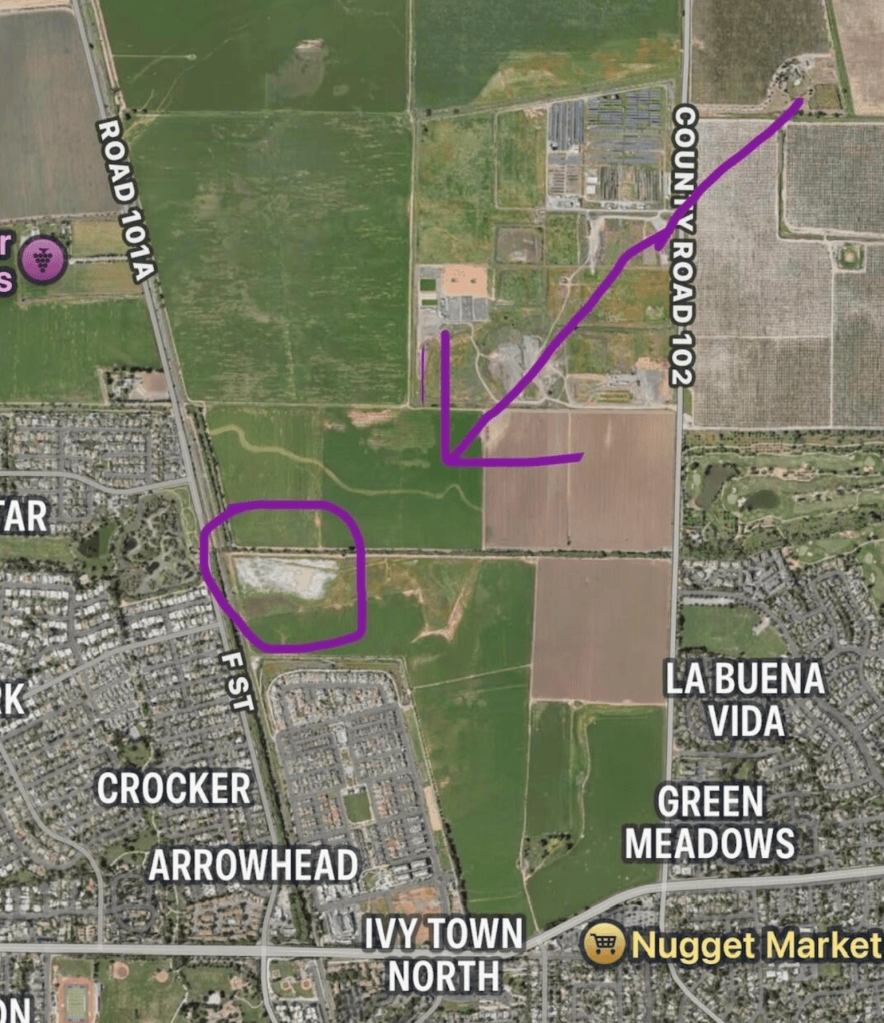
The city’s last remaining vernal pools—the ones on the Measure V (for Village Farms) property that supported a local population of the federally endangered vernal pool tadpole shrimp as well as two rare plant species (alkali milkvetch and San Joaquin spearscale)—were potentially filled, disced, and graded in the week of September 13, 2026.
The attached photos were taken early Saturday morning, September 19, showing the area where the largest pool existed, now a level surface. To give a little back story, this pool was on a property that has been proposed for development since the early 2000s and actively farmed since circa the late ’60s, according to historical aerial imagery. Despite regular discing, this vernal pool continued to pond because it was protected on two sides by a railroad berm to the west and an irrigation channel berm (Channel A) to the north. The developer has known about this vernal pool and the extremely rare species in it since the last time this project went up for a vote by the citizens of Davis back in 2005. At that time, it was known as the Covell Village project and it was voted down then as well. For both the Covell Village project and the Village Farms project, the associated environmental surveys supporting the EIRs revealed that these species were present.
(From press release) Nonprofit organizations are invited to submit applications to the Biberstein Social Action Fund for grants in support of projects addressing poverty, discrimination, abuse and neglect, and the promotion of social justice in Yolo County.
The Biberstein Social Action Fund was established in 2002 by the Board of Directors of Congregation Bet Haverim to honor Ernie and Hannah Biberstein, who are among the founding members of CBH, and who devoted much of their lives to community service and social justice. Hannah passed away in April 2011. This is the 24rth Anniversary of the Fund.
The goal of the annual awards made from the Biberstein Social Action Fund is to help Yolo County organizations in their efforts to meet unfulfilled needs. Special consideration is given to new and/or innovative projects.
An annual Call for Proposals is released each Fall. Grants ranging from $500 to $2,000 are awarded in December. The Biberstein Fund members review the proposals. Current Biberstein Fund members include Congregation Bet Haverim partners Ernie Biberstein, Amy Abramson, Anne Gieseke, Sandy Jones, Joan Sublett, and Shoshana Zatz.
Grant proposals must be submitted no later than October 16, 2026. Questions may be directed to the Biberstein Social Action Fund at: cbhbibersteinfund@gmail.com. Awards will be announced in December 2026.
Measure W -Willowgrove is the latest housing development to come up for consideration under Measure J/R/D. This measure is the City of Davis law that requires a majority vote of the public to annex farmland or open space to our city for urban development.
As you assess the merits of this project, it’s important to understand where we stand today. The state has imposed mandatory requirements for communities like ours to rezone the land needed for additional housing. These requisites include additional units of low income housing, as well as housing for moderate income persons who work in Davis but cannot afford to live here. Our failure to comply with these mandates would, without question, trigger state intervention to force our compliance with state housing policy.
That state intervention could even result in state action to override Measure J/R/D itself. The last legislative session saw strongly bipartisan approval in the Assembly of AB 2676. This bill would have curbed the use of local initiatives and referenda, that are widely being used around the state to block cities from meeting their state-mandated housing obligations. AB 2676 did not pass the Senate, but has momentum, and will almost certainly be reconsidered in some form in next year’s legislative session.
I went to the town hall Eric Jones held on August 26 at Watermelon Music. I came away from the town hall without a clear sense of why Jones is running for Congress in District 4 and what he hopes to accomplish. This emerged as he talked about the policies hoped to enact if elected to Congress. (That he showed more enthusiasm regarding an endorsement from Republican candidate Raymond Riehle than he did for the Democratic party’s goals seemed telling.) Comparing what he said at his town hall to what I found re-reading his website only compounded this sense. It’s not entirely clear what Jones stands for, especially since his policies have moved significantly to the right since the primary, as he sought Riehle’s endorsement. In many respects, it seems as if this movement has happened less as a ideological evolution than an opportunistic attempt to get elected. I do not believe Jones is a viable choice for progressives seeking change in Washington.
A continuation of the deceptive tactics we’ve seen since the primary
Republican-geared version of the Eric Jones for Congress flyer, with my annotations.
By Roberta Millstein
Last week, a Davisite reader sent me two versions of the same “Eric Jones for Congress” flyer that had been left at homes on her North Davis street on the same day. The one she received seems clearly pitched to Democrats; the other one, which she found near her driveway, is strikingly different and seems instead to be pitched to Republicans, which some of her neighbors on her block are. [1] To paraphrase her reaction, “How stupid does Eric Jones think we are?”
Now to be clear, this is not the first time we have seen this sort of behavior from the Eric Jones campaign. After months of playing the progressive, e.g., with a mailer that touted his endorsement from Our Revolution and implied (falsely) that he had been endorsed by Bernie Sanders and Ro Khanna, he:
But this does seem like a new low, pandering to Democrats and Republicans alike, trying to be everything to everybody, while still ridiculously claiming to be against PACs and special interests — even though his former Silicon Valley Dragoneer Investment Group colleagues and associates have dumped millions of dollars into his campaign via direct donationsand a Super PAC. And he is still trying to tout his health care experience as being good for employees and patients, when the evidence shows otherwise.
Public Invited to New Exhibit on Native Californian Stewardship
Promotional Flyer for Good Fire, Living Water; Illustration by Ooti Maxine
(From press release) Over 90% of the Sacramento Valley’s wetlands have been destroyed over the past 150 years, contributing to today’s interrelated extinction, climate and water crises. Naturalist, artist, and Maidu/Wintun Cultural Practitioner Diana Almendariz is working diligently – with plants such as tule and cattail, and with artists, youth, land managers, and scientists – to reverse this significant loss.
A leader in revitalizing Native Californian stewardship through cultural burning and Native plant restoration, Almendariz brings to life indigenous knowledge that was once targeted for erasure and genocide. In a sign of changing times and attitudes, the Sacramento Bee recently recognized Almendariz as one of the region’s top change makers. She praises tule – a keystone wetland species — for renewing her cultural traditions.
“Tule has been my creative muse for 30 years. This important reed is at the heart of the marsh economy – drawing down carbon from the atmosphere, creating rich soil, cleaning water, and cultivating the valley’s rich food web. By restoring wetlands, we can revitalize the natural systems that are key to a livable future,” explains Almendariz.
A new exhibit, Good Fire, Living Water: The Gifts of a Marsh Economy, opening on September 20th at the Davis Art Center, showcases Almendariz’ multifaceted eco-cultural practice that spans the arts, education, Native homeland culture, and environmental stewardship. The exhibit highlights how she is passing on this vital knowledge to the next generation of Native cultural practitioners – her daughters Ooti Maxine and Christina Almendariz.