

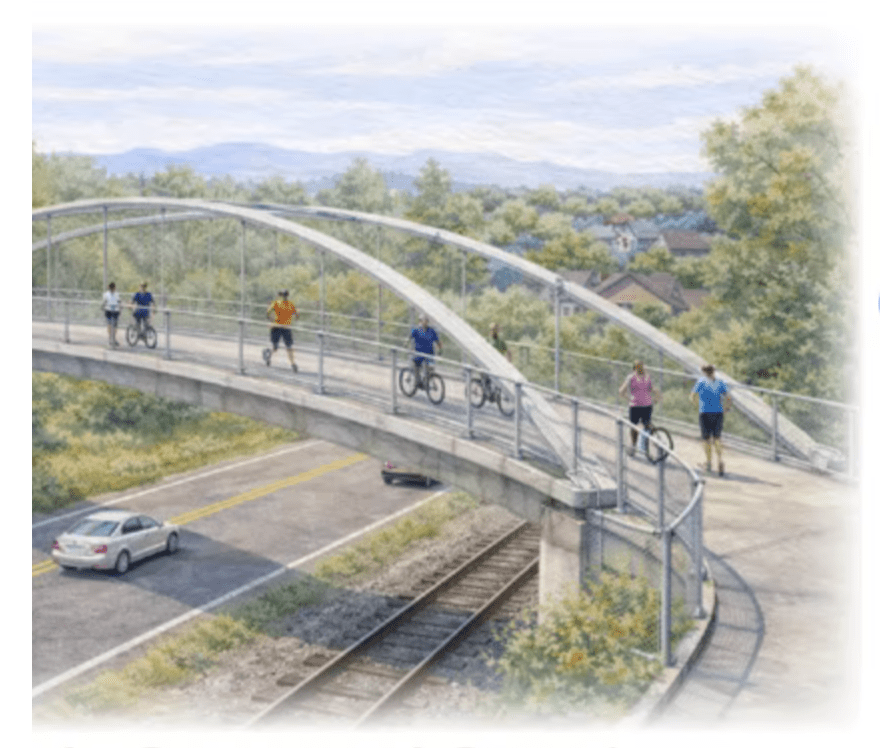
Original visual used by Yes on V of Village Farms to North Star bridge, now deleted.
by Tuvia ben Olam DBA Todd Edelman
l lived in the Czech Republic for about seven years – where I did similar mobility curmudgeon work as I do here, BUT everyone from local district mayors to engineering company bosses liked me because my father is Slovak and I’m Jewish… but mostly because I was an activist with constructive ideas. Imagine that!
In the Czech Language the term for “communication” generally encompasses systems and technology for things like the Internet and physical transportation infrastructure, for example…. bridges!
In that framework or lens I offer now a hopefully somewhat fresh look at bridges and the communication about bridges connected with projects of the Seven Generational Families of Davis (Henceforth: The Seven).
Still, the obvious place to start is Promenade (Formerly Known as Nishi)…
I’m binging GoT right now. That’s all.
The Bridge of Friendship between The Seven and Union Pacific
In a May 16th Op-Ed for the Davis Vanguard – its title is the basis for mine for this article – The Seven’s Sandy Whitcombe refers to the claim of Measure V opponents that “… Union Pacific Railroad (henceforth: UP) is holding up a grade-separated crossing”. She then says she wishes that the opponents “…asked us first…” about it.
Well, back in December 2017 during my first meeting on the Bicycling, Transportation and Street Safety Commission (BTSSC – the predecessor to the Transportation Commission), the then Assistant City Manager Ashley Feeney told us that City had a good relationship with UP and it would likely be possible to have a level crossing between Arboretum Drive and Nishi. Later on, as the proposal moved through Council’s approval step in County annexation and then towards the popular vote, the documents for the project referred to a “grade-separated crossing” but the main imagery I recall – and could find in a search – was an undercrossing.
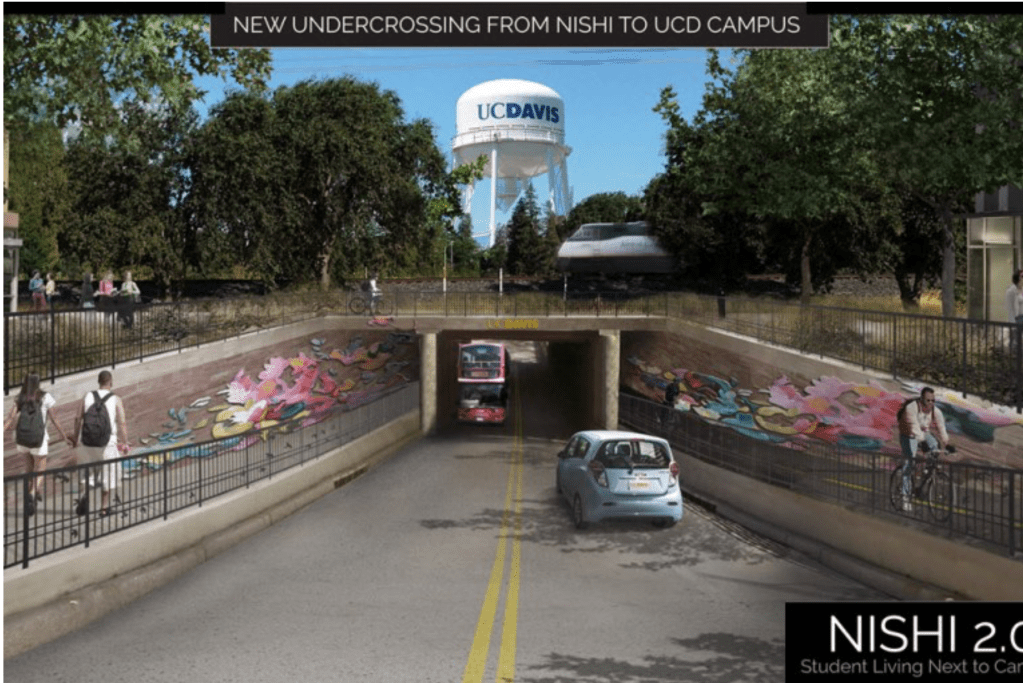
Visual by Promenade (Nishi) proponents from 2017 or so.
Jump forward to April 4, 2026 – hold on a bit for why I mention the precise date – at the Davis Farmers Market Whitcombe told me that up through the time of the 2018 annexation vote UP had the position that an undercrossing was possible (Whitcombe referred to correspondence, but I didn’t see it – I don’t think if she claimed that UP made an actual promise.).
Within a few months after the successful annexation vote the Nishi developers and UC Davis – it seems that the City of Davis was taking a back seat for the moment – perhaps because this was early in the five year or so period when the City had no senior-level traffic engineer – made a proposal for an undercrossing. This was rejected.
From that point for about five years there was no official statement or story about it. I was still on the BTSSC: We heard nothing. Brett Lee was mayor during part of the period and he doesn’t recall any kind of official statement. I looked at minutes for the BTSSC and the then Unitrans Advisory Commission meeting – there was a single mention of an over-crossing plan by Jeff Flynn – then and now the Unitrans General Manager – in a report. As the plan developed, residents of the then Solano Park were engaged as part of it would have to be torn down for the over-crossing – perhaps this was around 2019-2020, before everyone moved out of Solano Park).
When we spoke at that Farmers Market meeting last month, Whitcombe acknowledged that there was insufficient communication, something on the order of “we didn’t do that correctly.”
Nishi was re-introduced in 2023, five years after the vote, re-named as Promenade. I wrote about the overcrossing issues.
My take on it is that the all three main actors – developers, the University, the City – knew, at least in hindsight – that they really should have made a concrete agreement with UP about an undercrossing during the development process prior to the Council and popular votes. I vaguely recall being convinced that an undercrossing was going to happen when I voted – again the development legalese and the election imagery didn’t match up – but I was also distracted by the air and noise pollution issues which were the main reasons I voted against the annexation.
(Fun fact: During the Farmers Market conversation, Whitcombe referred to noise proof windows as a solution for I-80 noise – that’s over 2,000 people closing their windows to have some peace – really, Sandy?)
Whitcombe states in the April 16th Op-Ed UP’s “… stamped approval on the Nishi overcrossing engineering plans” and [she put this in bold] “we know exactly how to work with the railroad.”
That doesn’t seem to square with the earlier discussions – perhaps going back as far as 2014 during the process for the unsuccessful earlier variant of Nishi.
But more important – in a holistic communications way – the overcrossing solution is so unworkable – essentially impossible for anything not motorized, be that bikes or buses – that it’s not viable without even taking in the huge added cost. (Only in the most cynical world would we accept that transportation engineers at UP don’t care about active transportation!) I think that Whitcombe strongly implies a much longer term good relationship than what really occurred. But that’s irrelevant: It’s in fact a rotten relationship based on Union Pacific’s completely unnecessary standard that requires overcrossings, thus essentially killing access by the non-electric bicycle, and generally making it difficult for everyone.
And Now the Bridge They Now Want Us To Cross When We Come To It (i.e. fill in an X on our ballots in the YES box.)
At Farmers Market one of the first things I did with Whitcombe – this was actually the first I met her – was to call out The Seven on the over-crossing visual – at the top of the article, above – specifically that it was in no way representative of what an over-crossing here would look like. At the 4.5%-ish maximum gradient engineers prefer – before it gets into the class of ADA-compliance that requires 2% intermittent undulations like the 8% gradient Olive Dr-Pole Line connector – it would be as long as or longer than the existing crossing to the south at Covell – the road part gets to 8 or 9% – Pole Line, the Pelz Bridge, or Mace Blvd – all around 6 to 7%. Each side would be about 80% longer than the Olive to Pole Line Connector.
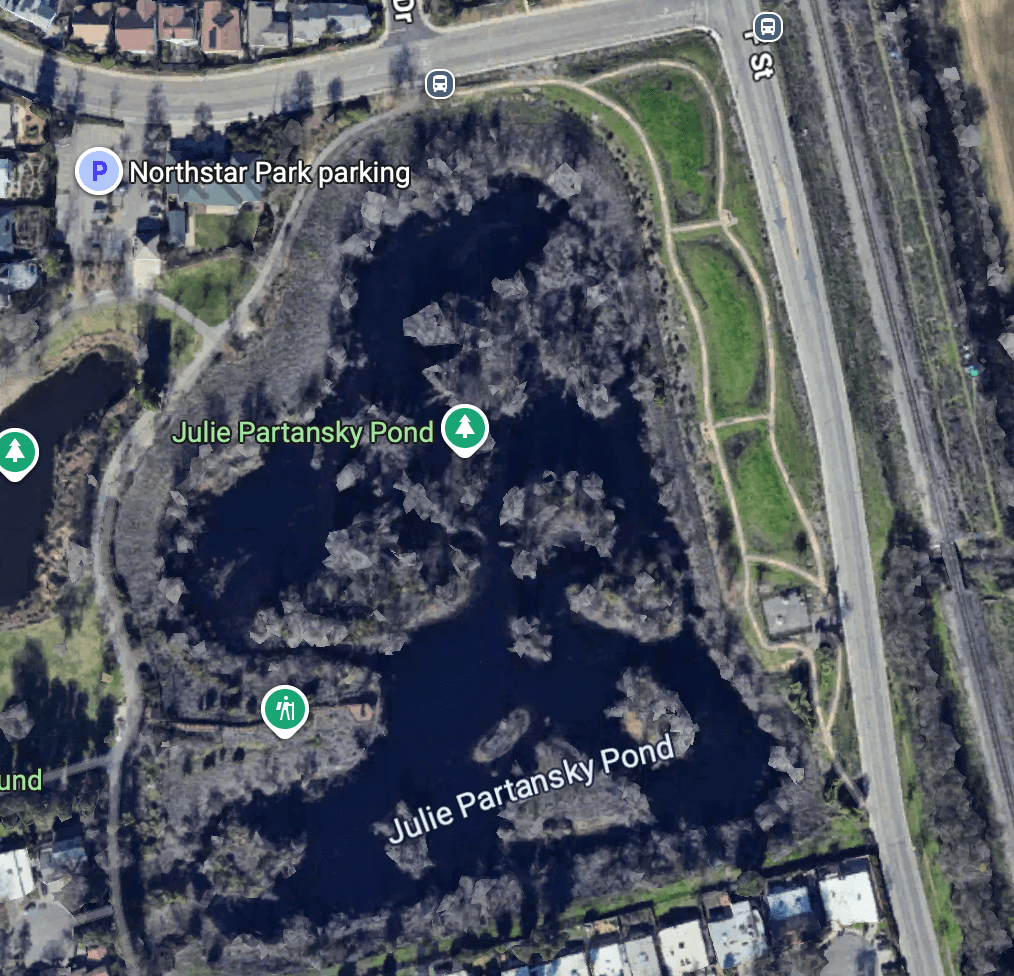
Space – to the right of the Pond – allotted for the North Star landing of the bridge to Village Farms
To get another idea of the length, see the bird’s eye of the landing area – Whitcombe said that this was planned by her father for Covell Village – specifically the area between the Julie Partansky Pond and F St. On the west side it would need all this space to snake down to ground level – and would require something just as long on the project side. (There’s no hint of this in the project drawings about how this would – for example – provide a great view into the backyards of the relatively sprawled out fancier houses at the north end of Village Farms, residents tanning with glee as they compare their potential for shorter commutes). It’s possible that the North Star side would not fit into that area at the 5% gradient, meaning that it would start to take on the uncomfortable features of the Olive to Pole Line Connector (I 100% support ADA compliance, but I’ve not been able to find this type of ramp at this length anywhere in California at least. These were never meant to be this long.)
It would take a long time to transit and a long 4.5% grade is not ideal for sharing nor for what it meets when landing – for example the MUP behind the Tandem Properties building in the park on the west side. It would obviously make for very schleppy access to the bus stops on and around F St claimed as “walkable” by Village Farms and in earlier writing by Alan Pryor.
Whitcombe told me she didn’t like the Village Farms overcrossing image – I could not tell if she had the opinion before I mentioned it – after all, they are already circulated it for weeks on their website and in tens of thousands of election mailers in March – and we talked a bit about what might actually be more visually accurate.
The Dave Pelz Memorial Bridge has around a 6.5% gradient. The latter VF-North Star should have 5%, max. The former has more to cross; the latter has to go higher – UP distance over “top of rail” is higher than the “top of highway” for Caltrans. Short walk to a bus stop on F St? Convenient school route? Perhaps as it’s not really more difficult than Pelz, but consider that snaky section next to the Pond. How many adults ride bikes to Target from South Davis and how many in East Davis ride bikes to South Davis Safeway?
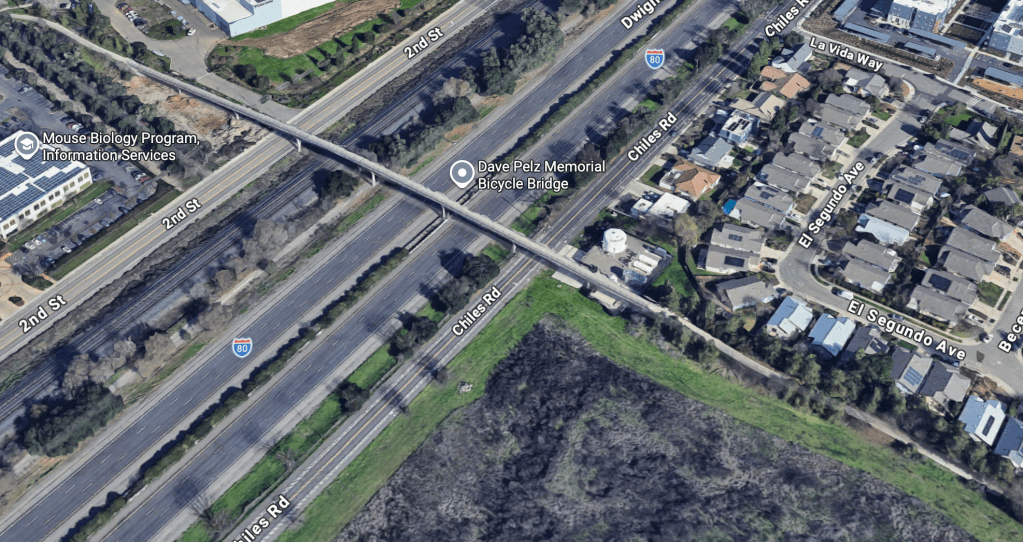
Pelz – a bit longer than the proposed VF-North Star bridge – but the shape will not be in a straight line. Would Yes on V – The Seven – put something like this in their promotional material?
Whitcombe states that the Nishi – it’s Promenade, why doesn’t she call it that? – “… is a significantly larger structure than the one planned at Village Farms.”. In terms of mass, width of the roadway, size of concrete supports and embankments etc. this is true.. BUT the Nishi crossing is 4.2% on the Old Davis Rd side and 8% on the Nishi side: The Village Farms crossing would be longer – the height clearance requirements are the same, Nishi has a roughly 100% wider railway section to deal with, but it makes for a marginal overall difference. More about use: Imagine being on Research Park Dr under Pole Line and wanting to walk to the DMV – first by going most of the way to Tesla Supercharger Station just north of Safeway and then back over the multi-use path on Pole Line – that’s a long walk. (The freeway and railway is wider than the stuff between the VF and the Pond, but it’s about a 7% gradient, compared to the likely 5%-ish target of the conceptual new bridge.)
Within about a day of my discussion with Sandy about the unrealistic visual of the over-crossing, on about April 6, the visual at the top was removed from the Yes on Measure V website.
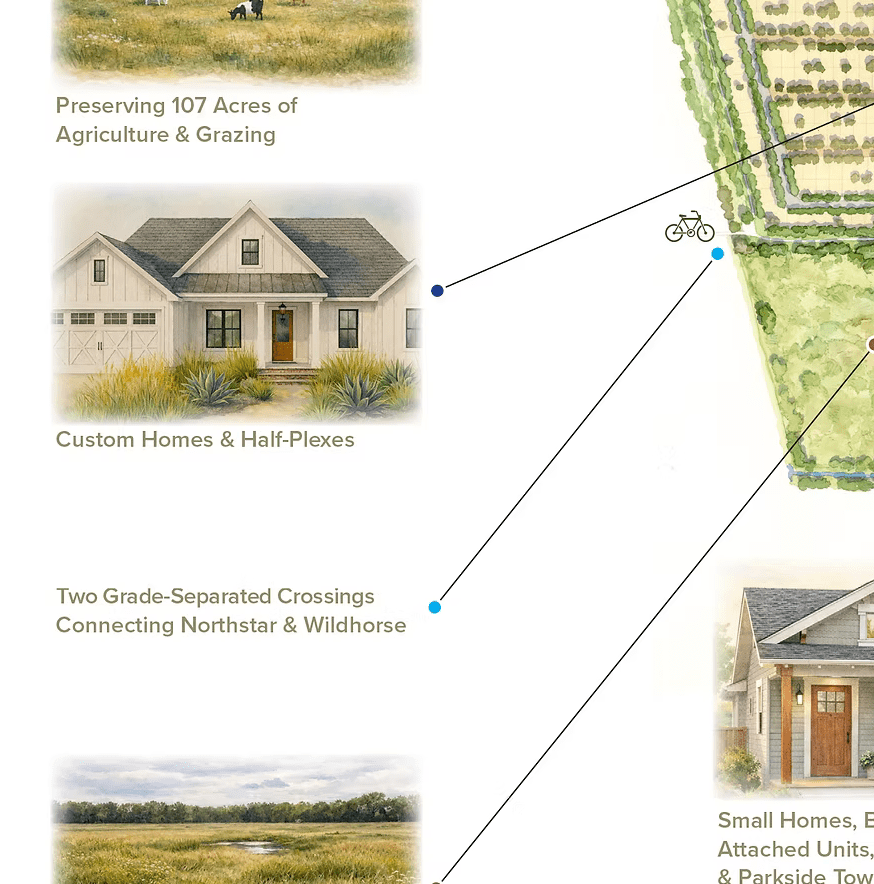
Screenshot from current Yes on V website – orphan caption at left.
And it has not been replaced: There’s a kind of orphan caption with no image. It’s been that way for about six weeks. My unfortunate conclusion is that though the Seven repeatedly claims different interpretations of project documents than the opposition, they are quite wary of a visual exaggeration as it’s much less open to interpretation. Bizarrely perhaps, they are likely hoping no one notices that lack of an image in their material and website. Now we all do.
Again, that’s weeks of an image Sandy later admitted was not appropriate, and the rest of the time with no image. It’s reasonable to conclude that it’s not an oversight. Trust for me in a project like this is a template: If there’s something I understand that’s not honest, it’s likely that other stuff that I understand less – like housing prices or flooding potential – is also not honest. And we did give the Seven over six weeks to do the right thing. They did not.



Leave a comment