Davisite Banner. Left side the bicycle obelisk at 3rd and University. Right side the trellis at the entrance to the Arboretum.

Category: Housing

  • Letter: Katie Porter is the fighter we need

    [Note: This letter first appeared in the Davis Enterprise online on Apr 6 and in print on Apr 12]

    Davisites, let’s throw our support behind Katie Porter for CA Governor — now, when we can really make a difference.

    California has a “top two” primary, meaning that the top two candidates from the June election will be the candidates we vote on in November. Right now, there are so many Democrats in the race that there is a serious risk of splitting the vote so badly that we will end up having a choice between two Republicans.

    We cannot let this happen. Thus far most candidates, even those with low polling numbers, won’t drop out. So we have to coalesce around one of the Democrats.

    I urge that we coalesce around Katie Porter.

    Porter is most known for her fiery whiteboard talks, holding corporate CEOs accountable, especially with regard to health care and big pharma. As a US congressperson, she passed laws that reined in the greed of the health care industry.

    She has a strong environmental record and will fight to expand clean energy and defend our clean air laws. She has pledged to protect our wildlands, open spaces, and oceans.

    She will work for federal funding for housing and to foster CA businesses.

    She has been endorsed by the United Nurses Associations of California/Union of Health Care Professionals, the Orange County Employees Association, Senator Elizabeth Warren, and California’s Amalgamated Transit Union.

    Porter will bring the fight that we need in these difficult political times. Please write a letter or send a donation now to register your support.

    Roberta Millstein

  • Let’s Play Contamination Whack-a-Mole with Opponents of Village Farms Davis

    By Alan Pryor

    INTRODUCTION

    A recent article was published in the Davis Enterprise (3/22/26) entitled “Village Farms Contaminant Risks” which purportedly discussed the alleged “risks” of environmental harm due to concentrations of a class of chemicals found in the groundwater beneath the Old Davis Landfill. These chemicals, known as PFASs, are likely found in the groundwater as a result of seepage from the long-since closed Old Davis Landfill. This article was later reprinted in a slightly altered form in the Davisite and Davis Vanguard on March 29,

    Unfortunately, however, the authors of the article really only repeated information already known about the concentrations of this only remaining organic contaminant currently found in  the groundwater.

    Further, the authors completely failed to actually quantify any real environmental “risk”of any type that this reported contamination might actually cause. Instead, the authors essentially  just say,”It’s there and it’s really bad”! – albeit saying that in a very ponderous and sonorous but seemingly credible manner. 

    But the authors did not even attempt to quantify the real likelihood of any environmental risk in their article. Why?…Because the risk of contamination is so infinitesimally low that to properly quantify that risk and disclose that information to the public would completely undermine their attempts to scare and frighten the public. This is not a thoughtful, deliberate scientific report. This is yellow journalism pure and simple.

    Let me explain.

    (more…)
  • Fall Ballot Measure Would Open the Door to 3 Percent Down Payments to Buy New Davis Housing

    By Dan Carson

    A $25 billion statewide bond measure headed for the November 2026 ballot could pave the way for middle income Davis families to purchase new homes in Village Farms Davis with only a 3 percent down payment via an innovative new statewide program that would create no cost burdens for City of Davis or California taxpayers.

    Backers of the measure have already submitted 920,000 signatures to send the California Middle Class Homeownership and Family Home Construction Act to the voters, well in excess of the 546,652 signatures needed to qualify it for a November 3, 2026 vote. About 2,300 registered voters in Yolo County signed petitions to send the measure to the voters.

    “We are excited about this promising new ballot initiative,” said Sandy Whitcombe of the Yes on V campaign. “If it passes, this program could be the key for the many young families who can afford monthly payments for a modest home but haven’t been able to save up tens of thousands of dollars for a 20 percent down payment —  a goal post that keeps moving further away from them as home prices increase. Village Farms Davis was designed with a diverse mix of new housing options for the missing middle, and it appears most of the homes would qualify for this downpayment assistance.” 

    The full text of the measure can be found via the link below. It would authorize the issuance of new state revenue bonds that would be sold to spur the development of additional housing within the financial reach of middle income families.

    (more…)
  • No on Measure V campaign at April 4th Farmers Market

    (From press release) The No on Measure V campaign will be at the Farmers Market tomorrow, Sat. April 4th, with literature and lawns signs and  volunteers to meet with Davis residents wanting more information. The campaign now  has a website, NoOnMeasureV.org posted with information about many reasons to vote NO on Village Farms on June 2nd.

    Village Farms is a proposal for a 1,800-housing unit project on 498 acres, at Covell Blvd. and Pole Line Rd. It is the largest project ever proposed in Davis, with the worst impacts and it would  impose costs on Davis residents.

    The project housing would be unaffordable particularly to local workers and families with young children. The vast majority of the project would be housing priced at $740,000 – $1.34 MILLION  per the BAE fiscal report which means a monthly housing payment of at least $6,000 to cover the mortgage, property taxes, insurance, CFD, and other fees.  Families with young kids cannot afford this so the project will not bring hundreds of kids as the School District believes, and therefore it will not help the schools as claimed.

    The developer is not responsible for building the affordable housing , except possibly 100 apartments in the last phase of the project 10+ years into the development.

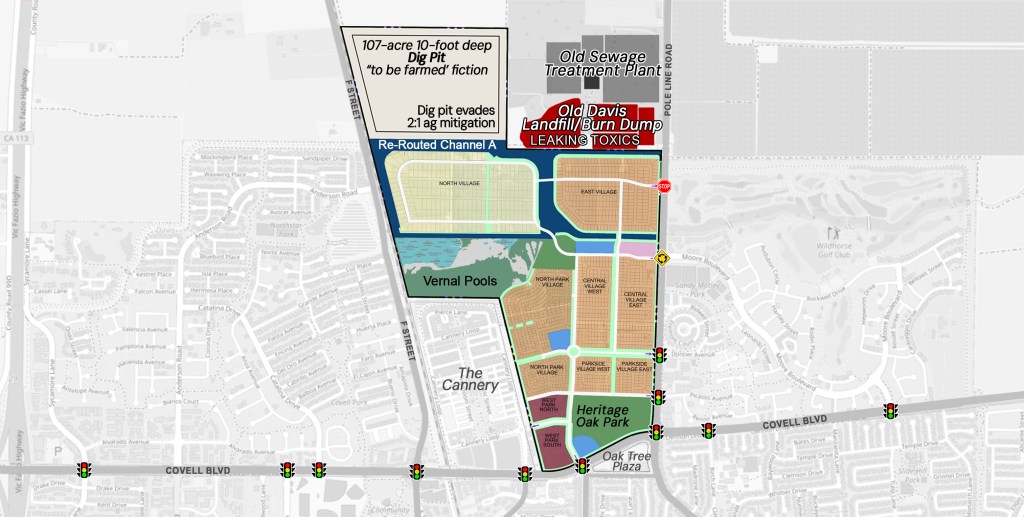
    Concerns also include toxics, including carcinogenic PFAS’ “forever chemicals” leaking from the adjacent Old Davis Landfill/Burn Dump and Sewage Treatment Plant into the project site. Vapor intrusion can result exposing future residents to these carcinogenic chemicals. The project also has high levels of could toxics including neurotoxic toxaphene and lead on the proposed Heritage Oak Park site where kids would play.

    (more…)
  • Village Farms Contaminant Risks

    [This Op-ed article was originally published in the Davis Enterprise on March 22nd in response to February 18th Davisite and Davis Vanguard articles in which Alan Pryor asserted that valid concerns related to contaminants associated with the proposed Village Farms Davis project, are “myths”.  This is a slightly modified version of that article.]

    This map from the Draft Environmental Impact Report, which was not included in the Davis Enterprise Op-ed article, shows Village Farms proposed drainage and housing adjacent the Old Davis Landfill/Burn Dump and Sewage Treatment Plant and monitoring well locations. The liner discussed in the Davis Enterprise op-ed article and the Partial Draft Response to EIR Comments does not appear in the Development Agreement or Baseline Project Features. 

    By Steven Deverel, Marjorie Longo, and Robert Okamoto

    There was a recent attempt to dismiss contaminant risks related to the proposed Village Farms project in north Davis. We herein summarize data and potential risks related to contamination from the adjacent Old Davis Landfill, Burn Area, and Wastewater Treatment Plant.

    First, it was posited that contamination from the landfill has dissipated, per and poly fluoralkaline substances (PFAS) are not a health issue and that Village Farms Davis will not be built on the landfill.

    Response

    (more…)
  • Who will really pay for the Affordable housing at Village Farms?

    By Matt Williams

    I learned something very interesting in the last few days that gave me an incredible sense of “Here we go again!” Specifically, where is the $6 million Affordable Housing contribution coming from?

    Alan Pryor has said on the Vanguard that the $6 million is coming from the developer, but is it? Or is it actually going to be coming from the taxpayers?

    The history of the Cannery tells us that there is a very good chance that the taxpayers will end up footing the bill for the $6 million. But because Village Farms is so sketchily defined/described, there is no way to know.

    Cannery was much better and more completely described/defined, but one year after the documents had all been signed, they came back to the City saying they “needed” $12 million more cash. City Council negotiated the $12 million down to $8 million … and then imposed a 30-year Mello-Roos Tax on the Cannery residents, with the taxpayer total payments of which amounting to more than $21 million taken out of those taxpayers’ pockets.

    There is nothing in the Baseline Features or the Development Agreement for Village Farms that tells Davis voters whether there will be a Mello-Roos levy (often called a CFD), and/or how large the Mello-Roos levy will be.

    To add insult to injury at The Cannery, the City Council never asked the developer what value the City would be getting back in exchange for the $12 million being asked for, or the $8 million eventually given. Unfortunately, the City got zero dollars of value in that Cannery situation.

    We have no way of knowing what might happen in the case over Village Farms. This is just one more way this project is not ready for prime time, and the only logical vote on Measure V is “No.”

  • An exchange over misleading Village Farms promises about affordable housing

    Greenwald concedes Village Farms could result in little or no affordable housing being built

    By Roberta Millstein

    I want to let readers know about some followups to my two previous posts about the toothless promises concerning Affordable Housing and affordable-by-design housing in Village Farms, which we will vote on in June as Measure V. One is that I meshed the two articles into one, did some more editing, and submitted the new article to the Davis Enterprise, where it appears, here. Now the analysis of affordable housing in Village Farms, which rests in large part on understanding the difference between Baseline Features and Development Agreements — and which “promises” appear where — is all in one place.

    The second thing I want to highlight is a response of sorts to my DE article from the Davis Vanguard, here. What I find interesting about this response is that at each point David Greenwald actually agrees with what I say about the promises of affordable housing. Indeed, there really is no other interpretation — it’s in black and white that the affordable housing is so flexible that the project could end up with little or no affordable housing at all. And he agrees that our city councils have a history of giving in to developers. Quoting from Greenwald’s article (my emphasis added):

    (more…)
  • Village Farms…Is It The Right Time? 

    By Georgina Valencia

    There is no perfect project and there is no perfect time.  But, there are good projects that come at the right time.  Such a project is Village Farms.  There are a few reasons I will vote YES for Village Farms. 

    First, Village Farms is contiguous with the City and I would label this site infill.  It is surrounded by The Cannery, F Street, Covell Blvd and Poleline Road.  While this land is farmland and has been planted under tomatoes, wheat, corn over the years.  It is surrounded by our community on three sides and is ideal for development.

    Second, the property that Village Farms sits on is in the sphere of influence created in 2008.  What is the Sphere of Influence?  “The legislature created the mechanism a “’sphere of influence’ (SOI) as a means for planning of probable physical boundaries and service areas within a local agency…SOIs are designed to both proactively guide and respond to the need for the extension of infrastructure and delivery of municipal services to areas of emerging growth and development.”  Village Farms (formerly Covell Village) is largely within the City’s SOI.  This means we as a community, former Councils as well as City Staff, have thought for decades about the areas of future growth and this is one of them.

    (more…)
  • Davis Deprives Younger Adults of Longterm Housing: Population Demographics

    by Hiram Jackson

    Introduction

    Davis has followed a policy of restrictive growth since 2000 when Measure J passed, which allowed city voters to approve of new projects on the margins of the city.  Since then, Breton Woods, designed for older (55+ years) residents, and the Nishi project, designed for UC Davis students, both passed in 2018. 

    Apart from that, every other proposed project, which notably would have been available for younger adults less than age 54, has been rejected.  This quarter century drought on peripheral developments for younger adults has consequences in our current demographic makeup.

    City of Davis census data show a local declining young adult population

    From 2000 to 2020 U.S. Census data show that Davis grew from about 60,000 to 66,000, an annualized growth rate of about 0.5%.  Within that time the population of 20- to 29-year-olds, which includes mostly UC Davis students, grew by about 2500.  The population of Davis adults aged 50 and older grew by 8,000, reflecting good health and the desirability of our community.  Meanwhile, the number of young adults aged 30 to 49 has shrunk by 2,000 during the same period (See Census chart). 

    Figure 1 – City of Davis Population – 2000 v. 2020 U.S. Census

    This last age cohort, specifically, includes parents who are likely to enroll students in the local public schools.   Based on the 2020 U.S. census, the 30 to 49 age cohort is proportionally larger, statewide and nationally, than either the Baby Boomer or older Gen X population, demonstrating that the Davis decrease is anomalous in not accommodating this age cohort.

    (more…)
  • The ballot arguments in favor of Village Farms are extremely misleading about affordable-by-design housing

    Arguably, they are downright deceptive

    By Roberta Millstein

    In a previous article, I explained how it is only the Baseline Features of a project that are guaranteed to be built.  I further explained that the Affordable Housing that Village Farms claims to provide is not part of the Baseline Features, i.e., the features that we will vote on as part of Measure V — it seems to be, but then by referring to the Development Agreement where it says only that the City “may elect to request Developer to construct the units” (emphasis added), it becomes clear that there is no guarantee of Affordable Housing at all. (Please refer back to that article for details).

    In this article, I will explain that the “commitments” to affordable-by-design housing that proponents tout in their ballot arguments and elsewhere are similarly ephemeral.  Voters should be aware that the project may not include much affordable-by-design housing at all.

    First, let’s clarify.  In California, capital ‘A’ Affordable Housing has a specific legal definition, with classifications based on income as a percentage of Area Median Income (AMI).  In order to qualify to occupy an Affordable Housing unit, one has to fall into the requisite income class.

    But “lower case ‘a’”, affordable-by-design (also called “missing middle”) housing has no such income restrictions.  Anyone can purchase it, regardless of income.  However, as the name suggests, the point is that certain types of housing are likely to be less expensive, and thus more affordable: duplexes, triplexes, cottage courts, and multiplexes are examples.  They are still “market rate” — they will cost whatever the market will bear — but the hope is that they will be affordable to those who do not qualify for Affordable Housing but who do not earn enough money to purchase larger, single-family homes.

    So, what do the Village Farms proponents promise? 

    (more…)