Davisite Banner. Left side the bicycle obelisk at 3rd and University. Right side the trellis at the entrance to the Arboretum.

Why Traffic “Improvements” Destroy Cities

By Tim Keller

I would like to briefly weigh in on one of the elements of the debate currently being waged online regarding Measure V.

Opponents complain that the new residents will clog our streets with “traffic” while supporters of the project point out that Village Farms will pay for “traffic improvements” that will mitigate or perhaps even improve traffic. 

It is my distinct impression that both sides of that debate are missing the most important question: What exactly are “traffic improvements”?

In practice, “traffic engineering” is usually shorthand for constructing LARGER intersections: adding pavement, turn lanes, traffic lights, slip lanes, and other infrastructure intended to move more cars through an area more efficiently.

You can optimize signal timing to some degree, but beyond that, most “traffic improvements” simply mean making more room for automobiles.  This is not necessarily something we should be cheering for.

As urban planner Lewis Mumford warned all the way back in 1955:

“Adding lanes to deal with traffic congestion is like loosening your belt to cure obesity.”

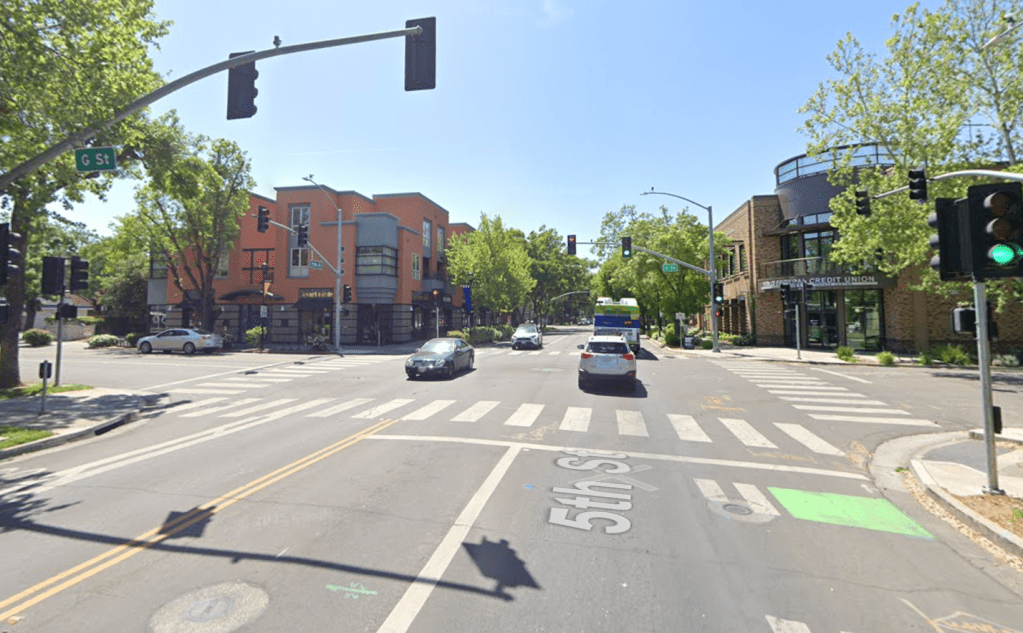
Consider these two downtown intersections here in Davis:
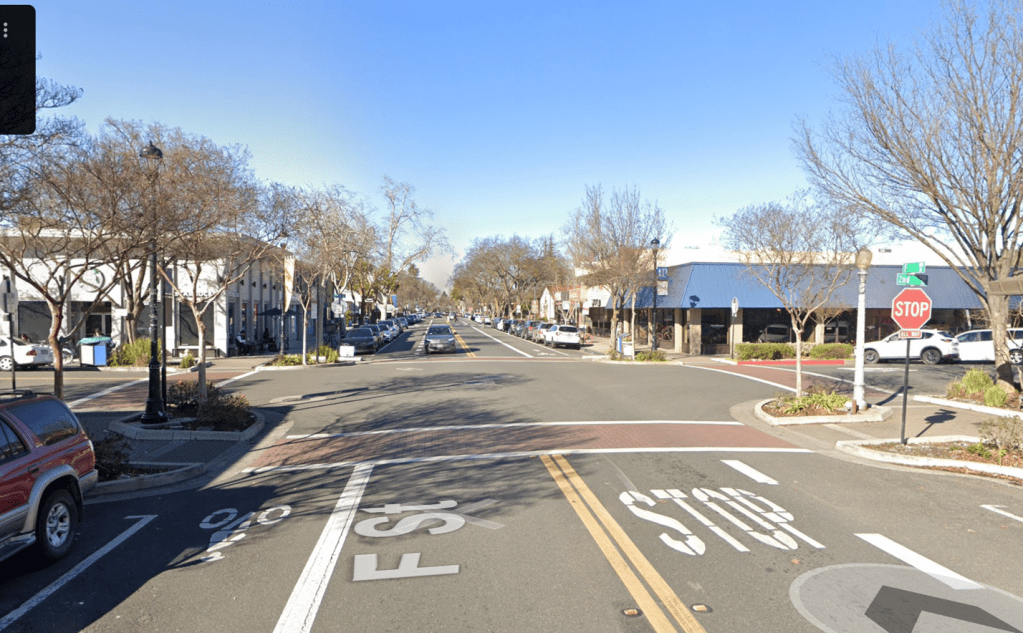
These are relatively human-scale intersections. They are not perfect, and the bike infrastructure could certainly be improved, but most people generally feel safe walking and biking through these areas.  

Now, as most Davisites know, driving through either of these places is rarely “fast” during peak hours. Davis has intentionally refused many of the engineering practices used elsewhere to maximize vehicle throughput. We have even put Fifth Street on a “road diet,” removing a lane for cars to make room for bicycles.

Now compare that to a heavily engineered commercial corridor in Roseville near the Galleria and surrounding strip malls.
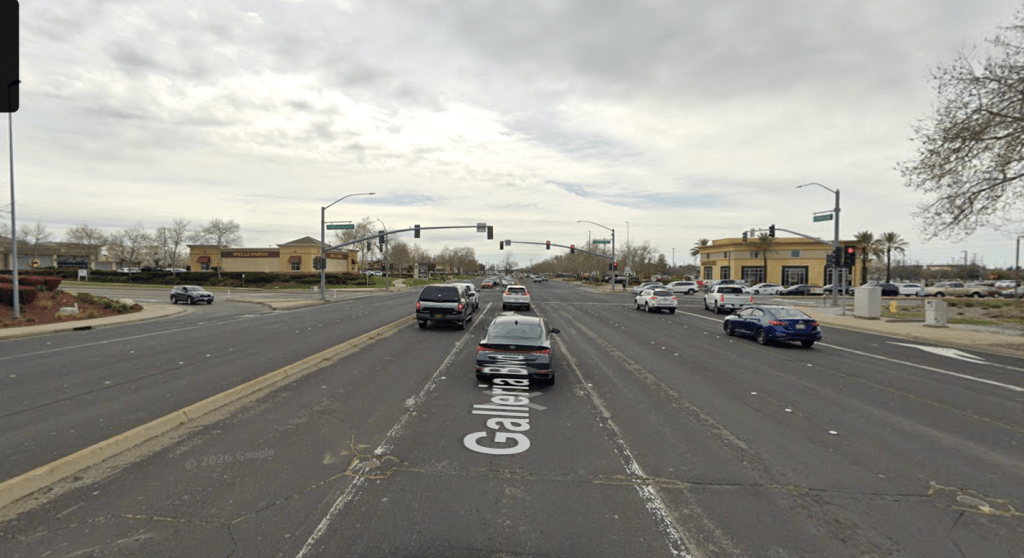
From a traffic engineering standpoint, this is, in fact, a very “efficient” intersection. Lots of vehicles moving through large commercial areas with minimal delay.

But this kind of environment is openly hostile to pedestrians and downright dangerous for cyclists.

(Notice the right-hand turning “slip lane” visible on the left side in the image. This is a common traffic engineering tool used to allow cars to turn right without slowing down. Davis has been removing many of these because drivers using them are typically looking left for oncoming traffic — not right for pedestrians entering the crosswalk and that fact alone makes collisions with bikes and pedestrians in the crosswalk 70%-80% more likely.)

Do we want “improved” intersections like this in Davis?  No, we do not.  This isn’t Davis, this is an automotive hellscape.  – Yet this is exactly what developers mean when they promise “traffic improvements.”

The uncomfortable truth is that there is an unavoidable tension between designing streets that efficiently move cars and designing streets that are safe and pleasant for human beings.

As Lewis Mumford also said:

“The right to have access to every building in the city by private motorcar… is actually the right to destroy the city.”

We should not be cheering on the fact that the developer has to pay millions of dollars to do traffic improvements.  On a holistic basis they are likely not be “improvements” at all.   In fact, the current situation is something of a lose-lose scenario that hinges on how the intersection is engineered:

  • If we attempt to reduce automotive wait times and maximize vehicle throughput, the intersection will almost inevitably become more dangerous and hostile to bikes and pedestrians.
  • If we prioritize safety for pedestrians and cyclists, that generally means intentionally slowing down vehicle traffic, so wait times for drivers go UP.

We cannot simultaneously create streets that maximize vehicle speed and throughput while also creating streets that feel genuinely safe and pleasant for walking and biking. Those goals are fundamentally in tension.

Which also means that the question about growth in Davis is not “should we grow or not” but “HOW should we grow:  What kind of city do we actually want?

If we “improve” Davis to move more cars faster, we destroy the walkability, bike culture, and human-scale character that made our city desirable in the first place.   If we don’t….  expect more next-door posts with photos of cars backed up on our streets during rush hour.

Happily, however, there IS another path forward:  We can reduce the number of trips that require a car in the first place by building smarter.

Urban planners have increasingly recognized this reality over the last several decades. One of the most important ideas is known as the Downs-Thomson paradox, which observes that traffic congestion in cities is ultimately governed not by roadway size, but by the quality of alternatives to driving.

In other words: 

  • If transit is slow, inconvenient, or nonexistent, people will drive no matter how many lanes we add. 
  • But if transit is fast, reliable, and integrated with housing, many trips stop requiring cars altogether.

This is why the world’s most successful urban environments increasingly focus not on maximizing automotive throughput, but on reducing automobile dependence.

Urbanist Jeff Speck summarizes the issue succinctly: “The best way to reduce traffic is to make driving optional.”

That is the conversation Davis should be having.  Not whether growth will increase the number of people on our street — of course it will.  The real question is what those streets need to look like and how our new residents use them.

If we build nothing but detached single family housing, we are in fact choosing 2+ automobiles on our streets every day for every household.  That is an unavoidable fact.   And then we have to choose between unsafe intersections or long wait times for cars.

Alternately, If we build multifamily housing along high-service transit routes, keep our streets relatively slow and provide protected lanes for bikes instead of optimizing for automotive throughput, then a large number of our residents will find biking or using the transit MORE convenient than driving.

That is the tradeoff that every well-planned city ends up making.   It is almost universal.  Is it time for Davis to make this choice as well?

Davisite logo

Did you enjoy reading this article? Then subscribe to the Davisite for free and never miss a post again.

Comments

10 responses to “Why Traffic “Improvements” Destroy Cities”

  1. darelldd

    Bravo. I appreciate this well-presented, important message. Thank you Tim.

    It seems like every development comes packaged with this same message: Sure this will add X thousands of new vehicle trips to our streets. But fear not! We will be spending millions to accommodate all these extra cars with huge new intersections, more lanes and some more paint for the bike lanes at the edges! For extra credit we’ll include gratuitous images of young couples riding around the landscaped paths with vegetable greens and baguettes in the front basket.

    So yeah, we’ll loosen our belt and call it “improved.” The best way to relieve all the added stresses of building more, is of course to build more.

  2. Tuvia ben Olam

    “Davis” is a fictional transportation ecosystem. The (more) real one includes the city, UC Davis campus, adjoining county areas and inter-regional transportation infrastructure and systems — I mention this because there are far better good alternative examples than the ones you mention… namely the roundabouts of California with Sprocket and with Hutchison… or really all four roundabouts on California. These are all parts of the general street grid of the ecosystem: the border is administrative and political. Yes, there are examples from other countries where motor vehicles are essentially guests and people using bikes or scooters are still quite safe.

    The sociopathic asphalt monster from Roseville is is a good thing to warn us about; but let’s look at other recent “improvements” in Davis… keeping in mind that these don’t appear automatically due to (insufficient) financial contributions from developers, but formally with a signature from the senior civil engineer for transportation and typically a final checked box or two in Consent:

    * The first example is the pilot project for three intersections on 5th in Old North. The goal was to reduce collisions. No data about traffic speeds was collected; there was no survey about fear of crossing 5th walking or rolling. The unstated goal was to maintain the uncivilized velocities which we pretend are reasonable. Also, equipment used for separating the travel lane from the bike lane is used in an atypical manner, to the detriment of people riding bikes or e-scooters — the small deflectors used on the ground are not safe if implemented perpendicular to traffic flow. Specifically, if people on bikes or scooters deflect a little bit to the right from the bike lane on 5th they will hit one of these things and even at a moderate speed will be ejected into the very sharp edge of the no left turn signs visible from I, J and K.

    * The second is one element of the perpetual “Mace Mess” which is the daily after school chaos at Mace and Cowell: https://photos.app.goo.gl/2oojKEuG6T7ugHVY9

    * The third is also about Mace; conversely it’s about a real proposal for improvements – no quotes, because it’s much more about the root of the problem than the “improvements” on Mace itself: https://davisvanguard.org/2022/03/guest-commentary-fixing-the-mace-mess-the-big-picture/

    Again, all that detail to illustrate bad engineering approved by confused or conniving politicians… the ultimate weaponizers of “improvements”.

    To date, the traffic engineer and city and relevant county politicians have ignored outreach relating to the three mentioned examples.

    Finally, the reality of the west side grade separated crossing for Village Farms is mentioned in the article I published in these pages Saturday morning. I’m curious if the traffic engineer – at least privately – said something similar to Village Farms proponents. For example, did they suggest any actual improvements for the multiple hairpin turns that fit into the proposed footprint of the bridge?

    1. darelldd

      Tuvia makes a great point about Mace. Recall that everything they’ve done to Mace–all the millions spent for the first redesign, and then tearing it up and trying again…. every bit of this was called “improvements.”

  3. Ron O

    Pretty sure that another word for traffic “improvements” is traffic “impediments”. Within the last 20 years, I’m aware of two “improvements” (new stop signs) on Road 102 (between Davis and Woodland), which are likely a direct result of development in the area.

    Each and every one of these type of “improvements” is an impediment to traffic flow thereby wasting gas, time, and wear-and-tear on vehicles.

    An actual improvement would consist of infrastructure which reduces impediments (but without enabling even more development). The latter is the reason this never works.

  4. Tuvia ben Olam

    Ron: one of the stop signs is at an intersection with extremely sightlines because of tall bushes etc all the way up to the property line from its location on the southwest corner.

    I’m guessing that they ask the owner for help but were rebuffed, and they didn’t want to pursue litigation.

    One way to solve it would be two see if the neighbors on the north side of the other road want to sell land so the road can be diverted some distance away from that property… or similarly with the property to the east and diverting 102.

    Perhaps they weren’t interested either!

    So the property owner is facilitating traffic violence, the other property owners might not be helping out, and the county is responding with the laziest solution.

    1. Ron O

      If that’s the corner I’m thinking of (intersection of Road 27 and Road 102), there’s a house inside of that thicket of brush. Been that way for years.

      What’s changed is more traffic, I suspect. And more to come when they build the “technology center” with its 1,600 housing units adjacent to Road 27.

      But truth be told, these type of traffic “improvements” are needed as development/traffic increases. Otherwise, drivers from cross streets (such as Road 27 and 29) will increasingly “take chances” rather than wait forever (to make left in particular) onto Road 102.

      Same thing is true regarding those exiting the Wildhorse and adjacent developments. That’s where the other new stop sign is located (with more “improvements” to come, if Village Farms is approved. All of these type of improvements are an impediment to traffic flow.

      “Improvements” (aka “impediments”) don’t just impact those who are driving personal vehicles. They also impact all deliveries, contractors, etc., by increasing their travel time, energy usage, wear-and-tear on their vehicles, etc. Those increased costs are passed on to their customers (which is probably one reason that prices are generally higher in places like San Francisco). The same thing is likely true regarding elimination of parking spaces, regarding the impact that has on deliveries and contractors (though they sometimes just double-park in those cases – further impacting traffic flow).

      No construction worker, landscaper, handyman, etc., is going to be taking a bike to work sites. Their vehicles are full of the tools they need, for one thing. And when society decides to make it harder or more-expensive for them to do their jobs, there’s only one party that ends up paying the bill (the consumer).

      Though I sometimes like to think that the “quality” of gas, for example, must be better in places like San Francisco (which accounts for the difference in cost compared to the valley).

      And that for some reason, the Golden Gate Bridge still isn’t paid off (which is the reason they keep increasing the tolls). Perhaps they took out an equity line on the bridge itself.

      On a somewhat related note, I’m still a little reluctant to try the new “Lexus Lanes” (as you put it) on I-80. I figure that it might be a trap (another way for the government to entrap me with some kind of unknown fine, if I screw something up regarding the process).

      But at some point, I may try to separate myself from the rest of the “peasants” using that highway. Hopefully, without getting run down by an impatient Lexus driver who can’t pass if I’m in that lane.

      🙂

  5. I want to try to connect the dots a bit — Tim can correct me if this was not his intent.

    If we build nothing but detached single family housing, we are in fact choosing 2+ automobiles on our streets every day for every household. That is an unavoidable fact. And then we have to choose between unsafe intersections or long wait times for cars.

    In other words, if we approve Village Farms as it is proposed for Measure V, this becomes our choice between two bad options.

    Alternately, If we build multifamily housing along high-service transit routes, keep our streets relatively slow and provide protected lanes for bikes instead of optimizing for automotive throughput, then a large number of our residents will find biking or using the transit MORE convenient than driving.

    In other words, if Village Farms is re-proposed with transit in mind from the outset, as a denser project (perhaps only below the channel), we can foster ways of moving around Davis that are convenient and safe for all, even if our car-dominated thinking has a hard time envisioning it.

    1. Tim Keller

      Yes exactly! The only way to grow without creating inhospitable streetscapes, or causing traffic nightmares is to plan housing in conjunction with transit. We can get more affordable housing, nicer streets, fewer cars on the road, cater more to local workers, have lower GHG footprints and have housing that the city doesn’t lose money supporting if we build multi family housing intentionally around transit.

      Village farms really is a huge loss if it passes. The huge park at the bottom displaces the one place where it makes the most sense to put a big chunk of affordable housing.. across the street from shopping, right on a transit line that can run to campus and downtown. And transit lines need that kind of density all along the line to pencil out… so putting a park there means every single person living I. That development will drive everywhere for everything.

      1. Tim, I think your last paragraph really spells out the lost opportunity that Village Farms, as it is current configured, represents. And the way it locks us into a dysfunctional future. I’ve seen you and your colleagues make that argument on the Vanguard but not really anywhere else (unless I missed it). That’s a point that I think is worth bringing out in more places (although time is short!)

  6. Kevin O’Connor

    Excellent article. Lewis Mumford was a very smart man.

Leave a comment