

By Tim Keller
I would like to briefly weigh in on one of the elements of the debate currently being waged online regarding Measure V.
Opponents complain that the new residents will clog our streets with “traffic” while supporters of the project point out that Village Farms will pay for “traffic improvements” that will mitigate or perhaps even improve traffic.
It is my distinct impression that both sides of that debate are missing the most important question: What exactly are “traffic improvements”?
In practice, “traffic engineering” is usually shorthand for constructing LARGER intersections: adding pavement, turn lanes, traffic lights, slip lanes, and other infrastructure intended to move more cars through an area more efficiently.
You can optimize signal timing to some degree, but beyond that, most “traffic improvements” simply mean making more room for automobiles. This is not necessarily something we should be cheering for.
As urban planner Lewis Mumford warned all the way back in 1955:
“Adding lanes to deal with traffic congestion is like loosening your belt to cure obesity.”
Consider these two downtown intersections here in Davis:
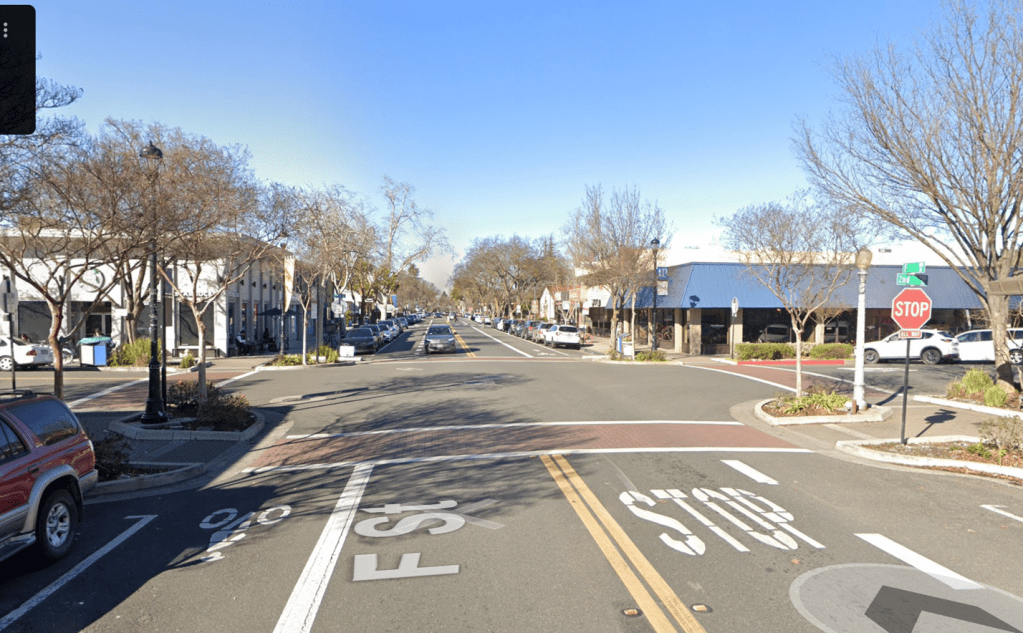
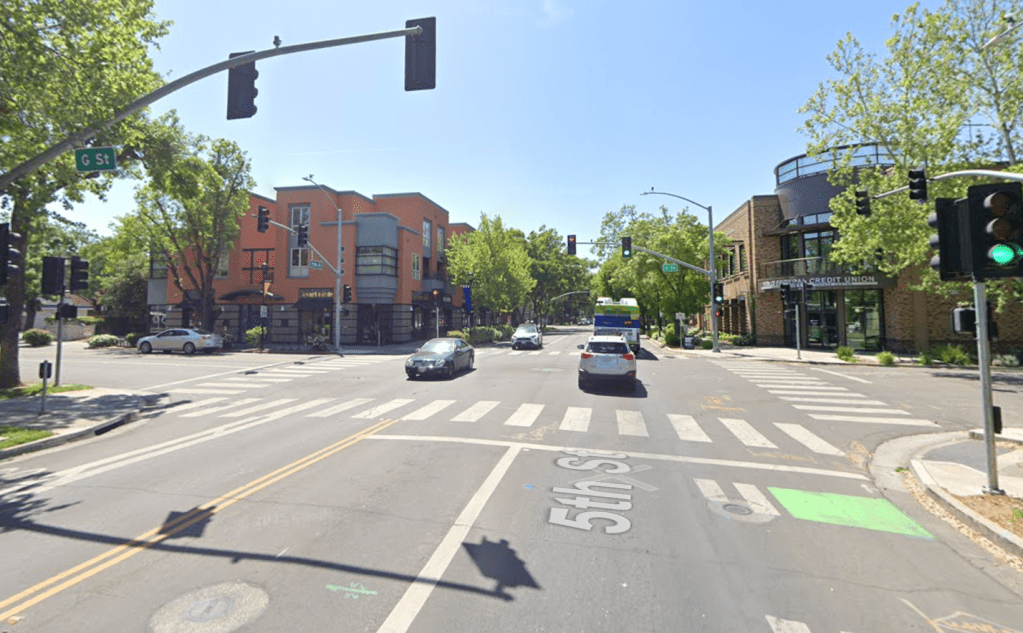
These are relatively human-scale intersections. They are not perfect, and the bike infrastructure could certainly be improved, but most people generally feel safe walking and biking through these areas.
Now, as most Davisites know, driving through either of these places is rarely “fast” during peak hours. Davis has intentionally refused many of the engineering practices used elsewhere to maximize vehicle throughput. We have even put Fifth Street on a “road diet,” removing a lane for cars to make room for bicycles.
Now compare that to a heavily engineered commercial corridor in Roseville near the Galleria and surrounding strip malls.
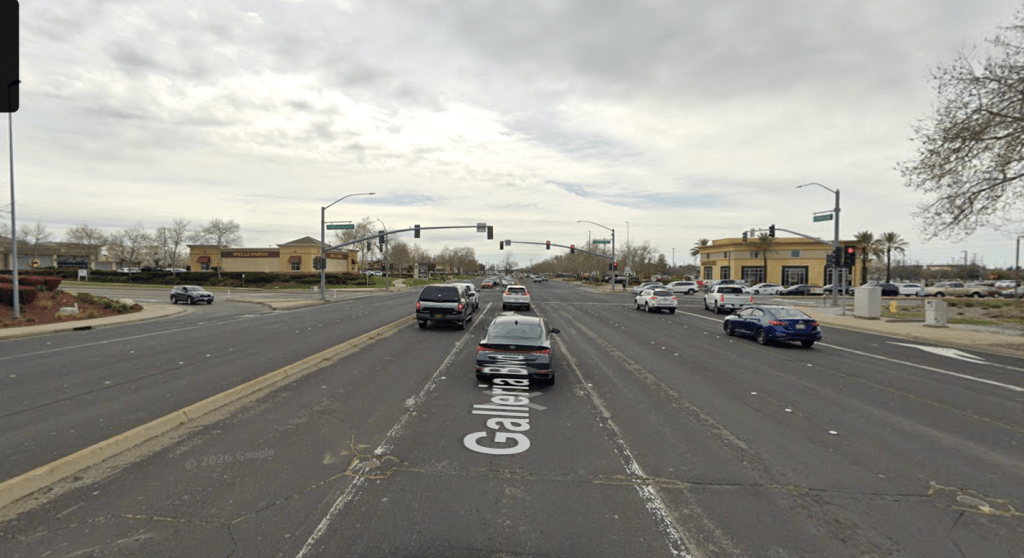
From a traffic engineering standpoint, this is, in fact, a very “efficient” intersection. Lots of vehicles moving through large commercial areas with minimal delay.
But this kind of environment is openly hostile to pedestrians and downright dangerous for cyclists.
(Notice the right-hand turning “slip lane” visible on the left side in the image. This is a common traffic engineering tool used to allow cars to turn right without slowing down. Davis has been removing many of these because drivers using them are typically looking left for oncoming traffic — not right for pedestrians entering the crosswalk and that fact alone makes collisions with bikes and pedestrians in the crosswalk 70%-80% more likely.)
Do we want “improved” intersections like this in Davis? No, we do not. This isn’t Davis, this is an automotive hellscape. – Yet this is exactly what developers mean when they promise “traffic improvements.”
The uncomfortable truth is that there is an unavoidable tension between designing streets that efficiently move cars and designing streets that are safe and pleasant for human beings.
As Lewis Mumford also said:
“The right to have access to every building in the city by private motorcar… is actually the right to destroy the city.”
We should not be cheering on the fact that the developer has to pay millions of dollars to do traffic improvements. On a holistic basis they are likely not be “improvements” at all. In fact, the current situation is something of a lose-lose scenario that hinges on how the intersection is engineered:
- If we attempt to reduce automotive wait times and maximize vehicle throughput, the intersection will almost inevitably become more dangerous and hostile to bikes and pedestrians.
- If we prioritize safety for pedestrians and cyclists, that generally means intentionally slowing down vehicle traffic, so wait times for drivers go UP.
We cannot simultaneously create streets that maximize vehicle speed and throughput while also creating streets that feel genuinely safe and pleasant for walking and biking. Those goals are fundamentally in tension.
Which also means that the question about growth in Davis is not “should we grow or not” but “HOW should we grow: What kind of city do we actually want?
If we “improve” Davis to move more cars faster, we destroy the walkability, bike culture, and human-scale character that made our city desirable in the first place. If we don’t…. expect more next-door posts with photos of cars backed up on our streets during rush hour.
Happily, however, there IS another path forward: We can reduce the number of trips that require a car in the first place by building smarter.
Urban planners have increasingly recognized this reality over the last several decades. One of the most important ideas is known as the Downs-Thomson paradox, which observes that traffic congestion in cities is ultimately governed not by roadway size, but by the quality of alternatives to driving.
In other words:
- If transit is slow, inconvenient, or nonexistent, people will drive no matter how many lanes we add.
- But if transit is fast, reliable, and integrated with housing, many trips stop requiring cars altogether.
This is why the world’s most successful urban environments increasingly focus not on maximizing automotive throughput, but on reducing automobile dependence.
Urbanist Jeff Speck summarizes the issue succinctly: “The best way to reduce traffic is to make driving optional.”
That is the conversation Davis should be having. Not whether growth will increase the number of people on our street — of course it will. The real question is what those streets need to look like and how our new residents use them.
If we build nothing but detached single family housing, we are in fact choosing 2+ automobiles on our streets every day for every household. That is an unavoidable fact. And then we have to choose between unsafe intersections or long wait times for cars.
Alternately, If we build multifamily housing along high-service transit routes, keep our streets relatively slow and provide protected lanes for bikes instead of optimizing for automotive throughput, then a large number of our residents will find biking or using the transit MORE convenient than driving.
That is the tradeoff that every well-planned city ends up making. It is almost universal. Is it time for Davis to make this choice as well?

 Davisite
Leave a comment