Davisite Banner. Left side the bicycle obelisk at 3rd and University. Right side the trellis at the entrance to the Arboretum.

Category: Bicycling

  • Why Traffic “Improvements” Destroy Cities

    By Tim Keller

    I would like to briefly weigh in on one of the elements of the debate currently being waged online regarding Measure V.

    Opponents complain that the new residents will clog our streets with “traffic” while supporters of the project point out that Village Farms will pay for “traffic improvements” that will mitigate or perhaps even improve traffic. 

    It is my distinct impression that both sides of that debate are missing the most important question: What exactly are “traffic improvements”?

    In practice, “traffic engineering” is usually shorthand for constructing LARGER intersections: adding pavement, turn lanes, traffic lights, slip lanes, and other infrastructure intended to move more cars through an area more efficiently.

    You can optimize signal timing to some degree, but beyond that, most “traffic improvements” simply mean making more room for automobiles.  This is not necessarily something we should be cheering for.

    As urban planner Lewis Mumford warned all the way back in 1955:

    “Adding lanes to deal with traffic congestion is like loosening your belt to cure obesity.”

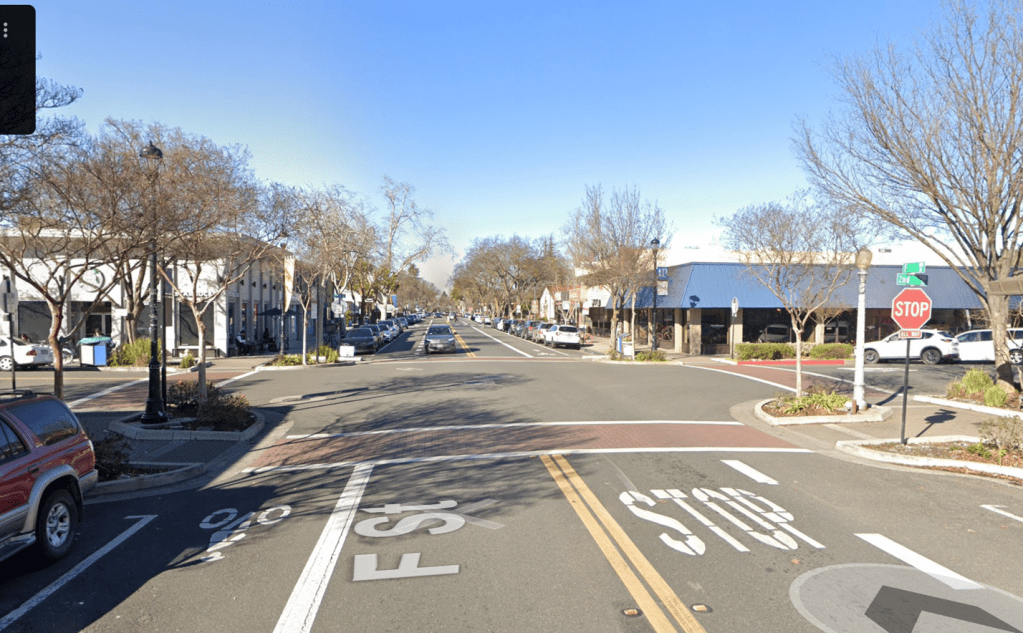
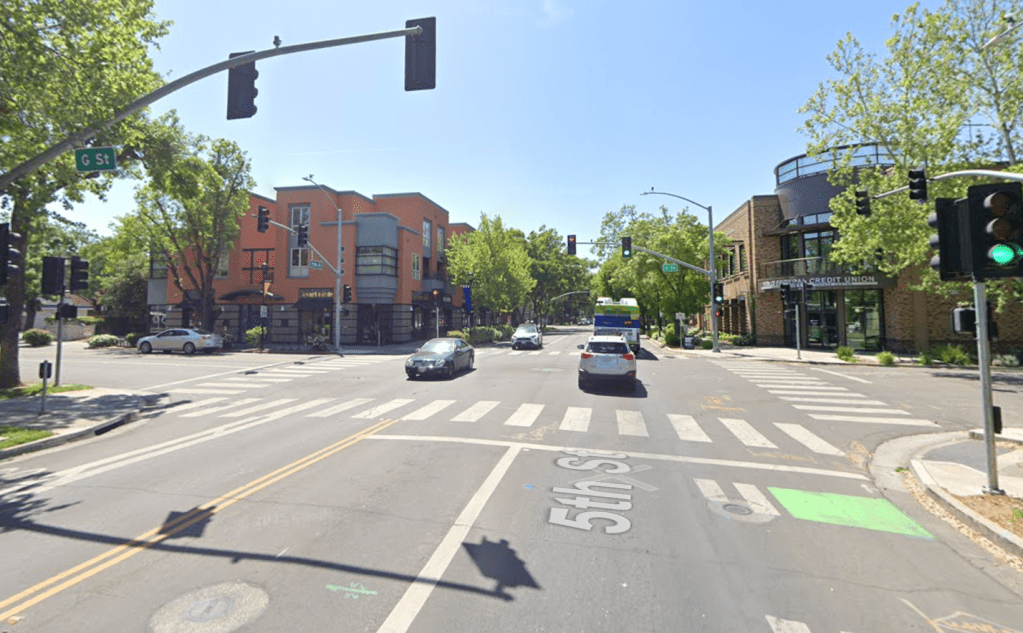
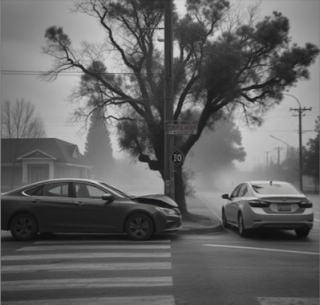
    Consider these two downtown intersections here in Davis:

    (more…)
  • Proposals for city budget fall far short of what is needed to address severe funding gap

    [The following email from Dan Carson was shared with the Davisite for posting]

    Dear City Council and Fiscal Commissioners:

    Attached please find a city staff report authored by the City Manager and the Finance Department — dated May 19, 2026 and titled “Fiscal Year 2026/27 Mid-Cycle Budget Update” — that was recently provided to you for public hearings this week. Given the brief timeline available for public consideration of this report by the Council and the Commission, I am sharing these comments with you in the interests of ensuring that you obtain critical information needed to assess the proposed actions and their potential effect on our city’s fiscal stability and integrity.  

    As you know, I served as a fiscal advisor to the California Legislature for 17 years, concluding my state career as Deputy Legislative Analyst of the nonpartisan and independent Legislative Analyst’s Office before serving for nine years on the City of Davis Finance and Budget Commission and then the City Council.  

    In summary, my analyses indicates that the first steps to address the city’s budget shortfalls being proposed by city management are reasonable but will fall far short of what is needed to address a severe funding gap caused primarily by dramatic and excessive increases in employee pay and benefits approved by the Council in a series of recent multi-year labor contracts. The budget package also does not provide the level of funding needed to fix our roads and bike paths and other infrastructure and discloses that it “defers” more capital improvement projects it does not identify. I recommend the Commission and the Council take a series of actions described below to address these issues.

    (more…)
  • UCD Sustainable Transportation Plan Open for Public Review Through May 4

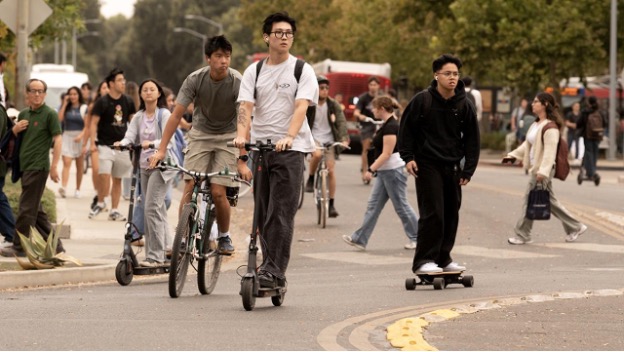
    Students navigate a mix of bikes, e-scooters, skateboards, and foot traffic on campus—illustrating the growing complexity of how people move through the Davis campus. (Courtesy photo / UC Davis)

    (From press release) UC Davis is inviting the broader Davis community to review and comment on a draft of its updated sustainable transportation plan through May 4.

    The plan—called Moving Forward Together—has been in development for over a year and outlines more than 100 possible improvements for how people get to and move through campus, from safer crossings and separated bike paths to better transit connections. It marks the first comprehensive update since 2009, with recommendations supported by input from more than 3,000 people, along with an analysis of travel patterns, infrastructure gaps, and collision data.

    Why this plan matters

    (more…)
  • A Lawsuit Waiting to Happen

    By Elaine Roberts Musser

    There was a pretty lively discussion that transpired on social media recently. Many citizens in this town don’t understand why Village Homes is getting a complete pavement makeover, while arterials are going to pot(holes).  Some suspicion was expressed that there may be political leverage involved in the decision making.  Neither do voters understand why their streets are so riddled with alligator cracks, fissures and pits, while the current City Council seems relatively unconcerned about maintaining basic city infrastructure. This is especially true when a recently approved sales tax hike was supposed to help solve the pavement problem. In fact, someone was concerned enough to reach out to both the City and the City Council for an explanation. The City finally responded.

    However, the reply seemed contradictory.  The City’s representative justified prioritizing repairing Village Homes inner streets over major arterials by saying: “Most of the streets in Village Homes are in failed condition”.  Yet later in their explanation the City made the following contrary statement: “Pavement preservation—proactive maintenance of roads in fair or good condition—helps extend pavement life and maximize the value of each dollar spent. This is why some streets may receive treatment even if they appear to be in better shape than others.” 

    The city can’t have it both ways, especially when it comes to fixing very small neighborhood streets in poor condition, at the expense of not repairing main thoroughfares in fair condition. First, considerably more citizens in this town use the thoroughfares than tiny side streets.  And secondly, those major arteries are fast deteriorating from fair condition, and are a good portion of the way to degrading to poor condition.

    As it turns out, a case was just handed down in May of this year from the California Supreme Court, which gives a harsh lesson to cities allowing their roads to unacceptably worsen. In a 7- 0 decision, the California Supreme Court ruled that the plaintiff could sue the City of Oakland for serious injuries sustained as a result of bicycling on crumbled or cracked pavement. It said the City was obligated to “maintain its streets in a reasonably safe condition for travel by the public”. In a statement announcing the $7 million settlement in favor of the plaintiff, the attorney representing the injured party indicated the court’s ruling sent a clear message to California cities that “safe streets are not optional”.

    (more…)
  • The General Plan won’t be a Genial Plan


    Screenshot 2025-07-30 8.22.55 PM"The goal is to manipulate

    Heavy hands to intimidate

    Snuff out the very idea of clarity

    Strangle your longing for truth and trust

    Choke wisdom sapience and prudence

    The war economy is inviolable violently

    Suppresses all intelligence that conflicts

    With the stakes of those who drive it."  - 

    From "Melodie is a Wound" by: Laetitia Sadier, Tim John Gane. Performed by Stereolab. Album: Instant Holograms On Metal Film. Released: 2025.  https://youtu.be/Nndpg90P2O8?

  • 5th & J Streets – Emergency Situation

    5th&J Image

    Open Letter to Davis City Council

    Davis City Council,

    Another collision at 5th & J Street today.  Car vs. Bike.

    Right after I called for Jersey barriers again at Council last night after the last collision. 

    This is an emergency situation.  Two collisions just this week, four in one week several weeks back.  Put up the goddamned Jersey barriers already, like today, like tomorrow.  Recognize that people are getting hurt at an alarming rate here.  I made a mistake being OK that the changes are coming after calling for Jersey barriers immediately after the four accidents a few weeks back. We can't wait.

    Here's how to do it:  put Jersey barriers on the left of each directional lane leading up to the intersection, and along the left-turn lane.  The left-turn lanes will face each other, so block the west to south lane, and allow east to north.  Put a 4' gap on each side for peds & bikes at crosswalks.  Do this also at I Street and K Street.  Similar site problems, and drivers will just cut over to I or K if J is blocked.  At I and K Street reverse which left turn lane is blocked, so cars can only go west to south.  This allows people to get into the neighborhood from 5th either direction, but prevents a 'face-off' between cars in the two left-turn lanes.  Then slap a vertical yellow reflector on the east and west ends of the Jersey barriers to prevent cars from hitting them.

    This has been going on for years, but the rate of collisions has increased greatly recently.  I live near the corner of 3rd & J Streets.  3rd is a bit less busy but still an arterial.  I can't recall ever seeing a collision there.  In over 35 years.  I'm sure it's happened, but it's rare.  So it isn't just bad drivers, it's the intersection.

    People keep asking why.  5th & J has inherent site problems.  These can't be fixed with shrub trimming – there are poles and trees in just the wrong places.  Going south to cross, you have to stop back of the stop line, then pull forward up to the bike lane, stop, and then pull across.  It's the only safe way to do it, but most people who don't use it regularly don't know this, nor is stopping twice a normal way to cross a street.  You get someone who pulls forward from the stop line with their site line blocked in just the wrong places, combined with a speeding car on 5th, and BOOM.  And it happens often.

    Do it!  Fix it!  Today!  Now!  No later than tomorrow!

    Alan C. Miller

    Old East Davis

  • NE Transportation Corridor – Tonight on City Council Agenda @8:40pm

    Open Letter to City Council on NE Transportation Corridor Item 7 (8:40pm, Tues 4/1)

    City Council,

    I may not be able to attend tonight so am making email comments here.

    I appreciate your taking up the NE Transportation Corridor.  As specified, the item as written would be part of the General Plan.  From the staff report, this involves more detail than the concept suggested by the Davis Citizens Planning Group (DCPG or close to that name).  

    I also came up with the almost identical idea of a transportation corridor north and east of Covell/Mace to run through the new suburbs, as a BRT or Bus Rapid Transit corridor parallel to a bike line.  As separate citizens came up with almost identical comments, perhaps the consultants should meet soon with the citizens for initial input, rather than or in addition to the consultants having citizens comment on the consultant's plans.

    Here are the basic features that I believe I and DCPG agree on:

    • There would be minimal stops as per BRT standards (1/4-1/2 mile spacing).
    • The corridor would not be for automobiles
    • There would be and adjacent and parallel bike track on the south/west of the corridor.
    • There would be minimal intersections, with only major arteries crossing the corridor to minimize conflicts.
    • The BRT would continue into Davis on regular roads, with some upgrades for the BRT infrastructure.
    • The Route:
      • The BRT would start at shopping center south of Hwy. 80 along Mace (Nugget) for a SE anchor.
      • The route would cut east on the north side of the tracks to access the corridor.
      • The dedicated corridor would continue in an arc north and west parallel to the curve of Mace and Covell.
      • At Wildhorse, the BRT could divert south to Covell, or use the 'cut-through lot' to access Moore and run to Moore & Pole Line.
      • From there the BRT could continue through Village Homes or south on Pole Line.
      • The BRT would serve Oakshade Shopping Center
      • The BRT would then continue Covell–>F Street–>Amtrak–>First Street–>South Campus (Library Silo)–>West Village
    • Each development could proceed on its own once the basic route is confirmed through the to-be-developed areas, as long as all developers agreed to link to the future through corridor once each segment is built.
    • The new route should minimize turns and instead follow a smooth arc.
    • IMPORTANT:  Building density for each development should be at its maximum nearest bus stops and along the corridor, and step to medium and to lowest densities (per project) as one gets further from the corridor.

    I believe the transportation corridor placement needs to be negotiated and agreed to with each landowner/developer far in advance of the General Plan Update.  This will allow the corridor to be whole and usable once all developments are in place.

    Alan C. Miller

  • California EBike Incentive’s Disaster Rollout

    When Climate Action meets Tech meets Social Justice

    By David Abramson

    Unnamed

    The California Air Resources Board alongside Pedal Ahead, a San Diego-based 501c3 whose stated goal is to ‘foster a transportation system that is both environmentally friendly and accessible to all’ just launched their first program to provide up to $2000 for 1500 low-income folks to purchase eBikes, called the California eBike Incentive Project.

    They announced the launch of the program to the public via what appeared to be a quite sizable multi-channel marketing campaign, with applications set to open on Wednesday, December 18 at 6PM. Fanfare and nervous, excited anticipation presumably ensued.

    As the local neighborhood techie, I supported a friend and their sibling in shooting their shot to be one of the lucky 1500. First off, my friend’s family comes from a disadvantaged background and economic status for whom this program was presumably intended, and truly needed the money in order to be able to buy an eBike so she and her sibling were quite excited about the prospect of getting support for this!

    I knew the odds were stacked against them once I saw how this program was going to go down, but we worked towards having the best chance possible to make it in.

    (more…)

  • Dangerous Bike Lanes: Automobile Normativity Breeds Neglect (Part 1 of 3)


    PXL_20240815_190057157.RAW-01.COVER

    East Covell, Westbound, between the Mace Curve and Alhambra. See Video. Reported on 8/1/2024. Based on my understanding of how My Davis Requests are processed, this has not even been evaluated at time of writing. 

    Davis, CA -  I've been riding a bike in cities for most of my adult life – that's forty years. As an example for others I don't often say that something feels safe; but when I feel a situation is dangerous it's a more valid perspective to share. 

    For the last six weeks or so I've had to travel two times a week from my home near Mace and Cowell to Sutter Davis. The fastest way there by car is via 80 and 113; by bicycle it's Mace to East and then West Covell.  I have an e-bike, and it takes about 23 minutes, a bit longer if I don't make the lights, and longer still if I have to slow or even stop to avoid hitting overgrowth of trees and bushes into the bike lane, and slower if I have to stop to let vehicles pass when the overgrowth extends all the way to the edge of the traffic lane. 

    "In some situations when the tree concern appears to be an immediate safety hazard [emphasis mine] the Street division will respond and put up barricades or traffic control to block off the area until tree work can be done. When the Urban Forestry division assesses the tree they determine the urgency of the concern and who the work will be assigned to. They also consider if the tree is the City’s responsibility to maintain. If a tree is blocking the public right of way per the clearance standards for that specific area they will assign pruning of the tree to meet clearance standards for the roadway, bike lane, sidewalk or path. Prune may be done but City Urban Forestry staff or by our contract arborist, currently West Coast Arborist. Work is completed based on the priority assessment conducted by one of the City’s Certified Arborist. If you have any additional questions please contact us …" – from a response to an earlier complaint. 

    How in this cornhole-tomato industrial apocalypse is the situation in the photo above  not an "immediate hazard"? As of time of writing,  along the westbound (WB) route between Mace and Sutter Davis, there are just over 30 bushes and trees which are "overgrowth" – the City's term – in the bike lane. Some require a diversion into the buffer (which is not a passing lane, and only part of this route has painted buffers), some require a diversion into the traffic lane,  some require ducking under possibly sharp branch ends (ironically, the by-product of earlier trimming….). 

    Along this route I first reported overgrowth on the NB Mace Blvd overpass on July 27.  It's still there, requiring a quick maneuver to avoid this punji stick, but – watch out! – not so far into the traffic lane! 

    What's curious is that "Closed" seems to only mean that the problem is solved in regards to potholes (and similar). "Closed" in relation to overgrowth on city property such as Covell indicates that the issue has been forwarded to the City's trees department, and with private property it means it went to the police for code enforcement.  I have mentioned this and suggested that "Closed" should only be used if the issue is resolved (or fixed, etc) or some kind of interim category should be created to show it's in process. While non-anonymous issue filers receive updates via email, it would be better if everything was more clear in the My Davis App. 

    So… a real question is what's a realistic timeframe for the City to respond to what is objectively an "immediate hazard"? BUT the better real question is:

    Would this be tolerated in [motor vehicle] traffic lanes for weeks at a time?

    What would people who drive motor vehicles do if their daily route required diversions, stopping, making sure a big truck wasn't going to ram into them, multiple times a week on the way to work or an errand?

    The answer is simple: The city would clear it immediately, or with a bit of delay during an exceptional weather event. They would clear the traffic lane or lanes. This is how it works here, and my personal experience for the last seven years I've lived here. 

    The roughly similar – but roughly more seasonal issue – is yard waste in bike lanes. It's explicitly completely illegal under city rules; "overgrowth" is not. Both are equally dangerous. 

    Reviewing City Hall minutes from ten years ago… many things regarding yard waste in bike lanes were promised. When I was on the BTSSC (RIP) – actually the night that Officer Natalie Corona (RIP) was killed  – the Commission supported my wording of a recommendation to City Council to improve things. (It's perhaps worth noting that the immediate sequence of events that resulted in a person with serious behavioral health issues killing Officer Corona started with a vehicle crash on 5th St – things like that with cars are seen as normal, and are forgotten). The Council watered it down and nothing improved, or changed (with the exception of a few signs in certain areas simply referring to the existing regulation.) 

    I have very little hope that the Council, Staff and relevant Commissions will do anything about it. Case in point: School starts today! Did DJUSD work with the City in the last weeks  to ensure that our City's safe routes to school (SRTS).. are safe? Beyond my ride to Sutter Davis I can say that they have not. There's lateral pot holes and overgrowth all over. 

    Measure Q?  It makes general promises about improvements, but why would Davis change now and target the needs of the most vulnerable road users? It's never been the priority: The City chronically builds infrastructure that's not compliant with the 2016 Street Standards  — while simultaneously referring to then as "progressive" when it is going forward on a street project. The BTSSC was never consulted about the ongoing 10-year pavement plan nor the overlapping Cool Pavements project. 

    The City's not making it feel safe for me to get around… my sense is that those who are younger or have less experience with bicycles simply don't consider the fastest routes if they feel unsafe on them. Do people who normally drive not take certain routes in town because they feel dangerous?

    *****

    In the following additional examples, there is also the before and after of a sewer grate on the Mace overpass damaged to the level where one could stand a bike up in it, and its "fix", a few months after being reported. Some fine craftsmanship, there!

    There's also a screenshot from the City's "What Do you Do?" video series of very light and uncritical portraits of city staff and their job duties. Why wasn't this slip up about "world" never corrected? 

    Additional photography and video from the Mace overpass on NB Mace to E. Covell just west of Pole Line.

    *****

    Parts 2 and 3 coming soon: 

    Part 2: What the City plans to do about yard waste and other materials in bike lanes – a ridiculous new tool. 

    Part 3: What the City should be doing (and why success of Measure Q might not help very much.)

    *****

    What can you do now? 

    * Write the Transportation Commission (copying to City Council, new Active Transportation Coordinator Sereena Rai and the City's tree department):  tc@cityofdavis org, citycouncilmembers@cityofdavis.org, srai@cityofdavis.org,citytrees@cityofdavis.org.

    * Ask the League of American Bicyclists if Davis deserves its "Platinum Bike Friendly" rating: bfa@bikeleague.org (there is not an application currently under review — this is just a cheeky way to get this corrosive garbage on their radar.)

    * Ask the Board of the Davis Joint Unified School District if the situation is safe for students, and if they got the City to check for obstructions – including potholes – on safe routes to schools in Davis before the first of day of class today: boe@djusd.net.

  • New Commissions are Opportunity for more public participation and Innovation

    By Alan Hirsch, Davis Lorax

    The controversial city council plan for commission consolidation and refocus is going into effect this summer. This is a rare opportunity for reform I hope is not missed. 

    Let us begin by restating the overarching goals council set forward in this reform: 

    Davis Council Resolution 24-079 May 2024

    Guiding Principle for New Commission Structure

    . City Commissions should act at all times with the understanding that guiding principles are at the core of their work.

    1. Promote and embrace diversity, equity, and inclusion
    2. Prioritize environmental and social justice
    3. Make space for community engagement
    4. Balance environmental and fiscal sustainability
    5. Strive for innovation and human progress

    The first meeting of the new Climate and Environmental Justice Commission on 7/22 Monday is precedent setting as it can begin to put implementation meat on the bone of these principles by:

    1. Better Prioritize Environmental  Justice than in the past  (principal B)
    2. Change meeting practices to allow more public participation. (principle A & C)  
    3. Speed surfacing of new ideas and follow through on their implementation.  (principle E

    As a first step in embracing council principles for this reorganization,  I suggest the  commission’s pass a resolution to  establish these ground rules for operation

    (more…)