Davisite Banner. Left side the bicycle obelisk at 3rd and University. Right side the trellis at the entrance to the Arboretum.

Category: Ethics

  • What Justice Looks Like in Davis

    We find out at the April 28th City Council Meeting

    By Scott Steward

    July 1, 2024, UCD Student Encampment – Popular University of Liberation of Palestine
    One sign reads: “As You Go to Class Today, remember that there are no Universities Left in Gaza

    City Staff released its version of the Muslim, Arab, and Palestinian and Allies (MAPA) recommendations this past Friday. (provided below)

    Discrimination against Muslim, Arab, and Palestinian bodies, families, and cultures has been an unfortunate project that has accelerated since the First World War. This bias is also evident in the colloquial, systemic, unequal, and dehumanizing treatment of our Muslim, Arab, and Palestinian residents and students in Davis.

    City email boxes are filling with canned opposition emails leading up to the April 28th special City meeting to hear Muslim, Arab, Palestinian, and Allies (MAPA) antidiscrimination recommendations, recommendations made by our own City Human Relations Commission (HRC).  The HRC recommendations were made after months of surveys, hearing testimony, and careful consideration. 

    (more…)
  • Eric Jones’s close ties to a Super PAC

    Jones criticizes Mike Thompson for taking PAC money, but is he being hypocritical?

    By Roberta Millstein

    Flyer in support of Eric Jones’s run for Congress, paid for by the New Leadership Now Super PAC

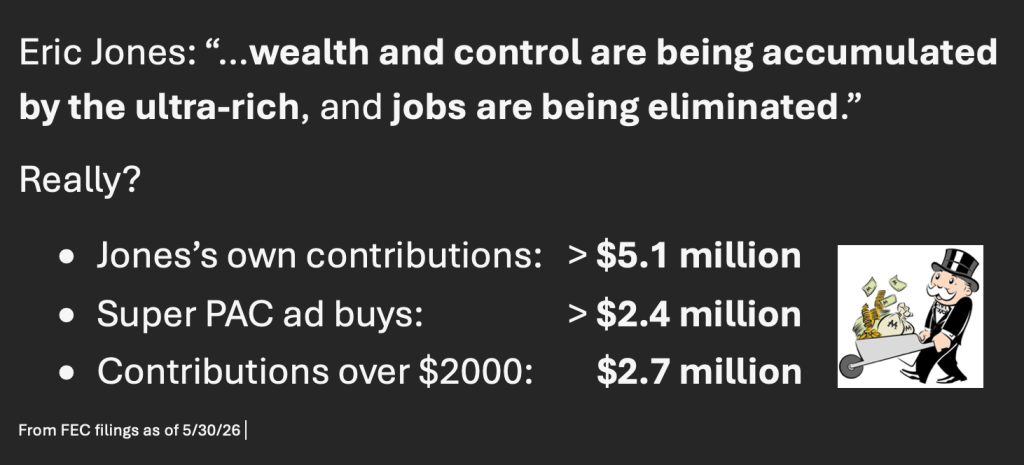
    Among the small deluge of flyers Davisites have received promoting Eric Jones’s candidacy for Congressional District 4, some may have noticed that one was different from the others: It indicated that it was paid for by a group called “New Leadership Now.”  Who is New Leadership Now, and what sort of connection does it have to Eric Jones, if any?  This article aims to shed a bit of light on these questions.  It is a follow-up to my earlier article discussing the direct campaign contributions from Jones’s former venture capitalist co-workers and other individuals from the high tech industry.

    New Leadership Now is registered with the Federal Election Commission (FEC) as a Super PAC.  What is a Super PAC?  Wikipedia has a helpful definition:

    Independent expenditure-only political action committees, commonly known as super PACs, are a type of political action committees (PACs) in the United States. Unlike traditional PACs, super PACs are legally allowed to fundraise unlimited amounts of money from individuals or organizations for the purpose of campaign advertising; however, they are not permitted to either coordinate with or contribute directly to candidate campaigns or political parties. However, in practice, restrictions on such coordination are considered flimsy and poorly enforced.[1]

    The unlimited expenditures coupled with not really knowing if the committees are actually coordinating with candidates make Super PACs controversial.  Eric Jones has touted his campaign as “Powered by People, Not Special Interests: Not a Dime from Corporate PACs”[2]  What I will describe below casts some serious doubt on that slogan, however.

    (more…)
  • What does “No on Measure V” really stand for?

    By Matt Williams

    For Davisite readers, the following is a response to an Alan Pryor post that made the following accusation, “Grass Roots” is not an accurate description of the opposition to Village Farms. How do you spell “NIMBY”? It is not spelled “Grass-roots”! (see https://nextdoor.com/p/9nSwSrmBTckW/c/1585068648?utm_source=share&utm_campaign=1776984857876&share_action_id=a32ff6cd-07c2-4764-a989-a686060c125a)
     
    Alan, is there a reason you are deploying the “If you can’t address the message, attack the messenger” tactic?  There are very few NIMBYs in No on Measure V.   That is very clear in the unifying principles of No on Measure V, which were just yesterday presented to DTA, the DJUSD teachers union, and are anything but NIMBY, specifically:

    (more…)
  • Give students stronger representation on the UC Board of Regents

    Support ACA 18

    By Raymond de Vente

    In a public university system that manages a $53.5 billion annual budget, oversees three national labs, and educates nearly 300,000 students, you would expect those students to have a real say in how things are run. Currently, they do not.

    That is why Californians should pay attention to ACA 18, a new Assembly Constitutional Amendment moving through the state legislature. Authored by Assemblymember Jessica Caloza (D-Los Angeles), this measure would finally fix a long-standing democratic deficit at the heart of the University of California.

    Here is the current reality: Under the California Constitution, the UC Board of Regents, the powerful body that governs the entire system, includes just one voting student representative. One vote for almost 300,000 minds. While the constitution currently authorizes the Board to appoint student members, it does not guarantee meaningful representation. After a year of serving as a non-voting “designate,” a single student finally gets a vote. For a system this massive, that is not representation; it is a token gesture.

    (more…)
  • Let’s Play Contamination Whack-a-Mole with Opponents of Village Farms Davis

    By Alan Pryor

    INTRODUCTION

    A recent article was published in the Davis Enterprise (3/22/26) entitled “Village Farms Contaminant Risks” which purportedly discussed the alleged “risks” of environmental harm due to concentrations of a class of chemicals found in the groundwater beneath the Old Davis Landfill. These chemicals, known as PFASs, are likely found in the groundwater as a result of seepage from the long-since closed Old Davis Landfill. This article was later reprinted in a slightly altered form in the Davisite and Davis Vanguard on March 29,

    Unfortunately, however, the authors of the article really only repeated information already known about the concentrations of this only remaining organic contaminant currently found in  the groundwater.

    Further, the authors completely failed to actually quantify any real environmental “risk”of any type that this reported contamination might actually cause. Instead, the authors essentially  just say,”It’s there and it’s really bad”! – albeit saying that in a very ponderous and sonorous but seemingly credible manner. 

    But the authors did not even attempt to quantify the real likelihood of any environmental risk in their article. Why?…Because the risk of contamination is so infinitesimally low that to properly quantify that risk and disclose that information to the public would completely undermine their attempts to scare and frighten the public. This is not a thoughtful, deliberate scientific report. This is yellow journalism pure and simple.

    Let me explain.

    (more…)
  • No on Measure V campaign at April 4th Farmers Market

    (From press release) The No on Measure V campaign will be at the Farmers Market tomorrow, Sat. April 4th, with literature and lawns signs and  volunteers to meet with Davis residents wanting more information. The campaign now  has a website, NoOnMeasureV.org posted with information about many reasons to vote NO on Village Farms on June 2nd.

    Village Farms is a proposal for a 1,800-housing unit project on 498 acres, at Covell Blvd. and Pole Line Rd. It is the largest project ever proposed in Davis, with the worst impacts and it would  impose costs on Davis residents.

    The project housing would be unaffordable particularly to local workers and families with young children. The vast majority of the project would be housing priced at $740,000 – $1.34 MILLION  per the BAE fiscal report which means a monthly housing payment of at least $6,000 to cover the mortgage, property taxes, insurance, CFD, and other fees.  Families with young kids cannot afford this so the project will not bring hundreds of kids as the School District believes, and therefore it will not help the schools as claimed.

    The developer is not responsible for building the affordable housing , except possibly 100 apartments in the last phase of the project 10+ years into the development.

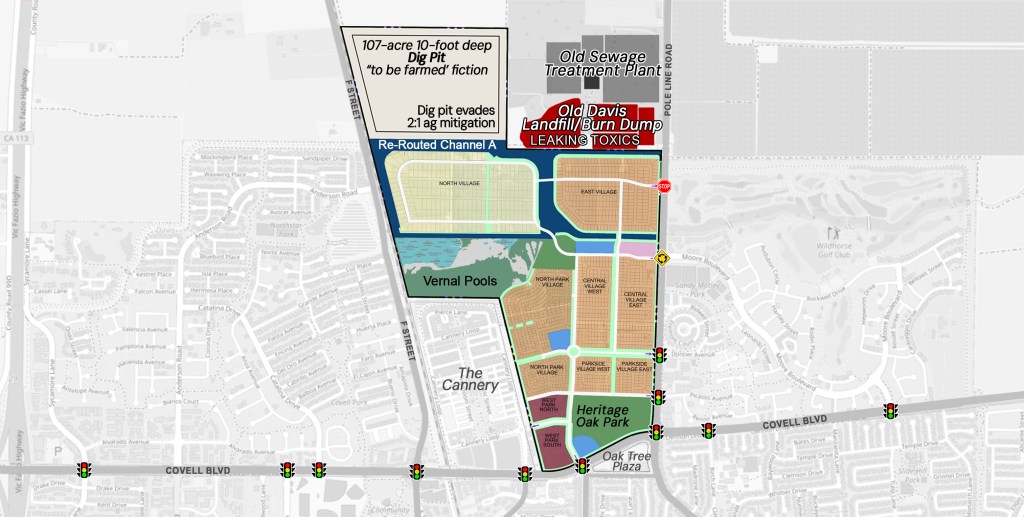
    Concerns also include toxics, including carcinogenic PFAS’ “forever chemicals” leaking from the adjacent Old Davis Landfill/Burn Dump and Sewage Treatment Plant into the project site. Vapor intrusion can result exposing future residents to these carcinogenic chemicals. The project also has high levels of could toxics including neurotoxic toxaphene and lead on the proposed Heritage Oak Park site where kids would play.

    (more…)
  • Village Farms Contaminant Risks

    [This Op-ed article was originally published in the Davis Enterprise on March 22nd in response to February 18th Davisite and Davis Vanguard articles in which Alan Pryor asserted that valid concerns related to contaminants associated with the proposed Village Farms Davis project, are “myths”.  This is a slightly modified version of that article.]

    This map from the Draft Environmental Impact Report, which was not included in the Davis Enterprise Op-ed article, shows Village Farms proposed drainage and housing adjacent the Old Davis Landfill/Burn Dump and Sewage Treatment Plant and monitoring well locations. The liner discussed in the Davis Enterprise op-ed article and the Partial Draft Response to EIR Comments does not appear in the Development Agreement or Baseline Project Features. 

    By Steven Deverel, Marjorie Longo, and Robert Okamoto

    There was a recent attempt to dismiss contaminant risks related to the proposed Village Farms project in north Davis. We herein summarize data and potential risks related to contamination from the adjacent Old Davis Landfill, Burn Area, and Wastewater Treatment Plant.

    First, it was posited that contamination from the landfill has dissipated, per and poly fluoralkaline substances (PFAS) are not a health issue and that Village Farms Davis will not be built on the landfill.

    Response

    (more…)
  • An exchange over misleading Village Farms promises about affordable housing

    Greenwald concedes Village Farms could result in little or no affordable housing being built

    By Roberta Millstein

    I want to let readers know about some followups to my two previous posts about the toothless promises concerning Affordable Housing and affordable-by-design housing in Village Farms, which we will vote on in June as Measure V. One is that I meshed the two articles into one, did some more editing, and submitted the new article to the Davis Enterprise, where it appears, here. Now the analysis of affordable housing in Village Farms, which rests in large part on understanding the difference between Baseline Features and Development Agreements — and which “promises” appear where — is all in one place.

    The second thing I want to highlight is a response of sorts to my DE article from the Davis Vanguard, here. What I find interesting about this response is that at each point David Greenwald actually agrees with what I say about the promises of affordable housing. Indeed, there really is no other interpretation — it’s in black and white that the affordable housing is so flexible that the project could end up with little or no affordable housing at all. And he agrees that our city councils have a history of giving in to developers. Quoting from Greenwald’s article (my emphasis added):

    (more…)
  • Village Farms…Is It The Right Time? 

    By Georgina Valencia

    There is no perfect project and there is no perfect time.  But, there are good projects that come at the right time.  Such a project is Village Farms.  There are a few reasons I will vote YES for Village Farms. 

    First, Village Farms is contiguous with the City and I would label this site infill.  It is surrounded by The Cannery, F Street, Covell Blvd and Poleline Road.  While this land is farmland and has been planted under tomatoes, wheat, corn over the years.  It is surrounded by our community on three sides and is ideal for development.

    Second, the property that Village Farms sits on is in the sphere of influence created in 2008.  What is the Sphere of Influence?  “The legislature created the mechanism a “’sphere of influence’ (SOI) as a means for planning of probable physical boundaries and service areas within a local agency…SOIs are designed to both proactively guide and respond to the need for the extension of infrastructure and delivery of municipal services to areas of emerging growth and development.”  Village Farms (formerly Covell Village) is largely within the City’s SOI.  This means we as a community, former Councils as well as City Staff, have thought for decades about the areas of future growth and this is one of them.

    (more…)
  • Davis Deprives Younger Adults of Longterm Housing: Population Demographics

    by Hiram Jackson

    Introduction

    Davis has followed a policy of restrictive growth since 2000 when Measure J passed, which allowed city voters to approve of new projects on the margins of the city.  Since then, Breton Woods, designed for older (55+ years) residents, and the Nishi project, designed for UC Davis students, both passed in 2018. 

    Apart from that, every other proposed project, which notably would have been available for younger adults less than age 54, has been rejected.  This quarter century drought on peripheral developments for younger adults has consequences in our current demographic makeup.

    City of Davis census data show a local declining young adult population

    From 2000 to 2020 U.S. Census data show that Davis grew from about 60,000 to 66,000, an annualized growth rate of about 0.5%.  Within that time the population of 20- to 29-year-olds, which includes mostly UC Davis students, grew by about 2500.  The population of Davis adults aged 50 and older grew by 8,000, reflecting good health and the desirability of our community.  Meanwhile, the number of young adults aged 30 to 49 has shrunk by 2,000 during the same period (See Census chart). 

    Figure 1 – City of Davis Population – 2000 v. 2020 U.S. Census

    This last age cohort, specifically, includes parents who are likely to enroll students in the local public schools.   Based on the 2020 U.S. census, the 30 to 49 age cohort is proportionally larger, statewide and nationally, than either the Baby Boomer or older Gen X population, demonstrating that the Davis decrease is anomalous in not accommodating this age cohort.

    (more…)