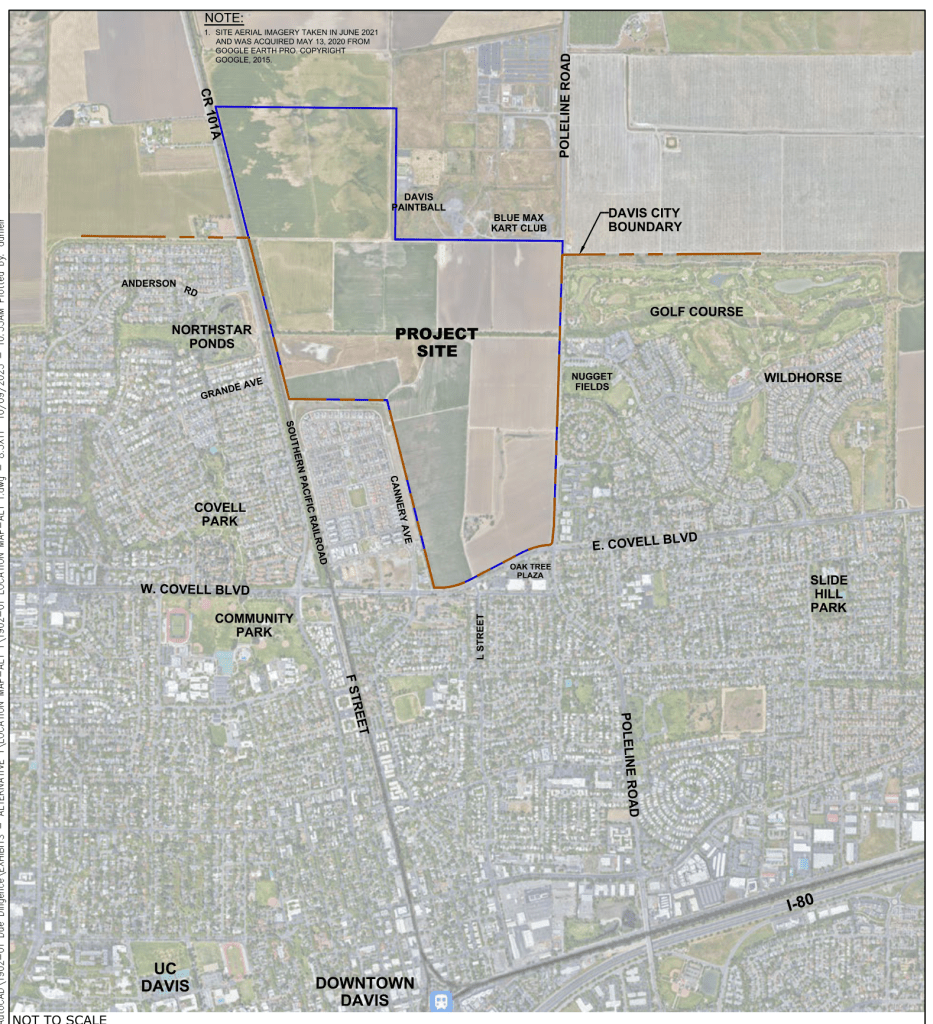
In an earlier article, I mentioned that there was a recirculated (and partial) Draft Environmental Impact Report (DEIR) for the Village Farms proposal, necessitated by “new information” related to the City’s overall Wastewater Treatment Plant (WWTP) capacity.” I also noted that the City was taking public comment on the recirculated (partial) DEIR, with comments due by 5 PM, January 2. As that day is very soon upon us, I thought I would share my own comments here.
Anyone thinking of submitting their own comments should note the following:
“Pursuant to CEQA Guidelines Section 15088.5(f)(2), the City of Davis directs that public comments must be restricted to the newly circulated information contained in this document related to wastewater treatment capacity. The City is not obligated to respond to any new comments that are directed to the portions of the Draft EIR that were not revised and are not being recirculated in this document.”
Comments must be directed to:
Dara Dungworth, Principal Planner City of Davis Department of Community Development 23 Russell Boulevard, Suite 2 Davis, CA 95616 ddungworth@cityofdavis.org
My public comments (submitted earlier today) are as follows:
Woodland Mosque and Islamic Center 613 East Street Woodland, CA 95776
More info to come!
Celebration of Abraham is a tax-exempt, nonprofit organization that aims to increase understanding and respect among all faiths in Yolo County based on the principles of religious pluralism.
Overcome and grateful for the rest, my activist colleagues, near and far, may you feel the blessing of solstice on these longest nights.
Many rest, taking the season to focus more on charity. The people’s work, to organize and break through the repression, is set to a simmer. Settle down – take the following “caring for the world” paragraphs one at a time, holding a warm mug. Rest and restore. Inspiration will call you to act soon enough.
Our Actions Abroad
Blankets and dollars for Gaza. Here is one of the most effective places to send aid to the children and families in occupied Palestine
Children in Gaza ride in the open bed of a truck with water and all their possessions.
Help Gaza survive this winter by donating to @projecthopepalestine. Part of the Taxpayers Against Genocide family of humanitarian efforts that go hand in hand with ending the illegal funding of genocide in Israel/Palestine.
I don’t care about housing and I don’t care whether Village Farms is built or not. Because I am a bad person. In your eyes.
What I do care about is transportation. And if more of you understood and cared about transportation, housing would not be the issue that it is and always will be. And you would be good people. In my eyes.
But what I really crave is a live soap opera unfolding before my eyes in City Chambers. A train wreck, if you will, to extend the transportation topic completely off the rails 🤦. And last Tuesday night in Council Chambers was the greatest episode in the long TV series “Davis City Council Meeting”, which is usually as exciting as the proverbial drying paint. Yes, this one may be runner up to 2010’s Greenwald vs. Asmundson for sheer dray-ma, but without a white-knighted local blogger galloping in to the lobby to ‘break it up’.
During Council discussions on Village Farms, three members of the development team came to the dais to ‘answer questions’. This progressively broke down into heated exchanges between the mayor and the development team. The core issue seemed to be whether ‘affordable’ housing units would be included in the baseline (Bapu’s alternative motion) for the developer to build, with a trigger, in order to ‘guarantee’ those be built, or whether to go with the new staff recommendation of the developer’s offer of more land and infrastructure. (If I got any of that wrong, people who care please clarify in comments)
I’ll highlight two statements, not because they are the best quotes to help readers understand the issue, but because they were the most dramatic and entertaining, the point of this article. The first is from Bapu in a back and forth with Doug Buzbee of the development team. This starts in the minute after 3:00:00 on the video:
“I’ll fight you every step of the way. Because that city code, what that city code says is build the units or . . . hold on, hold on, I’m gonna finish here . . . it says build the units. Or it says, give us in lieu fees and we set the in lieu fees — and by the way the level that we set the in lieu fees if they were multiplied by 280 they’re gonna come out to about $60 million which is the financing gap that we have. Or it says in language, and I pulled it up so I can read it, it says: “accommodate the land dedication requirement for the project in its entirety. The land dedicated would be of sufficient size to make the development of the required affordable units economically feasible”.
Now, do you think that City Council intended to provide an option that said either build the units, provide enough money in in-lieu fees or give us about 5% of the project value in land. Do you think that’s what City Council intended? Because I don’t. And if you want to come back with that offer, if that’s your interpretation, then I’ll fight you every step of the way.”
The second, rather jaw-dropping statement is from Sandy Whitcombe of the development team and can be found at 3:13:00 (and is the basis for the top-most political cartoon):
“I want to be clear that 16 acres of land is worth tens of millions of dollars once we’ve put all of the infrastructure in. That’s incredibly costly. This extra four acres and the six million is maybe a $30 million contribution. Just want that to be very clear.
Nobody has ever in this town done anything close. Nothing even close! And nobody will. You’ll see that very soon. Nobody will. We are talking so for over what anyone has done. And so, it is incredibly disappointing to have ‘people’ come back and ask for more more more !
Bapu! We talked. I wanted to make you happy. I had something that we discussed, and you know what it is, and that’s our line in the sand. We are not willing to go into the baseline features because we are already donating so much to get these 360 units done, that we are not willing to confuse voters and say: ‘oh, we’re going to do a hundred’. That makes no sense, and we are not willing to kill our election because of your fancy.
Basically we are willing to work in the development agreement and put in a provision that I worked on. There cannot be timing: ‘Oh in ten years if we don’t have it done we have to build it’. You’ll have another family of homeless people and that will be me — if you do that — my family. We have no ability to come up with $50 million dollars. I’m sorry.
So you can’t put timing in. You’ll have to — we, I told you what we would do, and that is our line in the sand. We’ve already said we will accept your dissent. And we will. We will accept your dissent. If we can get three of you, that’s fine. If we can’t, that’s fine.
You have to understand, this is an incredibly generous offer to the city. And I don’t think many other developers are going to come back with something like this. I really don’t. So that’s it. If you want to do the motion to include a conversation about the development agreement, we’re all in.”
Bapu’s alternate motion then failed 1-4, and the motion to pass the staff proposal then pased 4-1, with Bapu the “1” in both. I talked to two people I respect after the meeting — one said Bapu was ‘right’, one said the development team were ‘right’. So . . .
For context and to make up your own mind, set aside a few hours and watch the whole dang thang. It’s better than a terrible movie!
***Note: Pardon that the A.I. chose a white-male-appearing person with a suit and tie as mayor in the illustrations. I simply described the situation and used the first illustration it gave me. I did not try to describe character features, lest that get me in more trouble . . . . or lest we end up with an A.I. Bapu like what the Vanguard came up with several weeks ago 😳.
[The following message was shared with the Davisite for posting]
December 16, 2025
TO Mayor and City Council and Planning Commission
FR David J Thompson
RE Please Do Not Certify the Village Farms Application nor the Project Individualized Plan (PIP)
With so many unanswered questions still on the table and even newer projections which are still not sufficiently clarified I do not feel that the Village Farms proposal and its PIP are factual enough to deserve certification or approval at this time.
The newly released city staff report for Village Homes still includes a fourth fire station. It also adds a public safety center for police and EMS for good measure. It is estimated the fourth fire station alone would cost the city $3.5 million per year. God only knows how many more millions of dollars the addition of police and EMS at that spot would set the city back!
Where in the heck does city staff think the money for all this is going to come from? Last I looked there was no money tree in the back of City Hall. Nor do taxpayers have unlimited pockets. Many citizens are struggling just to make ends meet, as Mayor Vaitla has noted often enough, especially in light of what is going on at the federal and state level.
Additionally, City staff is trying to claim the city’s General Plan requires a fourth fire station, which is a patently false assertion. The general plan called for an analysis of fire facility needs, not construction of a 4th fire station.
The next fairy tale spun by city staff is that the Fire Department or the City Council itself already made the decision to build a 4th fire station. Where does staff get this tarradiddle from? First, the October 30, 2018 City Council minutes prove otherwise – the City Council just flat out didn’t make such a commitment. Second, the Fire Department has no authority to approve such an undertaking.
If the City Council wants this development project to pass a measure J/R/D vote, then any mention of a public safety center and 4th fire station should be completely removed. Any lame attempt to supposedly set aside a parcel for “public safety”, to disguise the real intent to build a fourth fire station, will not fool anyone.
You mentioned your need to curtail your exposure to politics and reading news as it often becomes too much.
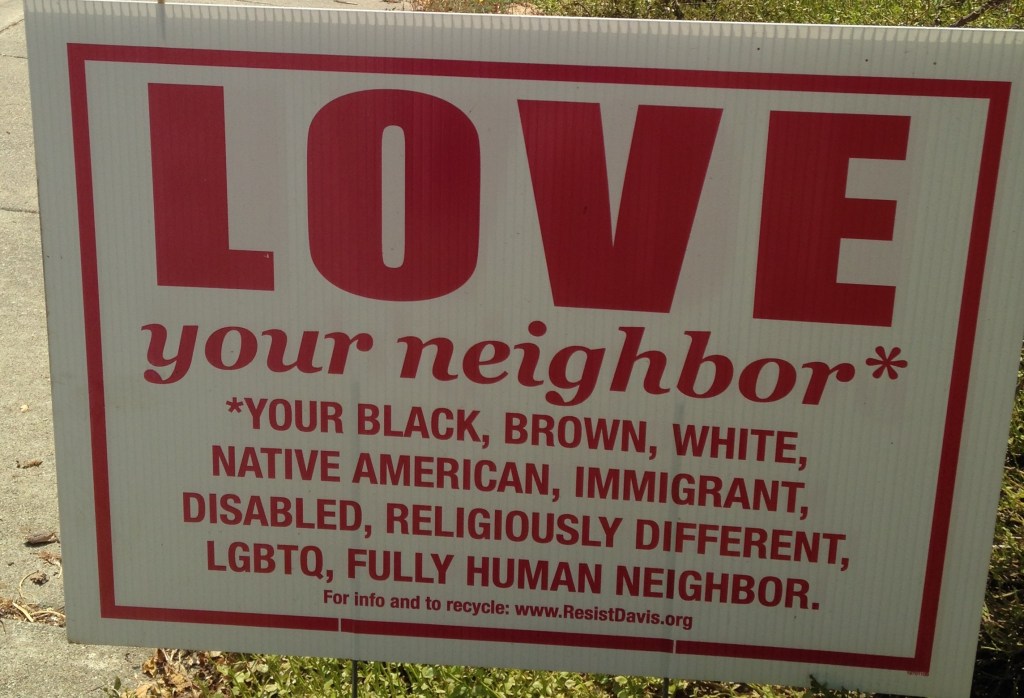
I offer you an opportunity to recharge. Come down to the Saturday Davis Farmers Market between 8 and 1 and table with me as I pass out free “Love Your Neighbor” lawn signs.
As strangers walk by my booth I call out “Free lawn signs!” And “Make your neighborhood a friendlier place!” Like a carnival barker. Rudely, Intruding into their conversations, texting, or thoughts of their shopping lists.
In response I get not ignored, but smiles, hundreds of smiles. And people responding, “glad you’re here!” And “Thanks— I’ve got a sign.” “I wish I had a lawn- I live in an apartment” or “You inspire me.” Half the people respond somehow. And I get hugs from total strangers every Saturday.
About once a Saturday, someone, usually from Davis who has seen me before, will spontaneously offer a donation so someone else can have a sign, often as they live in an apartment or have a landlord that forbids signs. (Hey city council- this is social equity: why does Davis allow HOA or landlords to forbid signs, even in windows. It makes places impersonal, an abridgement of speech for renters.)
Today: an older homeless man pushing shopping cart came by. The cart was filled with empty soda cans and liquor bottles he was collecting presumably to recycle for cash. He stopped across from me in the market, slowly read my signs, and then came over to give me $1.17 in change as a donation.
I frequently have heartfelt conversations with strangers who reflect they struggling to maintain their equanimity in face of The Darkness. People from out-of-town express regret that the 18×24 lawn signs won’t fit in a suitcase. Thought my signs don’t flag they are political everyone “get it” that these values a refutation of Trumpism.
Today a visiting UCD alumna now living in “deep red” Iowa suggested I was needed there to table. Someone from rural Nevada told me about her neighbors…first demurring on a “Love Your neighbor” sign afraid it would upset them …then came back and took one.
These Saturday mornings’ experiences are like no other I have had in my entire life giving out my Love lawn signs. “Love is one thing you get more of when you give it away.”
Heads up for Davis City Council “workshop“ on Village Farms, Tues, Dec 16, approx 7:20 PM. This is an opportunity for you to let the city know your views on the project.
Item 6: Staff recommends the City Council conduct a public workshop on the Village Farms Davis project (VF) applications, as follows: a. Receive Staff presentations on the proposed project; b. Receive Applicant presentations on the proposed project; c. Take public comment; and d. Consider the following project applications and documents and provide feedback:
i. Pre-General Plan Amendment, including provisions for Baseline Project Features as required by Chapter 41 of the Davis Municipal Code; and ii. Pre-Zoning and Preliminary Planned Development; and iii. Development Agreement.
IN PERSON PUBLIC COMMENTS: Speakers will be asked to line up at the podium and state their name for the record. Comments are limited to no more than 2 minutes per speaker.
WRITTEN AND VOICEMAIL PUBLIC COMMENTS:
Submit written public comments to CityCouncilMembers@cityofdavis.org. Emails are distributed to City Council and staff. To ensure the City Council has the opportunity to review information prior to the meeting, send emails by 3:00 p.m. on the meeting date.
Submit comments by voicemail prior to the meeting: Call the city’s dedicated phone line 530-757-5693 to leave a voicemail message for public comment. Staff will play comments during the appropriate agenda item. Comments will be accepted from 12:00 noon until 4:00 p.m. on the day of the meeting. Voicemail public comments will not be accepted after 4:00 p.m. Speakers will be limited to no more than two minutes.
Note: You must leave a separate voicemail for each item you wish to comment on. Please indicate your name and which item you are speaking about.
A portion of the Village Farms DEIR (contained in the Utilities and Services chapter) is being recirculated because the City, as the “lead agency” in the EIR process, has received a last-minute report from Brown and Caldwell dated November 7. This report indicates that the City’s existing Wastewater Treatment Plant (“WWTP”) is perilously close to exceeding its maximum flow capacity and needs to be upgraded to meet the City’s wastewater treatment permit issued by the Regional Water Quality Control Board. This information was not known by the City when they prepared and circulated the current Village Farms DEIR for comment.
However, since the new information impacts the analysis of the Village Farms project’s impact on the City’s WWTP, the City determined that the portion of the Village Farms DEIR addressing Utilities and Services needs to be recirculated with the updated information for public comment prior to consideration of the revised FEIR for certification by the City.
Unfortunately, the City has done a poor job explaining this need to the public when they recirculated the portion of the DEIR needing additional comment. Two questions immediately come to mind that should have been answered by the City in more detail and explained better when the DEIR was recirculated.
1) What Information Came to Light that Necessitated the Recirculation of the Portion of the Village Farms Davis DEIR?, and
2) Is this Process Proper and Legally Compliant with CEQA and State Regulations Regarding Public Noticing and Subsequent Consideration by the Planning Commission and the City Council?
The following discussion addresses these questions.







 Davisite