Davisite Banner. Left side the bicycle obelisk at 3rd and University. Right side the trellis at the entrance to the Arboretum.

What does “No on Measure V” really stand for?

By Matt Williams

For Davisite readers, the following is a response to an Alan Pryor post that made the following accusation, “Grass Roots” is not an accurate description of the opposition to Village Farms. How do you spell “NIMBY”? It is not spelled “Grass-roots”! (see https://nextdoor.com/p/9nSwSrmBTckW/c/1585068648?utm_source=share&utm_campaign=1776984857876&share_action_id=a32ff6cd-07c2-4764-a989-a686060c125a)
 
Alan, is there a reason you are deploying the “If you can’t address the message, attack the messenger” tactic?  There are very few NIMBYs in No on Measure V.   That is very clear in the unifying principles of No on Measure V, which were just yesterday presented to DTA, the DJUSD teachers union, and are anything but NIMBY, specifically:

  1. Davis needs housing, but the kind of housing our community needs is missing from the Village Farms project.
  2. Davis has a substantial shortage of workforce housing designed and built to be affordable for members of the Davis workforce of modest financial means and modest annual salary and benefits … workers like DTA members, whose starting salary at DJUSD ranges from $49,930 to $61,570 per year (see https://www.teacher.org/school-district/davis-joint-unified-school-district/)
  3. Davis has systematically excluded the members of the local workforce from ownership and owner occupancy by only building expensive homes … building no market-priced single-family homes small enough to be affordably priced. In our opinion, the exclusion borders on discrimination.
  4. Davis has a surplus of housing only affordable by wealthy folks who are more often than not empty nesters, without children who will be going to DJUSD schools.
  5. Annual Housing Costs in Davis are very high. According to HUD, annual housing costs should be no more than 30% of total annual household income. In Village Farms a $740,000 home with a 20% cash down payment and a 6.0% mortgage has a total of over $6,000 of housing costs per month … over $75,000 per year … requiring an annual household income greater than $250,000. Ask your members how many of them have a household anywhere close to $250,000.
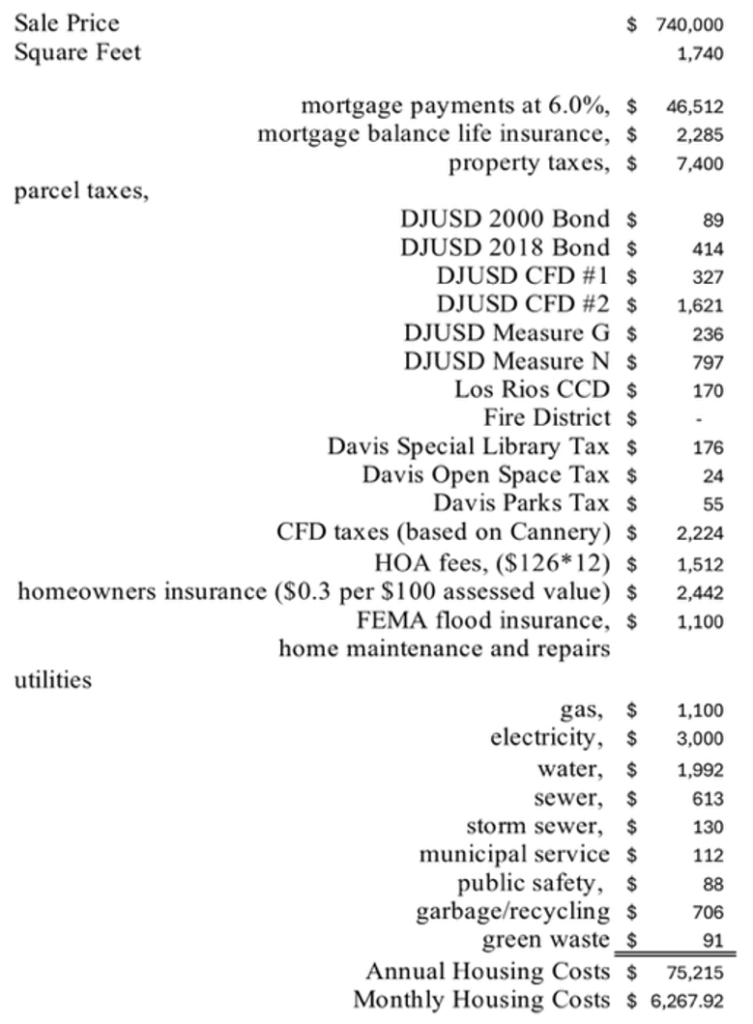

In conclusion:

  1. Our group opposes Village Farms because it is too big, has too many impacts and costs.  It would have unaffordable housing, and has a seriously inadequate affordable housing plan which can very likely result with no affordable housing.
  2. We are not anti-housing. We support a smaller “Reduced-Footprint” alternative below Channel A that avoids the vast majority of the floodplain and toxics problems. This plan also avoids City liability exposure into the future due to the toxics exposure and flooding potential.
  3. In addition to the Social Justice issues described above, it is important to clearly say that Village Farms is a poorly conceived project that should be rejected at this time, and go back to the drawing board for a reduced footprint with housing that is affordable. We will address those “bad project, bad planning, bad process” issues in your Question 5.
  4. It is the largest residential project ever proposed in Davis: 1,800 units on about 498 acres at Covell Blvd. and Pole Line Rd. with the most impacts and costs.
  5. Our concerns are the same core concerns Davis voters had with Covell Village (voted down 60/40 in 2005) – massive traffic, floodplain risks, toxics, unsafe access, habitat impacts, costs, and unaffordable housing.

Davisite logo

Did you enjoy reading this article? Then subscribe to the Davisite for free and never miss a post again.

Comments

13 responses to “What does “No on Measure V” really stand for?”

  1. Jay

    “In Village Farms a $740,000 home with a 20% cash down payment and a 6.0% mortgage has a total of over $6,000 of housing costs per month … over $75,000 per year … requiring an annual household income greater than $250,000. Ask your members how many of them have a household anywhere close to $250,000.”

    And how many have enough saved up for the $148,000 down payment needed on this $740,000 home to keep their monthly payments at $6000? Less down payment = higher monthly payments including PMI when borrowing over 80% of sale amount.

  2. Ryan

    We have lots of small houses in Davis already – and they are extremely expensive because housing is in short supply all around. Building more housing (increasing supply) seems the only realistic way to reduce the cost. The other way would be to make Davis undesirable (reducing demand)… but nobody wants that.

    We can build infill housing and we can build new housing on ag land. The Village Farms is a little of both, it certainly is building on ag land, but it is somewhat infill as well because of the other developments already built.

    New buildings are always expensive, and asking developers to build small square footage housing won’t really reduce the costs per house by much. So let them build whatever kind they think will sell. If we can increase the supply, then some high income buyers will buy into the new homes which could reduce the price of our smaller old stock homes.

    To increase supply we could also make it really easy for developers to increase density anywhere they want to. We could try to reduce the barriers to building more housing within the current city limits. Let developers subdivide lots, eliminate lot coverage rules, setbacks etc… This along with new growth might be able to lower the barrier of entry for new families in the income brackets you seem to desire (I do too).

    1. Ryan, the whole thrust of the No On Measure V campaign is that building large homes with expensive price tags does nothing to bring down the price of existing homes.

      The only way to add lower priced homes to our community is to build smaller homes. In 2025 the average square feet of the many expensive homes that sold was over 2,700. On the other hand the average square feet of the very few inexpensive homes that sold was under 1,200.

      I agree with you wholeheartedly that the City government needs to make it easy, dare I say reward, developers who choose to reduce lot sizes to increase density and build smaller more affordable homes. Unfortunately, our current City of Davis rules actually PENALIZE developers for splitting lots. Specifically, when a large lot is cut into two small lots the entitlement costs fore one-time taxes and fees goes up from $60,000 to $120,000. Developers have no choice other than to pass that extra $60,000 on in the sale price of the home.

      If our City Council truly does want to address housing affordability they need to “walk the walk” not just “talk the talk.”

      1. Ryan

        > building large homes with expensive price tags does nothing to bring down the price of existing homes.

        This doesn’t make sense to me. Say a prospective buyer has a budget of 750K. They can either buy a new home with the total 750K, or they could buy an older home for 600K and remodel / update with the remainder. This scenario seems very common for home buyers in Davis. If the buyer opts for the newly built home that means they aren’t competing for the older stock of homes, lowering demand and potentially reducing the sale price for these older homes.

        For many buyers the 500-600k range of homes are not adequate, they often have 1 bathroom and an outdated kitchen. That doesn’t mean they aren’t just fine for someone else! Older and smaller homes are one source of lower income housing. But, they are increasingly bought by high income earners and remodeled into the 750K+ homes (emphasis on the +).

        totally agree on the infill issues… and infill is were I would prefer new housing but I think we need all the new housing we can get.

      2. Ryan, yours is a very good question/statement. Here is how I believe it works in our local real estate market. One of the contributing factors is that for all intense and purposes the Davis real estate market and the Woodland real estate market are really two parts of one single market. So, when a buyer is looking for either your $750,000 home or the $600,000 home alternative that you described, they are almost surely looking at the $600,000 homes in both Woodland and Davis.

        In 2025 for homes that sold for $600,000 and below, Davis had 61 sales and Woodland had 240 sales. So, you hypothetical fixer-upper buyer was four times as likely to find a home that fit the profile in Woodland than in Davis.

        Further, the average size of the 61 Davis homes was 1,193 square feet as opposed to 1,466 square feet for the 240 Woodland homes. So, for the same money your hypothetical fixer-upper gets 22% more home for the same price.

        Another factor is the real estate industry’s standard practice for setting the listing price of resale homes. What both real estate agents and real estate appraisers to set a home’s price/value is look at local “comparables” with particular emphasis on dollars per square foot. Because of the cost of new construction (approximately $500 per square foot in Davis) new homes add higher priced “comparables” than existing homes do. What that causes the agents to do is set the price of their listings at a per square foot level at, or just below, the $500 per square foot that the new homes sold for, which is considerably higher than the cost per square foot that it cost to build the existing homes. It is a “whatever the market will bear” approach … and it increases the earnings of the real estate agents because they are paid a percentage of the purchase price.

        Let me know if you have follow-up questions.

        Thanks for engaging!

  3. It is incredibly disappointing to see Alan Pryor call people names. How low he has sunk.

  4. Alan Pryor

    I had quite a laugh reading the supposed “Unifying Principles” of the No on V Campaign. Some of these purported “Principles” are really no more than meaningless platitudes.

    For instance, the very first “Principle” states, “Davis needs housing, but the kind of housing our community needs is missing from the Village Farms project”. Well, I guess that phrase is great for a motto – so I suppose it is unifying. But it’s a mindless soundbite; sort of like “Make America Great Again”. The phrase is nonsensical because it does not even say what “type” of housing the No campaign feels in needed in Davis. Nor does it indicate why the proposed “type” of housing proposed at Village Farms is not what is needed. Like I said, the “Principle” is meaningless.

    But some of the other “Principles” go beyond just mindless pablum. Some of the “Principles” are outright deceitful and/or misleading. For instance, in another one of the “Principles” it is stated, “In Village Farms a $740,000 home with a 20% cash down payment and a 6.0% mortgage has a total of over $6,000 of housing costs per month”; clearly implying that an average home at Village Farms Davis might cost $740,000 As explained later, however, this is clearly misrepresenting the facts. Even worse, in their ballot statements, the No Campaign also states that, “The minimum cost of a new home at Village Farms will be $740,000. Only very well-to-do purchasers will be able to afford to live there!”

    But this is a complete and total fabrication by the No campaign. Mark Twain once famously said, “There are lies, damned lies, and statistics” when describing how false information is often spread buttressed by the incorrect use of “statistics”. The No campaign has clearly used “statistics” to promote an untrue statement about housing prices at Village farms

    The erroneous estimate of the “minimum” price of a home was improperly excerpted by opponents of Village Farms from an economic analysis of the property taxes that might be generated by the project. The analysis was done for the City by BAE Associates. That study’s purpose was, in part, to estimate future property taxes paid by future residents of Village Farms Davis. However, the study projected the $750,000 lower end of Village Farms sales price NOT by talking to the Developer to inquire what size of homes they intend to build and possible price points for them. Instead, the study just assumed an “average” size home on “medium density lots” would be 1,741 sq ft selling for an “average” of $425 /sq ft – or an “average” sales price of $740,000. But that data was based ONLY on historical market data on recent home sales prices in Davis and NOT on the actual intended and projected sales price. In other words, the fictitious minimum $740,000 sales price stated by the No campaign in their ballot statement and “Principles” had nothing to do with what types and prices were actually anticipated at Village Farms.

    “Assessed Valuation
    The assumed starting valuation for the residential units is split among medium density,
    low density and market rate apartments. The estimated market rate for medium density
    units is $425 per square foot (or $740,000), with low density set at $480 per square foot
    ($1,340,000). Apartments are set at $400,000 per unit. These assumptions are
    generated from current market data and staff believes are reasonable.” (see Staff Report 06A-Village-Farms-BAE Fiscal-Impact Memo_4-2-25.pdf)

    Project opponents were made fully aware that this analysis had nothing to do with what size homes and pricing were actually proposed for the project, But the naysayers continued to use and peddle this false information anyway.

    In fact, as recently approved by the City Council, there are 1,017 lots in the project that will be less than 5,000 sq ft on which hundreds of townhouses and smaller homes/duplexes will be constructed. These smaller lots are specifically designed for first-time home buyers. Of these smaller lots, at least 10% will be for attached townhouses expected to be between 800 and 1,000 sq ft. The remaining lots can either be half-plexes or stand-alone single family units and are expected to range from 1,000 – 1,400 sq ft each.

    The actual per square foot sales price of these townhouses and smaller half-plex/single family homes will be highly dependent on then current construction costs. But even assuming a $500 per sq ft sales prices for the homes at Village Farms Davis, the 800 – 1,000 sq ft townhouses would cost starting in the $400,000s and the 1,000 – 1,400 sq ft half-plex/single family homes would range in price from $500,000 to $700,000. These prices are thus far less than the fictitious “minimum” price of $740,000 otherwise erroneously touted by project opponents. Indeed, the most expensive of these 1,000+ starter homes homes in Village Farms Davis should be less expensive than the supposed “minimum” starting price of $740,000 as otherwise reported by the No campaign

    Matt Williams is intimately familiar with the errors often made in work done by BAE Associates for the City of Davis because of his tenure on the City’s Finance Commission. Indeed, he often complained about the accuracy and veracity of their work. For Mr. Williams to now embrace this objectively false misrepresentation of the No campaign is telling.

    1. I’m not part of the No campaign, but what is disappointing to me is the fact that the developer isn’t actually committed to building the discussed affordable by design housing, as I discussed in my previous Davisite article. https://davisite.org/2026/03/12/the-ballot-arguments-in-favor-of-village-farms-are-extremely-misleading-about-affordable-by-design-housing/

      So to me, all this discussion of probably-won’t-get-built housing is a bit moot.

    2. Alan Pryor said, “Project opponents were made fully aware that this analysis had nothing to do with what size homes and pricing were actually proposed for the project, But the naysayers continued to use and peddle this false information anyway.

      In fact, as recently approved by the City Council, there are 1,017 lots in the project that will be less than 5,000 sq ft on which hundreds of townhouses and smaller homes/duplexes will be constructed.

      Alan’s assertions above are (barely) half truths. First, he is accurate that he has stated that the $740,000 financial analysis number was an estimate by BAE, but Alan fails to point out that BAE used estimates because the project and the City were unable to provide any details for BAE to use. That is the epitome of “Not Ready for Prime Time.”

      But it gets worse, Alan’s 1,017 lots assertion is smoke and mirrors. In the Development Agreement (on page 49) the “under 5,000 square feet” listing of the 1,017 lots doesn’t even meet the RHNA definition of Residential Medium Density. In addition, neither the word “townhouse” nor the word “duplex” appear anywhere in the Development Agreement. There isn’t anything said about smaller homes, only smaller lots.

      What is it about the word “accountability” that Alan and the Village Farms developers don’t understand. In my comments above, I’m giving them the benefit of the doubt by noting that the Development Agreement has the 1,017 reference, but it is nowhere to be found in the Baseline Features.

    3. Alan Pryor said … ”Matt Williams is intimately familiar with the errors often made in work done by BAE Associates for the City of Davis because of his tenure on the City’s Finance Commission. Indeed, he often complained about the accuracy and veracity of their work. For Mr. Williams to now embrace this objectively false misrepresentation of the No campaign is telling.”

      There were no “errors” in either this BAE report or prior BAE reports. In their presentation to the Fiscal Commission and in their report, they were very clear about the fact that they were not given information by either the developer or the City on housing sizes or housing types. All they had to work with was Table 1 of the Staff Report, which showed 310 Low Density Units on 61.4 acres (a density of 5.05 units per acre) and 1,130 Medium Density Units on 135.9 acres (a density of 8.31 units per acre). BAE devoted a whole paragraph entitled Assessed Valustion on page 7 of their report on how they calculated the $740,000 figure based on comparables “including, but not limited to housing units in The Cannery and in Bretton Woods.”

      So, no “errors” in the BAE analysis. Alan owes BAE an apology for his pejorative attack on BAE’s professional reputation and integrity.

      1. Alan Pryor

        Matt – Like I clearly stated, BAE relied on historical sales of much larger housing sizes in other locations around Davis despite the fact that Village Farms Davis has always stated they were intent on building smaller size houses on the project. If BAE was really doing their job, maybe they should have just asked the developer team what the planned sizes were going to be. But they didn’t and so their report came out skewed and not reflective of the reality of the project’s much smaller anticipated housing sizes.

        But the real problem here is that opponents of Village Farms Davis knew the info was wrong but went ahead anyways and intentionally claimed in their ballot statement that the “minimum” price of the housing was going to be $740,000 – even though they knew it was flat out wrong. If any apologies are necessary, it should be from the No side for deliberately misleading voters with information they knew to be faslse and misleading. And you should similarly apologize for knowingly continuing to disseminate information as fact that you otherwise knew to be false.

  5. ER

    When looking at current new small homes (1,227 sq ft and larger) offered in Bretton Woods, these homes have a CURRENT start price of $710K and up. The likelihood of the Village Farms folks to offer homes of similar size for anything LESS THAN $700K is laughable.

    1. Agreed ER. At $500 per square foot to have a price at or near $500,000 the size will need to be at or below 1,000 square feet, which almost surely means a 2-bedroom home.

Leave a comment