Davisite Banner. Left side the bicycle obelisk at 3rd and University. Right side the trellis at the entrance to the Arboretum.

Village Farms Flood Analysis Is Behind the Times

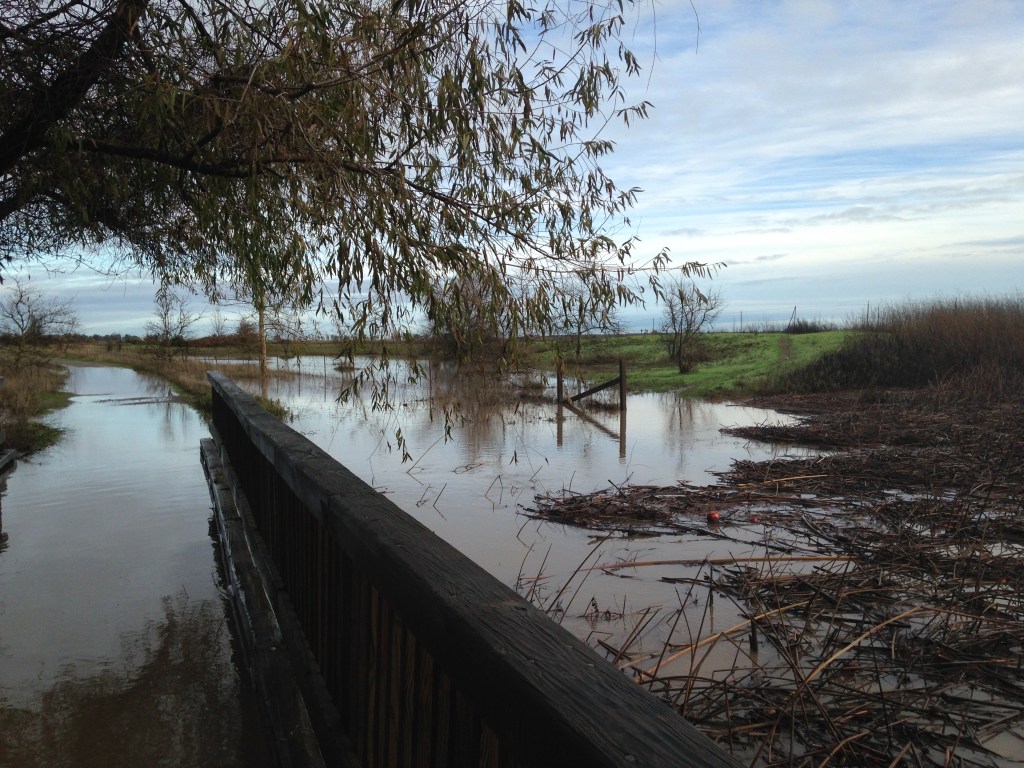
Ponding at the Wildhorse Agricultural Buffer during winter storm.

By Marjorie Longo

Water doesn’t care about property lines—it flows wherever the land takes it. That’s why flood studies shouldn’t stop at property lines. However, the Village Farms flood analysis mostly focuses on the project itself and a few broader downstream areas (https://www.cityofdavis.org/city-hall/community-development/development-projects/village-farms-davis). It does not show detailed results for existing neighborhoods—the places where people actually live, drive, and may need emergency access. Where are the post-Village Farms flood maps for Wildhorse, North Davis, or the streets south of Covell?  A few extra inches of water during a storm can mean the difference between a dry home and a flooded one, or between a passable road and a blocked evacuation route.

While the Village Farms flood analysis provides numbers for farmland and shows water pooling on the Wildhorse Golf Course and Wildhorse Agricultural Buffer, it doesn’t answer the key question residents have: what happens on my street?  When the next atmospheric river is dumping on Davis, runoff spreads broadly over our flat topography. And inches of extra flood water add thousands of dollars of damage to flooded homes and can mean the difference between muddy flood water in your home or not.

There’s also a gap in how these projects are regulated. Federal FEMA approvals (like CLOMRs and LOMRs) check whether flood maps meet certain standards, but they don’t guarantee that nearby properties won’t see increased flooding.  FEMA’s no‑rise rule applies to regulatory floodways only, not to the neighborhoods surrounding those floodways. Local rules in Davis and Yolo County require studies, but they don’t clearly set a strict limit like “zero increase allowed” for neighboring areas. This leaves room for projects to meet technical requirements while still potentially shifting flood risk onto nearby communities.

Experts in flood management, such as The Association of State Floodplain Managers, argue that one property owner’s project should not make flooding worse for others. Some parts of the country are moving toward this “no adverse impact” approach, using detailed, citywide computer models that simulate flooding across entire neighborhoods—not just individual sites (https://fortress.wa.gov/ecy/ezshare/wq/SWMMs/2024SWMMWW/Content/Topics/Shared/APMs/APM2OffSiteAnalysisReport.htm, https://streamline.tech/resources/2d-overland-flow-or-not-2d-overland-flow-that-is-the-question).

With a more forward-thinking flood-control approach, the City of Davis should have taken several steps:

  1. Require flood modeling that includes all nearby neighborhoods, not just the project site and unpopulated land.
  2. Set a clear rule of no measurable increase in flooding outside the project area.
  3. Ensure FEMA approvals also meet stricter local no-impact standards.
  4. Make all neighborhood flood maps and data publicly available so residents can see the risks.

Davis prides itself on data-driven decisions. In flood planning, that means showing clearly—block by block—what will happen outside a project’s boundaries. Because when the rain comes, the water won’t stop at the fence—and neither should the analysis.

Marjorie Longo is an Emeritus Professor of Chemical Engineering, UC Davis

Davisite logo

Did you enjoy reading this article? Then subscribe to the Davisite for free and never miss a post again.

Comments

4 responses to “Village Farms Flood Analysis Is Behind the Times”

  1. Alan Pryor

    As extensively studied and completely disclosed in the 5,000+ page EIR for the project, there is not now, nor will there ever be in the future, ANY runoff from the Project itself into Wildhorse Golf Course or any other surrounding neighborhoods. Any runoff from the Project will instead be directed north to a detention basin away from the project. This author has explicitly been made aware of this fact but continues to try to imply the opposite is true – but provides absolutely no evidence to substantiate their allegation.

    There is a stormwater conveyance channel (Channel A) crossing Village Farms that ONLY carries excess stormwater all the way from West and North Davis though the North Davis Ditch, crossing the Village Farm development, and then under Pole Lines through the Golf Course on its way to the Yolo Bypass. But Village Farms is engineered to maintain existing flow conditions in Channel A and will not add ANY additional stormwater to this conveyance ditch In fact, the Project will actually reduce excess runoff from the North Davis Ditch into the Wildhorse golf course because the newly constructed Channel A conveyance crossing the project will be deeper and wider with greater holding capacity.

    Additionally, the golf course itself is constructed with a broad floodplain itself to protect it from flooding events. In fact, the photo posted by the author actually shows this Wildhorse golf course floodplain feature is working perfectly and all of the stormwater from West and North Davis is fully contained within this designed floodplain even as the author infers otherwise. This is just another false claim by a Village Farm opponent who otherwise knows the truth.

  2. Marjorie Longo

    The EIR does not show a time lapse of how (and from where) the additional storm water ends up in areas on the Wildhorse golf course and agricultural buffer. But the EIR does show additional water in those areas and some of it close to homes. This leads to the obvious question: will there be additional water in the Wildhorse area neighborhoods, East Davis, and North Davis/Cannery? However, the EIR does not answer that question. A “no rise anywhere” approach that included the nearby neighborhoods is what this article is suggesting would have been the more forward-looking approach. In addition, modeling of the neighborhoods would not have left neighboring residents wondering about the change in flood risk on their street. https://documents.cityofdavis.org/Media/Default/Documents/PDF/CDD/Planning/Special-Projects/Village%20Farms%20Davis%202023/EIR/Appendices/Appendix%20N_Village%20Farms%20-Rick%20Engineering%20Drainage%20Report_BRPA.pdf

    1. Alan Pryor

      Ms. Longo described the likelihood of flood waters from Village Farms impacting adjacent neighborhoods best in her opening lines to her article,

      “Water doesn’t care about property lines—it flows wherever the land takes it. That’s why flood studies shouldn’t stop at property lines. However, the Village Farms flood analysis mostly focuses on the project itself and a few broader downstream areas.

      These few sentences in the article clearly acknowldege that WATER DOES NOT FLOW UPHILL! The EIR and the accompanying hydraulic analysis thus only analyzed downstream areas because that is the only direction water can flow. In the case of Village Farms, the land gradient falls to the east and north except for the drop into the Habitat area…which we want to annually flood. There is no reason to analyze Cannery and North Davis or even Wildhorse because they are all uphill and thus protected. North Davis is also protected by the railroad tracks. The EIR otherwise determined than no additional flow will go through Channel A so even the golf course is not at risk of flooding beyond its built-in floodplain which, incidentally, functions perfectly as shown by the photos in the article.

  3. Marjorie Longo

    The EIR includes topographical information that clearly shows that Village Farms will be raised to an elevation higher than surrounding Wildhorse and East Davis areas. So water can flow downhill in those directions – especially surface water. Cannery looks to be of a similar elevation, if not slightly lower after development of Village Farms. Sartopo.com shows North Davis a couple feet higher than Village Farms now, so with 5 feet of fill on Village Farms, some surface flow could also go that way or at least stagnate. However, the point is that citizens shouldn’t have to be combing through the EIR or Sartopo.com to look at the TOPO data. With forward-looking flood planning, the surrounding neighborhoods would have been included in the flood analysis. Iteration until there is zero rise in the surrounding neighborhoods and the farmland, within carefully decided tolerances, is the future that this project decided not to take!

Leave a comment