

Arguably, they are downright deceptive
By Roberta Millstein
In a previous article, I explained how it is only the Baseline Features of a project that are guaranteed to be built. I further explained that the Affordable Housing that Village Farms claims to provide is not part of the Baseline Features, i.e., the features that we will vote on as part of Measure V — it seems to be, but then by referring to the Development Agreement where it says only that the City “may elect to request Developer to construct the units” (emphasis added), it becomes clear that there is no guarantee of Affordable Housing at all. (Please refer back to that article for details).
In this article, I will explain that the “commitments” to affordable-by-design housing that proponents tout in their ballot arguments and elsewhere are similarly ephemeral. Voters should be aware that the project may not include much affordable-by-design housing at all.
First, let’s clarify. In California, capital ‘A’ Affordable Housing has a specific legal definition, with classifications based on income as a percentage of Area Median Income (AMI). In order to qualify to occupy an Affordable Housing unit, one has to fall into the requisite income class.
But “lower case ‘a’”, affordable-by-design (also called “missing middle”) housing has no such income restrictions. Anyone can purchase it, regardless of income. However, as the name suggests, the point is that certain types of housing are likely to be less expensive, and thus more affordable: duplexes, triplexes, cottage courts, and multiplexes are examples. They are still “market rate” — they will cost whatever the market will bear — but the hope is that they will be affordable to those who do not qualify for Affordable Housing but who do not earn enough money to purchase larger, single-family homes.
So, what do the Village Farms proponents promise?
The ballot argument in favor of Measure V tells us that “young families, teachers and local workers can’t afford to live” in Davis, but Village Farms is coming to the rescue! It will provide “diverse homes for every income level… Seventy percent of market rate homes are attached or on small lots, providing much needed “missing-middle” housing.” The rebuttal from project proponents similarly states, “Additionally, over 70% of market-rate homes will be townhomes, half-plexes, and smaller homes, making homeownership possible for younger families with modest incomes.”
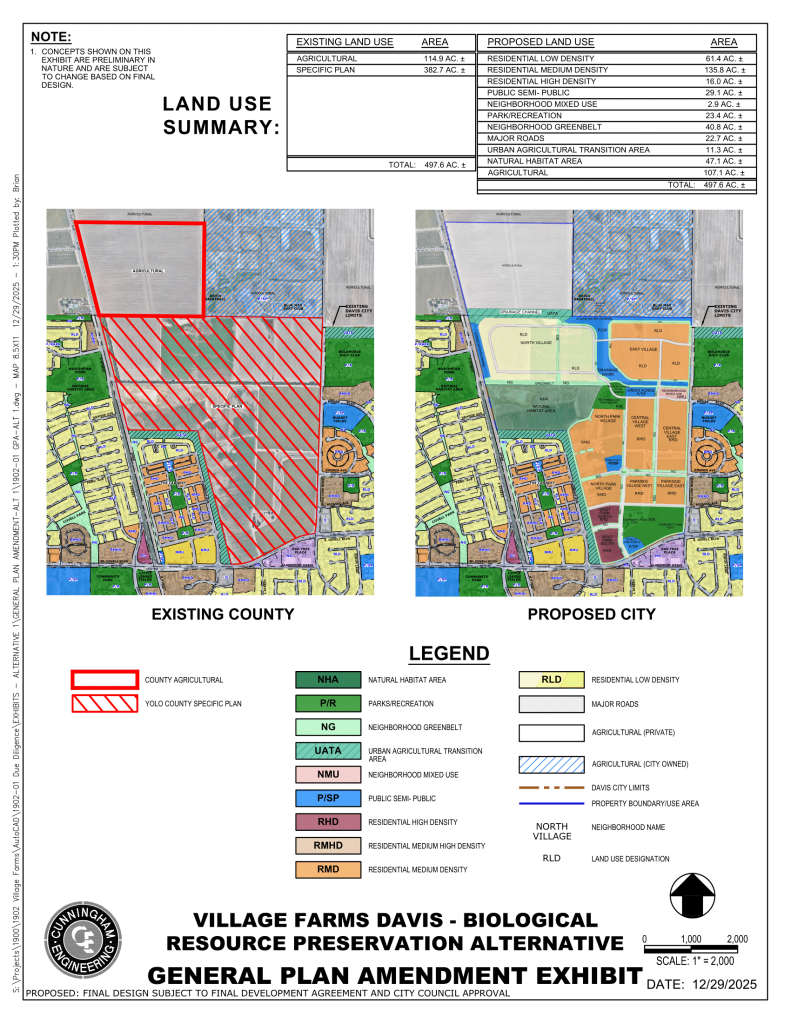
That 70% promise sounds firm, right? Quantitative! Exact! Surely that is in the Baseline Features, then, right? Nope. What does it say about the non-Affordable Housing in the Baseline Features? Here’s the whole thing: “The residential portion of the land will be zoned for a maximum of 1,800 residential units and will include Residential High-Density, Residential Medium-Density, and Residential Low-Density zoning designations.” There is a map included (see above), but it has the proviso that “CONCEPTS SHOWN ON THIS EXHIBIT ARE PRELIMINARY IN NATURE AND ARE SUBJECT TO CHANGE BASED ON FINAL DESIGN” (all-caps in original) and does not say how many units will be in each of these three zoning areas.
To find that 70% number, one has to go to the subject-to-change Exhibit E of the Development Agreement. If you subtract the 360 maybe-they-will-be-built (but who knows?) Affordable Housing units from the total of 1800, there are 1440 remaining. The Development Agreement breaks down that 1440 as follows: 310 Single-Family units on lots larger than 5,000 square feet (Low-Density), 113 Single-Family units on lots larger than 5,000 square feet (Medium-Density), and 1017 Single-Family units on lots smaller than 5,000 square feet (Medium-Density). 1017 units divided by 1440 is .7 — that is, the Development Agreement says that 70% of Market Rate units will be built on lots smaller than 5000 square feet.
Again, however — it doesn’t really matter what the Development Agreement says. These promises of affordable-by-design housing are subject to the whim of the developer and whoever happens to be on the City Council at the time. And we have seen that Davis City Councils will, time and time again, allow developers to back out of their promises. They did so with the Cannery, repeatedly. Arguably, they did so with Bretton Woods as well (where even features that people thought were part of the Baseline Features, such as a memory care facility, turned out to be changeable parts of the project, too).
Ask yourself this: If the developer really wanted to promise 70% of the market rate housing to be affordable-by-design, wouldn’t that be in the Baseline Features? Instead, it was deliberately left changeable.
A changeable promise is no promise at all. What the developer claims to promise is misleading at best, deceptive at worst.

 Davisite
Leave a reply to Eileen Samitz Cancel reply