

by Alan Pryor
Introduction
I have been a fairly consistent opponent of most peripheral development projects in Davis over the past decade. For instance, I was the Principal Officer, Treasurer, and Chair or Co-Chair of the No on Nishi 1 (Student Housing), No on West Davis Active Adult Community (Senior Housing), and both the No on both DISC 1 and DISC 2 campaigns (primarily Commercial).
All of those peripheral annexation measures failed except West Davis Active Adult Community. But none of these projects provided for family housing for modest income buyers. I think Davis desperately needs that type of family housing and I believe the Village Farms Davis project provides it so I support the Project.
As a result, I recently both publicly endorsed the Yes on Measure V campaign and was a co-signer of the Rebuttal to the Argument Against Measure V that will appear on the June ballot.
Many folks that I had previously worked with opposing other projects have accused me of abandoning my slow-growth and/or environmental principles after hearing of my endorsement of Village Farms Davis or reading some of the articles I have published about various environmental aspects of the project. Some are saying it is inexplicable to them why I would make this seemingly sudden change in my views toward peripheral development and endorse this Project.
Well, the reasons are actually pretty simple. I opposed past peripheral development projects because I did not feel any met all of the 3 primary criteria that I look at when considering supporting or opposing a project. And the reason I can now support Village Farms Davis is because I can now check-off each of the boxes for the same 3 criteria – 1) the Features of the Project itself, 2) the Location of the Project, and 3) the Quality of the Developers of the Project.
Let me explain.
When I look at any major peripheral project I first take a broad view of the project and ask some basic questions.
1. The Project’s Location – I first look at the pros and cons of the project’s location:
- Is the location an in-fill location that is close to amenities such as schools, stores, and other amenities allowing for easy biking or pedestrian access?
- Is the project adequately served by existing and accessible public transportation routes?
- Is the project near local employment centers?
- Does the location of the project make it susceptible to unmitigated external environmental risks?
2. The Project’s Features – If the project is for family housing, I look for family-friendly project features:
- Does the project contain an appropriate mix of subsidized low income rental apartments and entry level housing in appropriate size and amounts to primarily serve low to middle-income communities in Davis?
- Does the project devote sufficient land to open space including parks and bikepaths/greenbelts?
- Does the project provide for other public needs in terms of on-site facilities?
- Does the project have sufficient environmental safeguards and mitigations to minimize any potential adverse environmental or undesirable impacts the Project might have on surrounding areas or neighbors?
3. The Track Record and Reputation of the Project‘s Developer – Perhaps the most important questions to ask are those relating to the development team:
- Does the developer have a long track record of successful development projects in Davis?
- Does the developer have a long history of philanthropic and other contributions and ties to the Community?
In my opinion, Village Farms Davis is the only peripheral project yet to come before voters that checks the boxes on each of these major evaluation criteria, as follows:
☑ THE PROJECT LOCATION
The location of the Project is one of the its main selling points.
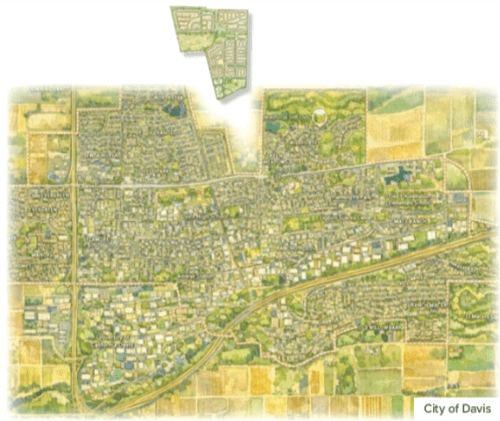
1. Infill Development – Village Farms Davis fits very nicely into the natural borders of the City and is surrounded by residential development on 3 sides. It is truly infill development.
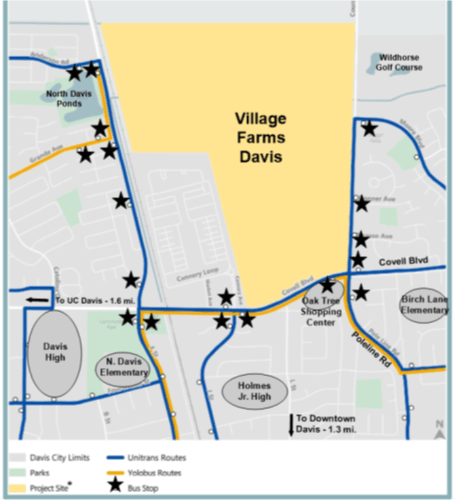
2. Pedestrian and Biking Accessibility – The Project’s location is within easy walking or biking distance of many destinations thus minimizing future commuting and intra-city automobile traffic. Nugget shopping center is directly across the street. There are four K-12 schools within ¾ mile. Downtown and UCD are each about 1.5 miles away; easily accessible by walking or bicycle.
3. Public Transit Access – Plus, the location of Village Farms Davis is immediately adjacent to or within a short walk of 18 existing dedicated bus stops for six Unitrans routes (E, F, L, P, Q, and T) and two Yolo Bus routes (43 and 230). There is no other location in the City where 1,800 units might otherwise be built that offers this many public transit options and close proximity to so many local destinations.
Neighborhood Connectivity – The Project will also have strong neighborhood connectivity by completing the Davis Bike Loop with an above-grade crossing over F St. and the railroad tracks landing near Northstar Pond and a below-grade crossing under Poleline landing near Nuggett Fields.
Impacts of the Local Environment on the Project – I am very aware of derogatory claims made by project opponents that the Project’s future residents will be at risk either 1) due to groundwater contamination as a result of it’s location near the former Old Davis Landfill and 2) due to risks of flooding because part of the project is now in a FEMA 100-year floodplain map. These claims are demonstrably false and made without any supporting 3rd-party, objective facts to support their assertions.
Firstly, the former Davis Landfill and the Project have undergone extensive groundwater testing since the 1980s which have conclusively shown that all of the volatile organic chemicals previously identified in past decades have completely dissipated and are no longer present at all.
Additionally, the California Water Quality Control Board sent a letter to the City stating there is “no risk” to future residents of Village Farms Davis from groundwater contamination providing that all of the water for the project is provided by the City of Davis municipal drinking water system – which it is!. Only Davis municipal drinking water will be used both for residents’ use and/or irrigation purposes.
Project opponents also claim there is a huge risk of future flooding because part of the project is in a 100-year floodplain. This is a red herring argument.. In fact, opponents are fully aware that the Project will meet 200-year flood protection standards (that more strict than FEMA standards) before construction even begins. While a portion of Village Farms is currently in a FEMA 100-year floodplain, the entire site will be engineered to provide protection for a 200-year flood event as now required by State law. All lot elevations will be certified by FEMA prior to authorization of construction and NO FEMA flood insurance will be required for any homes. As a result, Village Farms Davis will actually be more flood-resilient than almost all other subdivisions in Davis.
☑ THE PROJECT FEATURES
Diverse Housing Options – This 1,800 unit project is designed to provide many different housing choices primarily focused on missing middle-income housing needs. It will have a minimum of 100 townhouses starting at 800 square feet with prices starting in the $400,000s. It will also have hundreds of modest half-plexes and single-family homes starting at around 1,000 square feet. The Project also also includes a 16-acre land donation and a $6 million donation to the Davis Housing Trust Fund for construction of 360 permanently rent-subsidized low income housing units – the largest low-income housing contribution in Davis history
Green Space and Preserved Habitat – Over 50% of the project area is dedicated to open spaces, including parks, bike and walking paths, and accessible greenbelts and ag land. The development also preserves 47.1 acres of unique onsite alkali playa/wetlands habitat with a conservation easement and an endowment for permanent maintenance.
Climate Friendly – As a 100% all-electric community, every building will feature solar panels and be pre-wired for electric vehicle charging.
Community Amenities – The development includes land donations to DJUSD for both an early learning and daycare center and a learning farm for agricultural curriculum development. The Project will help sustain our beloved local public schools by providing housing for over 1,100 new students; helping reverse declining enrollment while minimizing out-of-district transfers.
Impacts on the Environment by the Project – I am also very aware of assertions made by project opponents that the Project itself will have a deleterious affect on the environment in terms of 1) PFAS contaminated groundwater migrating from beneath the Project site into a drainage channel that bisects the property, and 2) adverse impacts of traffic on local streets.. Both of these alleged adverse impacts have been extensively analyzed in the 5,000+ page, independently-prepared and reviewed Environmental Impact Report and the claims refuted”.
With regard to possible contamination by PFAS, other than a allegation that is “might” occur,. there is absolutely no quantitative evidence or studies that have been provided to even substantiate the possibility of such contamination much less the possible extent of the contamination. As more fully discussed in Appendix A below, these claims are simply not credible..
Project opponents also speak of a traffic Armageddon resulting from the Project and even claim in their ballot statement that the project will result in deterioration of traffic “Level of Service” to “F“. But this statement is completely misleading because it reflects modeling of traffic conditions assuming absolutely no improvements are made to any of the streets surrounding the project. In fact, tens of millions of dollars of mandatory street and traffic improvements on local streets must be made by the Project. And when these required improvements are made, modeled traffic conditions are substantially improved to acceptable Levels of Service as more fully discussed in Appendix B below
☑ THE PROJECT DEVELOPERS –
Local and Experienced – The Project is being developed by North Davis Land Company which is comprised of 7 local multi-generational families – The Whitcombe, Makley, Roe, Streng, Shepard, Schulze, and Buzbee families..But the vision for the project really came from John Whitcombe and his desire to provide middle income housing for more young families in Davis.
I’ve personally know John Whitcombe for about 20 years. He is a lifelong resident of Davis with family roots going back almost a century to when his parents met as students at UC Davis in the 1930s. John attended local public schools and was the senior class president in 1958 at Davis Senior High School. During his senior year, at 17 years of age, he built his first home in Davis. He then worked his way through UC Davis building homes and went on to Harvard Business School. Luckily for the Davis community, John returned home after a stint in the Army to begin his professional career as a local apprentice carpenter.
Leadership in Environmental Innovation – The other families in North Davis Land Company were equally influential in building many local housing projects utilizing local small builders that were on the forefront of environmental stewardship. These folks built our first Davis greenbelts and bike paths and were instrumental in preserving and increasing wildlife habitat within residential developments in Davis. Their legacy of environmentally responsible, family-oriented development continues with Village Farms Davis.
Local Philanthropy – The developers have also maintained deep philanthropic ties to Davis going back decades including establishing the Tandem Foundation for local school support, donating to a breadth of local causes, and funding and operating an organic farm that has donated over 500,000 pounds of produce to food banks and local non-profits. They actively support numerous community organizations including Davis Community Meals, Yolo Food Bank, and various sports and other youth programs. Indeed. there is hardly a major non-profit or civic undertaking in Davis that has not benefited from their support and financial contributions including the Bicycle Hall of Fame and the Farmers Market. These families were instrumental in building Davis to what it is today.
☑ CONCLUSION – For all of these reasons, I am an enthusiastic supporter of Village Farms Davis and hope others will join me in voting Yes on Measure V.
Appendix A – False Claims of Adverse Impacts by the Project on the Environment
Also seeSetting the Record Straight – Myths and Facts about Village Farms Davis (https://davisite.org/2026/02/18/setting-the-record-straight-part-1/) for more information
1) False Claims of Risks of PFAS Contamination of the Environment from Groundwater Contamination Beneath the Project – In 2024, additional groundwater testing showed the presence of PFASs chemicals beneath the landfill and, to a much lesser extent, in one of the three groundwater monitoring wells beneath the Project. Previous testing did not look for PFASs in the groundwater so prior concentrations of these chemical in groundwater are not known. Nevertheless, pundits claim that should groundwater rise to levels never before seen historically going back over a hundred years, that some of this contamination could seep into the primary drainage channel (“Channel A”) carrying surface runoff from West and North Davis. This drainage channel flows through the Project, under Poleline Rd into Widlhorse Golf Course, and on to the Willow Slough and the Yolo Bypass – potentially carrying these contaminants to the Vic Fazio Nature Preserve.
But these claims are beyond far-fetched. Firstly, such a scenario would require a rise in groundwater to levels never before seen. Even then, the risk of substantial PFAS contamination reaching the Yolo Bypass is almost infinitesimal because such small quantities of water could infiltrate into Channel A over time. Secondly, Village Farms Davis will actually provide increased protection from PFAS or other infiltration into the channel because a newly constructed Channel A will be lined with an impervious compacted clay layer to prevent any infiltration of any groundwater into the new channel.
Project naysayers who needlessly worry about PFAS contamination of the Yolo Bypass from the Project should instead focus their attention on the Davis Wastewater Treatment Plant that is about 3.5 miles away which discharges 6 million gallons of wastewater per day into adjacent wetlands with overflow eventually carrying into Yolo Bypass. Such effluent has a PFAS contamination over twice that found in the groundwater beneath the project representing a mass transfer of PFAS contamination into Yolo Bypass many orders of magnitude greater than that posed by the comparatively far smaller and extremely unlikely contamination posed beneath the Project.
2) Claims of Extreme Adverse Traffic Impacts of the Project on Surrounding Streets – Project opponents also speak of a traffic Armageddon resulting from the Project. In their REBUTTAL TO ARGUMENT IN FAVOR OF MEASURE Vthat will be on the June ballot, they claim, “It would bring over 15,000 more car trips DAILY near Covell Blvd. and Pole Line Road causing gridlock and Level of Service “F.”
But this statement is knowingly misleading because their claim does not account for the improvements in traffic conditions brought about by mandatory traffic and street improvements that are required for the Project. These will cost tens of millions of dollars and are more fully described below.
When these mandatory street and traffic management improvements are implemented, the delays at all the intersections near the project are substantially improved to acceptable Levels of Service.
According to the Local Transportation Analysis provided with the Environmental Impact Report, “Overall, the improvements would substantially reduce delays and queuing throughout the study area. The implementation of the recommended improvements would improve peak hour operations to acceptable levels at all study intersections under Existing Plus Project conditions.”
This is shown in Table 10 from that Local Transportation Analysis
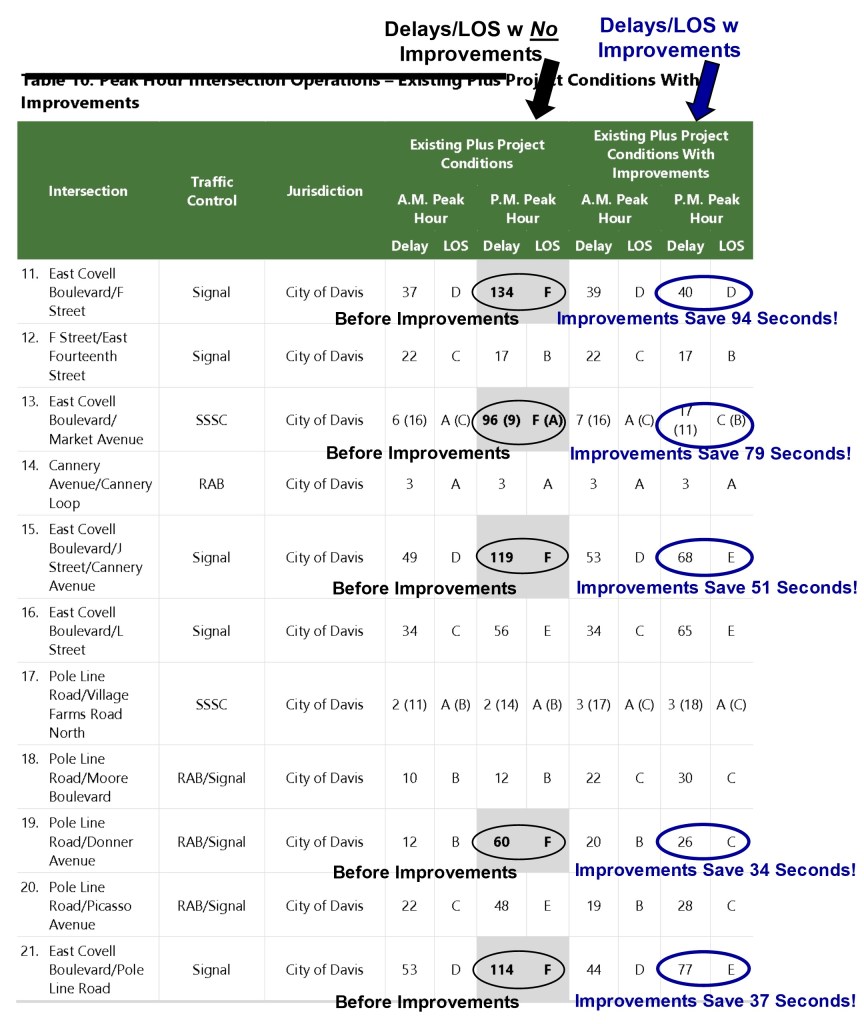
When viewed in this correct factual light, the adverse impacts of inccreased traffic are very manageable.
_____________________________________
Following is a partial list of the extensive bike path and biking safety-related street mitigation improvements along with on- and off-site roadway improvements required by the Project to minimize vehicular traffic and biking impacts. These include:
a) Biking and Pedestrian-Related Improvements –
• Development of over 7 miles of multi-use trails, public bike lanes and walking paths throughout the Project,
• Construction of new Class I shared-use paths along the entire Pole Line Road (west side) and East Covell Boulevard (north side) of the site frontages,
• Construction of new high-visibility Class I shared-use path connections/road crossing at all entrances to the Project including 3 on Covell Blvd and 3 on Poleline Rd,
• High visibility crossing improvements on Covell Blvd at Birch Lane and Stripe Class III bike route on Birch Lane from Covell Blvd to Pole Line Road,
• Develop over 7 miles of multi-use trails, public bike lanes and walking paths throughout the Project.
b) Street Traffic-Related Improvements
• Roundabout and street crossing improvements at Moore Blvd,
• Traffic Signals and street crossing improvements at Donner and Picasso on Poleline,
• Traffic Efficiency Improvements at the signalized Covell Blvd/Poleline Rd Intersection,
• Fair share funding toward cumulative traffic impacts including expansion of roadway facilities and construction of traffic control and safety improvements along the Covell Corridor.

 Davisite
Leave a reply to VL Cancel reply