Davisite Banner. Left side the bicycle obelisk at 3rd and University. Right side the trellis at the entrance to the Arboretum.

Two updates on the Village Farms project

By Roberta Millstein
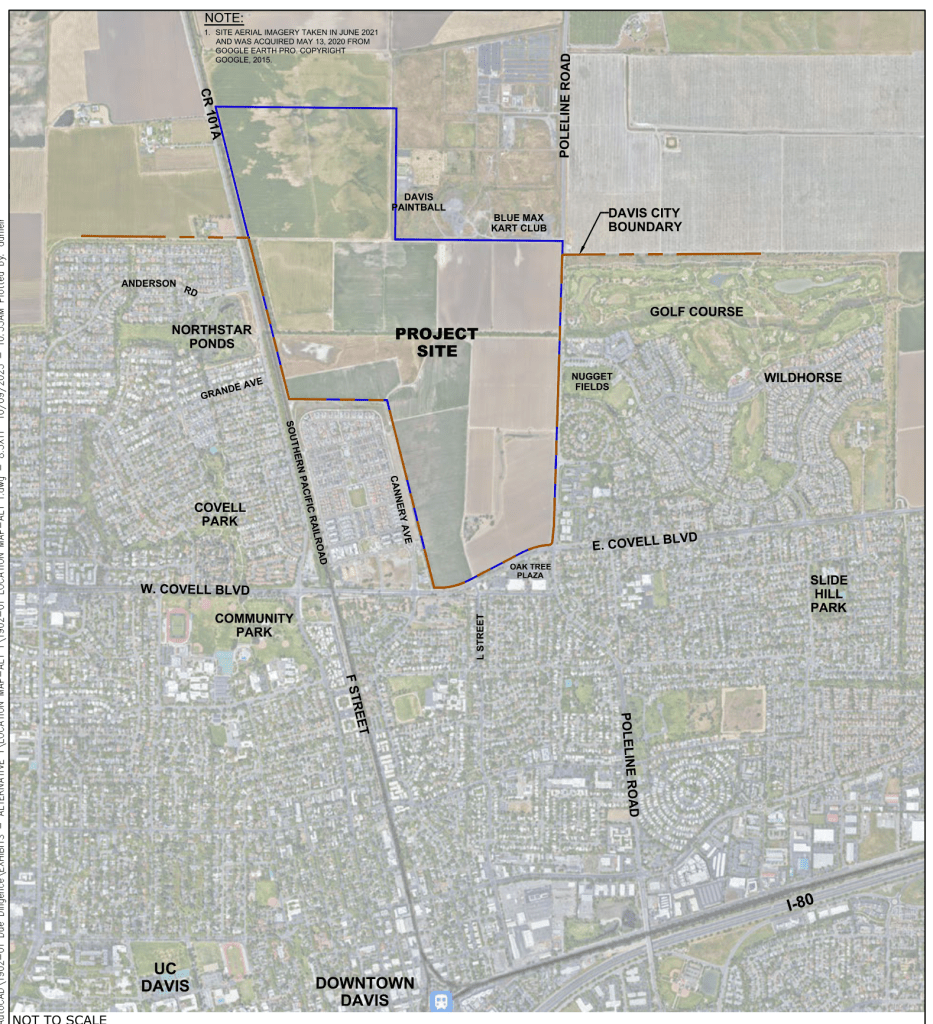
This is just to call people’s attention to two updates on the Village Farms project. We had been expecting to see a Final Environmental Impact Report (FEIR), responding to comments on the Draft EIR, when on November 17, the City announced:

New information has recently come to the attention of the City of Davis Department of Public Works Utilities and Operations related to the City’s overall Wastewater Treatment Plant (WWTP) capacity. Preliminary results from an ongoing study – which is still underway – revealed that the wastewater treatment system is approaching capacity sooner than anticipated, in large part due to the City’s successful water conservation efforts. Simply put, reduced water flow causes a higher concentration of waste. Though the system is performing efficiently, changes to the composition of the wastewater and new assumptions about treatment necessitate modifications to the WWTP to ensure continued reliable service for years to come. Once the study is complete in early 2026, staff will facilitate a discussion with the City Council and community about next steps.

Thus:

… the City of Davis is recirculating the portions of the Village Farms DEIR that require revisions to reflect this new information. Until January 2, 2026, the public may submit comments on the recirculated portions. The City will prepare a revised “response to comments” document that includes comments on these revised sections of the DEIR, and intends to make the full Final EIR available to the public at least 10 days prior to City Council action to certify the EIR. Comments submitted during the initial circulation in early 2025, and the City’s responses to those comments, will be made available in draft form for public review prior to the Planning Commission consideration of the project.

But then on November 21, the City made an additional announcement:

A partial draft response to comments on the previously circulated Draft Environmental Impact Report (DEIR) is provided at the link below. This document is a draft to provide the public and decision makers with an early preview of the partial responses to comments on the previously circulated DEIR for the project. This document is being released to the public prior to the Final Environmental Impact Report (FEIR) for the project and is not required by CEQA regulations but is being provided for maximum public transparency. Minor revisions to this draft document may be required to fully respond to public comment received on the partially recirculated DEIR during its 45-day comment period (November 17, 2025 through January 2, 2026).

“The link below” that is referred to in the quote is here: https://documents.cityofdavis.org/Media/CommunityDevelopment/Documents/PDF/CDD/Planning/Project-Applications/Village%20Farms%20Davis/VFD%20Partial%20Draft%20RTCs%20DEIR_Optx.pdf

For those of us that have been waiting to see the FEIR and have been wondering what was going on (e.g., me), this gives us probably a close-to-final version of what the FEIR will be — as I understand these announcements. (It’s a Draft Final EIR responding to the Draft EIR — got it??)

For more information on the Village Farms proposal, and for the text of the two announcements copy-pasted above, go here: https://www.cityofdavis.org/city-hall/community-development/development-projects/village-farms-davis

Davisite logo

Did you enjoy reading this article? Then subscribe to the Davisite for free and never miss a post again.

Comments

21 responses to “Two updates on the Village Farms project”

  1. George Galamba

    Thank you for this info. Two observations: Who can read this thing? It’s longer than Moby Dick and twice as dense. Second, I’m not positive, but I think the map above is for the Shriner’s project (?)

    1. 1) No kidding!!

      2) Oops, thanks for the catch. I think I have the correct map now!

  2. Greg Rowe

    Thanks for helping to publicize this project,Roberta. Just a couple of comments and suggestions. First, the planning commission public hearing will occur on Tuesday, Dec 2. Yes, a Tuesday. Planning Commission typically meets the 2nd and 4th Wednesdays, but scheduling complexities necessitated a Tuesday meeting. There is another VFD meeting tentatively scheduled for Dec 17, if needed. It would be a continuation of the Dec 2 meeting. This means the Dec 2 meeting would not be adjourned, but continued to Dec 17. By continuing the Dec 2 meeting, rather than adjourning, it means there would be no public comment period at the Dec 17 meeting. The rationale for this arrangement is that if there is extensive public comment on Dec 2, the meeting could very well last until well past midnight. As a planning commissioner, I can tell you that it is difficult to deliberate and make decisions on important projects when it is well past bedtime. Continuing the hearing to Dec 17 will enable the commission to focus exclusively at that meeting on making decisions on recommendations to the City Council on the DEIR and the other project documents.

    In terms of reading the FEIR, I have some suggestions based on working with EIRs since 1984. First, concentrate on the Master Comments section, which is page 2.1 through page 2.31. If you don’t have time to read anything else, read that part. Next, look at the Section 3, Revisions, which is 28 pages. Next read the MMRP, which is 100 pages. Make the responses to individual comment the last thing you read. Keep in mind that many of the pages in this section are mostly blank.

    Sorry the FEIR is so long, but that is the nature of EIRs for large, complex projects.

    These are my personal comments, and do not represent a position of the Planning Commission or the City of Davis.

    1. Thank you so much, Greg. This is all extremely helpful information. Will the Planning Commission be discussing the draft FEIR; the partially recirculated (revised) DEIR, with the information about impacts to the wastewater treatment plant; or both?

      1. Greg Rowe

        The primary purpose of the Dec 2 and 17 public hearing will be to make recommendations to the Council on the FEIR and the project documents for the VFD project (Development Agreement, annexation docs, ballot Baseline Features, etc.). The comment period on the partially recirculated DEIR (Chapter 4.14) ends January 2, but I don’t know whether it will be an “official” part of the agenda for the Dec 2 public hearing. It is anticipated that the staff report package for the Dec 2 hearing will be published on the City website next Tuesday, Nov 26, so we’ll know by then whether there will be a staff update and agendized discussion of the Partially Recirculated DEIR.

        Of course, anyone who is interested in the Partially Recirculated DEIR (PRDEIR) can certainly make a comment on it during the public comment period on Dec 2. That may be the only chance to do so, because the Notice of Availability for the PRDEIR includes the following underlined statement: There will not be a public comment meeting for the partially RDEIR.

        I hope this helps.

        Also, keep in mind that the Planning Commission will hold a meeting on Wed Dec 10 to receive comments on the DEIR for the proposed Willowgrove project. Yes, December meetings 3 weeks in a row with lots of reading before that.

      2. Thanks again! Again, extremely helpful, and yes, busy December! If I can ask one more question: so, will the Planning Commission be making its official recommendation on Village Farms at this meeting (Dec 2 or 17?) It strikes me as irregular to make a recommendation based on a not-final FEIR, but that might just be my own ignorance.

      3. Greg Rowe

        Well, this situation is certainly complicated. Based on communications from staff, it is my interpretation that the Planning Commission will be able to discuss and comment on the FEIR on Dec 2 and 17, but won’t be able to make formal recommendations to Council as we would normally do. Until the Partially Recirculated chapter 4.14 of the DEIR came about, it was anticipated that the Dec 2 and 17 public hearings would be like any other “normal” project in terms of the formal actions requested of the Planning Commission. Hope this helps.

      4. Thanks. Yes, that does make sense. But it also sounds like there will have to be another Planning Commission meeting down the line where it makes its formal recommendation, February, March whatever.

  3. Ron O

    If enough eligible people vote no on the two proposals, the EIRs will be irrelevant. (So that’s what I’m hoping occurs.) Also less reading needed, that way – just mark the “no” box on the ballot.

    By the way, dropped by the newly-rebuilt University Mall yesterday. Very busy and challenging to park (I ended up parking next to the employee parking in the back), but the new mall looks good (with buildings in additional locations, as well).

    It’s fortunate that (try as they might), the council wasn’t able to screw up the new mall after all – they only delayed it for a few years or so.

  4. Robrrto

    After reading various articles about this project, I still don’t understand why Davis needs this new project.
    So what is the reason. Why??

    1. Greg Rowe

      This is not an argument for or against the proposed new project. However, State law enforced by the CA Department of Housing and Community Development (HCD) requires each city and county to zone land to accommodate its “fair share” of housing allocated to the region in the Housing Element of its general plan. It is called the “Regional Housing Needs Allocation” (RHNA). The Sacramento Area Regional Council of Governments (SACOG) is responsible developing the RHNA fair share for each city. The fair share calculations are revised every 8 years. The City’s current housing element covers 2021-29. As per the Housing Element, Davis is required to have land zoned during that period for about 2075 housing units, over 930 of which must be affordable to very-low and low-income residents. (This does not mean that many housing units must be built, but the city has to have land appropriately zoned to accommodate that many units.) The City is required to submit an annual report to HCD on its progress toward meeting the current RHNA requirement. The City expects to meet the current RHNA cycle requirements, but the next RHNA cycle (2030-37) will probably require Davis to zone land for an additional number of housing units that will probably exceed the current 2,075 requirement. (This means that the City must develop a new Housing Element to the General Plan.) So, that means that under State law, cities such as Davis must continually be looking at land that can be zoned to meet our regional housing allocation. If all of this sounds complex, it is! I only know that because I was the chair of the City’s Housing Element Committee during 2020-21 and had to deliver our report to City Council.

  5. Greg Rowe

    Roberta, as I understand it, the Council is scheduled to make a decision on the proposed governing documents (General Plan amendment, annexation, etc.) and whether to place the VFD project on the ballot, at its meeting of Tuesday January 6. That is what appears on the Council’s long range calendar. The City could possibly decide to move those decisions to a later meeting in January, but it is my understanding that the decision whether to place the project on the June ballot must be made in January in order to meet deadlines of the County Board of Elections. So, bottom line, waiting to Feb or March to make these decisions, as you allude to in your comment, would not enable the project to be on the June ballot. It would need to be moved to a future election, such as the November 2026 election. That election is already targeted, however, for the Willowgrove project Measure D ballot measure.

    1. But isn’t the Planning Commission statutorily required (pardon if this is not the correct language) to make a recommendation to the City Council before it approves the FEIR? And how can it the CC certify an FEIR that is not completed? I’m sorry to keep bugging you with more questions. It just seems like each answer opens up new ones.

      1. Greg Rowe

        At this point you’re getting into an area beyond my expertise. Due to the evolving nature of this project, those are questions better addressed to City staff, which are working on a strategy and schedule for the project approvals.

      2. Fair enough. Thanks, Greg, for all of your insight.

  6. Ron O

    It should probably be noted that the state’s RHNA targets are not being met ANYWHERE in the state that I’ve seen. In essence, ALL of the housing elements submitted to the state are essentially “fake”.

    I’m not seeing any that are “on target” in regard to the current round, let alone any future rounds. Some cities/counties still don’t even have an approved housing element.

    One might ask if the state “intended” cities to sprawl outward to address these targets.

    https://cities.fairhousingelements.org/

  7. Jay

    Greg, I have questions about the RHNA.
    1) How many total housing units does Davis currently have in place?
    2) How many of the State-required and SACOG-allocated 2075 zoned housing units are already met, broken down by built and zoned but unbuilt?
    3) Same questions for the 930 very low and low income zoned units requirements.
    4) It seems SACOG and the State came up with these numbers without considering critical infrastructure needs. Can these requirements be modified if the city does not have waste water treatment capacity to serve them?
    5) I assume Davis can’t be forced to provide housing we don’t have the infrastructure for, and it would be unwise to put a housing measure on the ballot that we can’t provide wastewater treatment for. What would Davis be expected to do if voters approved something the city infrastructure cannot support?
    6) Has the city looked at all critical infrastructure needs, such as water availability, drinking water treatment capacity, etc or are there other possible surprises similar to this one lurking in the shadows?

    Thanks helping me understand the process here.

  8. Greg Rowe

    Jay, there are a number of useful documents on the City website that will answer most of your questions. In the City website, go to Community Development. In the Planning and Zoning tab you can drop down to see the General Plan Housing Element Version 3 that was adopted by City Council on 5 December 2023. The Housing Element has tables that start on page 67, showing the various types of housing in Davis. For example, there are over 11,000 single family homes. More information can be obtained by going to the Housing Dashboard tab in Community Development. Finally, the City is required to submit an annual housing progress report to HCD. The most recent report can be found on the Planning Commission agenda for March 12, 2025. Go to Commissions and Committees, then to Planning Commission, then find the agenda packet for March 12. It is a very good report with lots of good information on housing construction trends in recent years. Left unsaid in the report, however, is that a number of large housing projects approved by the City in recent years have not yet started construction, however, because the developers have been unable to obtain financing, or that the interest rate on obtaining construction funds is so high that the project is not fiscally feasible.

    In terms of your questions 5 and 6, the EIRs for major discretionary projects (i.e., those that can’t approved administratively), perform a detailed examination of the available infrastructure to accommodate proposed new development projects. The EIR will look solely at the impact of that project, plus its cumulative impact taking into consideration anticipated future projects. Every EIR that I’ve dealt with since joining the Planning Commission in January 2018 has concluded that there is adequate domestic water and sewage treatment capacity, up until a consultant report issued in April 2024 indicated that the secondary treatment capacity of the City’s Wastewater Treatment Plant (WWTP) was nearing capacity and may not be capable of handling the additional influent from the 1800 housing units proposed at Village Farms Davis. A follow-up report issued by another consultant on 7 November 2025 generally reached the same conclusion.

    Your questions 4 and 5 are excellent and are something I’ve been thinking about a lot lately. They are overarching policy questions that I can’t answer, but in my personal opinion are subjects that may warrant in depth discussions among the various City commissions and City Council. For example, if the next RHNA determination for the City of Davis could only be obtained by annexing land that is with a FEMA Flood Hazard zone, how could additional housing be constructed in that area without incurring a flood risk to that housing? Could the homeowners even obtain flood insurance? It has been suggested that perhaps the City should develop a comprehensive stormwater and floodwater management strategy before proceeding piecemeal with projects that have a majority of the housing within FEMA Flood Zone A (chance of 100-year flood).
    Anything stated above is my personal opinion and not in my role as a planning commissioner.

    1. Jay

      Thanks Greg

  9. Eileen Samitz

    The Village Farms project is a disastrous proposal. It has a 200-acre FEMA Hazard Zone A floodplain (the worst category) with serious flooding potential. Let’s not forget that the State has passed legislation that has made clear that State will no longer bail out cities foolish enough to build on huge floodplains like this. So, the Davis community would get stuck those costs and City would be exposed to litigation.

    Village Farms has toxics issues including high levels of carcinogenic PRAS “forever chemicals” leaking from the immediately adjacent (to the north) unlined Old City Landfill and Sewage Treatment Plant as well as other chemical contaminants, it has ultra-high levels of the carcinogenic and neurotoxic toxaphene as well as high levels of lead in the soil where the Heritage Oak Park is to be located where kids would play. The City would be also exposed to litigation into the future for the consequences of residents being exposed to these toxics.

    Village Farms has unsafe access issues including no grade-separated crossing planned for Covell Blvd. which is like a freeway, and there has been no confirmation of “feasibility” in writing, nor if the developer is going to pay for a F St. overpass, or a Pole Line grade-separated crossing so these are more potential infrastructure costs for Davis residents.

    More infrastructure costs would include the many street “improvements” that the project will cause the need for that the developer would only pay a “fair share” of, and we pay for the rest. That includes an expensive new 4th fire station proposed, which would mean massive costs for the community for the additional fire fighter staffing, equipment, and operational costs into the future (when the City can’t even afford to pave the roads.)

    Then there are the vernal pools (which the developer had planned to develop housing on originally) are not protected by a conservation easement yet, nor have any funding identified to their management and protection even though they have an endangered species of the Vernal Pool Tadpole Shrimp.

    Then there is the massive traffic that 1,800 housing units would bring to the already heavily impacted at the Covell Blvd. and Pole Line Rd. vicinity. The Draft EIR state that Village Farms would bring more than 15,000 car trips DAILY. That would mean gridlock on Covell Blvd. and Pole Line Road and tons of cut-through traffic into the neighborhoods.

    Then there is the unaffordable housing where 80% of the housing would be market rate housing where the cheapest house would be $740,000 which means a housing payment of at least $6,000 PER MONTH to cover the mortgage, property taxes, CFD, insurance and he many other fees. The housing would go up to at least $1.3 MILLION per the BAE fiscal report. Local workers and families with young children especially cannot afford this. So, there is no way that Village Farms would bring 700 school age kids as the School District would like to believe.

    Plus, the developer is only willing to dedicate 9-9.5 acres of land when the requirement per out Municipal Code requires the Village Farms project to dedicate 18.6 acres. But the City is rolling over and allowing eh developer to get away whit this. Yet, the project is a 497-acre project. On top of this, the City is also letting the developer get away without providing the 2:1 ag mitigation required for the massive 107-acre dig-pit site to which would be used to try to fill the massive 200-acre flood plain. This enormous dig-pit is an urban use, not an agricultural use. So, this is yet another violation of the City Municipal Code that the City is rolling over on also.

    The Village Farms project is too big, has far too many serious problems, and would bring far too many impacts, and costs as well as liability to the City. The EIR is grossly inadequate, has insufficient information , incorrect information like the wastewater treatment capacity issue what somehow only got recognized recently.

    The Village Farms project does not even have a Final EIR yet, no completed development agreement nor does it have completed baseline project features for Measure J/R/D. yet, the developer is trying to prematurely put it on the ballot. Let’s not forget that the developer, John Whitcombe (Tandem Properties partner) is also the Nishi project developer which was approved 7 years ago yet is still sitting dormant. The developer promised a grade-separated crossing yet it is not happening nor is any housing development is happening either. If he has not produced a grade-separated crossing at Nishi, what makes us think he will produce TWO grade separated crossings at Village Farms? Well, maybe he plans to flip both properties if he gets Village Farms approved, so it will not be his problem.

    Village Farms is being fast-tracked to accommodate the developers wishes to race this seriously flawed project to the ballot as soon as possible before the many serious issues are addressed and resolved. The Village Farms project needs to go back to the drawing board and include an EIR analysis of a “reduced footprint” alternative to build only below Channel A alternative as was including in the Covell Village Draft EIR which as the “environmentally superior alternative” since it reduces the impacts and risk to the residential by distancing the housing from the massive flood plain and the toxics from the adjacent unlined Old City dump leaking toxics. Further, it would need to protect the vernal pools with a conservation easement and secure the funding for its management and protection, and reduce the number of housing units to 900-1,000 units or less. This analysis can be done now due to the Draft EIR now being re-circulated.

Leave a reply to Roberta Millstein Cancel reply