


By Alan Hirsch
On Wednesday May 1, the 1971 page (plus 345-page appendix)- final EIR for yolo80 was released. The 139 comments take up nearly 71% of the pages. – 108 of the 139 were from individuals, not government agencies, cities or environment groups with paid staff. This highlights the fact this science-defying proposal from Caltrans has become “the most controversial freeway project in the state.”
———————–
NOTE: The last chance to comment on the funding will be at California Transportation Commission Meeting Thursday May 16, By Tuesday send any comments. (esp inadequately funded mitigation plan, induced demand negates any congestion relief, no environmental justice plan for tolls)
to CTC@CATC.CA.GOV
Subject: Widening I-80 with a Expensive Toll lane.
Pro-Tip: use 14 or 16 pt font for short email.
————————–
The EIR concluded that despite the widening the freeway will generate 158M more miles of driving (VMT) a year…equal to adding over 11,000 more cars to the road and should be built based on “Statement of Overriding concern” as it has benefit to reducing congestion- Even though everyone agree this is wrong as congestion will return within less than ten years. It is also strange given their VMT Mitigation plan only offsets 55 Mil VMT miles year of the additional driving and ignores the nearly 50Million of additional a truck.
Adding capacity via toll lanes only guarantee richest member of community- and groups of Tahoe travelers never faces congestion.
The EIR also ignores any analysis of increased danger from narrowing lanes and permanently removing shoulders. (see diagram)
The ability of the proposed mitigation plan to provide a carbon/VMT offset is taken to higher degrees of absurdity to somehow claim the project tolls will fund adequate mitigations- and have money left for a social equity/environmental Justice program into perpetuity.
Public not told about public hearing on toll levels.
It's worth noting 108 individuals who took the time to write a comment letter on the Draft EIR, yet only one individual member of the public showed up at the public hearing setting up the toll for the new lane— and how they would be set. This was because SACOG/California Transportation Commission staff failed to publish notice of the hearing anywhere outside of their own twitter feed….then did not share on a website what the hearing was about so interested members of the public would know. They held the hearing at rush hour (5:30) in West Sacramento when 89% of the drivers on the causeway neither work nor live in Yolo County.
YoloTD staff have said they expect the tolls will be $1/mile at rush hour, $10-$15 on way for a Davis to Sacramento commuter.
Caltrans FEIR contains obviously bogus VMT Mitigation Plan
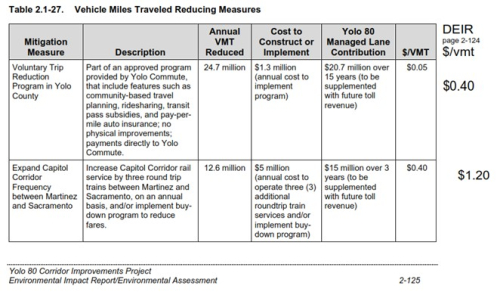
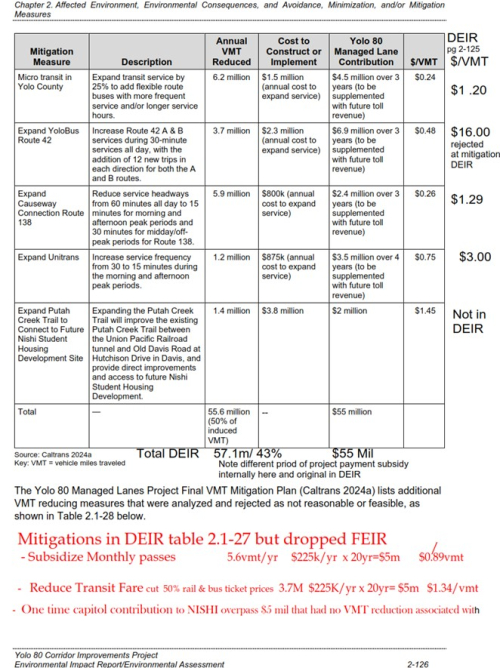
The below table is from the Final EIR (4/24). This plan funds program to get people to drive less by improving transit, Microtransit, bicycle programs and trip reduction (TDM).
The table is from the FEIR pg. 2-125/126, show the plan (“Mitigation Measures”) proposes to cumulatively reduce car travel (mitigate) 55.6m VMT/year for a cost of $11.8m/year—this mitigation plan for the 154mil VMT/yr. Yolo80 will generate.(Alt 4b page 2-124)
To describe the massive commitment 55M VMT/year is for yolo county, YoloTD bus carries about 12m passenger mile/year. This mismatch is not surprising, considering yolo county will generate only 11% of new trip on this stretch of I-80 (89% trip Yolo80 both begin and end outside Yolo county.).
The table show the estimated cost/effectiveness of each measure– the basis on which Caltrans choose the specific measure. I have added a new column showing cost/effectiveness estimate for each measure in the Draft EIR. Note the wildly different cost/effectiveness- for FEIR it improved on not just 10-30% but 200% to even 3,300%. The improved cost-effectiveness of these measures allowed the project to be approved by Caltrans based on a “finding of no significant environmental impact and save tens of millions of dollars a YEAR difference in liability. For comparison, The net toll revenue for chosen Alt 4 HOT3+ per is just $9 mi/year, already short the $11.8m needed even if cost/effectiveness pencil out as proposed.
The FEIR does not seem to have any back up for these cost/effectiveness number in them nor reference to specific document where these number can be validated against standards.
Also, of note is for caltrans0 or any project, the VMT offset for project can only be counted as much as the Project fund it. Microtransit service requires subsidy of $8 to $15 a mile, to the mitigation plan only suggest it will provide 24 CENTS a mile. So how can Yolo80 count 100% of VMT reduction is generate as offset. This is concept of additivity. See Caltrans document ****.
Who will guarantee additional funding if these uncorroborated cost/ effectiveness number are wrong?
Or will this just be another unpaid environmental debt we pass on to our children?

 Davisite
Leave a reply to Ron O Cancel reply