Davisite Banner. Left side the bicycle obelisk at 3rd and University. Right side the trellis at the entrance to the Arboretum.
  • Smoky Days Ahead!?! Leafblowers, Buses and Climate Shelters.

    7.27-28_windsI just sent the following to the City Council, relevant Commissions (BTSSC, NRC and SSC), County Supervisors and Yolo Solano Air Quality Management District…

    Per Weather.com the winds will shift to the north (and variants) at least part of this Tuesday and Wednesday. The prevailing south winds (from the south) have until now seem to have helped spare Davis and the immediate region (esp. to the west) from wildfire fallout from the huge fires east of Chico.

    As the wind may not just shift until late Monday or early Tuesday, I hope that Staff will be prepared to put the leaf blower ban into effect. (Note that most of the combined air region has had Spare the Air days for most or all of last week, if only for ozone)

    Davisinbottomleftcorner

    Davis is in the lower left corner – https://fire.airnow.gov

    Spare the Air means that Unitrans is free. Possible smoke and almost certain heat (esp on Wednesday through Friday) will in my understanding open our "Climate Shelters" at Vets and the Mary Stephens Library. As 14th Street is served by Unitrans buses (1 to 3 lines depending on the time of year and day of the week) it seems like a good and free way for many to get to the Climate Shelters, yes? It seems likely that Climate Shelters disproportionately serve lower income people who have less access to not only modern HVAC but also personal motor vehicles.

    Unfortunately the free Unitrans service is in tiny print at best on the Share the Air notices (email or website), and as far as I recall has never been mentioned in the City's notices about the Shelters. All of these programs are happening, but the communication is not joined up, and few know about them

    SparetheAir-Unitrans

    Beyond this, I don't understand why Yolobus doesn't have free service during Spare the Air days. Do I understand this correctly? Can people in Davis get to Climate Shelters (or anywhere else urgent) during a smoke and/or wildfire fallout event by free public transport, but not anyone else in Yolo County?

    Thanks for taking immediate action when necessary…. or preemptively!

    Davisite logo

    Did you enjoy reading this article? Then subscribe to the Davisite for free and never miss a post again.

  • Tree Davis Position on Sutter Davis Hospital Tree Removal

    Sutter Parking Lot Shade Trees 1

    Sutter Parking Lot Shade Trees

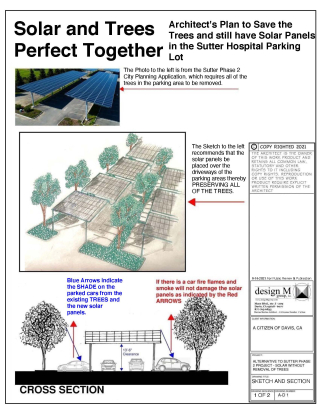
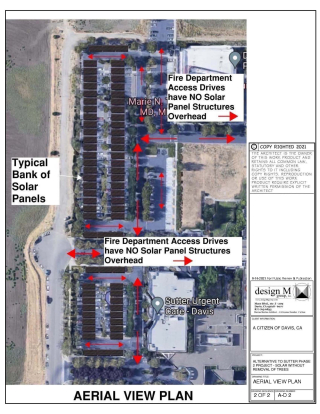
    A recent article in the Davis Vanguard ("City Will Have to Weigh between Trees and Solar Panels at Sutter as Complaints Reign about Public Process," July 21, 2021) described a variety of issues concerning the Planning Commission’s recent approval to remove 205 trees in association with improvements to the Sutter Davis Hospital campus. Tree Davis appreciates the efforts made by David Greenwald and Alan Hirsch to bring this proposal into the public spotlight. The Tree Davis Board has these thoughts to share.

    1) Our tree canopy is under increasing threat from decline due to old age, development, and climate change stressors like drought, wind, and pests. Tree Davis supports increasing measures to protect and preserve healthy trees and to grow our community canopy with climate-ready species. 

    2) We recognize that in certain circumstances, retaining healthy trees may not be possible. Full mitigation of lost canopy, through planting either on-or off-site should be accomplished, as per our Tree Ordinance.

    3) We support retaining mature tree canopy in parking lots when possible because trees can provide environmental and social benefits that PV arrays cannot, such as heat island mitigation, carbon storage, air pollutant uptake, beauty, stress reduction, and wildlife habitat.

    4) Tree Davis believes that the Tree Commission’s charter should be updated to include consultation on individual project proposals because of the expertise they can provide. For example, the proposal to transplant 43 mature trees to another location at Sutter Hospital may sound reasonable, but, the benefits may not offset the costs in the long term. The failed effort in Woodland to transplant historic olive trees along Gibson Rd. is an example.

    Greg McPherson
    President, Tree Davis Board of Directors

    Davisite logo

    Did you enjoy reading this article? Then subscribe to the Davisite for free and never miss a post again.

  • Sustainability, Adaptation, and Regenerative Farming: Understanding Responses to Global Warming

    This article was first published at https://islandviewmedia.net/blog/ and is reprinted here with permission of the author.  Davisites may find it of interest given the re-surfacing of the DISC project, which would pave over farmland and replace it with an automobile-oriented industrial project.  Regenerative farming envisions a way that the land could be used to combat rather than contribute to climate change and could potentially be deployed in various places in the Davis area.

    By Robert Chianese

    We strive to ensure our future by living, growing, and building sustainably. I’ve written about “Sustainability” since  the 1970’s, starting with my prize-winning essay on forming a local Sustainability Council which I did here in Ventura County. I became a true believer in its promise to reduce our impacts on the planet through its very tough tri-fold requirements: use renewable energy, no toxics, cause no loss of biodiversity.

    I later saw its promise fade as it became lost first in the fraudulent use of the term to “green-wash” all sorts of products and processes–lying about their sustainability. The FTC issued “Green Guides” in 2012 to push back on unsubstantiated claims about so-called green products, but corporations ballyhoo the term even more now. We hear boasts about the eco-friendly products of Clean Coal Energy, ExxonMobil, Monsanto, Dow Chemical, Malaysian Palm Oil and the Fur Council of Canada. Short-term ugly profit is more like it.

    Even more disturbing are current reports about our failures to shift off our carbon-hungry diet. Through our human-caused, “anthropogenic” actions, we cloak the globe in a heat shroud, intensifying droughts, wildfires, floods and sea level rise. Nothing sustainable here.

    Teenage phenom Greta Thunberg spent almost a year investigating how well we are meeting our environmental challenges. The documentary, “I Am Greta,” follows her through various countries and climates in search of sustainability successes, but she’s mainly discouraged and defeated. She even confronts the dean of environmental programs, David Attenborough about his gorgeous nature films in the time of climate systems collapse. He half-concedes he needs to change his pitch. His new series “A Life on the Planet” tries to atone for glossing over our very un-gorgeous damage to the earth.

    Ecologists have come up with new concepts we need in order to save the planet. Some say we need to adapt to the new climate realities, which implies accepting the damage we have done and adjusting to it. But neither adaptation nor adjustment get defined clearly.

    (more…)

    Davisite logo

    Did you enjoy reading this article? Then subscribe to the Davisite for free and never miss a post again.

  • What is in a Street Name?

    Amherst cropTime for more inclusive street names in Davis

     By Colin Walsh

    Since George Floyd’s death just over a year ago, Americans have taken to the streets raising their voices against racial oppression. A new desire to reckon with racism has arisen in our country. One form this has taken is in reevaluating the naming of buildings and places though this reevaluation of names also predates the rise of the BLM movement. For example, in 2017 Yale changed the name of one of its residential colleges which had been named after Vice President Calhoun, an infamous white supremacist. The University of Virginia renamed its law school away from that of a former confederate general. Closer to home UC Berkeley renamed 2 of its buildings in 2020 to move away from the names of former faculty members with slave holding ties or well documented white supremacist views. (link)

    Sometimes this has been controversial. In San Francisco the school district recently voted to rename 44 public schools, but then later rescinded the decision.

    A few years ago in Davis we debated the appropriateness of “Sutter Place”, and ultimately renamed part of it to Risling Court after David Risling Jr. a civil rights activist and founder of DQ University (link). But, the City left both Bidwell street and place, named after John Bidwell, Sutter’s business manager. The Davis Sutter Hospital also still lists its address as Sutter Place. 

    Clearly street names with a problematic legacy are not easy or quick to change, but it is time we look hard at the names of other streets and institutions in Davis. This would be an excellent job for the Historical Resource Management Commission, or a specially appointed committee. In the meantime, here is my first look at the subject. We have a few problematic street names in Davis and some serious issues of omission.

    (more…)

    Davisite logo

    Did you enjoy reading this article? Then subscribe to the Davisite for free and never miss a post again.

  • Why we need to change our thinking about the pandemic: virus variants, vaccination, divisiveness

    The following comments from Tia Will are in response to an editorial from David Greenwald, which you may wish to read first for context.

    Reality Check – or why I strongly disagree with almost everything you said:

    1. “Our biggest concern is that we are going to continue to see preventable cases, hospitalizations and, sadly, deaths among the unvaccinated,” Walensky said.  It shouldn’t be. Our biggest concern should be the possibility of more variants. How do you think the Delta variant arose? It came from our unwillingness to implement and maintain the preventive measures to control the novel virus in the first place. If you look at our county’s website graphics you will see that every time we masked, distanced , chose outside activities and avoided crowds, the virus came under control, every time we didn’t, it surged. Around a year ago I wrote here that my nightmare scenario was the emergence of a variant that was highly transmissible, had high lethality and attacked the young, and was vaccine resistant. Delta was just the virus’ first stab at that. Do we honestly think if we just let the virus spread, even amongst just the unvaccinated,  the nightmare scenario cannot occur?

    2.”The good news is that if you are fully vaccinated, you are protected against severe Covid, ” Let’s look at this a little closer. The current vaccines confer a 95 percent chance that an individual who contracts the virus will not have severe COVID or die or a 5% chance you will. Viral Roulette anyone?  This focus on severe disease and death only was useful in the beginning when the biggest concern was to keep people out of the hospital in order to “flatten the curve”. This was a worthy goal when hospitals are overwhelmed but which allowed the “only the vulnerable” will be affected attitude to arise. This neglected other undesirable consequences both economic and medical – shutdowns, deaths of those under 50 ( often our first responders and medical personnel, careers and lives not taken, but ruined by long COVID, and, once again, the rise of variants.

    (more…)

    Davisite logo

    Did you enjoy reading this article? Then subscribe to the Davisite for free and never miss a post again.

  • Pacifico proposal rushed without community input

    SignA letter to City Council from Trace DeWitt

    ——–

    Dear Mayor Partida and Council –

    Like many residents of South Davis I was shocked and startled to learn on Friday morning that the Davis City Council plans, at a meeting this coming Tuesday, July 20, to “direct the Council Subcommittee and City staff to negotiate a tentative master lease agreement with Yolo County” embodying a CalWORKS proposal based on a Yolo County Health and Human Services (Yolo County HHS) presentation for the future use of the City’s Pacifico property that will only be received by the Council as part of the same agenda item at the very same meeting.  The Subcommittee and staff are then to be directed to “bring [that Pacifico  master lease agreement] back to the City Council for a final review.”   

    I understand of course that the Brown Act only requires 72 hours’ notice of city council meetings even though 48 hours of that notice period is a weekend. This letter isn’t about the legality notice.  It’s about fairness of notice to the affected community, which in the two business days allotted cannot possibly respond to even the cursory terms of the CalWorks proposal’s most terms l in a way that can provide the Council the input needed for an intelligent decision on whether the CalWorks proposal should be negotiated with the County at all.

    As all members of the Council are well aware, the historic mismanagement of the Pacifico property in South Davis as low-income housing since its default acquisition by the City a decade ago has inflicted a number of ills on the surrounding community that have yet to be satisfactorily addressed by the City, and so continue to fester to the present day.  While the City has taken some first, necessary steps to ameliorate the situation, it is far from having resolved the issues that have plagued Pacifico residents and neighboring homeowners, including drug use, alcohol abuse, theft, trespass, physical assaults, verbal violence, noise, littering, and a host of behaviors that adversely impact the lives of residents of South Davis.  The City’s inattention to these problems has been a bane on the lives of vulnerable residents of Pacifico, and of their neighbors at large. 

    Now the City proposes not merely to entertain, but to negotiate an agreement with Yolo County that will presumably double the current number of residents of the Pacifico property by the addition of single-parent families to the low-income housing mix.  This increase is of necessity presumed, since Yolo County HHS’s CalWorks proposal – its “project details” comprise all of 20 lines of text (Proposal, 06-5) — does not bother to disclose the number of new residents it will add to Pacifico’s current population (the staff report implies an increase of perhaps 56 beds (Report, 06-3).  The proposal does indicate it plans to utilize the two of four buildings that are currently vacant on the property, and “keep the dormitory style layout” (Proposal, 06-5) that has been a source of complaints from residents in the currently-occupied buildings, with “no budget to improve the habitability of each unit” (ibid.).  And  while proposing to add this new population of single parents and their children to the residents currently housed on the Pacifico property, Yolo County HHS apparently plans to do nothing to address the problems emanating from Pacifico  – only to “manage its own residents” (Report, 06-3) and “[p]rovide additional fencing for site security and control” (Proposal, 06-5) – apparently believing it will wall off its own “vulnerable population in need of safe and secure housing” (Report, 06-3) from the onsite problems that have plagued Pacifico’s existing residents and the neighboring population for the last decade.

    Three business days is simply not enough time for citizens having a genuine interest in the welfare of our vulnerable, underserved populations to bring to the Council what it needs to know of their concerns for their Pacifico neighbors and themselves in their daily lives.  The community has a right not to have its concerns dismissed with the bland assurance of the City that “Staff and the Council Subcommittee heard the questions and concerns and believe that many of them can be addressed in partnership with Yolo County” (Report, 06-2).  Citizens have a right to express their skepticism of that belief in the face of the spectacular failure of the past partnership to come to grips with Pacifico’s problems.  The City Council should defer Agenda Item 6 to the next appropriate council meeting to afford a meaningful opportunity to make their views known to their representatives.

    – Tracy 

    Davisite logo

    Did you enjoy reading this article? Then subscribe to the Davisite for free and never miss a post again.

  • WWJTD?

    How to take back some control in the COVID era

    IMG_0530

    Your author, walking the walk

    By Roberta Millstein

    With COVID cases re-surging in California and locally as a result of the highly transmissible “delta variant”, it is hard not to feel powerless.  Maybe you got vaccinated (I hope so – if not, please do).  Maybe you are still wearing a mask when indoors in public places (I hope so – if not, please do – Yolo County is now recommending it).

    And yet, we sit here and watch the numbers rise yet again, the product of yet again opening too soon even as the voices of many epidemiologists told us not to.  Our political leaders bowed to public pressure and who suffers?  Well, everyone, individuals and businesses alike.  We’ve taken the shortsighted route and with numbers trending up again we’re headed back to the bad scenarios we thought we left behind.

    What can we do?  I ask myself, WWJTD?  That is, What Would John Troidl Do?  In these times I am especially missing the wise guidance of John Troidl.

    IMG_0515I don’t know for certain what he would say, but as he did so many times while he was still alive, I expect he would urge us to get tested regularly.  Yes, even if you’ve been vaccinated.  Being vaccinated dramatically reduces your chances of contracting COVID, but it doesn’t eliminate the possibility entirely, and I don’t think it eliminates the possibility of transmitting the virus, either.

    (more…)

    Davisite logo

    Did you enjoy reading this article? Then subscribe to the Davisite for free and never miss a post again.

  • City of Davis and the (Near) Future of Rail Travel

    L21spanish

    Virtual Public Workshop! Thursday, July 15 from 530 to 7pm


    I wrote the Bicycling, Transportation and Street Safety Commission (BTSSC) earlier today:

    To the BTSSC,

    I strongly suggest that the BTSSC set up an ad-hoc sub-committee about Link21 so that it can stay engaged long-term, receive and process community input and then at the appropriate time make recommendations to the City Council.

    The City of Davis is a small tomato in a huge pot of soup in this matter, but the railway proportionately bisects the City of Davis more than other town along its current route between Oakland and Davis. Davis grew around the rail and I-80 corridor in a way that – especially in the last 60 years – did not facilitate multi-modal travel based on the railway. A typical regional or suburban station like Davis in much of Europe would have multiple bus lanes that terminate at the station and hundreds of secure bicycle parking space for all kinds of bikes, suburb connections for walking and cycling for all directions, and a lively place for activity in front of the station, instead of a parking lot. The City has made some progress in this area of late, but, for example, there are still many who want a new parking structure at the station, and voters thankfully – but only narrowly – disapproved a new development project far from the station with no good cycling connections to it, lots of parking and imagined good access to I-80.

    I had tried to form a sub-committee nearly three years ago about the I-80 Managed Lanes Project, but it was terminated shortly after Commission approval because the second member moved to Sacramento. While I appreciate the healthy skepticism the BTSSC had about the Managed Lanes Project at the last meeting, I believe it prudent to get ahead of the game as much as possible for this even larger project that relates to both the Managed Lanes Project as well to our Downtown and General Plans, as significantly improved rail service would facilitate the creation of a lot more carfree or carlite households in town. As you seem to recognize, the worst outcome of the Managed Lanes project will do nothing but worsen traffic in town and literally throw a rotten tomato at our forming Climate Policy. The worst Managed Lane implementation will not support railway travel until perhaps many years from now, and indirectly, when thousands of Davis residents, frustrated with increased congestion and pollution, surround Caltrans District 3 HQ and bombard it with stinky, rotten tomatoes genetically-modified to annoy "deaf" state officials and narcissistic automobilists.

    TomatoesAs a robust railway powered by renewable energy is a key tool in fighting Climate Change, I would also suggest you consider making the sub-committee a joint one with NRC, and Social Services too in order to help ensure that the system is accessible for all households.

    The person who seems to be the current project manager for this part of the Megaregion, Jim Allison from Capitol Corridor, is very approachable and helpful. The Link21 sub-committee would be wise to also connect with other – especially smaller – communities along the corridor in order to create common, expected and seamless last-mile connections to their stations, and dense and proximate housing that makes good public transportation possible. All the pieces are necessary, but the puzzle has to be solved by everyone. I think that I prefer the tomato to the puzzle metaphor.

    Thanks,

    Todd Edelman"

    Davisite logo

    Did you enjoy reading this article? Then subscribe to the Davisite for free and never miss a post again.

  • Where are our fully-loaded EBT cards?

    Foodbanks


    Yesterday, the Davis Vanguard's "Food Assistance Has Tripled in Yolo County in the Past Year – Here's How We Can Continue to Meet These Critical Needs" invited some obvious praise – and perhaps some not so obvious further thoughts…

    But to start I'll say: Good going Yolo Food Bank! And Freedge, Davis Nightmarket, Tuesday Table, Buy Nothing (Facebook) and others in your efforts towards nutritional equity. It’s also vital that doubling for Calfresh (EBT/”Food stamps”) at Farmers’ Markets continues.

    I’m curious, however: The combined value – monetary, simplified – of the assistance one e.g. single-member household can get from Calfresh and related government-programs with YFB and the other programs is substantial. If one has the capacity, organization, transportation etc. it’s not difficult to receive upwards of $400 of assistance per month. That’s great, but a wealthier person – I didn’t say a “wealthy person” – can simply go  to Nugget, the Davis Food Co-Op, or the many specialty stores for all their needs (yes, one can use EBT for food items on Amazon). No travel around town (a challenge for people without easy automobile access), no waiting out the produce at Farmers’ Market which is distributed for free later in the day.

    So it seems that potential calories, proteins, phytonutrients etc. are at a considerably more equitable level than the distribution system itself. A member of a low-income household visiting a half-dozen locations at all times of day for food which the wealthier person can get in one trip is simply far from equitable.

    Is there a concept in these organizations to administratively and literally centralize all this food into a seamless operation, for example a $500+ monthly Calfresh allowance for a single-person household, and perhaps even a certain fraction that can be used at a restaurant (Calfresh currently partners with McDonald’s, 7/11 etc, seems contrary to the program’s nutrition agenda but paternalism is not welcome here, okay.)? Is this a goal, that’s stymied – at best – by government actors? What examples do we have from other places?

    Hungry for some answers….


    Davisite logo

    Did you enjoy reading this article? Then subscribe to the Davisite for free and never miss a post again.

  • Vague lanes solving regional pains?

    Davis80

    Not the Caltrans project! This is the author's concept for a bypass to and from the Bypass.

    On July 1st Davis Vanguard covered the announcement of Federal funding of 86 million dollars for the Yolo-80 Managed Lanes project.

    I appreciate most the comments of Alan Miller, Alan Pryor and Richard McCann. I hope I can add something below.

    The MTC area gets a lot of income from its bridges, and uses it for public transportation. Consider that Davis and SACOG-area drivers pay into this when driving south to San Jose, west to Oakland and San Francisco, and so on, but people from those areas make no similar contribution our region – really, the east side of the Northern California Megaregion – when traveling to Davis or Sac or of course towards Lake Tahoe.

    Caltrans dropped the long-promised new bike-ped bridge across the Bypass, replaced by some improvements on the west side of the Bypass. Combined with new infrastructure such as separated lanes and a lot of shade trees in West Sac,  the  whole corridor could be optimized for faster e-bikes and provide a good alternative for many, especially in east and the east part of South Davis. But… nope! Or so it seems.

    The graphics in the Caltrans presentation on the Yolo 80 Corridor planned for the BTSSC meeting this Thursday show only buses in the managed lanes, which is not what’s really planned for the managed lanes. Nasty! The managed lanes are mostly in added lanes, and if these lanes are available for private vehicles off-peak, for a premium, or free for a carpool then induced demand happens – see also Alan Pryor's comment in the Vanguard article – and we eventually lose.

    It’s also not clear how this project interfaces with the 80-Richards project.

    It’s not clear how much congestion there will be during the long construction period.

    It’s not clear if any general re-paving will decrease noise (new technology makes this possible).

    It’s probably unlikely that Caltrans will support a discount on Capitol Corridor during the construction period.

    But yeah, rail. What’s up with the future Capitol Corridor improvements? How does this project related to our impending new General Plan? My favorite idea is to build a highway bypass south of town and then put the railway below grade so that it also no long splits the City in two (in retrospect, it would probably have been better to not build anything south of the 80-rail corridor). Anyway, all the new space roughly in the center of Davis could be the location of a lot of new dense, mixed-use development which could facilitate low-vehicle ownership or at least use, as it would eventually be convenient to UCD and Downtown by bike, to both Sacramento and especially the Railyards, and to points to the west by rail. It would also be much quieter in parts of the City with this sort of ring-road solution. In general terms it would complement my concept for building above 113 roughly between Russell and Covell. I've also proposed a noise-mitigation and solar-generation project for the I-80 corridor through Davis.

    Related to this whole thing and that next to last point, over three years ago when I was on the BTSSC I initiated a sub-committee on 80 and related. It never went anywhere and was dissolved as the other Commissioner who joined it moved to Sacramento and no one else on the Commission wanted to pursue this… route. Sigh. Please demand that BTSSC members ask some hard questions this Thursday!


    Davisite logo

    Did you enjoy reading this article? Then subscribe to the Davisite for free and never miss a post again.