Davisite Banner. Left side the bicycle obelisk at 3rd and University. Right side the trellis at the entrance to the Arboretum.
  • Letter to the City Council about G St Re-Opening

    The City Council will address the G Street Closure / Re-Opening tonight. It’s item 8 on the agenda if anyone is interested to chime in.  https://www.cityofdavis.org/city-hall/city-council/city-council-meetings/agendas

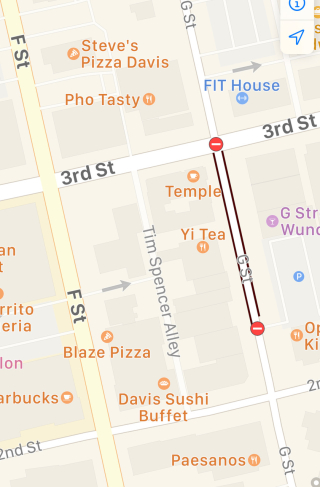
    G st closure

    Dear Mayor Partida, Davis City Council members, Liaisons and Managers,

    Thank you for your attention and consideration to re-open G Street to traffic.

    The city staff has published their recommendation for only a partial re-opening of G St, only one lane of traffic but the data from the DDBA’s survey contradicts their recommendation.  To their point of rescuing restaurants from failing during the Pandemic, they succeeded. It is a fact that a handful of restaurants are profiting with increased seating capacities that exceed the their TUP proposed usage. While still, retail and locally owned businesses are still teetering on closing. We’re wondering why the deadline for the street closure over shot the August 5th deadline without a word from the City. We were never asked about the street closure in the first place. I hope the City will try to help all businesses downtown from the economic effects of the pandemic to keep a diversified culture and serve the entire community. This should align with your goals for a vibrant downtown and thriving neighborhoods.

    I would kindly ask the City Council review this statistical information on the advantages, disadvantages and effectiveness of full and partial street closures adapted from www.trafficcalming.org

    (more…)

    Davisite logo

    Did you enjoy reading this article? Then subscribe to the Davisite for free and never miss a post again.

  • Activists Launch Fossil-Free UC Davis Campaign

    DecarbonizetheUC

    UC Davis students protest in Davis on 9/24/21 demanding an end to fossil fuel use across the UC system. Credit: Stephen Wheeler

    (From press release) As the United Nations-sponsored COP26 climate conference begins in Glasgow, UC Davis faculty, staff, and student activists today announced a petition and educational campaign asking the university to commit to ending fossil fuel use by 2030. The petition also asks that specific policies for doing this be adopted by the end of 2022.

    Although UC Davis has made progress in improving the energy efficiency of its operations and buying cleaner electricity from off-campus, annual on-campus emissions from Davis and Sacramento campuses have remained steady at about 150,000 metric tons of CO2 since 2008. Most of these emissions are due to the university’s large methane-fueled heating and cooling plants. 56% of campus energy use continues to be generated directly from fossil fuels, mostly fracked methane. Climate activists ask that heating and cooling systems be electrified using renewably generated electricity.

    UC Davis installed a 16MW photovoltaic array in 2015 which provides about 11% of campus electricity. The university is also converting campus heating and cooling pipes from steam to hot water in a program called the “Big Shift,” a step that will make electrification easier. But the campus has yet to commit to ending fossil fuel use. In a recent message to the Chancellor, activists said “The Big Shift is just one step in the right direction. Other steps need to be identified asap, and UCD commitment to ending fossil fuel use articulated.”

    UC Campus emissions

    According to data released by the University of California Office of the President following a Public Records Act request, on-campus (Scope 1) greenhouse gas emissions have remained steady at most UC campuses since the late 2000s. Credit: Adam Arons and Eric Halgren

    The UC system has committed to reaching carbon neutrality by 2025 for on-campus emissions and purchased power. But while purchased electricity has gotten cleaner, on-campus emissions have yet to fall at any UC. To meet the 2025 goal, campuses plan to buy carbon offsets, which claim to reduce GHG emissions elsewhere in the world.

    However, there are major questions whether offsets would represent permanent and verifiable GHG reductions that would not have occurred otherwise.[1] The UC Office of the President has so far been unable to identify nearly enough offsets for UC campuses. Activists ask that campuses instead end fossil fuel use and commit to electrifying operations.

    (more…)

    Davisite logo

    Did you enjoy reading this article? Then subscribe to the Davisite for free and never miss a post again.

  • Comments for the Natural Resources Commission review of DiSC 2022

    TrafficThe following comments were shared with the Natural Resources Commission at its meeting last night and are reposted here with permission of the author.

    This is Alan Pryor speaking as a former 12-year NRC Commissioner. I think it's telling to review a comment made by a Planning Commissioner at a hearing on this project last year.

    "You want this to be the most sustainable, innovative tech campus in the United States. But you have come to us with a car-dominated, auto-centric proposal on the edge of town, far from the capitol corridor station, not linked to good transit, with huge parking lots and parking structures. Widening Mace to accommodate more traffic is not the answer. It's going to induce more traffic."

    Nothing has functionally changed with this project since then except its size is been reduced by less than half but the applicant is now proposing transportation features that are even less conducive to non- automotive forms of transportation.

    For instance the applicant is now refusing to construct the previously agreed upon off-grade crossing to allow arriving pedestrians and bicyclists to safely cross six lanes of Mace Boulevard during rush-hour traffic. How is that possibly welcoming to bicyclists and pedestrian employees arriving on the west side of the street or to school kids living at the project trying to get to school and back each day without a parent driving them.

    Also, the original proposal was an environmental nightmare in that it projected over 83,000,000 lbs of CO2 equivalent emitted each year. The new estimate is about  45,000,000 lbs of CO2 equivalent per year – or about 4.5% of the City's current carbon footprint for this one project alone. All of these emissions would have to be later eliminated for the City to reach carbon neutrality by 2040 but the developer has not proposed how they will do this.

    (more…)

    Davisite logo

    Did you enjoy reading this article? Then subscribe to the Davisite for free and never miss a post again.

  • Use of American Rescue Plan Funds (ARP) to obtain an Urban Tree Canopy Assessment and Report

    Street-treesThe following letter was shared with the Davisite this morning.

    Dear City of Davis ARP Subcommittee:

    The City of Davis' urban forest is comprised of trees, gardens, green spaces and other natural areas. This urban tree canopy provides a myriad of benefits making our communities cleaner, safer and healthier while reducing the costs associated with many services. Managing, monitoring, and enhancing this important resource is critical to sustained economic development and environmental health.

    I am requesting that sufficient ARP funds are dedicated to allow for: (1) A complete analysis of Land Cover and Urban Tree Canopy; (2) Assess an Ecosystem Benefits Analyses, including: air quality, energy, stormwater, and carbon; (3) GIS-based and other tools to model strategic tree canopy development scenarios; and (4) Complete training for Davis Tree Canopy Partners, such as Tree Davis and the Tree Commission, on use of these tools to accomplish management objectives.

    Urban Tree Canopy Assessment and Report (UTCAR) would be a onetime use of ARP Funds and benefits all living animals and humans regardless of gender and group stereotypes, including race, age, ethnicity, ability level, socioeconomic status, or sexual orientation. An UTCAR would bring data from various studies to evaluate and understand the extent and value of the region’s trees and to provide a benchmark of the urban tree population, land cover, and the value of the current and potential future urban forest.

    The data and tools produced will enable planners, managers, and commissioners to develop strategies for community development, air quality enhancement, energy conservation, stormwater management, and community forest management.

    The UTCAR would be conducted in a manner that defines and quantifies various environmental and economic benefits of the region’s tree canopy, known as ecosystem services, focusing on air quality, energy use, stormwater, and carbon sequestration.

    The dynamic modeling tools developed for this project would allow planners and managers to envision and plan their desired future urban forest. With these tools, users identify and prioritize strategic tree planting areas based on management objectives, and create alternative designs and cost/benefit scenarios at a regional-scale or for specific sites.

    Though the City of Davis' urban forest is relatively young, it nonetheless provides substantial benefits that can be quantified, monetized, forecasted and enhanced over time with proper planning and management. To maximize the function and value of the urban forest resource, it is critical to target canopy increases strategically and to educate policymakers and citizens about the benefits of urban tree canopy.

    Thank you for your consideration.

    Sincerely,

    Tracy DeWit

    Davisite logo

    Did you enjoy reading this article? Then subscribe to the Davisite for free and never miss a post again.

  • Leeward Renewable Energy, Valley Clean Energy Sign 15-year Solar-Plus-Storage Power Purchase Agreement for Willow Springs 3 Solar Facility

    Project to provide 72MW of solar power, 36MW of battery storage for Valley Clean Energy customers

    (From press release) Leeward Renewable Energy (Leeward) and Valley Clean Energy (VCE) announced today that they have entered into a 15-year solar-plus-storage Power Purchase Agreement (PPA) involving Leeward’s 72-megawatt (MW) solar and 36 MW (144 megawatt-hour) battery storage Willow Springs 3 facility in Kern County, California.

    VCE’s board of directors approved the PPA on October 14. The Willow Springs 3 project will supply enough reliable, clean electricity for approximately 27% of VCE’s 125,000 customers in Yolo County, California, by the end of 2023. The agreement will also support VCE in achieving its goal of having a 100 percent carbon-neutral portfolio by 2030.

    As part of the agreement, Leeward will contribute to VCE’s local workforce development and sustainability efforts in Yolo and Kern counties to support local hiring and training.

    (more…)

    Davisite logo

    Did you enjoy reading this article? Then subscribe to the Davisite for free and never miss a post again.

  • Letter to the Tree Commission re: DiSC 2022

    Red leaves

    One of Davis's urban trees

    To Davis Tree Commission:

    In regard to the DISC proposal (Item 6B on your agenda this evening),  I support your subcommittee's recommendations and encourage you to recommend them as a "baseline feature".

    Given that the size of the proposal is already known, recommendation of a specific number of trees should be achievable (as it was during the previous iteration of the proposal).

    I understand that the developer is proposing to satisfy shade requirements via the use of solar panels or trees. Unfortunately, this type of "choice" will increasingly be used by developers, as we've already seen in regard to Sutter Hospital's expansion. It may be that developers generally prefer solar panels, to help them meet other requirements (and to claim that a given proposal is "green", while simultaneously eliminating "greenery" in regard to trees).

    At some point, the city itself will need to come up with a clear policy regarding the use of solar panels vs. trees for given situations. While either can be used in parking lots, trees (unlike solar panels) require soil and space to survive. As such, solar panels are suitable for a wider variety of locations (such as rooftops), while trees are not.

    Until/unless the city comes up with a clear policy (supported by the tree commission), I would encourage the tree commission to not be distracted by an "either/or" choice, and simply focus its efforts on recommendations regarding trees and the benefits they provide.

    Sincerely,

    Ron Oertel

    Davisite logo

    Did you enjoy reading this article? Then subscribe to the Davisite for free and never miss a post again.

  • Credit Where Credit is Due

    People PowerBy Larry Guenther

    At Tuesday's meeting, (10/19/2021) City Council acted on recommendations made by a Council subcommittee, one of two subcommittees to look at the issue of "Reimagining Public Safety." Most of the discussion and credit for these changes was focused on the work the City Council subcommittee did. While the Council Subcommittee did do real work on producing these recommendations, there was a mere mention of the work done by a Joint Subcommittee of the Human Relations, Police Accountability, and Social Services Commission. Councilmembers and staff made almost no mention at all of the contribution from the rest of the Community.

    The Joint Subcommittee did an enormous amount of work and research to make Nine Recommendations to City Council for changes that would create a more effective and just Public Safety system. Members of the Joint Subcommittee included: Cecilia Escamilla-Greenwald, Dillan Horton, Judith MacBrine, Don Sherman, Susan Perez, Bapu Vaitla, Matthew Wise, Sheila Allen, Emma O’Rourke-Powell, and Judith Plank.

    Additionally, many community members put in countless hours of work, research, and thought that laid the ground work for the Nine Recommendations and, in fact, created the roadmap for the path the City is taking. Yolo People Power and the Yolo Democratic Socialists of America were two community groups that took the lead on this issue. Julea Shaw, Jordan Varney, Morgan Poindexter, and Francesca Wright of Yolo People Power stand out. These women were instrumental in analyzing Police Data, researching non-traditional and successful Public Safety programs in other municipalities, and educating and organizing community members. 

    If you see any of the people mentioned in this letter, please thank them. Their work has been instrumental in moving Davis Public Safety to a more effective and just system.

    Innovation and change comes from the Community.

    Davisite logo

    Did you enjoy reading this article? Then subscribe to the Davisite for free and never miss a post again.

  • Criticism of failure to restore strong affordable housing policy draws attack from Carson

    Sterlingby Colin Walsh

    I delivered this comment to the Davis City Council on 10/19/21 and received a very unprofessional attack from Council Member Carson in return. The comment was given in relation to the "Affordable Housing Ordinance – Extension of Alternative Rental Housing Requirements and Preliminary Scope of Work for an Update of Affordable Rental Housing Requirements" agenda item in which the Council voted to extend the weak interim inclusionary affordable housing ordinance.

    —–

    On February 6 of 2018 the Davis City Council approved the 2nd attempt at the Nishi project. This project had what has proven to be an unworkable exclusionary affordable housing that forces people accepted into the affordable housing to sharing a room. What’s worse is the combined cost of the two people who share the room is higher than that of market rate single room.  Worse there are only 264 affordable beds out of 2200 beds. Beds not units. Most of the market rate is not shared.

    (more…)

    Davisite logo

    Did you enjoy reading this article? Then subscribe to the Davisite for free and never miss a post again.

  • Comments to the Tree Commission concerning DiSC 2022

    Screen Shot 2021-10-19 at 9.55.57 AMThe following was emailed to members of the Tree Commission this morning.  The Tree Commission is scheduled to discuss the revised MRIC/ARC/DISC project, now dubbed DiSC 2022, at its meeting this Thursday, Oct 21.  If you wish to comment on the project yourself, see instructions on the agenda for the meeting, located here.

    Dear members of the Tree Commission,

    I am writing to you as a former commissioner (10+ years) and Chair of the Open Space and Habitat Commission (OSHC), having completed my term last December. I was involved in analyzing what is now being called the DiSC 2022 project in all of its iterations, so I hope you find my comments helpful in your discussions.

    I think it's great that you appointed a subcommittee to review all the materials, given that the changes are more extensive than the City has stated – this is not just a project that has been cut in half, as your subcommittee's analysis shows. I endorse your subcommittee's recommendations and encourage you to adopt them as a body in the strongest possible language, remembering that the only way to guarantee that a promised feature will be in the actual project is for it to be designated as a "baseline feature." A cautious route would have you even recommend that the relevant ordinances be satisfied (this was something that the OSHC did last time), since there is a history of the City Council bending its ordinances, including ordinances concerning trees (it is my belief that they did this in the recent Sutter parking lot decision).

    (more…)

    Davisite logo

    Did you enjoy reading this article? Then subscribe to the Davisite for free and never miss a post again.

  • Yocha Dehe Joins The Sierra Club, Yolo County Farm Bureau, And Residents, To Demand Sensible Cannabis Land Use Policy

    Tribe joins suit calling for changes to flawed Cannabis Land Use Ordinance

    (From press release) In an effort to hold Yolo County accountable for developing fair and sound cannabis land use policy, the Yocha Dehe Wintun Nation has partnered with the Sierra Club, Yolo County Farm Bureau, and local residents in a lawsuit to do precisely that.

    The lawsuit does not seek to stop cannabis cultivation and related businesses in Yolo County, or to prevent County residents from profiting from the cannabis industry.  Rather, it would simply require the County to comply with California environmental law by evaluating the full and real impacts of cannabis cultivation, and mitigate those impacts, before adopting an ordinance regulating it.  Adhering to this process is what the California Environmental Quality Act requires, and indeed, these same requirements apply to every other regulated land use.

    “The cannabis industry has a place in Yolo County, just as cannabis has a place in the medicine cabinets of many people in California,” noted the Tribal Council of the Yocha Dehe Wintun Nation. “But sensible cannabis permitting can’t happen until the County is clear-eyed about the problems overconcentration creates, especially in sensitive areas around schools, near cultural heritage sites, and in smaller communities like those in the Capay Valley.”

    (more…)

    Davisite logo

    Did you enjoy reading this article? Then subscribe to the Davisite for free and never miss a post again.