

By John Smolenski
I went to the town hall Eric Jones held on August 26 at Watermelon Music. I came away from the town hall without a clear sense of why Jones is running for Congress in District 4 and what he hopes to accomplish. This emerged as he talked about the policies hoped to enact if elected to Congress. (That he showed more enthusiasm regarding an endorsement from Republican candidate Raymond Riehle than he did for the Democratic party’s goals seemed telling.) Comparing what he said at his town hall to what I found re-reading his website only compounded this sense. It’s not entirely clear what Jones stands for, especially since his policies have moved significantly to the right since the primary, as he sought Riehle’s endorsement. In many respects, it seems as if this movement has happened less as a ideological evolution than an opportunistic attempt to get elected. I do not believe Jones is a viable choice for progressives seeking change in Washington.
Jones opened his town hall laying out his major political priorities: corruption, healthcare, and affordability for residents of District 4. Jones argued that democracy had been co-opted by capitalism, creating a “corrupted system.” He came out in favor of term limits, pledging to serve not more than twelve years if elected, and a ban on stock trading for members of Congress. He also condemned gerrymandering, saying that “both sides” have abused the system: Republicans in California have less representation, while Democrats in Texas and South Carolina have less representation.
This equivalence was somewhat surprising, and not merely because of Jones’s previous support for Proposition 50 in California. (He now says that he is “ashamed” of his past position — see screenshot below). Jones seemed not to realize that Democrats had challenged redistricting in Texas, South Carolina, and elsewhere for being racially discriminatory, not merely for partisan reasons. A both-siderism that ignores the history of Republican attacks on the Voting Rights Act and repeats conservative talking points does not represent a progressive approach towards handling political corruption.

I found Jones’s healthcare proposals somewhat contradictory. He said he believes in a world where all everyone has healthcare in America. He pledged to support Medicare, with a particular focus on making it more accessible to rural areas and expanding it to include dental and vision benefits. But he also came out against Medicare for All, fearing that it could simply become a way to enrich the insurance industry (pointing out that many in the insurance industry favored Medicare for All). Jones was unclear about what kind of healthcare system he envisioned, particularly how those not eligible for Medicare would be covered. Given Jones’s experience in the healthcare sector—he noted during the question and answer and states on his website that he has created thousands of jobs in this area—this was frustrating. I came away thinking that his lack of support for Medicare for All was due solely to the fact that it might enrich insurance companies. Meanwhile, his support for expanding Medicare would also increase the profits of insurance companies.
Jones said he hoped to address affordability in two other ways. First: he proposed eliminating federal taxes for households making under $150,000, which might give California households a $10,000 tax break (but would cost hundreds of billions of dollars a year in revenues to the federal government). He suggested that enforcing current IRS rules and forcing corporations to pay could pay for this tax break. No need for anyone to see their taxes raised. Second: he pledged to take on PG&E, curb rate hikes, and reduce its role in politics.
Jones ended his opening pitch by stating that while he identified as a Democrat that he was not a proud Democrat, that he did not agree with the party establishment on “basically anything, not on health care, not on war, not on corruption, not on taxes, not on the environment.” If elected, he hoped to work on issues that voters on the left and right cared about, like healthcare, corruption, and utilities. He noted that he heard this message talking to Republican voters at recent campaign events, who told him how much they felt that Sacramento had left them behind.
The question-and-answer portion of the townhall was, in my view, ultimately disappointing. I asked Jones about one of his proposals on his website, where he came out in favor of setting an expiration date on every federal program (except Medicare and Social Security). Each program would undergo a full federal review or expire. I pointed out that this idea of “sunsetting” programs is championed by the Heritage Foundation and the Cato Institute, two major conservative think tanks, and said that I was surprised Jones had embraced these conservative ideas. I noted that he had exempted Medicare and Social Security (a recent change) and asked how he would decide which other programs he would exclude. Would he support, for instance, sunsetting Supplemental Nutrition Associate Program (SNAP) or the National Science Foundation (NSF)?
Jones responded that sunsetting SNAP would be off the table, given how important it had been for his family growing up. But he failed to articulate any coherent reasoning that would guide his decisions regarding which programs would come up under review, though he suggested sunsetting Immigration and Customs Enforcement. Jones suggested that this was a lack of political skill, where he was using “code word[s] for things I didn’t mean” and that he really couldn’t give any specific answer to my question. He ended his response by saying he’d love my advice on how to pick programs for review and communicate his thoughts more clearly.
This exchange left me wondering, though. How would he decide on what was safe and what was not? SNAP was off the table, but what about the NSF? The Environmental Protection Agency? The Consumer Product Safety Commission? The National Labor Relations Board? Did he have a guiding philosophy here?
Moreover, the lack of clarity seemed (and seems) to me not a question of communication or execution, but rather a question of political values. There is a reason that right-wing think tanks like the Heritage Foundation and the Cato Institute have embraced sunsetting laws and why the conservative lobbying group American Legislative Executive Council writes cookie-cutter legislation for states to enact these laws. It’s because sunsetting laws can easily be used to shrink government services. I found it truly worrisome that Jones would adopt this position without thinking more carefully about its implications. I was not flattered that Jones asked for my advice on this topic (and actually don’t believe this was a sincere request). Frankly, I would think that a candidate for Congress would have a better idea about how they would approach government programs and not need to outsource this to questioners at a townhall. This is especially the given that Jones had, only a few days before the town hall, sent out a press release in an attempt to clarify his position. Apparently, things are still a work in progress.
I also asked Jones if he was in favor of a wealth tax and was very heartened to his full support for one. Arguing that unrealized capital gains allowed for too much concentration of wealth at the top of society and hurt economic growth, he called for a “forced sale rule” as one way of taxing money that individuals like Elon Musk have accumulated (mentioning Musk by name).
I was, though, disappointed in Jones’s discussion of foreign policy. When asked about Israel and Palestine, Jones offered a commendable response: “No U.S. taxpayer should ever be paying for a bomb that kills a child or a member of a foreign country,” something he believed should be true whatever one’s feelings about Israel’s right to exist or the viability of a two-state solution. This answer seemed to suggest that the United States should limit military aid to Israel (see screenshot below). Jones states that he believes that every military aid package, to every country, should be passed through an open vote and be subject to conditions: allies must “follow international law and respect human rights,” continuing with “your tax dollars should never underwrite a foreign leader breaking the law and killing innocent people.”)

While I firmly support the idea that no American military aid should go to countries who violate international law, I wish that Jones was willing in the town hall to come out and named Israel as a violator of international law, if he believes that. Being asked a question about Israel and Palestine and shifting immediately to a blanket stance that no taxpayer money should go for bombs that kill children was tantamount to a declaration of “All Lives Matter” in the Middle East. I feel that it is important at this moment for politicians to be explicit on this issue (though I acknowledge that not all progressives agree). More and more Democratics agree, as 103 Democratic Congressmen voted against military aid to Israel in July (out of the 211 Democratic Congressmen who cast votes on the bill). Jones emphasized at the outset of the town hall how much he disagreed with the Democratic party on war, yet dodged a question about the war in Gaza. This did not inspire confidence in me that Jones would be willing to hard stands on controversial issues.
Two other things raised concerns in my mind. First: I was struck to the degree to which Jones refused to criticize the Republican party. Given his stance as a political novice and Mike Thompson’s twenty-seven years in office, Jones’s dissatisfaction with the Democratic establishment was hardly surprising, though he praised Ro Khanna, James Talerico, and Jon Ossoff. He did not, however, criticize any Republicans except Donald Trump. He singled out Republicans Thomas Massie and Paulina Luna for their willingness to work across the aisle and co-sponsor legislation with prominent Democrats. (This was a bit dissonant in that Massie and Luna have been the recipients of significant corporate PAC money during their times in office, an uneasy fit with Jones’s stance that does not take corporate PAC money and that all corporate PAC money should be banned. They make unlikely heroes for a “get money out of politics” candidate.)
Jones also spent several minutes talking about how he secured the endorsement of Raymond Riehle, the Republican candidate for District 4 who finished third in June’s primary. Jones spoke about how he reached out to Riehle and asked the Republican for support. Jones said Riehle had three conditions: that Jones consult Riehle on his water infrastructure program; that Jones put more emphasis on federal infrastructure and investment on website; and that Jones add a “debt clock” widget to his website, which tracks the rise of the federal debt. Jones said he agreed and thought these all solid ideas. Jones and Riehle announced the endorsement on August 17. They even created a joint committee entitled Californians Against the Democratic Establishment.

(Jones added that he is not the only one in the race who has sought Republican endorsement. Jones told the audience about former Republican Congressman Doug Ose’s endorsement of Mike Thompson and Ose’s formation of the Republicans for Congressman Thompson Committee. However, no record of Ose’s endorsement of Thompson exists online, nor is there any record online of a Republicans for Congressman Thompson Committee.)
The second concern I had was Jones’s unwillingness to address his ties to the Dragoneer Investment Group, where he was a partner up until 2025. He responded negatively to a voter who asked about Jones’s support from Dragoneer as well as how long he had lived in District 4, suggesting these were planted questions. Jones ultimately failed to answer the latter, quite reasonable question. (Voters are entitled to know how long a candidate has resided in a district.) Regarding Dragoneer, he simply noted that its investments in OpenAI and Anthropic happened after he left the firm.
This, in my opinion, is not enough. Jones’s time at Dragoneer is central to his campaign message. When he talks about having created thousands of jobs in the healthcare field, he’s referring primarily to investments he made at Dragoneer in Maven Clinic (where he is a board member) in San Francisco, along with investments in other healthcare companies. And he was still receiving payment from Dragoneer until this July. Voters deserve to know what ties he still has to the investment firm (if any). Anti-corruption is a crucial part of Jones’s campaign, highlighted by his support for a ban on Congressional representatives trading stock while in office. Jones also says that he would “require candidates and elected officials to disclose financial conflicts of interest in real time” as a way of keeping politicians accountable. It strikes me that Jones owes the public this kind of transparency in terms of his financial and any possible conflicts of interest.
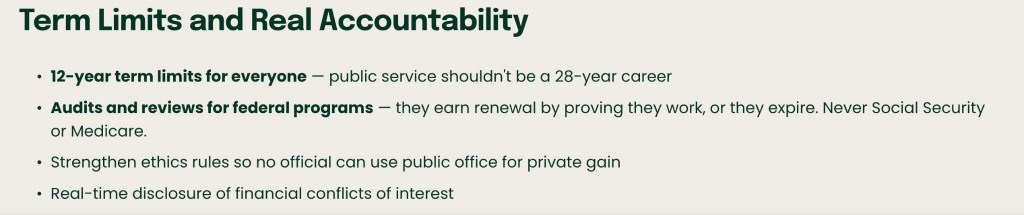
As I stated at the outset, my dissatisfaction at the townhall led to me investigate his website more thoroughly. What I found there truly bothered me.



Leave a Reply