

By John Smolenski
I wrote previously about my disappointing experience at the townhall Eric Jones held in Davis on August 26. I had previously looked at Eric Jones’s website, ericjones.us, before the townhall, simply to get a sense of him and his campaign. This reinforced my impression of Jones. It also caused me to look back at how Jones’s ideas have evolved over time. This made me question Jones as a candidate even more. Jones announced his candidacy for Congress on August 17, 2025. Over the last year, his views have undergone remarkable transformations. He has undergone a significant shift to the right, especially after the June primary. Some major issues he previously championed have disappeared from view. His political values seem like a moving target. I have been left wondering what Jones actually stands for, on key issues.
This is all drawn from ericjones.us, looking at the website as it now stands and earlier versions that can be found at the Wayback Machine. I have provided links for all screen shots.
The issues I will explore here are: immigration; taxes; housing and renting; balanced budget amendment and sunsetting programs; and abortion, childcare, and transparency. I know this article is long, so readers can scroll down to find a particular item they might be interested in.
Immigration
Jones has moved to the right on the topic of immigration. The more I have learned about Jones, the more surprising—and disappointing—this is. Jones’s father is an immigrant, a British Army veteran. His father, Jones said on an Instagram post from June 2025, “came to America with zero dollars in his pocket.” In that same Instagram post, Jones celebrated America as “the world’s only multi-racial, multi-ethnic democracy,” stating that the United States is “a country of immigrants” who arrived to fight for “a better future for yourself, your kids, and your communities.” He concluded by thanking his dad “for the chance to be an American.” Jones has personal experience with the difficulties poor immigrants face.

Jones is of course not obligated to talk about this part of his past, and when he talks about being from a military family he does not mention that his father is a veteran from the British, not US, Army. But it is one place where I would have loved to hear how his personal story connected to his stance on immigration.
Jones was a staunch supporter of immigrants before he even ran for office. He publicly condemned ICE and the effect ICE’s terror campaigns have had on immigrant communities and put these principles in action. In an op-ed piece published in the Press-Democrat published before he announced his candidacy, Jones said that ICE’s actions were “purposefully punishing people and fracturing families” and “a scourge on our nation.” (“Close to Home: Immigration Crackdown Conflicts with American Values,” Press-Democrat, August 4, 2025 ). Moreover, the Eric and Rachel Jones Foundation has given financial support to the Immigration Institute of the Bay Area, the largest provider of immigration legal services in Northern California. This is an admirable record.

So it was not surprising that Jones laid out a strong set of policies regarding immigration that included support for immigrants and fiercely condemned ICE. Among the other items in his Five Point Plan, he insisted that ICE protect immigrants’ constitutional rights, and supported accountability for federal agents, with “clear statutory pathways for investigation, discipline, and civil liability when rights are breached.” He called for a “clear, earned path to permanent legal status and eventual citizenship” for non-violent undocumented immigrants, adding that “bringing people out of the shadows makes our communities safer and stronger.” He also called for more training for ICE agents to meet the same professional expectations other law enforcement officers followed. He even called for moving ICE to the Department of Justice.
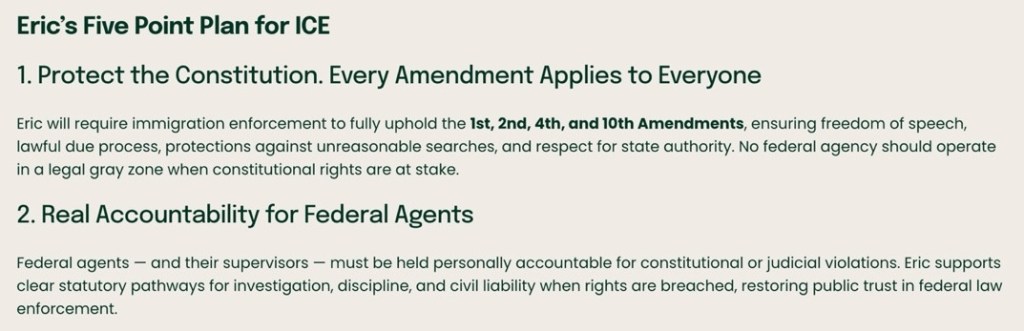
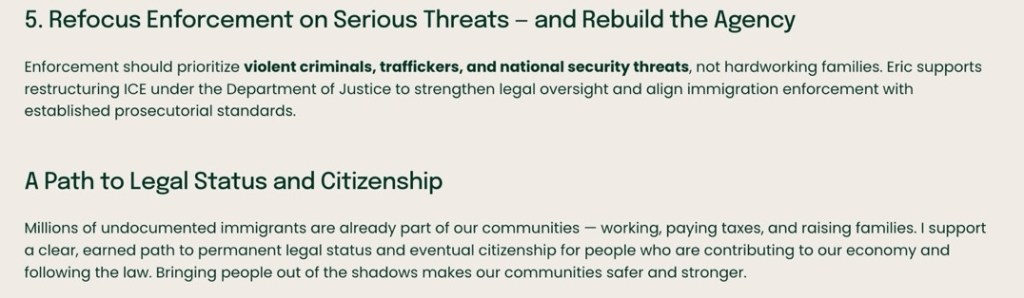
Now, it is true that many progressives would disagree with some of these policies, perhaps by pushing for ICE’s abolition and not its reform. But Jones took a strong stance on the rights of documented and undocumented immigrants and the need to protect them from harm. Nor did he use coded language, such as “securing the border,” that conservatives so often employ to whip up anti-immigrant sentiment. And his repeated emphasis on the need for a path to citizenship is something that too few Democrats articulate. Before the primary, Jones seemed like a strong candidate on immigration.
After the primary, Jones’s stance changed. By the end of July, the page on his site that had his earlier, more progressive priorities disappeared. One of the things that disappeared was his platform on immigration. As of September 18 (when I am writing this story), his campaign site does not mention immigration directly at all. Searching his entire website reveals that neither the words immigrant nor immigration appear at all on the site. (Nor does he mention ICE.) He addresses the question of immigration only obliquely, in his platform entitled “Get Our Growers the Workforce They Need & Protect Those Workers.” Jones’s top priority here? “Protect our own workers first,” limiting the H-2A program to “support Americans working in rural and agricultural jobs.”

Jones previously celebrated immigrants as part of “our communities.” Now they are not; he wants to focus on “our own workers first,” a category that only includes “Americans working in rural and agricultural jobs.” The difference is sharp.The difference is sharp.
His ideas about naturalization have changed as well. Jones no longer calls for a path to “permanent legal status and eventual citizenship” for documented and undocumented immigrants. Now he wants a “workable legal channel for the people already doing the work, and a status for the experienced hands who have been here for years, raising families and paying taxes.” This policy change turns community members into workers alone. Compare how his language on immigration has changed over two months.
On June 3, 2026:

Today:

“Permanent legal status and eventual citizenship” has become “workable legal channel” or merely “a status.” Immigrants who used to be part of “our communities” have become “people already doing the work,” or just “experienced hands.” Jones no longer mentions citizenship and has, as I noted above, purged the words and immigration from his site. He has gone from a platform that emphasized human rights, dignity, community, and the possibility of inclusion in the nation as a full and equal citizen for everyone who lives here to a dehumanizing platform that treats people as workers who might, though a legal channel, get a status. Language matters, especially at a moment when our government is hellbent on terrorizing non-white citizens and non-citizens, documented and undocumented immigrants alike.
I can only wonder how the people at the Immigration Institute of the Bay Area feel about Jones’s change of heart, or how he squares this with Instagram Reels thanking his father for the chance to be an American.
Taxes
Jones tax policies have changed over the campaign, and not for the better.
Jones began his campaign with an eye towards tax fairness. His “Fair Share Refund” was his top priority on the early iterations of his site. He wanted $10,000 to go back in the wallets of California families to make life more affordable.
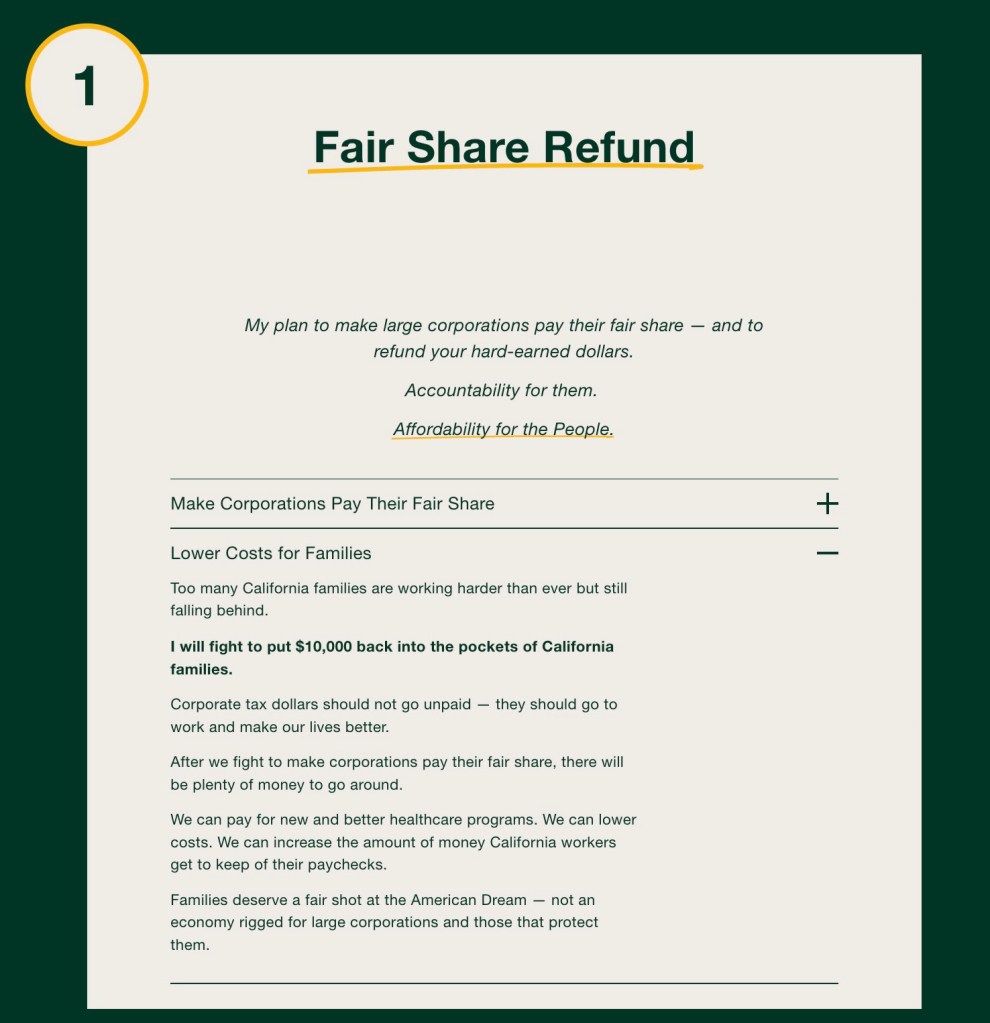
By the spring, Jones had revised this slightly, specifying that he wanted a $10,000 tax-credit for working- and middle-class families to help Californian households.

Screenshot taken September 18, 2026
Now, though? After the primary? Jones has expanded his tax policies to include some long-time conservative ideas. In addition to a refundable $10,000 tax credit, Jones now supports an elimination on all income tax under $15,000
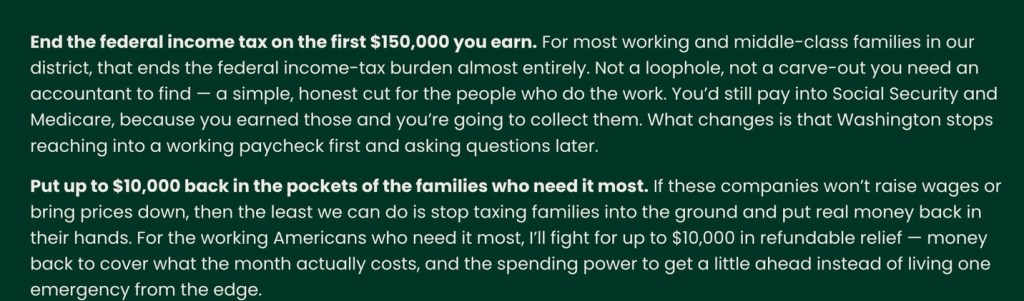
This will cost the Treasury hundreds of billions of dollars, but Jones believes that corporations will pay for all of it. Through a corporate tax increase? Not exactly.
Jones started out his campaign last fall with a staunch position on corporate tax rates—he thought they were too low.
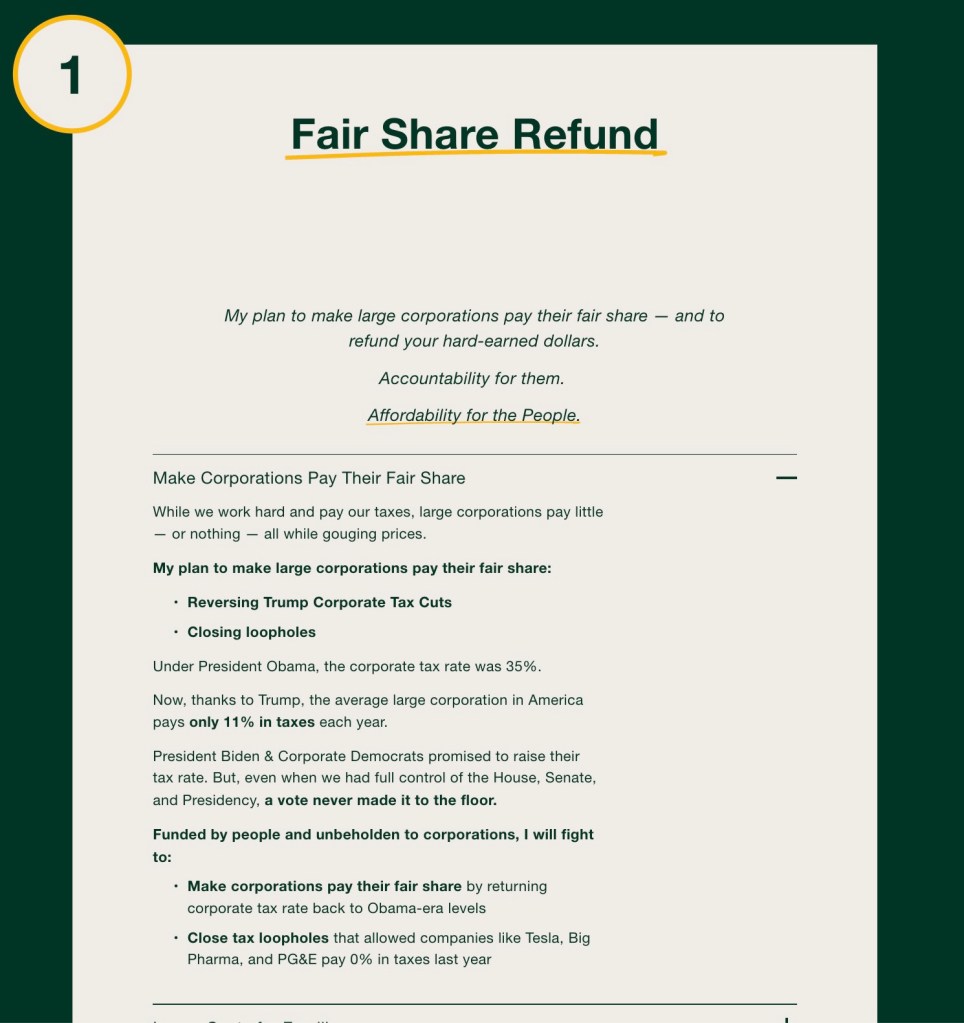
Screenshot taken September, 18, 2026
He continued to support this through the spring, up until the primary.
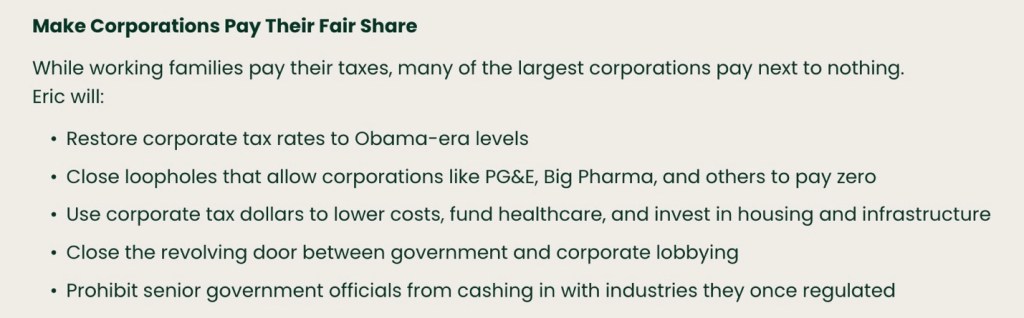
https://web.archive.org/web/20260430070730/https://www.ericjones.us/corruption
After the primary, though, Jones sang a different tune. He still believed that corporate tax revenue would pay for income tax cuts—but only by ending loopholes. keep corporations from paying their fair share. Cutting out fraud and waste, he says, will cover the tax cuts and rebates. Curiously, nowhere does Jones suggest raising taxes on anyone. Anyone. It is frankly astonishing to me that a candidate billing himself as a progressive is interested in undoing the massive tax cuts for the wealthy in the One Big Beautiful Bill and raising income taxes on the rich.
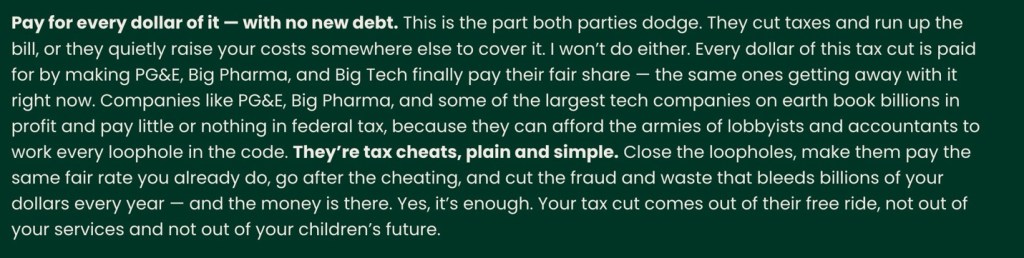
(Screenshots taken September 18, 2026)
This is a seismic shift. Raising corporate tax rates was the first item listed in his first priority at the outset of the campaign. Jones believed that he had identified the problem: “President Biden and Corporate Democrats” who promised to raise corporate taxes but “a vote never made it to the floor. (emphasis original).” Well, now times have changed. Jones stated at the townhall that he disagreed with establishment Democrats on taxes. Apparently, this disagreement hinges on the fact that establishment Democrats think corporations should have higher tax rates than they do now, while Jones thinks the corporate tax rate is just fine.
(Jones made this clear at the townhall, when he said “Our plan to balance the budget relies on raising corporate tax, or just enforcing the corporate tax code, but functionally raising tax, charging appropriate taxes for America’s largest corporations….That’s 1.2 trillion from simply enforcing a 21% tax and enforcing the individual tax code.” Raising the tax code becomes a shorthand for just enforcing the current code.)
Losing the primary apparently caused Jones to be more ideologically flexible on fiscal issues. As he states

Screenshot taken Sept 18, 2026
The idea that cutting waste and fraud can pay for tax cuts without any income tax increases at all has been a cliché in Republican political language since the 1980s. Jones certainly draws from both sides in his tax place, just much more from one side than the other.
So who would benefit from Jones’s new platform? Working-class families in the district would still get a $10,000 refundable tax credit, which would help pay rent, buy groceries, see the doctor, and much more. An elimination of taxes on all income below $150,000 is a different story. It would benefit households at the median income in the district, to be sure. But it would benefit higher-earning households much more. A household making $150,000
Jones’s position on personal income taxes moved to the right as well. Before the primary, Jones supported a $10,000 tax credit refund to working class families. He ideas have changed. He still supports this tax credit refund, but now also proposes eliminating taxes on all income below $150,000. This change would benefit households at the median income in the district, to be sure. But it would provide a much larger benefit to families in the district making more money. A household making $150,000 would get thousands more back than working class families.

Screenshot taken on September 18, 2026
On his website now, he writes that “More than 4 in 10 families here rent, and most earn well under $150,000—so this isn’t a cut aimed at people who already have plenty.” It is curious, then, it benefits some of those other families significantly more.
Housing and Renting
Jones’s housing plan has changed over time as well. Before the primary, he developed a plan to help people become homeowners. It was a bold plan as Jones wanted to build 2 million houses a year and make them affordable. Jones was thinking big, at a time (before the primary), when he still believed in Obama-era corporate tax rates.
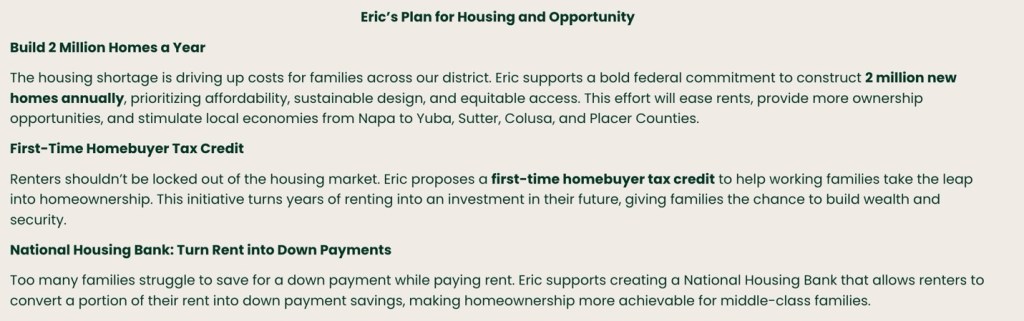
Screenshot taken September 18. 2026
Jones further developed this program after the primary, suggesting that would creating a system modeled on the Veteran’s Association housing loan program that would be able to help first-time buyers purchase housing with no money down. He has kept his support for the first-time homebuyer tax credit.

Screenshot taken on September 18, 2026
Jones also proposes the creation of a National Housing Construction Bank, to fund the construction with up to 2 new million new homes a year. A bank, he believes, can fund itself and make a profit.

Screenshot taken September 18, 2026
Two million homes a year is a lot, Jones admits, but, he notes, “[t]he country used to do big things on purpose. We need aspirational goals again—national projects we can all get behind—and this is one of them.”
Jones promises it can all be done without new debt. How? Even if the housing loan program and construction bank never cost a dime—which is a large if—there is still another tax credit involved. The answer? Closing corporate loopholes.

Screenshot taken on September 18, 2026
This is a bold plan premised on enforcing tax policy but not raising taxes on anyone. Jones is correct that the nation used to do big things, like the Great Society. But it also did so with a top marginal tax rate of 77% and not 37%. (The top marginal rate in 1944, when the VA loan program Jones wants to emulate was founded, was 94%.) Big programs have, in the past, gone along with higher taxes. Perhaps Jones’s housing plan might also have been easier ten weeks ago, when he still believed in raising the corporate tax rate to Obama-era levels.
Since the primary, Jones has also expanded his thoughts on renters. Now he proposes giving renters the same tax benefits that homeowners get. Just as homeowners can deduct mortgage interest from their taxes, Jones proposes “making rent tax deductible” by giving renters a tax credit for their monthly rent (with an undefined limit so that it would not pay for luxury high-rise apartments).

Screenshot taken on September 19, 2026
Jones vows to pay for this “by making real estate tax cheats pay what they finally owe.”

But this, again, this plan represents a commendable plan to help working-class without actually raising taxes on anyone.
It is also unclear who this policy would help. A tax credit would do nothing to households making $150,00 a year or less, since they would not be paying any income taxes under Jones’s proposed plan. Is Jones planning to help households earning $200,000 a year but rent? Perhaps Jones that those households that rented really needed a break.
Balanced Budget Amendment and Sunsetting Programs
Now, if my questions make me sound like too much of a Republican deficit hawk, the reason is that Jones has become one too. After the primary, Jones proposed a long-time Republican chestnut: “a balanced budget amendment in both Sacramento and Washington.” This could be accomplished, he believed, by limiting new programs sharply.
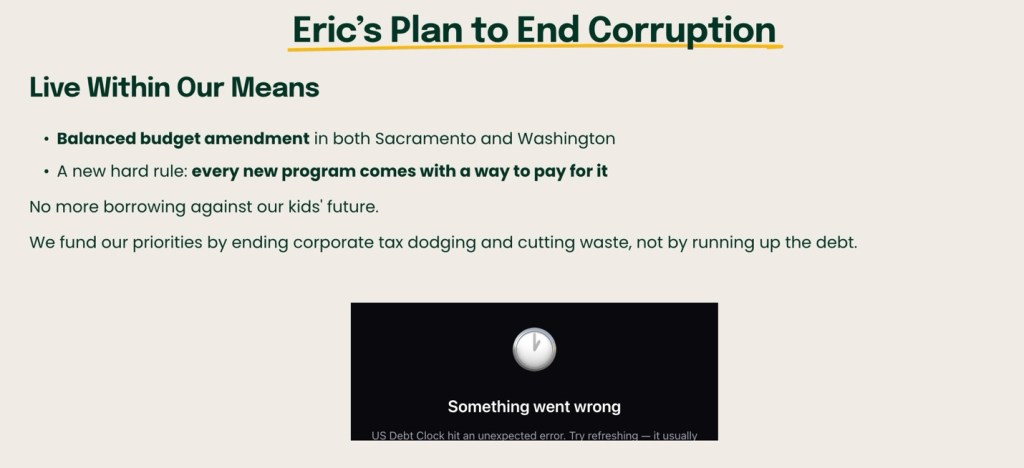
Screenshot from Jones’s campaign webpage on July 28, 2026
Screenshot taken September 18, 2026
(Note: the “Something went wrong” rectangle is a widget to the national debt clock, found at https://www.us-debt-clock.com/)
Letting aside the fact that Congress does not have the power to amend California’s constitution, a balanced budget amendment has the potential to slash all federal spending, current and future, which is why Republicans regularly push for it. (Mostly recently, Republican Congressman Jay Obernolte from California opening the 119th Congress in January 2025 with such a proposal.) This kind of slashing would be necessary in part because of Jones’s newfound opposition to raising tax rates.
Along with the balanced budget amendment, Jones endorsed another Heritage Foundation favorite: sunsetting programs.
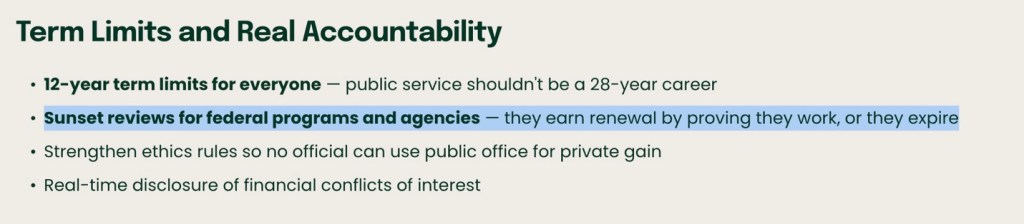
Screenshot taken September 19, 2026
As Jones explained it, he would “[m]ake every program earn its place with sunset reviews. A sunset review is simple: instead of running forever on autopilot, a program or agency gets an expiration date and has to prove it still works before renewal — real goals, real numbers, an independent audit of where the money went. Pass and the program continues. Fail or finish the job and it expires or gets rebuilt.” (Rebecca Wasik, “Jones’ stance on entitlements stirs controversy,” Davis Enterprise, August 21 2026). In other words, all federal spending was potentially on the chopping block.
Jones later updated his position, promising to “[m]ake everything prove its worth — except what people already earned. Social Security and Medicare are protected, permanently. A sunset review is simple: instead of running on autopilot forever, a program gets an expiration date and has to prove it still works before renewal — real goals, real numbers, an independent audit of where the money went. Pass, and it continues. Fail, or finish the job it was created to do, and it expires or gets rebuilt.” (Rebecca Wasik, “Jones’ stance on entitlements stirs controversy,” Davis Enterprise, August 21 2026 , linking to https://www.ericjones.us/priorities/fight-corruption/term-limits). Notably, Medicaid, another entitlement program, was not spared from review.
His positions continued to evolve. On September 5, this section of his website read “Make everything prove its worth—except what people have already earned. A federal review is simple: instead of running forever on autopilot, a program or agency gets an expiration date and has to prove it still works before renewal — real goals, real numbers, an independent audit of where the money went. Pass and the program continues. Fail or finish the job and it expires or gets rebuilt.” He continued by saying that this was meant for “what Washington never touches: the defense contracts that overrun by billions, the farm payments that land with the biggest corporations, the tax carve-outs that cost the treasury more than most agencies spend” (emphasis added)—still silent on what programs, exactly would be safe. As of September 18, his positions have changed somewhat:
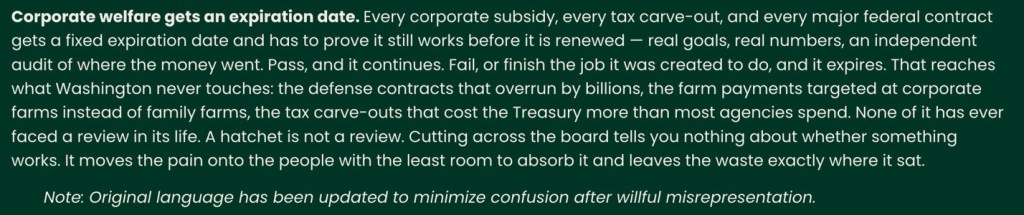
Jones now focuses reviewing and cutting corporate welfare rather than government programs, which is good. Between September 5 and September 18 he added a note about changing the original language, though he does not say how many times it has been updated. (I may have missed some.) Nor does he say what the “willful misrepresentation” was. Jones has maintained since August that “Sunset reviews are for corporate subsidies, defense contracts and tax carve-outs that have never faced accountability. Not earned benefits.” (https://www.davisenterprise.com/news/jones-stance-on-entitlements-stirs-controversy/article_6e6f66e7-63a7-4603-9e69-e05772343cd0.html ). But even as he said that, his own website put every other program except Social Security and Medicare on a potential chopping block; that language stayed there for weeks.
Some confusion about Jones’s stance on sunsetting could come from people looking through different parts of his website. Writing about protecting Society Security and Medicare in August, he promised that he would never reduce benefits. He would do so by conducting sunset reviews of many things, not just corporate welfare.

That language is still on Jones’s website today.

Screenshot taken September 19, 2026
Jones talks about sunsetting programs elsewhere on his site. He still maintains his support for a balanced budget amendment in Sacramento and Washington (though again, it is unclear why the federal government should have such control over state budgets).
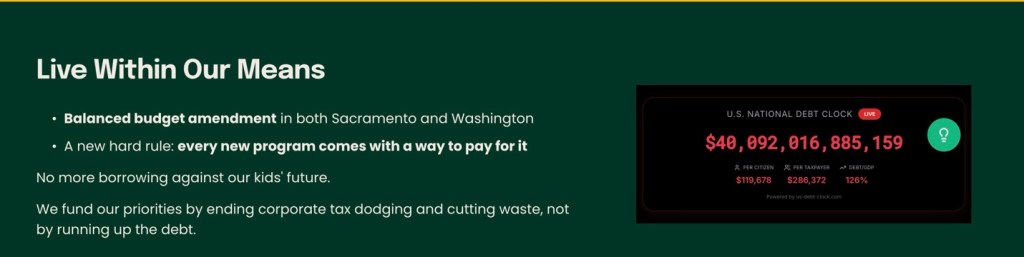
Screenshot taken September 19, 2026
This would require putting programs on the chopping block. He promises to “lead with the cut—end the waste before we ask anyone for another dime. Before a single new tax, we go after the spending no one can defend: the duplication, the fraud, the programs that fail every audit, the pet projects bought with your money.” He pledges to “[m]every dollar prove its worth before we send Washington one more.”

Screenshot taken September 19, 2026
In other words, Jones’s policies about which programs he might sunset and which would be spared has changed multiple times since the primary. Moreover, he has talked about how he would want to go about this kind of review differently in different pages of his website. (I have used screenshots here from his “Term Limits & Real Accountability,” “Defend Social Security,” and “Live Within Our Means” policy pages.)
Jones’s policies on balancing the budget and cutting spending are barely distinguishable from what the most “fiscally conservative” Republicans in Washington would say. The notion that finding and cutting waste can fix federal spending was part of the justification given for the Department of Government Efficiency (DOGE), a governmental program that both cost money and cost lives. Combined with Jones’s plan to put expiration dates on every program except Social Security and Medicare unless they pass audit, this would allow lawmakers take an axe to the federal budget, and it seems especially worrisome given the fact that Jones lacks a coherent approach for which programs would be protected from sunsetting.
(Note: Jones mentioned in the townhall that he would exempt SNAP, but he leaves no programs safe on his website except Social Security and Medicare.) Jones may say that he only wants to cut the programs “no one can defend.” But he fails to consider the very elementary point that people—and political parties—often disagree on what programs are defensible. Under a balanced budget amendment, programs politicians disagreed on might get the ax out of necessity.
At the Davis townhall, Jones said that some of the confusion over his position on sunsetting programs was a matter of language. The fact that he added a note to one page saying that he updated some language to avoid confusion. But I would suggest that part of the issue here is political values. A more coherent political vision, or a clearly set of political values, where he expressed support for the same policies across different webpages, might do a little more to tell voters what he thinks.
And what about taxes? Jones is correct that “balancing the budget won’t happen while the richest people and biggest corporations pay a smaller share than the nurse and electrician,” but suggests that the solution is closing loopholes and catching tax cheats, rather than raising any taxes.

(emphasis added)
Screenshot taken on September 18, 2026
Again, it is hard to envision a progressive with interested in balancing the budget who doesn’t support raising taxes on the wealthy. None of his bold policy proposals matter if Jones gets the balanced budget amendment he wants, as this amendment would almost certainly stop these projects from getting off the ground. It would also make it next to impossible to rebuild social safety net programs that need rebuilding after the destruction wrought in President Trump’s second term.
Again, all of these changes came after the primary. The timing of these changes is interesting, in that they came as Jones was courting Republican Ray Riehle’s support. Jones noted during the town hall that Riehle had multiple conditions for giving his endorsement, such as Jones working with Riehle to on his water infrastructure program, with a real emphasis on securing federal investment in that infrastructure, and Jones putting the debt clock on his website. Between the June primary and the end of July, Jones revised his web page to highlight the need to “secure our water,” pledging to “invest in California’s water infrastructure now” and “secure funding for the major water projects in CA-4.”
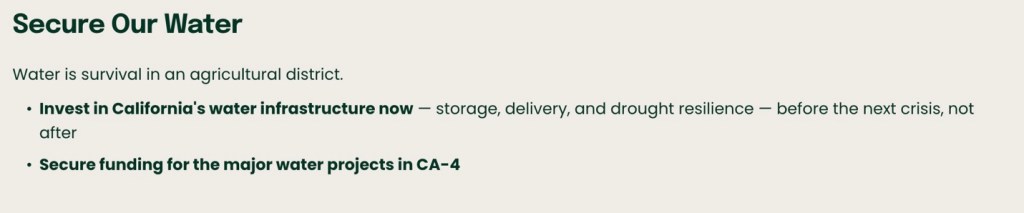
Screenshot taken September 19, 2026
He also added the debt clock widget in July. These changes in his campaign platform match Riehle’s condition for an endorsement; Riehle endorsed Jones on August 17, about few weeks after the latter changed his positions.
Jones appears to have undergone something of a metamorphosis since the primary. I’m curious: how much of Jones’s economic changes of heart had to do with Riehle’s endorsement? Jones’s embrace of a balanced budget amendment, his aversion to raising taxes, his desire to sunset federal programs to slash spending—all of these match Riehle’s priorities. They are all ways in which he has adopted a campaign platform that is in many ways Republican-lite. The timing here seems quite remarkable. I really don’t know what would be worse. Did Jones adopt these political stances in July as part of the process by which he secured an endorsement? Or are Jones’s political values are malleable enough that he could change his mind so abruptly and so quickly after he lost a primary badly in June and realized that he would need Republican voters to win the general election? Neither option is flattering.
Disappearing priorities: abortion, childcare, and transparency
Jones’s website is a testament a particular political evolution. His pledge to raise corporate taxes is only one thing that has disappeared from his campaign program. Gone in is his promise “to fight every day” for “Progressive American Values” and his assurance that he would “actually fight back against Donald Trump,” things which appeared on the earliest iterations of his campaign website.
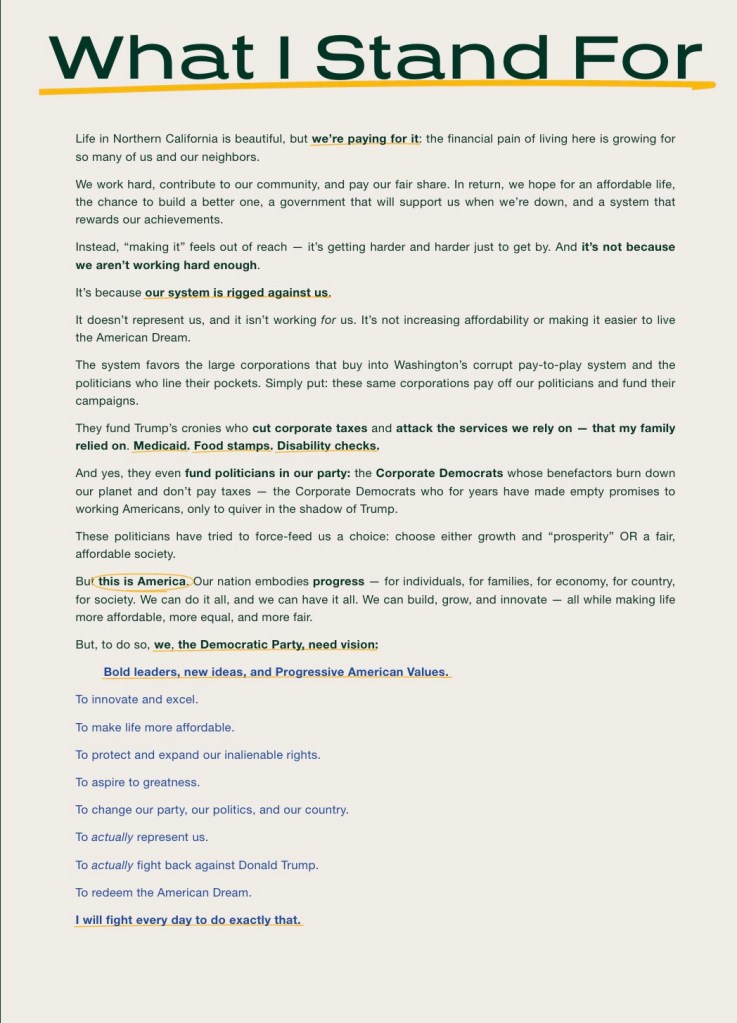
Snapshot taken September 19, 2026
(At the time of this writing, the word “Trump” does not appear on ericjones.us)
More significantly, Jones no longer offers his support for “universal reproductive care,” a commitment that included the strong declaration that “Women have a right to full bodily autonomy.” (emphasis original) “Family care was initially one of Jones’s three campaign priorities, and emphatic support for reproductive justice was a part of that. So was universal childcare.
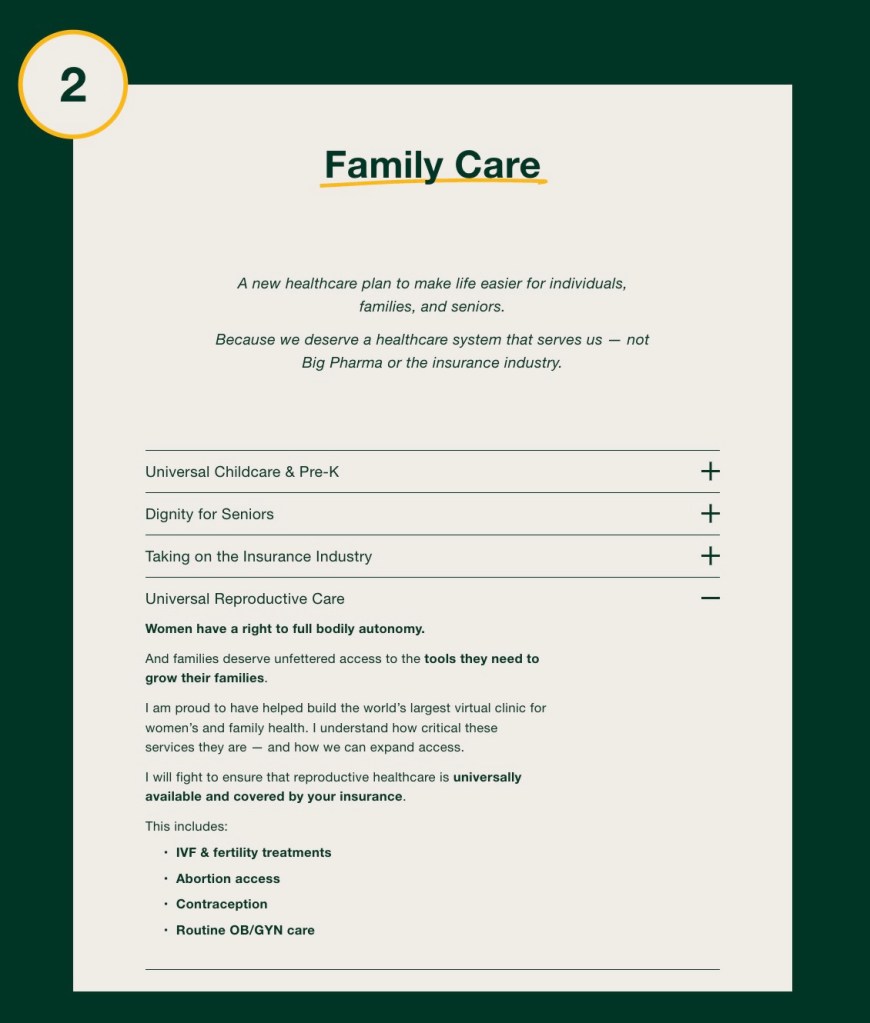
Screenshot taken September 19, 2026
Each of these issues remained central to Jones’s expanded healthcare plan until the primary.
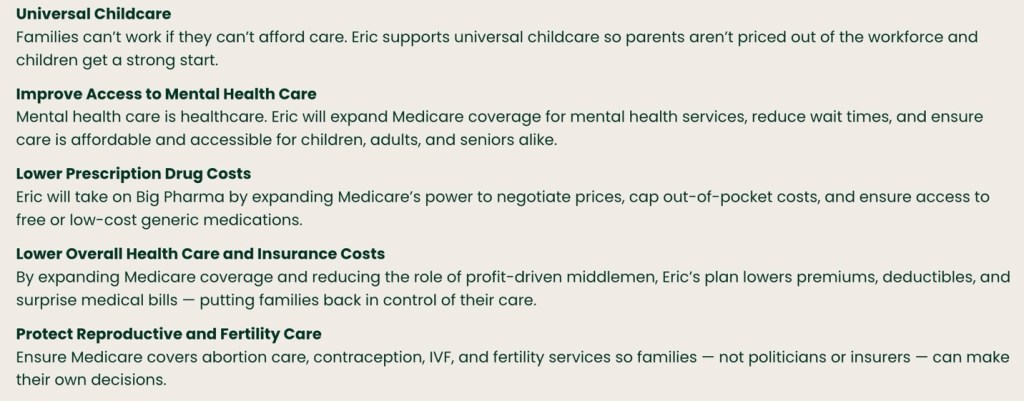
Screenshot taken September 19, 2026
Now? Neither of these crucial topics gets a mention in his list of “27 Policies—and counting” of current political priorities.
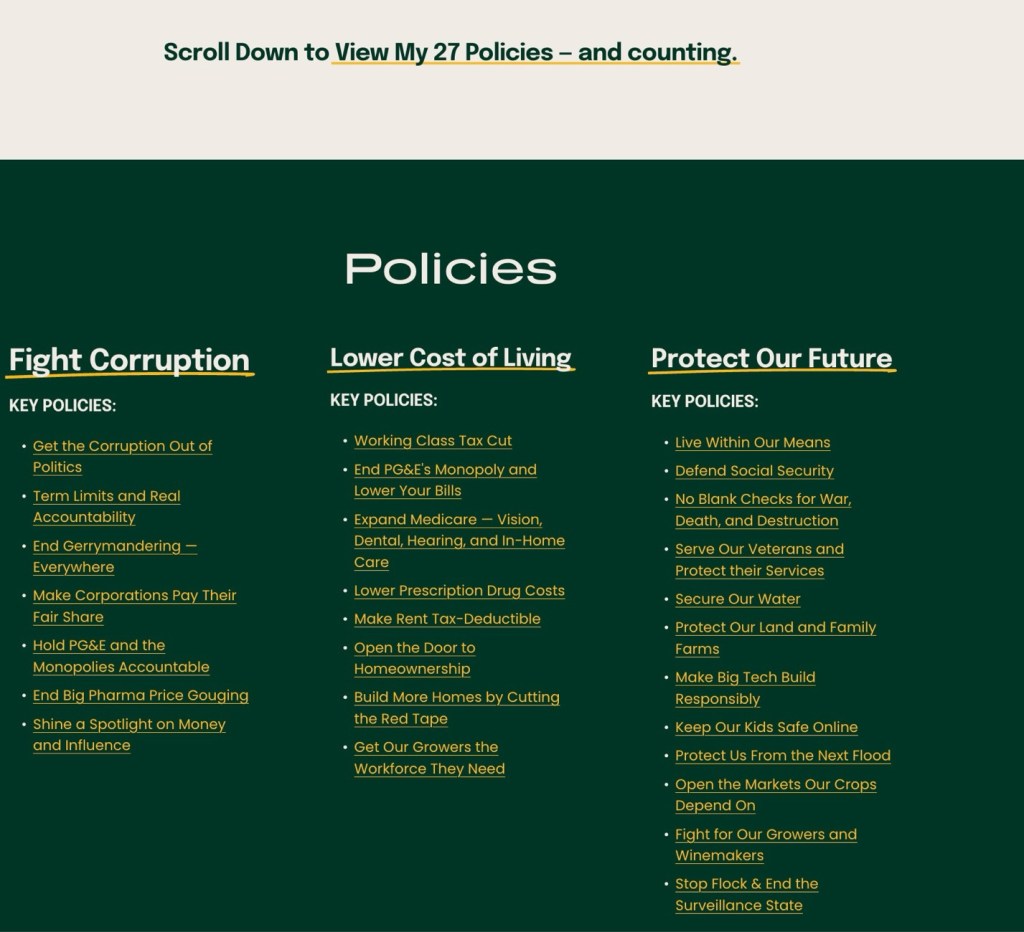
Screenshot taken September 19, 2026
At the same time, his stance on transparency has become, well, less transparent. The candidate who said a question on his relationship with Dragoneer was a plant continues to call for “disclose financial conflicts of interest in real time.”
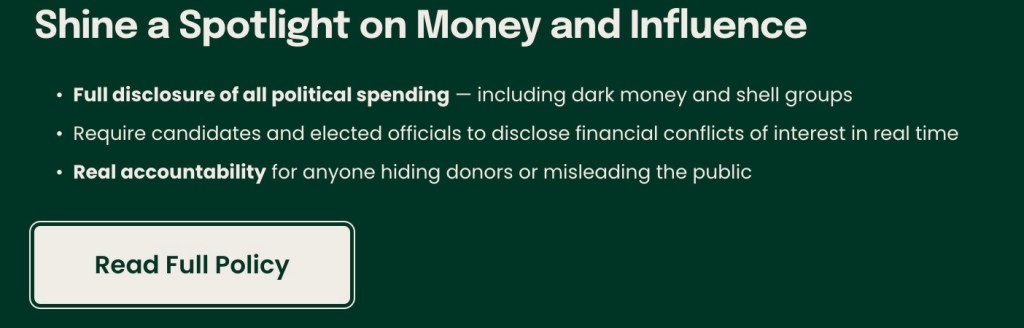
Screenshot taken September 19, 2026
Now, though, if you would like to know more about this policy, you can find this:
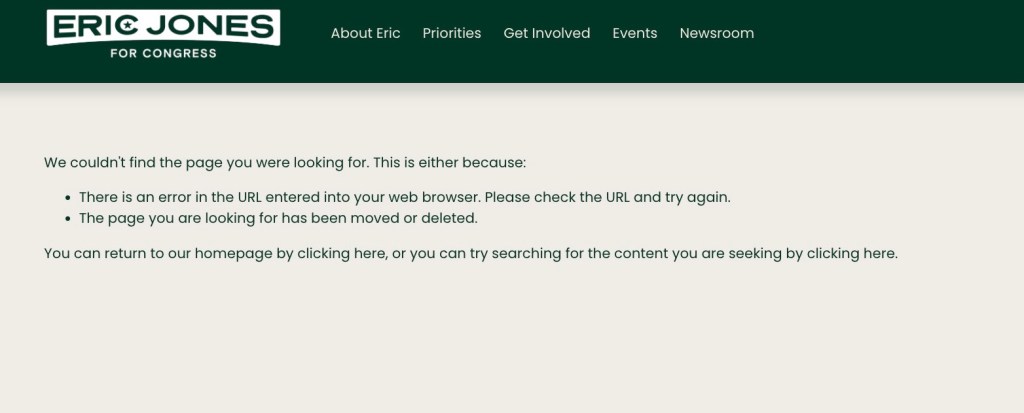
Screenshot taken September 18, 2026
Conclusion: a man in motion
Gone, too, is Jones’s initial description of the American Dream Institute From the start of his campaign to the present, Jones has made the ADI a key part of his personal story.
At first, he characterized it as “a nonprofit organization committed to countering partisan extremism, political disinformation, and the forces that seek to undermine democracy, while promoting a forward-looking, aspirational vision for the country.” The nonprofit “supported local and national initiatives that strengthen civic institutions, promote transparency, and hold powerful interests accountable.”
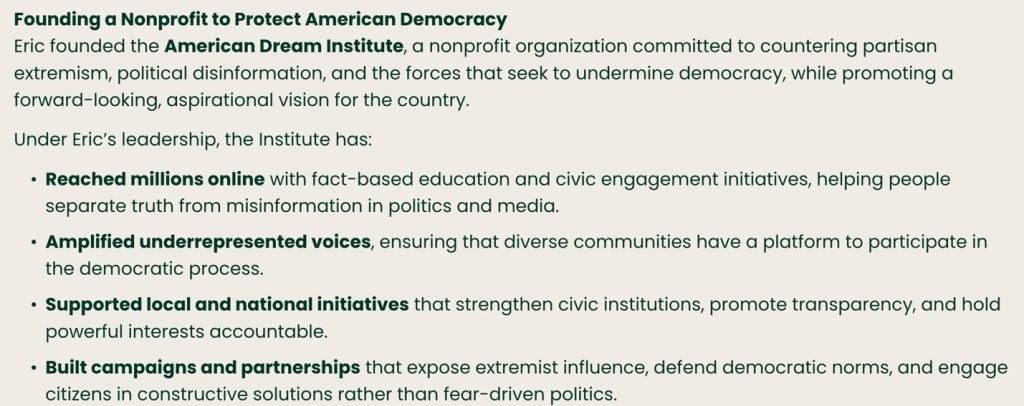
Screenshot taken September 19, 2026
In this telling, the ADI was “a natural extension of Eric’s life’s work: protecting communities, defending the integrity of our democracy, and standing up to the powerful corporations and actors that profit from division.”

Screenshot taken September 19, 2026
(Note: the same language appears in on Jone’s website in May—where the screenshots are from—and in June on Jone’s website: https://web.archive.org/web/20260603020626/https://www.ericjones.us/meet-eric)
At some point after the primary, the ADI changed, according to Jones’s website. It was now a “nonprofit organization committed to empowering free speech online.” It now “encourag[ed] voices online to speak safely online about the issues that matter to them,” rather fighting extremism. And it now “supported local and national initiatives that strength civic institutions, promote unity, and encourage free speech.”
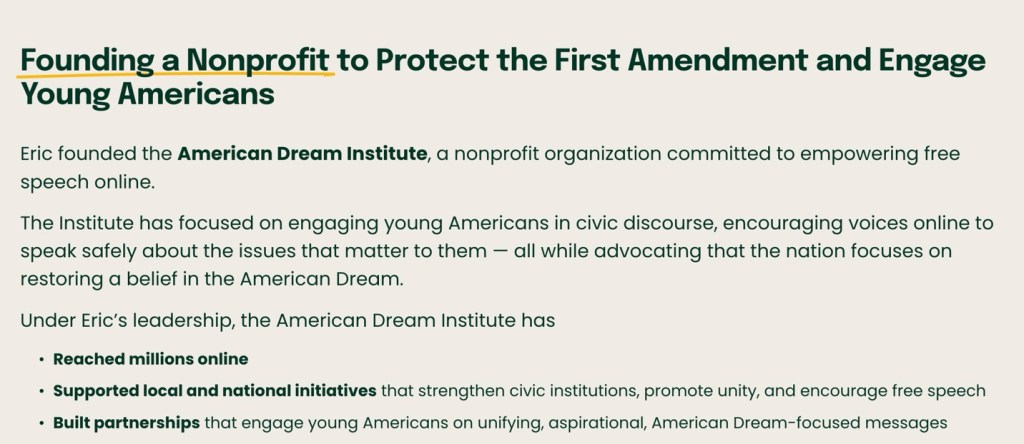
Screenshot taken September 19, 2026
(Note: the same language appears on https://www.ericjones.us/meet-eric, as of September 19, 2026.)
In other words, the organization went from promoting transparency to promoting unity. It went from promoting holding powerful interests accountable to promoting free speech. It no longer fought the forces undermining democracy. The ADI had seemingly changed, and not for the better. Now, had the nonprofit really changed?
Of course not, if one judges by its website (the front page of which is exactly the same today as it was the day it launched). It was not, and is not, committed to countering “partisan extremism” or “the forces that seek to undermine democracy.” It was not, and is not, established to “Protect the First Amendment.” Each of this characterizations is a stretch, one might say—something plenty of candidates do. It seems notable, though, that the stretching has gone in opposite directions.
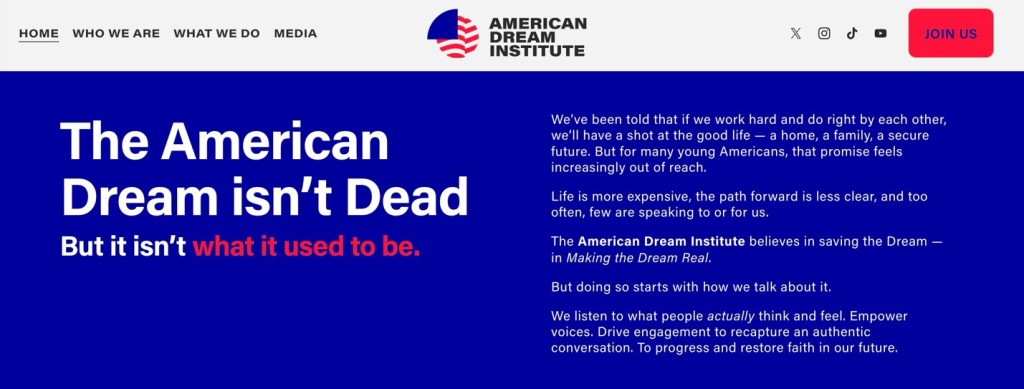
So the ADI hadn’t changed, what had? The context had. Things were different after Jones came in second in the primary and swung to the right to court more conservative voters.
Why does this matter? Well, perhaps the pre-primary website was correct, and the American Dream Institute really is “a natural extension of Eric’s life’s work.” Jones’s ADI espoused one set of goals and values before the primary. And then, when it was more convenient, the ADI espoused a completely different set of goals and values.
That actually seems to be a perfect metaphor for the evolution of Jones’s political positions during his campaign.



Leave a Reply