

By David Kupfer
The summer of 2026 has witnessed the quiet, heavy closing of an era. With the recent passings of population biologist Paul R. Ehrlich, radical theater pioneer R.G. “Ronny” Davis, and most recently, the visionary agrarian writer Wendell Berry on August 31, we have lost a singular trinity of American defiance. Operating in vastly different arenas—the university laboratory, the public park, and the rural hillside—these three men were bound by a shared, ferocious commitment to shaking humanity out of its industrial complacency. To have known them as friends and mentors over the decades was to witness the rare alchemy of brilliant intellect wedded to an uncompromising moral compass. Now, as the dust settles on their long lives, their final, intimate moments reveal the heavy burden borne by those who dare to speak truth to a civilization bent on its own consumption.
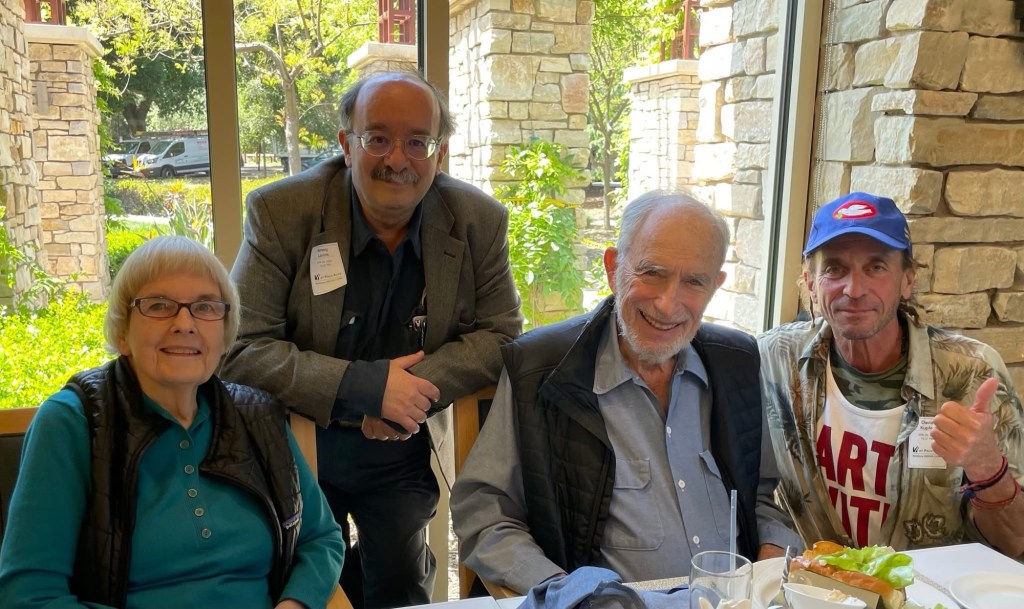
Three years ago, when I last spent time with him, I engineered a lunch at the Stanford University Retirement Home with Paul Ehrlich, along with his brilliant wife and co-author Ann, and my principle mentor, the energy visionary Dr. Amory Lovins, who is now teaching at Stanford. Paul was at that time putting the final touches on his autobiography, “Life: A Journey through Science and Politics.”
After a lifetime of pioneering ecological data—from co-founding the concept of coevolution to warning the world of systemic limits in The Population Bomb—Paul did not offer the polite, manicured optimism expected of elder academic statesmen. He was stark, clear, and deeply cynical. He looked at me and corporate society, noting with a heavy finality that human hubris had finally messed up the global environment to an irreparable state. He wasn’t looking for applause; he was a scientist observing a terminal diagnosis.
That same unfiltered, clear-eyed cynicism echoed in my final conversation with Ronny Davis. As the founder of the San Francisco Mime Troupe, Ronny had spent the 1960s and 70s in San Francisco using commedia dell’arte street theater as a weapon against militarism, corruption, and corporate greed. When I spoke to him near the end, he was as delightfully curmudgeonly as ever. Physically healthy, his mind remained an uncompromised steel trap, yet he shared Paul’s dark prognosis regarding human fate. To Ronny, the corporate structure had successfully commodified dissent. Both he and Paul had spent their lives trying to break the machine; both left this world watching the machine consume the very air and culture they fought to protect.
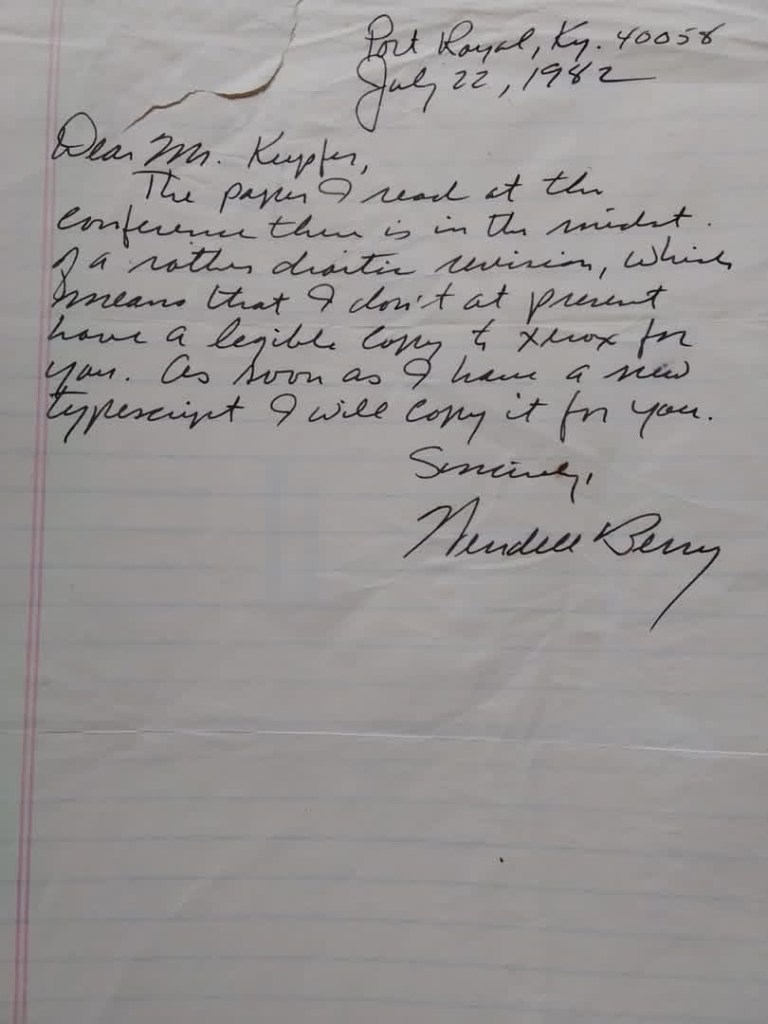
Yet, if Paul and Ronny represented the fierce, burning rage of the urban and academic resistance, Wendell Berry was the quiet, grounded, humble soul that offered an alternative framework. My friendship with Wendell spanned over forty years, beginning in 1982 when I was a mere undergraduate at UC Davis, editing the University of California Appropriate Technology Program quarterly newsletter. I still possess the envelope he sent me that year, written in his careful, penciled handwriting. In an act of radical politeness and characteristic humility, Wendell had addressed the envelope to “Professor David Kupfer.” He was a literary giant apologizing to a nineteen-year-old student for a brief delay in mailing the transcript of a campus speech I’d requested.
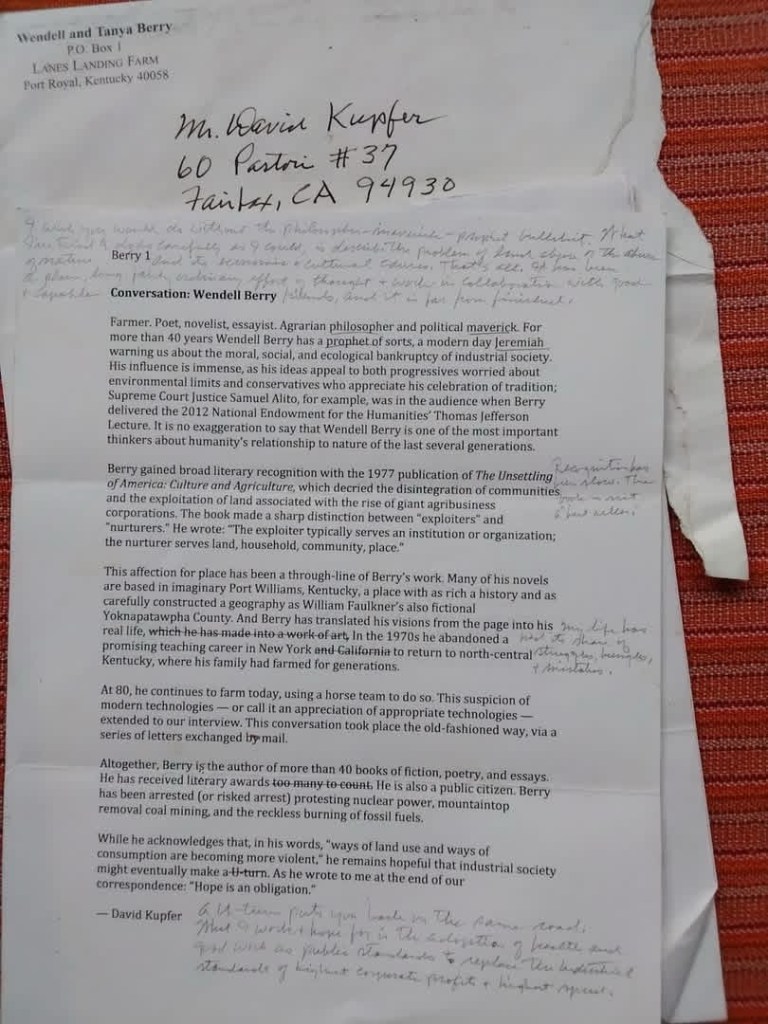
Thirty three years later, I interviewed Wendell for the Earth Island Journal. True to his famous rejection of the digital apparatus, I at his request via his publisher Counterpoint Press, I mailed my short list of questions to his Kentucky farm. A week later, they returned—every single response handwritten in pencil. It remains the only interview I have ever conducted entirely by post. When the article ran, Wendell sent me another note. He didn’t thank me for the praise; instead, he gently reprimanded me for the introduction I had penned, writing me a note, again in pencil, that I had made him out to be something far bigger and more important than he actually was.
That was the essence of Wendell Berry: absolute, radical humility. While Paul warned us of the mathematical and ecological boundaries of a finite planet, and Ronny produced the political theater exploiting it, Wendell embodied the quiet, proactive solution. He understood that saving the world from corporate destruction was not a matter of becoming a famous icon, but of committing to a local piece of earth and nuturing and defending it with your life.
There is a profound, tragic irony in how these three lives intersected in my memory. Paul and Ronny left me with a stark, cynical warning that time has run out, whereas Wendell left me with handwritten reminders that regardless of the global outcome, our moral obligation remains micro-local, humble, and rooted in the soil. They were the great prescient heretics of the American century. As we navigate a world they accurately predicted, their legacies remind us that whether through a microscope, on a public stage, or with a pencil on a Kentucky farm, the ultimate task of the human spirit is to resist the corporate consensus and remain fiercely loyal to the living Earth.
David Kupfer is a San Francisco-born, Marin native freelance writer, organic farmer, and environmental consultant who greened Hollywood 35 years ago. He is the creator of the San Francisco Green Map and a former executive director of the Environmental Action Committee of West Marin. His writing has appeared in The Progressive, Bay Nature, The Sun, Whole Earth Review, Annals of Earth, and Earth Island Journal



Leave a Reply