

Wrong seat, wrong moment, CACD-04 Part VI
By Judy Tipple
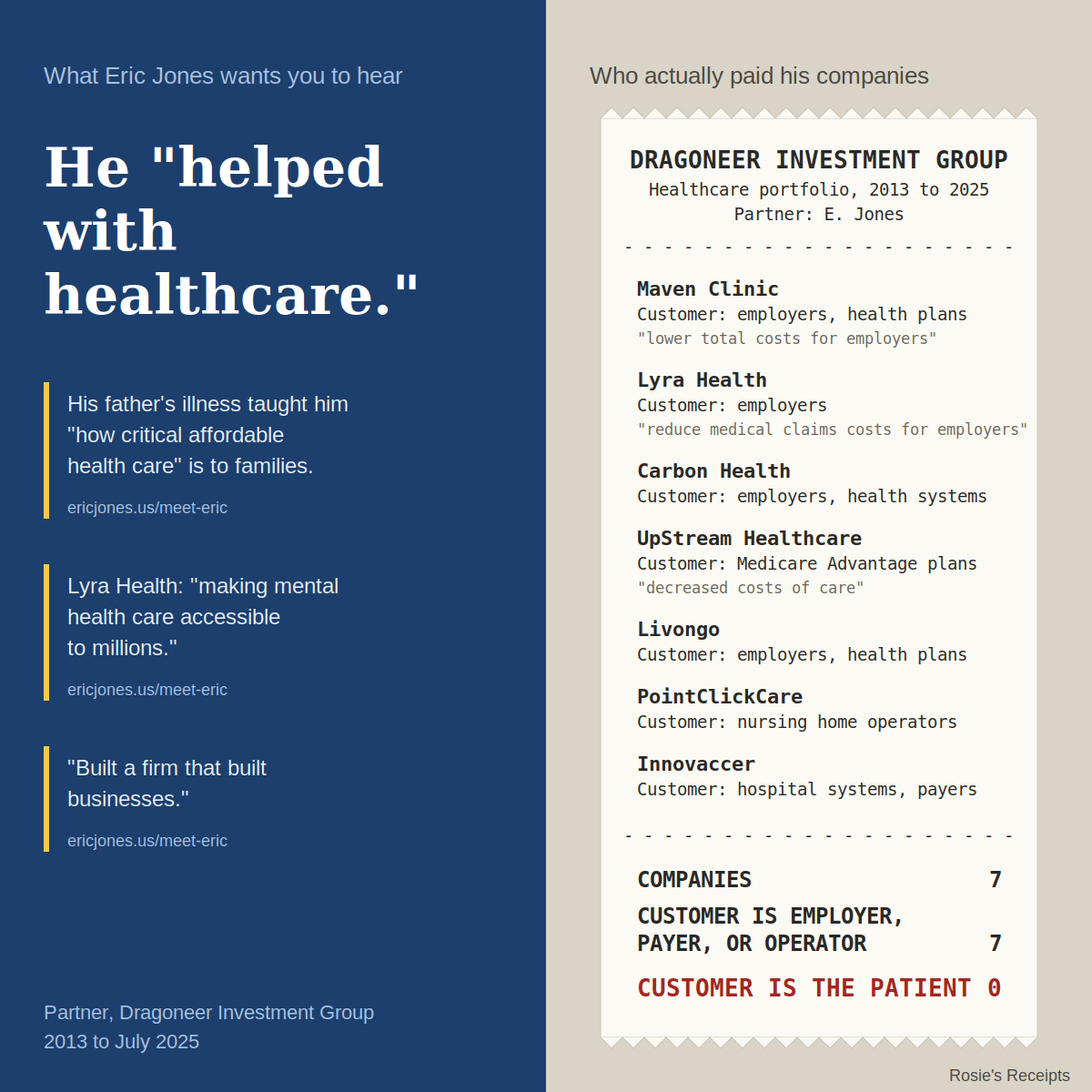
His campaign biography says his father’s health struggles taught him “how critical affordable health care” is to working families (ericjones.us/meet-eric). It says he “built a firm that built businesses.” It lists Lyra Health as a company he helped make “accessible to millions.”
Fair enough. Let’s look at the businesses.
His job was healthcare
Jones joined Dragoneer Investment Group in 2013 and became a partner 4 years later, where he remained until he resigned in July 2025. Not an employee. A partner. His sector title at the firm was “Partner – Healthcare, Fintech, Internet” (RocketReach profile; his LinkedIn will confirm). Healthcare was not a side interest. It was his book.
So the question is simple. When Jones and Dragoneer put money into healthcare, who was the customer?
Seven companies. Same answer.
Maven Clinic. Women’s and family health. Jones sits on the board (Crunchbase). Maven’s own site says its care model “results in lower total costs for employers” (mavenclinic.com/maven-managed-benefit). Its corporate boilerplate says it partners with 2,300 employers and health plans to reduce healthcare costs (PR Newswire, July 15, 2026). The customer is HR.
Lyra Health. Mental health. Dragoneer led the $235 million Series F in January 2022 (Lyra press release, Jan. 19, 2022). Lyra describes itself as “Workforce Mental Health solutions for employers.” The same release says the model is proven to “reduce medical claims costs for employers.” The customer is HR.
Carbon Health. Clinics and virtual care. Dragoneer led a $100 million round in 2020. Jones was the quoted partner (Mercom Capital, Nov. 12, 2020). The growth model was employer and health-system contracts.
UpStream Healthcare. Senior primary care. Dragoneer co-led the $140 million Series B with Coatue in December 2022 (PitchBook). Jones was the quoted partner, praising the company for having “decreased costs of care significantly” (Healthcare IT Today, Dec. 13, 2022). UpStream is a Medicare Advantage managed services organization. The customer is the physician practice and the MA plan.
Livongo. Diabetes and chronic condition management. Sold to employers and health plans as a claims-cost reducer. Dragoneer lists it as a portfolio company (Dragoneer boilerplate, Lyra press release). Acquired by Teladoc in 2020.
PointClickCare. Nursing home software. Cloud records and billing for senior care operators. Dragoneer and JMI Equity backed it through its $650 million purchase of Collective Medical (Solomon Partners, Dec. 17, 2021). The customer is the nursing home chain.
Innovaccer. Health data platform. Dragoneer was an existing investor in the $105 million Series D that made it a unicorn (Fierce Healthcare, March 2022). Sells to hospital systems and payers.
The receipt
Seven healthcare investments. Zero whose customer is the patient.
Every one sells to an employer, a health plan, a hospital system, or a nursing home operator. Every pitch is the same: lower cost or higher margin for the buyer. That is not a criticism of the companies. It is what growth equity does. You find a business with a paying customer and you scale it.
But it is not “helping with healthcare” the way a voter hears those words. When a voter hears “healthcare,” he or she thinks of his deductible, her copay, his mother’s Medicare Advantage denial. Jones’s portfolio was built to serve the other side of that transaction.
Same money, different story
Jones’s campaign site says Lyra makes mental health care “accessible to millions.”
Lyra’s own press release, the one announcing Dragoneer’s money, says Lyra reduces “medical claims costs for employers.”
Both sentences are about the same company. Only one was written to sell to voters.
The tell
In 2025, before he declared, Jones set up the American Dream Institute, a nonprofit whose stated purpose was to learn what messaging worked in this district. He is its chairman (americandreaminstitute.org/eric-jones).
Healthcare tests well in CA-04. It tests well everywhere.
The investments came first. The story about them came after.
The question
Mr. Jones, name one Dragoneer healthcare investment whose primary mission was lowering costs for the patient rather than the payer.
Still waiting.



Leave a comment