

by Hiram Jackson
Introduction
Davis has followed a policy of restrictive growth since 2000 when Measure J passed, which allowed city voters to approve of new projects on the margins of the city. Since then, Breton Woods, designed for older (55+ years) residents, and the Nishi project, designed for UC Davis students, both passed in 2018.
Apart from that, every other proposed project, which notably would have been available for younger adults less than age 54, has been rejected. This quarter century drought on peripheral developments for younger adults has consequences in our current demographic makeup.
City of Davis census data show a local declining young adult population
From 2000 to 2020 U.S. Census data show that Davis grew from about 60,000 to 66,000, an annualized growth rate of about 0.5%. Within that time the population of 20- to 29-year-olds, which includes mostly UC Davis students, grew by about 2500. The population of Davis adults aged 50 and older grew by 8,000, reflecting good health and the desirability of our community. Meanwhile, the number of young adults aged 30 to 49 has shrunk by 2,000 during the same period (See Census chart).
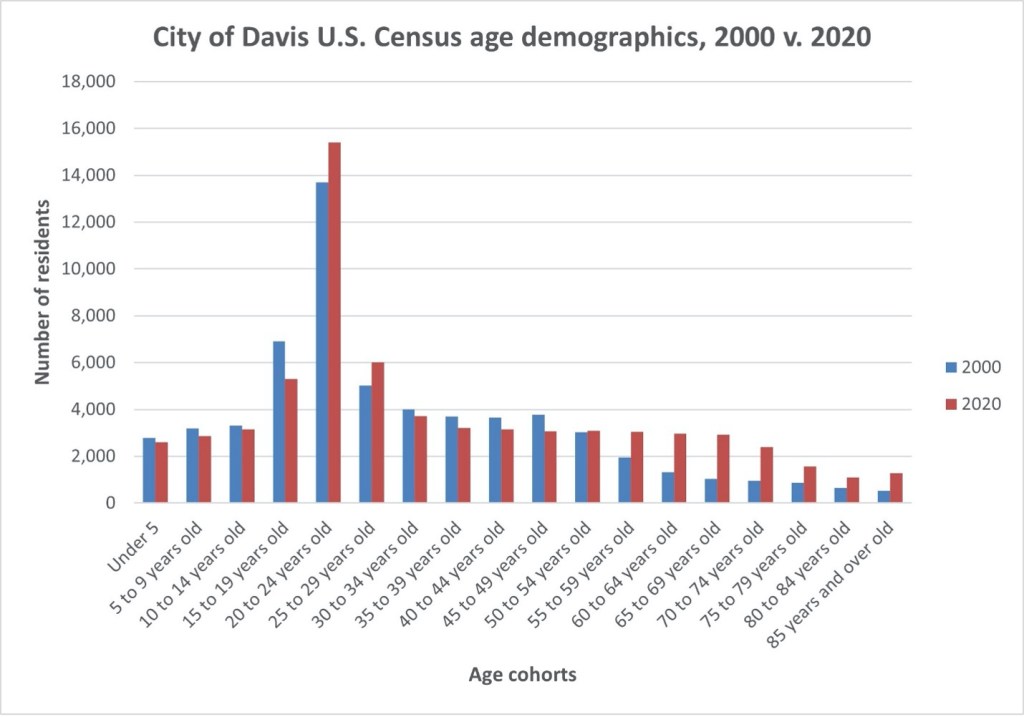
This last age cohort, specifically, includes parents who are likely to enroll students in the local public schools. Based on the 2020 U.S. census, the 30 to 49 age cohort is proportionally larger, statewide and nationally, than either the Baby Boomer or older Gen X population, demonstrating that the Davis decrease is anomalous in not accommodating this age cohort.
Many of the Davis residents from the 2000 census who were aged 30 to 49 have aged in place to become 50- to 69-year-olds, and insufficient new housing has been created to accommodate newer young families. We have created a situation in Davis where we have effectively shut out this younger age cohort from living here.
We are rejecting many of our own local high school and UCD graduates who would like to continue to call Davis home. Nationwide, we have a housing crisis. This is what that the housing crisis looks like in Davis, almost invisible to older, long-settled residents, but very real to younger generations. Over time we are on a trajectory of transitioning to a retirement community with a large public university.
Impact on our local K-12 schools
One symptom of restricting housing availability for younger adults and families is that we have fewer school age children in the district. Although the local Davis population for years has been gradually declining for grade school children, much of that decline has been countered by students transferring from neighboring communities to the Davis schools. Such transfers are called Inter-District Transfers or IDTs.
A healthy majority of IDTs are due to parent employment in Davis, and state law allows that such students to be accommodated as long as space is available. The school district is appropriately compensated by the state to serve such students. A majority of newer employees at UC Davis, Davis JUSD, and the City of Davis live in neighboring communities and are among those enrolling their kids in Davis schools. But we have reached a point where overall enrollment declines are no longer covered by IDT’s, and that decline is great enough to affect the viability of keeping schools open in the district.
Whether or not more housing accessible to 30-49-year-old adults is made available, the school district will respond and adjust to the community that exists. But voters should be aware of the consequences. California school districts that are not declining in enrollment serve communities that provide secure housing for younger families.
Locally, every relevant housing development that has been put up for vote over the past 20+ years has been rejected, with the message being that it’s not good enough. The overall result is that we are not planning to accommodate any fair proportion of this age cohort. As city voters we have a chance to change that on the June 2 ballot.
Conclusion
The perfect has been framed as the enemy of the good, but the overall impact of current policies is to push younger adults away from Davis into other communities; even adults who work in Davis and would like to live here.
Multi-generational balance in a community gives us better institutional balance. Local schools can remain viable; diverse businesses can thrive with a steady local workforce; and churches, religious communities, and other civic organizations can be sustained. Village Farms is a great project, at this time it is appropriate for our community as a whole, and it deserves your support. Vote Yes on Measure V!
______________________________________
About the Author – Hiram Jackson in the DJUSD Trustee for Area 1 and current Board President. He has been an active parent-volunteer in the district since 1998. In that time, he’s been a hands-on music booster and co-founded the Mariachi Puente band with his wife, Ximena.

 Davisite
Leave a comment