

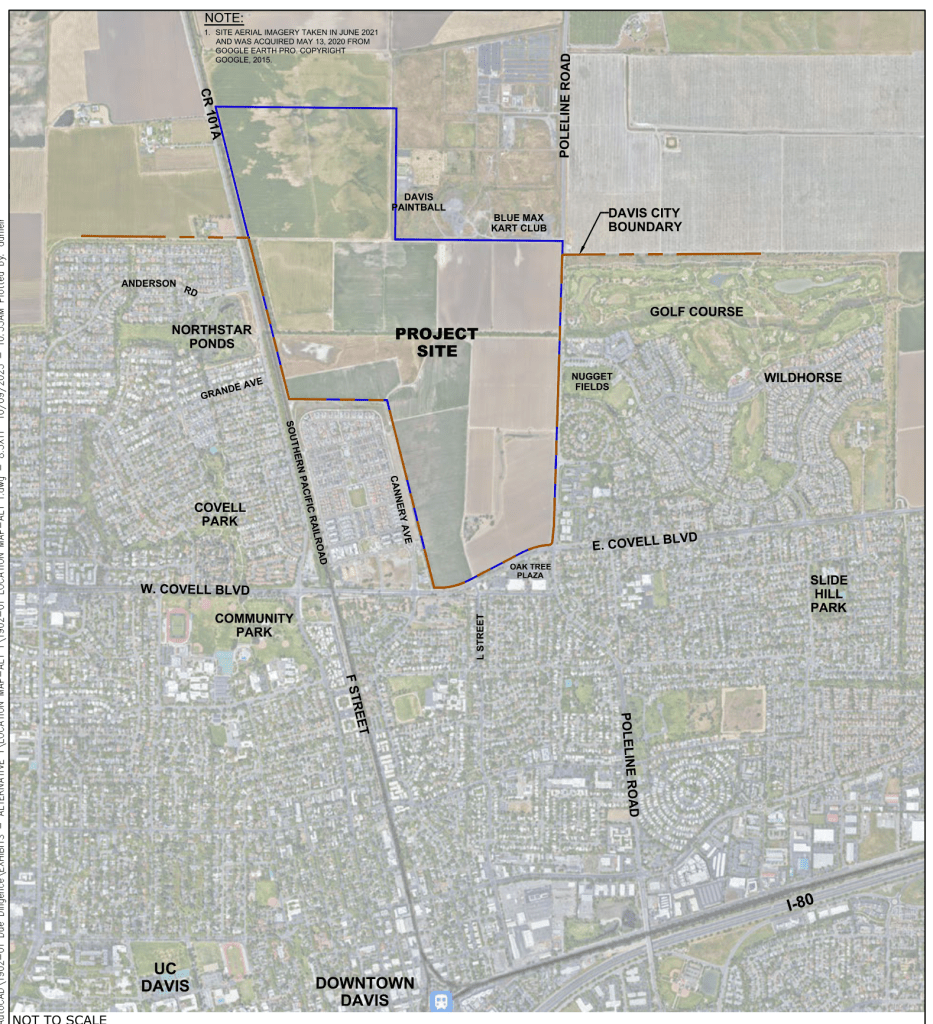
By Doug Buzbee
In a recent Op-Ed in the Enterprise (“Commentary: Why a planning commissioner voted no on Village Farms, Jan 2, 2026” [or see longer version on the Davisite here]), Greg Rowe stated he opposed the Village Farms Davis project claiming the site had excessive flood risks.
He stated that because part of the proposed project site is currently in a 100-year Flood Zone as mapped by the Federal Emergency Management Agency (FEMA) and because climate change will bring more extreme weather events in the future, we simply should not build anything at all in that part of the project.
While flood risks are real and climate concerns are valid, Mr. Rowe’s comments ignore the fact that proven engineering solutions will be implemented at Village Farms Davis to remove it from the mapped 100-year flood zone, and furthermore, provide protection against a more severe 200-year flood event.
Village Farms Davis is actually designed to meet higher flood protection standards than significant portions of the rest of Davis, including many older neighborhoods developed before modern flood-protection standards, and over 400 acres within the city limits that still remain within the 100-year flood plain – including swaths of residential West and Central Davis.
Let me explain.
Davis, and indeed much of the Central Valley itself, was once much more prone to flooding. However, as levees, drainage channels, and holding basins were constructed throughout the Central Valley, flood risks were dramatically reduced in areas planned for development – witness the levees of the Yolo Bypass directly to the east of Davis, the complete re-routing of Putah Creek to the south of Davis, and the Covell Ditch built to convey excess flood waters away from homes in North Davis.
Similar changes to the topography, on a much smaller scale, will be implemented at Village Farms Davis. These engineered solutions are not simply an “unproven stormwater contrivance” as Mr. Rowe claims. Rather, they use sound, proven engineering design principles that are routinely employed by competent, registered professional civil engineers.
Indeed, the engineered changes at Village Farms Davis must be certified by FEMA as meeting 100-year flood protection before construction can even begin at the site. And California law requires that the project meet the higher standard of protection from the 200-year storm event. Project opponents who have raised concerns about flooding continue to ignore these facts.
Mr. Rowe seems to base his entire argument around the fact that the climate is changing and so we must not build in 100-year flood plains. And we agree. Where we differ with Mr. Rowe, however, is that we believe in science-based solutions to problems and accepted engineering principles and practices.
The project’s Environmental Impact Report (EIR) includes hundreds of pages of engineering analysis related to the impacts of extreme storm events to the project and the surrounding areas in Davis. Those engineering studies, based on the most recent, most conservative science, demonstrate that Village Farms Davis will be better protected against flooding than the vast majority of subdivisions previously constructed in the city.
The engineered solutions proposed at Village Farms Davis include 1) Raising the elevation of the land by a sufficient amount to remove the residential areas from the mapped 100-year flood zone and provide 200-year storm event protection, 2) Rebuilding and redirecting the Covell Ditch through the property to increase conveyance and holding capacity, and 3) Constructing a large basin to the north of the property to hold runoff water both from the project as well as from Central Davis.
These are not simply “contrivances”, as claimed by Mr. Rowe. Rather, they are standard and proven engineering practices routinely used for decades throughout the US and in Davis to minimize flood hazards.
In fact, these same engineering practices were recently employed at the Bretton Woods development in West Davis. That land was previously entirely within the 100-year flood plain, but the new project was required to be engineered to withstand a 200-year flood event using the same types of engineered solutions that will be implemented at Village Farms Davis. These flood protection practices were acceptable to Mr. Rowe at Bretton Woods (as a planning commissioner, he supported Bretton Woods), but somehow are now deemed inadequate in the context of Village Farms Davis?
Doesn’t make sense to me.
To anyone who is actually concerned about flood risks: I invite you to support Village Farms Davis so that people will someday have the opportunity to rent or buy a home in one of the most flood-resilient neighborhoods ever constructed in the City of Davis.
Doug Buzbee is a member of the Village Farms Davis development team. His family is one of the seven generational Davis families that are part of the North Davis Land Company; the developers of the Village Farms Davis project.

 Davisite
Leave a comment