

CHAPTER ONE: Digging into the Details About Federal Candidates’ Supporters —- Looking Beyond the Hype, Hyperbole, and Total B.S.
LESSON TWO: Sorting Analyses Using Custom Standard Filters
[Note: you may first wish to read the intro to this chapter as well as Lesson One: Sorting Analyses Using Basic Standard Filters, linked here].
By F.E.C. Nerd
Step One: Log into your favorite Internet browser. Then go to:
https://www.fec.gov/data/browse-data/?tab=candidates
This will take you directly to the Homepage of the Federal Election Commission (FEC) and its webpage that permits browsing of candidates’ financing. This is the official repository of federal election campaign finance information relating to Federal office candidates. Campaign reports are filed electronically and the information reported can be directly accessed here.
Step Two: Scroll down the page towards the bottom and click on the link for “House of Representatives Candidates.”
Step Three: The next page that appears lists all House candidates in order of totals raised for this election cycle. The list is topped by AOC, with Hakeem Jeffries and Mike Johnson both near the top. However, if you scroll down to the 18th-ranked you will see Eric Jones with $8.3 Million. Where did all this money come from?
Step Four: So that you know how to search for any House candidate use the search box — “Candidate Name or ID” in the upper left corner. Type in: “Jones, Eric”. A drop-down list of several “Jones” candidates will appear. Select the one for “Jones, Eric H6CA04222”. That will take you to the link for Eric Jones’ campaign reporting.
Step Five: Scroll right to get into the main display and click on the “Jones, Eric” link that is active. This will take you to the following screen, where we start to get to the substantive data.
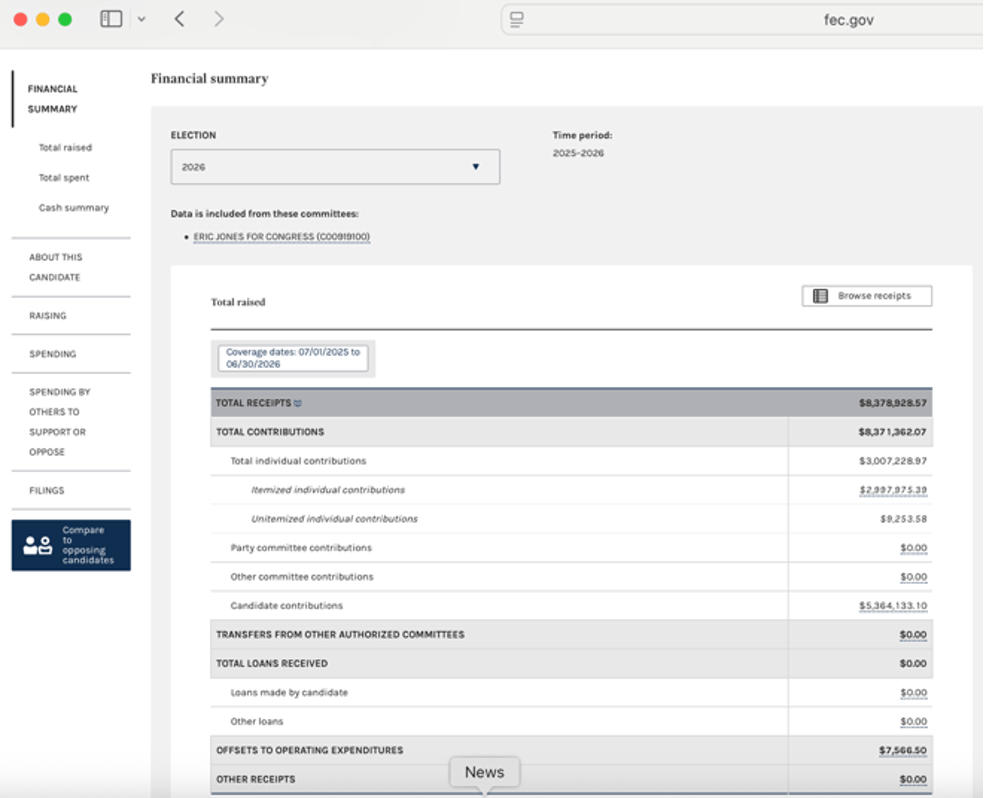
At the top is “Total Contributions” and below it “Total Individual Contributions” and then below that, how much of the total were “Itemized” and how much were “Un-itemized”. Un-itemized contributions must be less than $200 aggregate from the same source during the reporting period. So, this presents an initial tool for comparative analysis. Unlike Lesson 1, we will now dig deeper using customized search filters.
Step Six: Click on the button in the upper right for “Browse receipts.” This will open the dialogue boxes in the left-hand column (“Filters”). They are very useful. In addition, the + marks on the far right are very useful. In the following steps you will be shown how to use them to learn more details.
Scroll down in the left-hand column of filters, near the very bottom, click on the + symbol for “More source details” and then check the box for “RESTRICT CONTRIBUTIONS” “From Unique Individuals Only.” This will focus in on the real contributors. Next, scroll down a little further and click on the + button for “Receipt details.” In the drop-down box you can enter certain search criteria. I suggest starting from the highest amounts. So, insert $3,000 in the “From” box and $9,999 in the “To” box, just to see what pops up. You should see a page that looks like these two screenshots (the entire page wouldn’t fit into one screen):
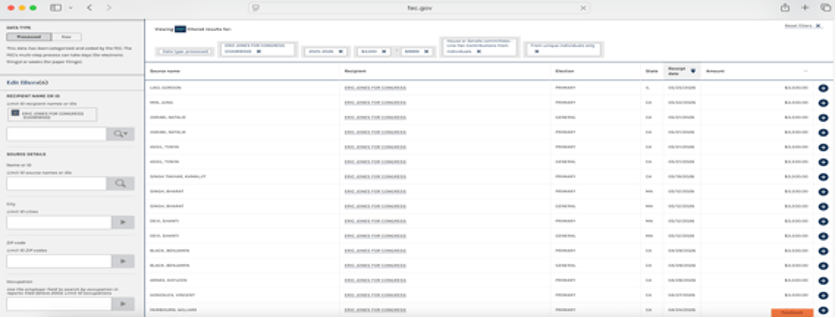
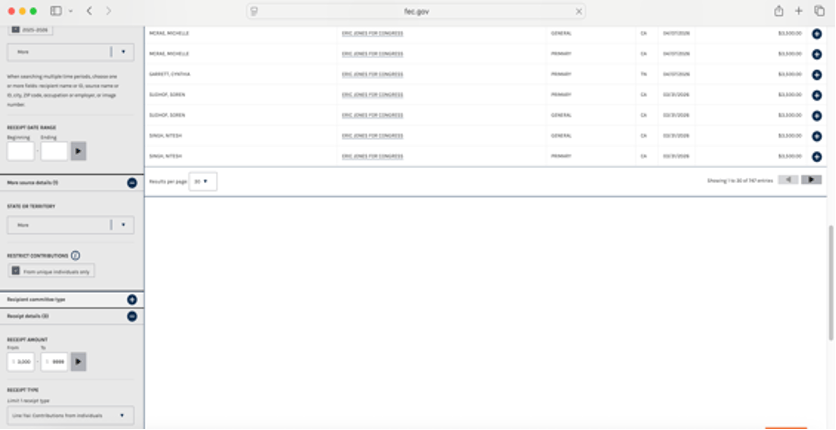
At the very top (upper screenshot), you can see your various filters (little rectangles) and also in the left-hand side-bar all the way down the page. Look at the lower right-hand end of the column of 30 contributions and you will see there are a total of 747 that meet these search criteria — unique individual contributions totaling between $3,000 and $9,999 per contributor during this two-year election cycle (2025-26) for Congress. There’s a lot to dig into here, so let’s start with a large contributor from this page, then move to other pages.
Step Seven: Here’s where the + buttons on the right-hand side of each contribution entry come into use. As you can see, there are quite a lot of contributors who gave the maximum $3,500 for both the Primary and the General. Obviously, these contributors are major backers of Eric Jones’ campaign for Congress. Let’s check out some information about a few of them, so you can see how to research yourself.
Scroll down the page and go to “Black, Benjamin,” who gave the maximum twice $3,500 twice on April 29, 2026 — for both Primary and General. Click on the + button at the right-hand side next to either of his two contributions for $3,500.00. You should see the following drop-down information appear.
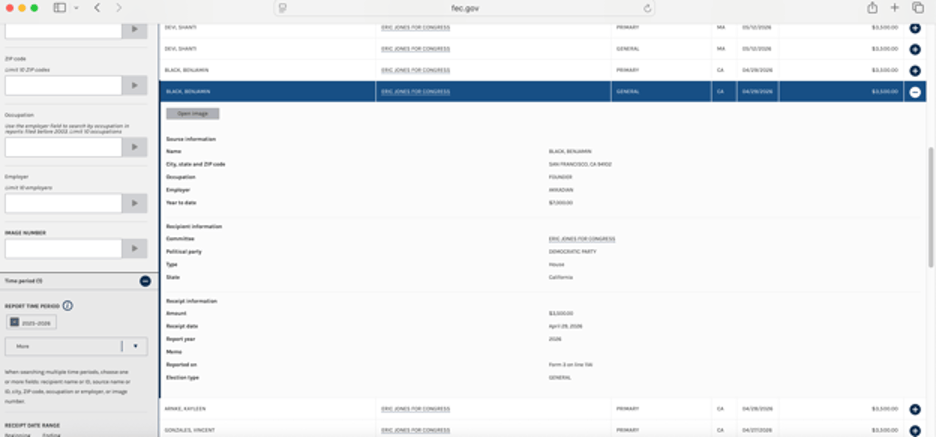
We see that Benjamin Black is the “Founder” of Akkadian, based in San Francisco. and he strongly supports Eric Jones’ campaign. So, what is “Akkadian”? Search on-line and then look at this venture capital firm’s “Portfolio” to see what they are involved with. Scroll through the list and you can see this set of businesses.
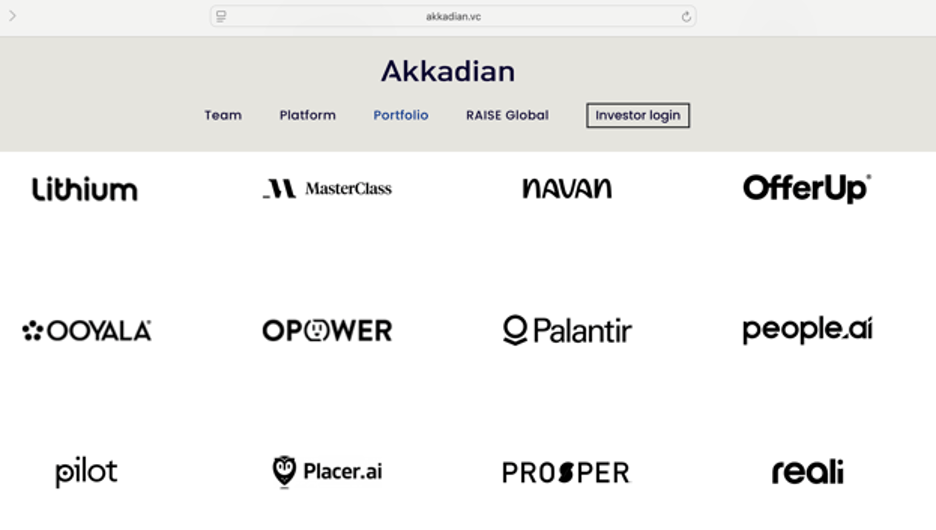
Note, in this partial sample there are two “AI” firms, plus Palantir, the folks involved with ICE.
Next let’s click on the “arrow >” button in the lower right-hand corner of the screen to advance to the next page of contributors. The page will refresh and will show results for 31 – 60 among the 747 large contributors. Scroll down and click on the name “Brundage, Miles.” Click on the + to the right of Miles Brundage’s two maximum contributions on March 31, 2026. Next you will see:
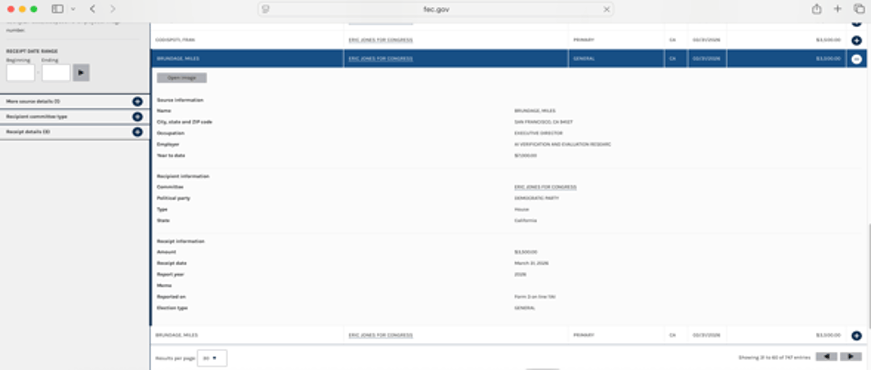
We see that Miles Brundage is “Executive Director” of AI Verification and Evaluation Research, based in San Francisco. He, too, is all-in on Eric Jones’ campaign.
Next, you can scroll down a few names to those whose last names are “Israni”. There is “Radha” and there is “Haku.” Both hail from Texas. Click on the + button to the right of each. Both list themselves as “NOT EMPLOYED” and from “Missouri City, Texas”. Yet both have contributed the maximum amount twice to Eric Jones’ campaign out here in our area. That’s $14,000 combined! From folks who have no job!
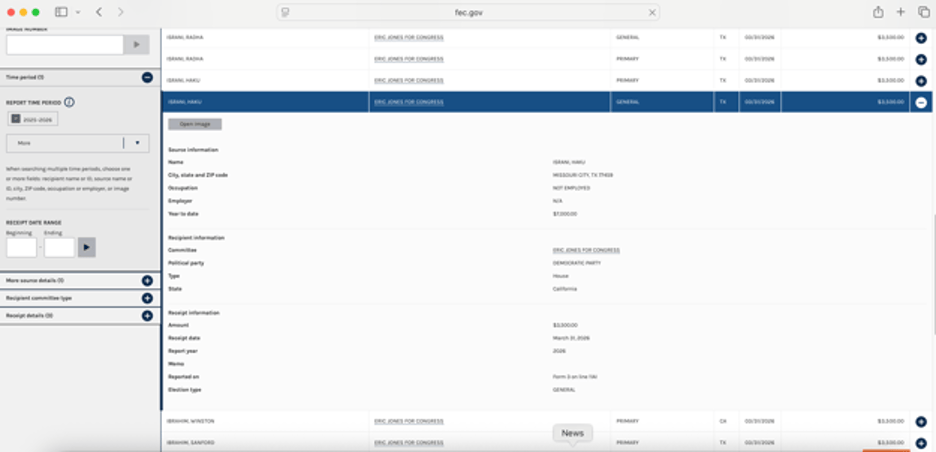
By now, you should have these techniques down, so pursue your own research amongst the 747 big investors in Eric Jones’ campaign. That way you can reach your own conclusions.
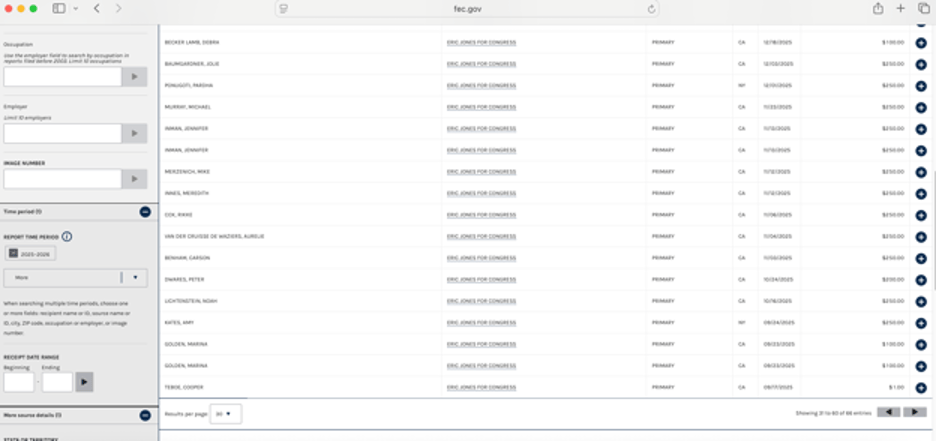
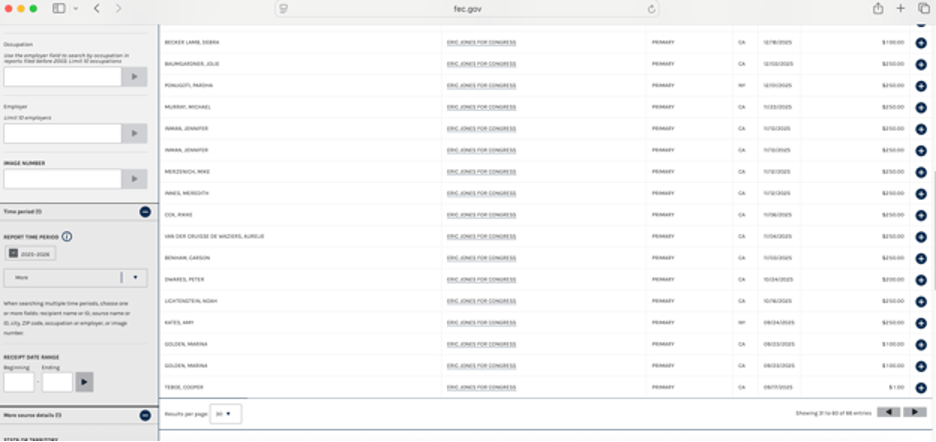
Step Eight: Let’s take a different approach to using the filters in the left-hand column to tease out some other information. Return to the basic page for Eric Jones contributions — the one we reached at Step Six. This will require you to go back a few screens to where we entered the dollar range. Now, let’s look at the lower end of the contributions by changing the “range” of contributions to “From” $1 and for “To” insert the highest amount YOU have ever contributed in any one election cycle to any candidate for Congress (or local elective office if you haven’t contributed in a congressional race). Search to see how many contributors like yourself are displayed. For purpose of illustration only, I will use $250 as the upper limit — yours may be higher or lower. For display, I’ve chosen the second page (31-60 of 66) because it shows a $1 contribution as well as some as high as $250 — here’s what it shows, but the primary point is there were ONLY 66, small donations identified, compared to 747 large donations of $3,000 or more:
Step Nine: Let’s take another approach at sorting the data using the other filters. First, remove the dollar amounts in the “Range” filter that we have been using for the last two searches, leaving those spaces blank. However, leave the “Restrict Contributions” checked.
This time, let’s look at the “Occupation” filter. It is a dialogue box in the left-hand side bar. In the screenshot below, you can see I chose several terms designed to pick up high-level business principals, such as: “Chief” “Partner” “Found” “Manag” and “CEO” “CFO” and “COO” because each of these could appear in a description of someone who is a “Chief”, “founder”, “founding partner” a “Managing . . .”; and the obvious abbreviations for Chief Executive Officer; Chief Operating Officer; and Chief Financial Officer, etc. When the screen came up, I clicked the + button to the right of “Bologna, Bejamin” who gave even more than the maximum.
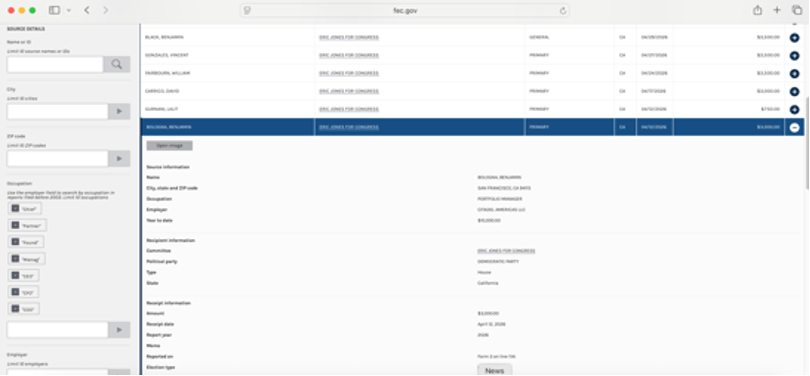
This is a look at “Bologna, Benjamin” whose occupation is shown as “Portfolio Manager” for “Citadel Americas LLC” located in San Francisco. Interestingly, Benjamin Bologna really went all-in for Eric Jones’ campaign to the tune of $10,000. (Ooopps!)
Overall, the search using these seven “occupation” filters uncovered 333 contributions from donors that included one of these terms in the “occupation” category of the details–the “big brass” if you will.
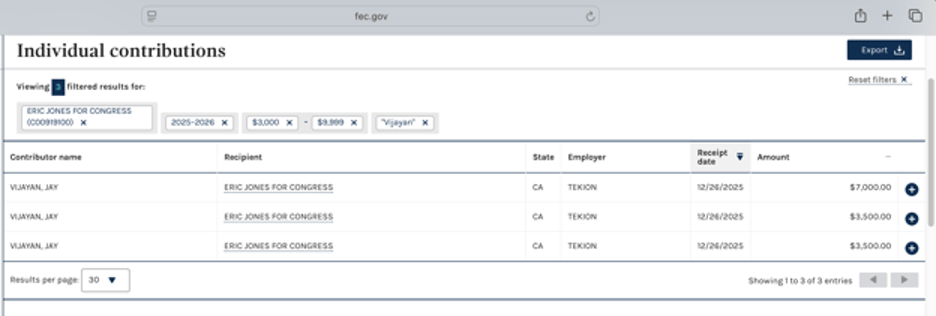
Let’s take a look at “Vijayan, Jay” who is shown as contributing $14,000.00 on 12/26/2025. We can see that the employer is “TEKION”.
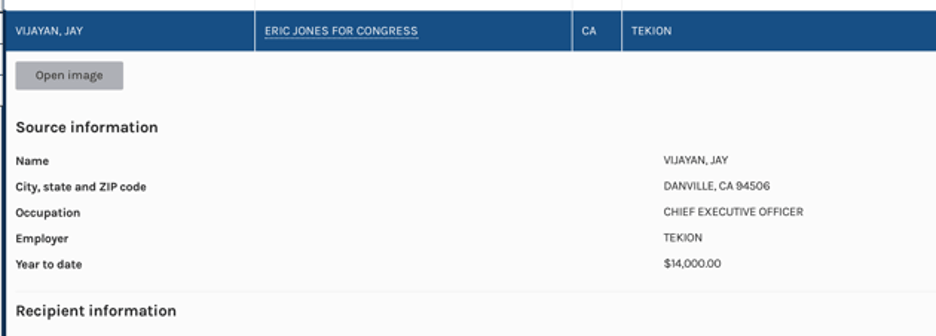
Click on the + button to the right to see that his position at Tekion is Chief Executive Officer.
So, what is TEKION? An on-line search brings up the following:

Step Ten: Let’s add another filter to the search. In the left-hand filter column go to the “Employer” dialogue box and let’s put in terms, such as: “Inc”; “Co”; “Corp”; “LLC”; “LLP”; and “Capital” or “Invest”.
But, this time, let’s begin by adding filters one at a time to see what that turns up. Later, we can try adding them all together with the “occupation” filters to see how that affects the total of 333 contributions. Begin with just “Inc” added into the list of filters. This is because Eric Jones repeatedly claims he doesn’t take “corporate contributions” — however, as explained above, that is flatly prohibited anyway. But what about contributors who act on behalf of their corporations (i.e., “employers”)? With this search we should be able to find out. Go back to the basic Step Eight, and then insert “Inc” into the “Employer” box in the left-hand side, you will see the lower portion of the first page that contains contributions “1 to 30 of 40 entries.” We see the list shows businesses that are incorporated as denoted by “Inc.” in their name!
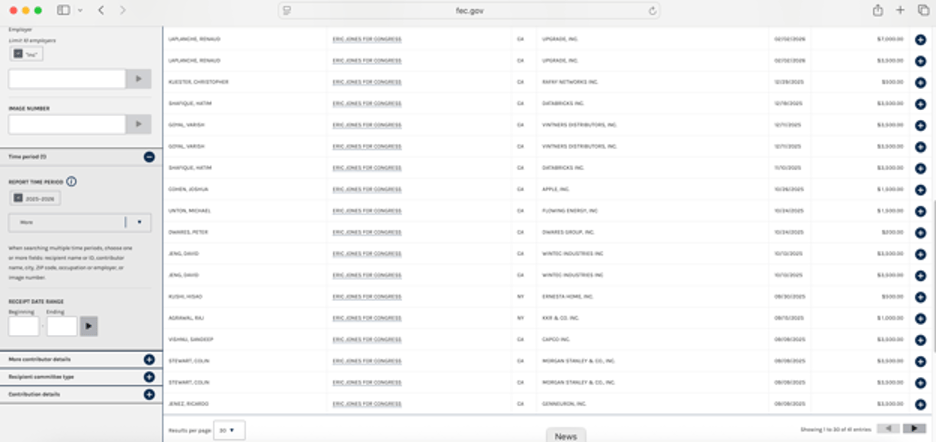
Next look at some of these large contributors, who have given the $3,500 max more than once. At least two are so enthusiastic about Eric Jones that they have given $14,000.00!! (Oopps, again!) But some of it was apparently refunded, at least in the case of “Larsen, Chris.” Click on “Laplanche, Renaud” to see what that is all about. Click on the + button to the right of “Laplanche, Renaud” to get the details. Here’s what we find:
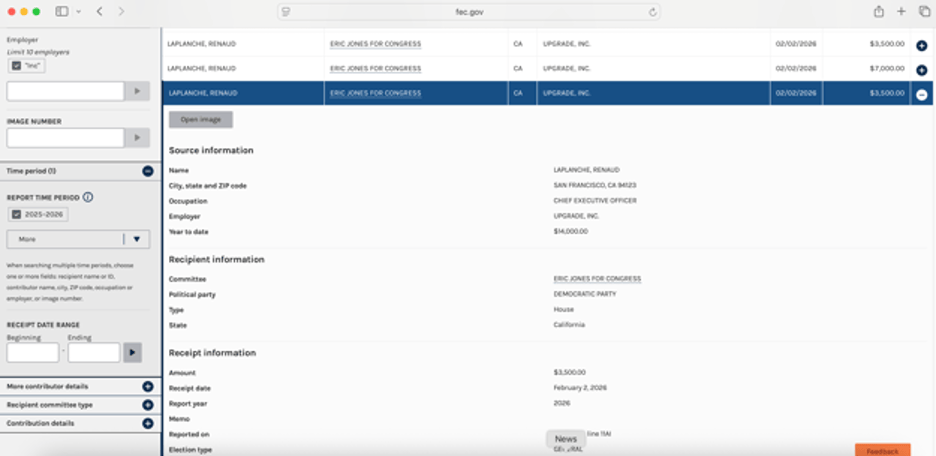
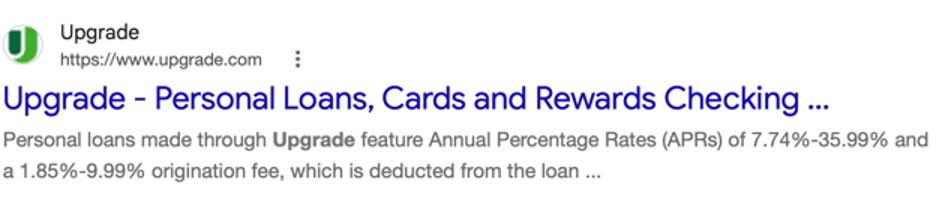
Renaud Laplanche is the Chief Executive Officer for Upgrade, Inc. located in San Francisco, CA., and contributed a total of $14,000.00 to Eric Jones’ campaign. All of it on February 2, 2026! I searched on-line and found this information about Upgrade, Inc.:
Next, let’s take a look at the other multi-max contributor on February 20, 2026, “Larsen, Chris.” Click on the “-” link on the right to shrink the window about Renaud Laplanche; and then click the “+” to the right for “Larsen, Chris.” Here’s what we find:
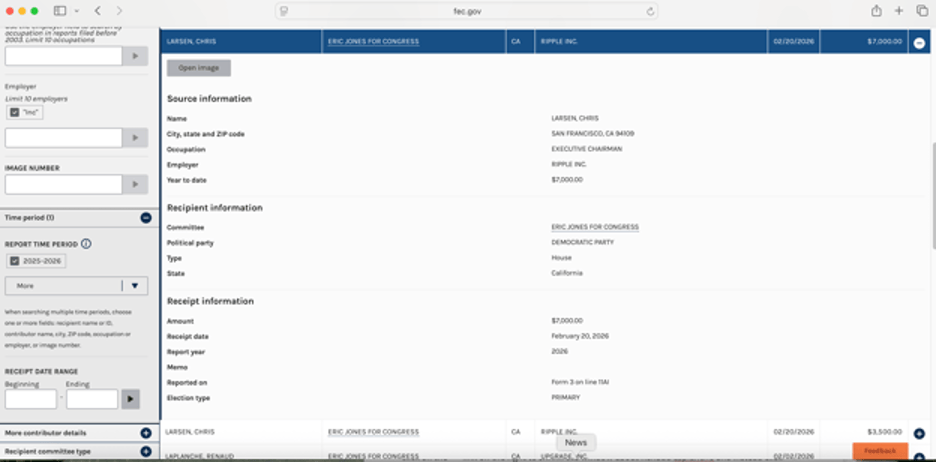
Chris Larsen is the Executive Chairman of Ripple, Inc., a corporation located in San Francisco. Wikipedia describes Ripple’s endeavors and lists Chris Larsen as one of the two founders of Ripple.
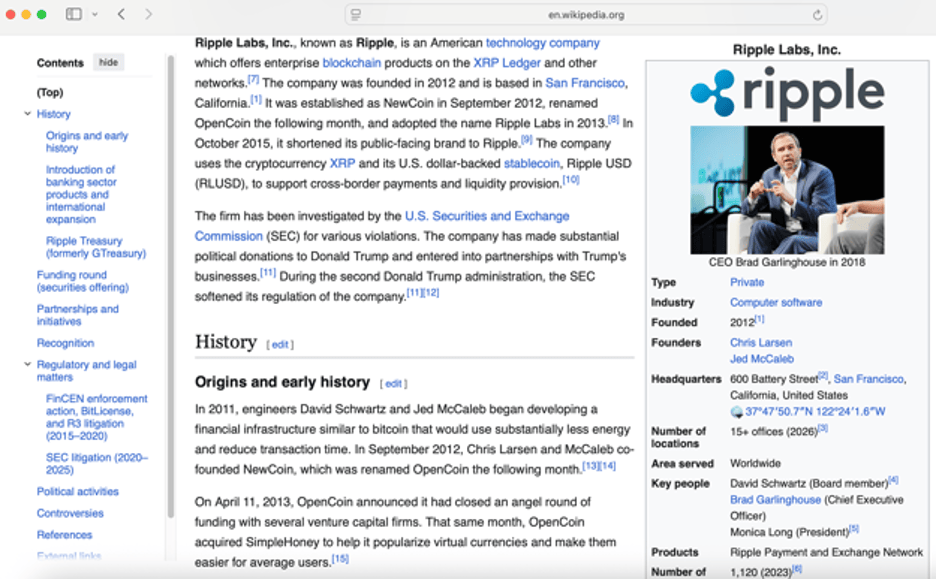
What Ripple’s website says is the following, captured from another Ripple screen.

Note the “Treasury Management” above — “powered by AI . . .”
Let’s take a look at more of the double-maximum contributors. Click on the right arrow > in the bottom right-hand corner of the page and go to the last 10 contributions on the second page under this “Inc” search. Click on the + button to the right of “Weitzman, Ofek” and see what appears.
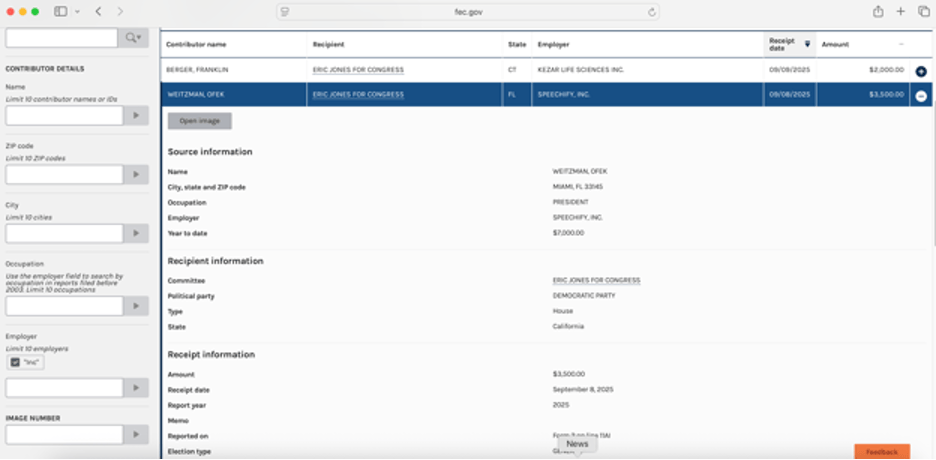
We see that Ofek Weitzman gave $7,000 and he is President of Speechify, Inc., based in Miami, Florida. So, what is Speechify, Inc.? A search pulls up the following:
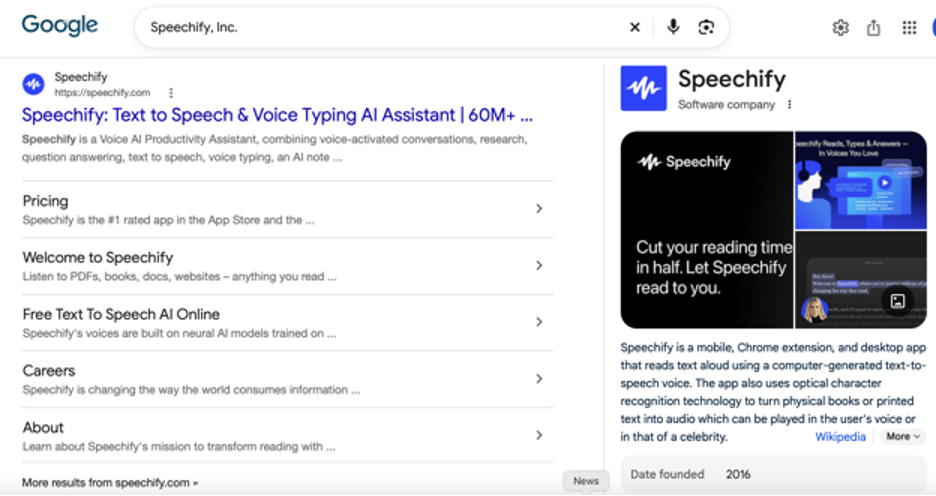
The President of Speechify, Inc. (a corporation in Miami) dug into his pocket and parted with $7,000.00 to help out Eric Jones’ campaign.
Step Eleven: Next let’s uncheck the box on the left for “inc” and instead type into the search window for “Employer” “LLC” and then also in a separate entry “co.” This should reveal contributors whose “employers” are other kinds of business entities. This turns up a new listing of contributors, numbering 122. Since “Y Combinator” is involved with helping finance a lot of startups, I wanted to check out the contribution from “Nathoo, Kristy”, which appears below.
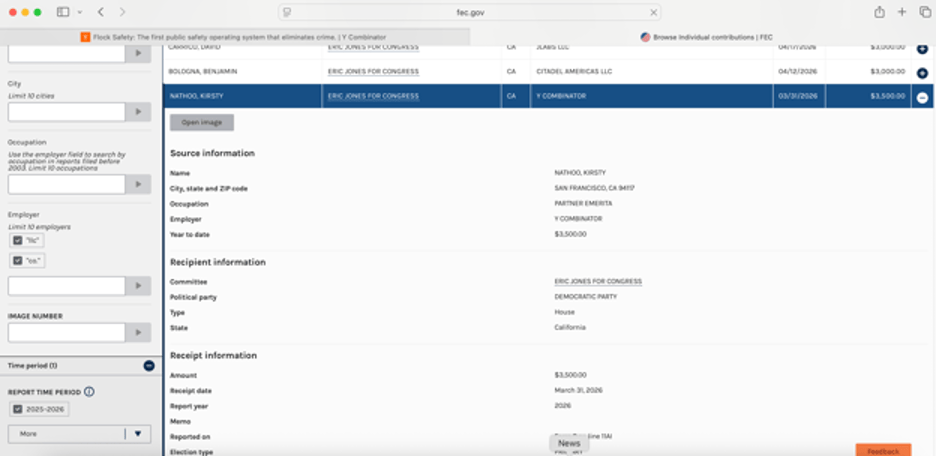
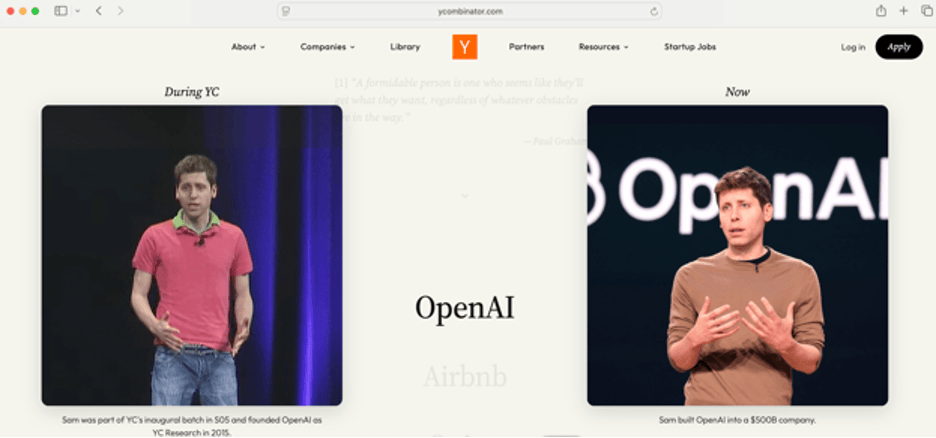
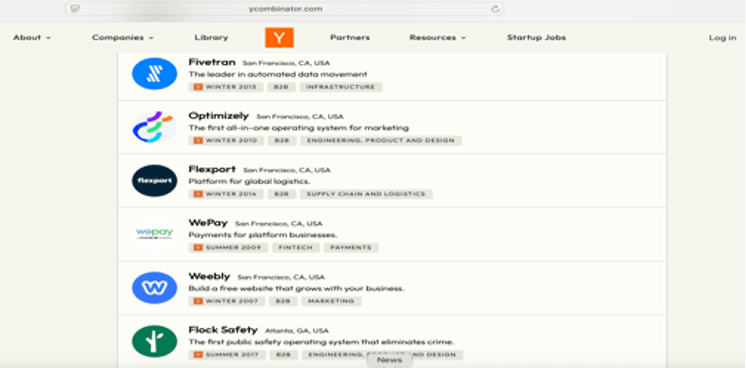
Kristy Nathoo is a “Partner Emerita” of Y Combinator who is located in San Francisco and donated $3,500.00 (the maximum) for the Primary on March 31, 2026. Looking into “Y Combinator” we can see the many well-known clients of this “venture capital” business.


And from a lengthy list of more of its clients, we see the following group, including Flock Safety:
Step Twelve: Do your own exploration now that you should have mastered the fundamentals of how to use the filters to dissect the data. One other interesting way to evaluate the data is to use the “date” filter that appears in the left-hand column — “Receipt Date Range” and put in a particular time frame. That way we get an idea which contributors were “on board” when the campaign launched. Eric Jones’ filed his Statement of Candidacy with the FEC on 9/9/2025.
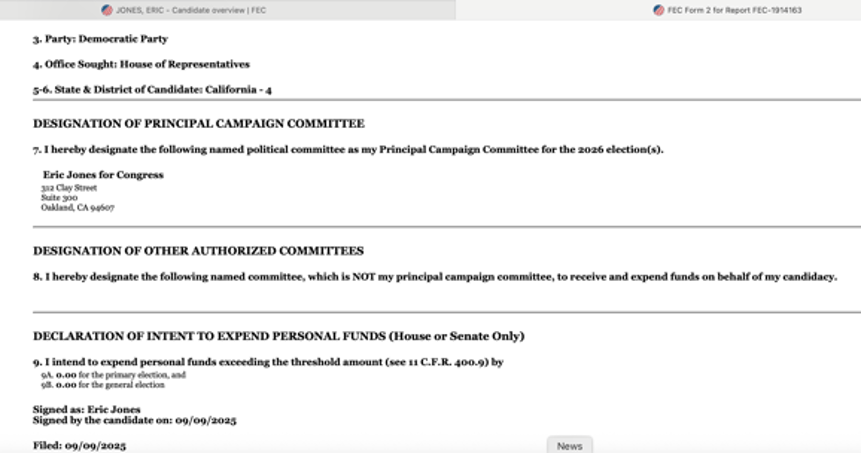
This “Original” statement does not appear to have ever been amended. So, I am curious about the “Declaration of Intent to Expend Personal Funds” and its lines 9A and 9B, both of which read: “0.00”. The “threshold amount” must be quite high if his $5 Million plus self-funding for the Primary does not exceed the threshold.
Step Thirteen: Going back to our basic page of unfiltered “receipts” (contributions) scroll down and put “07/01/2025 – 09/30/2025” into the “Receipt Date Range” filter and in the “amount” filter, put in “from $2,500 ” and “to $9999” and click on the >. After the page opens, click on the right-hand > (bottom right-hand corner) repeatedly to advance all the way to the final page. There we get to the end of the 369 large contributions received during the reporting quarter from July 1 to September 30, 2025 — for a campaign that officially began on 09/09/2025.
Because the entries are in “reverse chronological order” with the oldest/first, those appear at the end during the specified period.
We can see that many “double-maximum” contributions came rolling in, several even prior to 09/09/2025. So, these folks were in-the-know and on-board from the very beginning. This screenshot shows the bottom of the final page. Those are the contributors who were most “in-the-know” about Eric Jones and his planned campaign (all contributions on this screenshot were received well in advance of his Declaration of Candidacy filed on 9/9/2025). So, these contributors bought into whatever he was “selling” in terms of his planned candidacy. There’s a long-standing political action group supporting women candidates called “E.M.I.L.Y.’s List”. Its name represents its philosophy: “Early Money It’s Like Yeast — It Makes the Dough Rise.” Let’s explore some of these very early contributors to Eric Jones’ campaign.
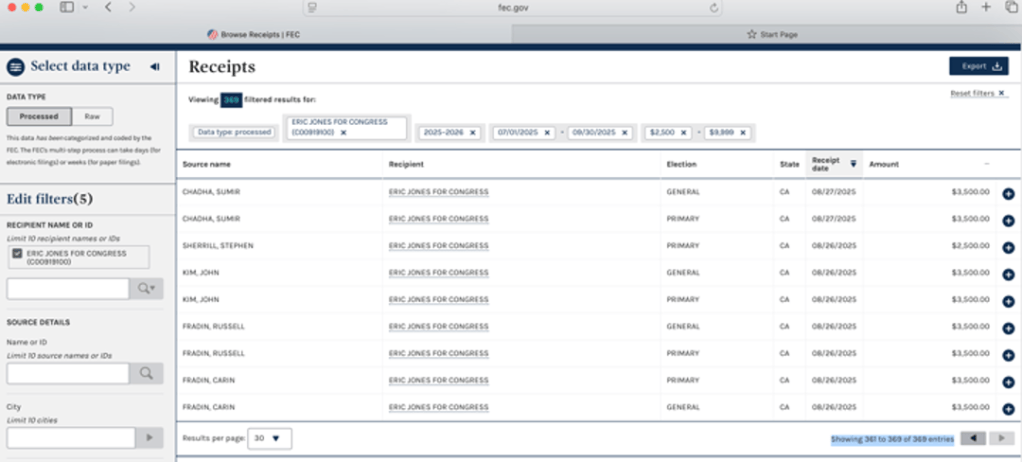
Let’s start with the “first-in” contributions on 8/26/2025, roughly two weeks prior to the Declaration of Candidacy. So, click on the + button on the right of one of the contributions of Fradin, Carin. Note first that there are FOUR contributions of $3,500.00 from persons with the last name of Fradin. Here’s what we see.
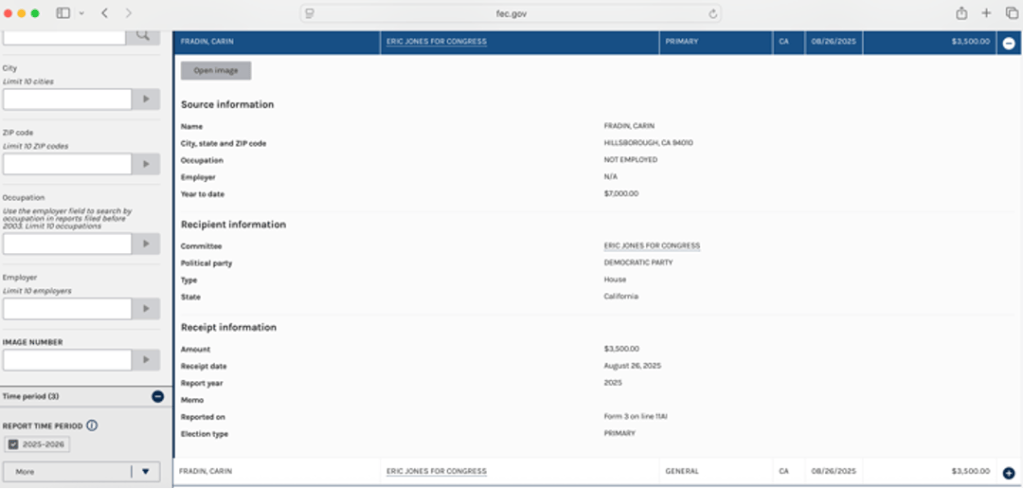
Carin Fradin is “not employed” and is from Hillsborough, CA and gave the maximum of $3,500 twice on August 26, 2025. Next, click off that entry and scroll up to “Fradin, Russell” to see the detail there.
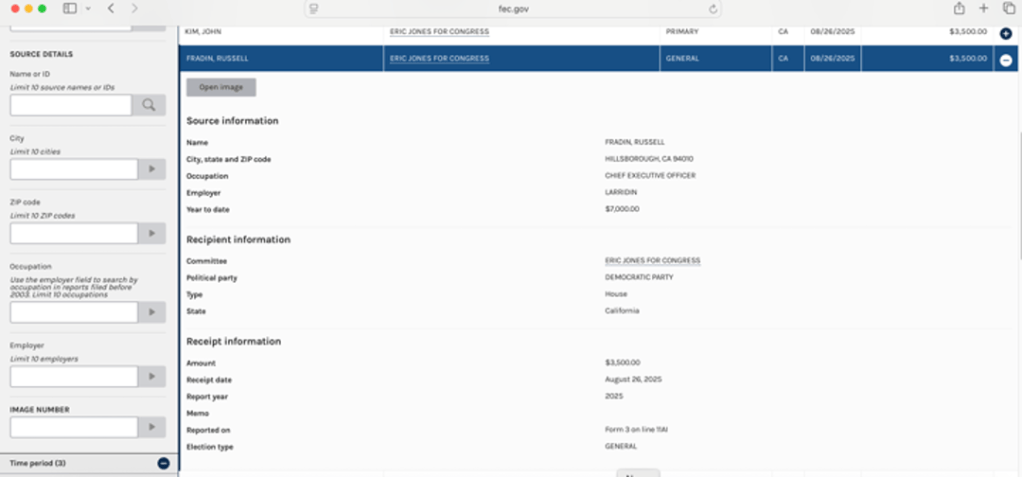
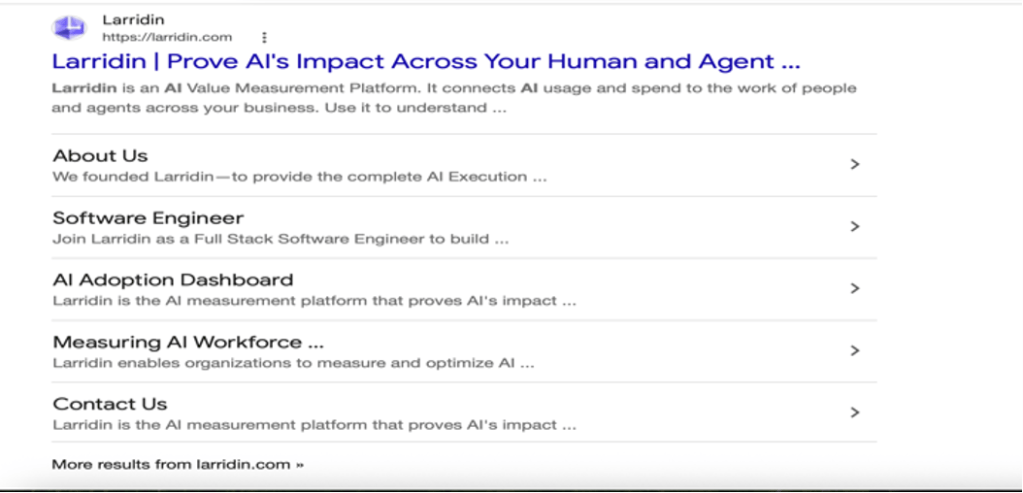
Russell Fradin also is from Hillsborough, CA and is the “Chief Executive Officer” for Larridin. search on-line to see what Larridin is all about.

Note at the top that Larridin is “Backed by Andreesen Horowitz” a major private equity venture capital firm that focuses on AI, as shown on their website.

If you scroll down on Larradin’s website, you will see Russ Fradin is shown as “Co-founder & CEO.” He and his “spouse”(?) together gave $14,000.00 well in advance of the filing of the Declaration of Candidacy. Larridin’s activities are shown on their website:
Next, look at “Chadha, Sumir” who gave the double-maximum ($7,000.00 total) on 8/27/2025. We find:
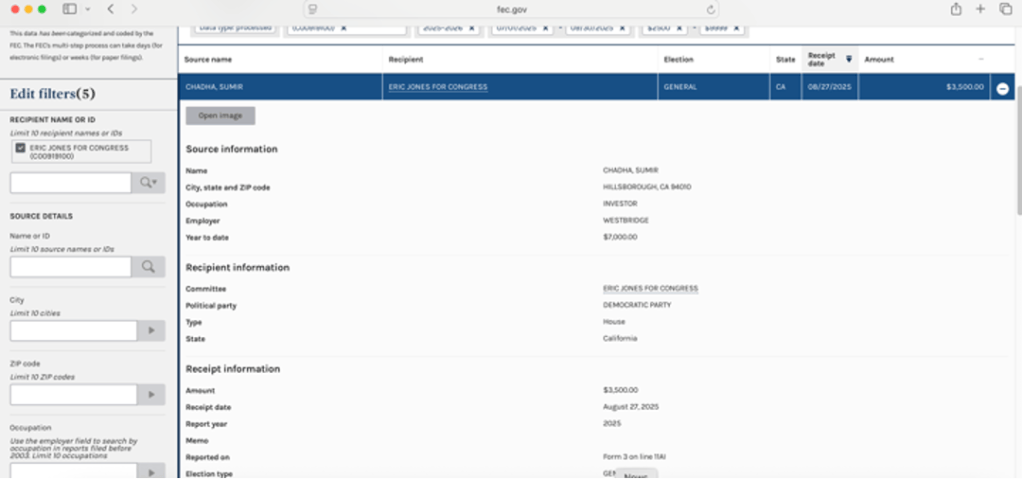
Sumir Chadha is also from Hillsborough, CA., and an “investor” with “Westbridge;” look on-line to find that Sumir Chadha is “Managing Partner” of Westbridge Capital/Advisors.
Westbridge’s business involves:

Step Fourteen: Scroll up a page or two (use the left < arrow to go up to pages with more slightly more recent contributions). Look at the contributions on 9/5/2025 made by “Dimitruk, Corrine” and “Dimitruk, Michael” — both gave the double-maximum ($7,000) prior to the Declaration of Candidacy on 9/9/2025; thus, a combined total of $14,000. We find that Michael is a “Partner” at “Dragoneer Investment Group, LLC” and Corrine is “Not Employed”.
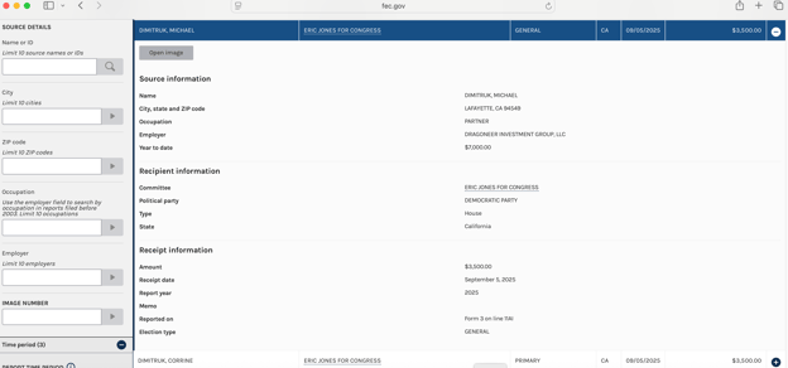
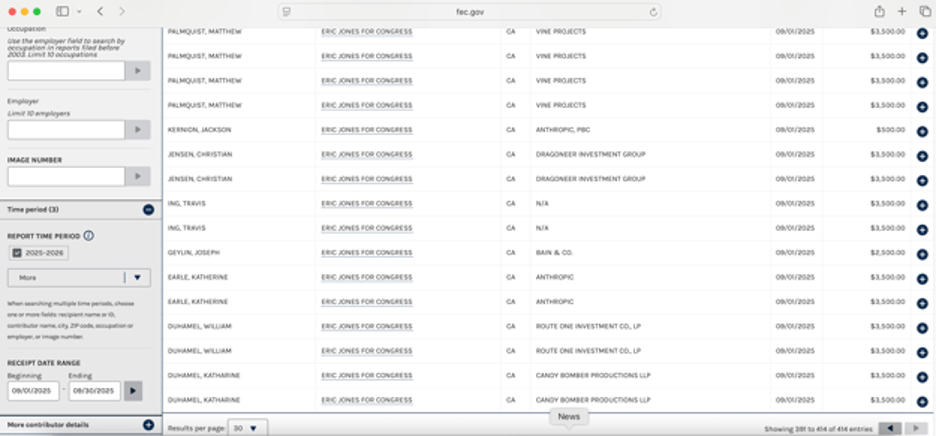
Take a look at some of the other early investors in Eric Jones’ quest for Congress. Use the + button on the right-hand side to check out the details behind the contributions from Anthropic’s and Dragoneer Investment Group’s other people — such as “Jensen, Christian” at Dragoneer and Earle, Katherine at Anthropic.
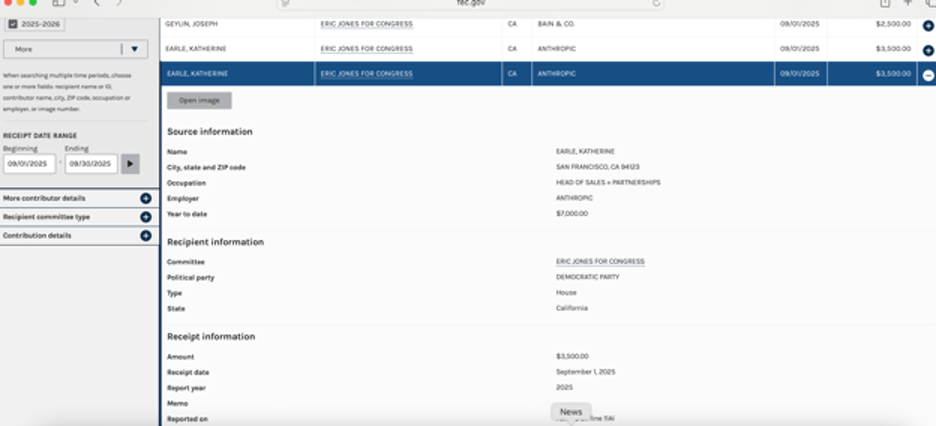
Katherine Earle, Head of Sales & Partnerships at Anthropic gave the double-maximum of $7,000 on September 1, 2025 — 8 days before Eric Jones’ Statement of Candidacy was filed.
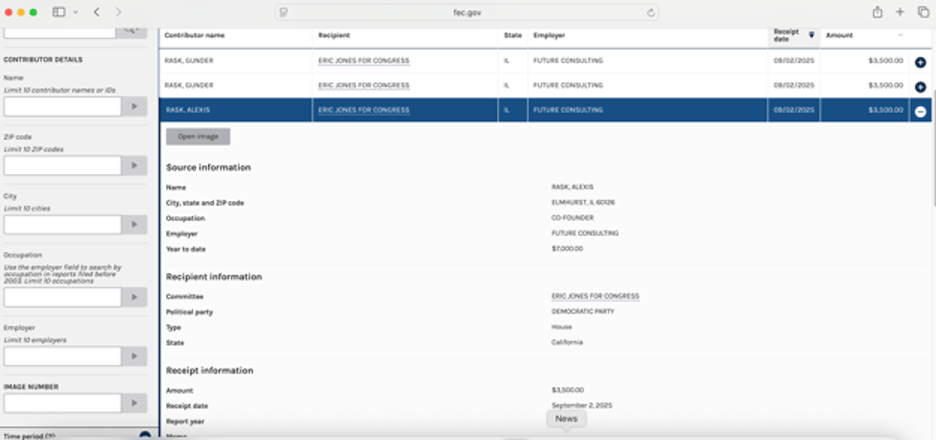
Scroll up to the contributions dated 9/2/2025, the day after Katherine Earle’s, and it’s obvious the word spread fast (or the mail was slow) because the following day, September 2, 2025, four $3,500.00 contributions arrived from “Rask, Gunder” and “Rask, Alexis.” Click on the respective + buttons to learn they are both “co-founders” of “Future Consulting” in Elmhurst, Illinois.
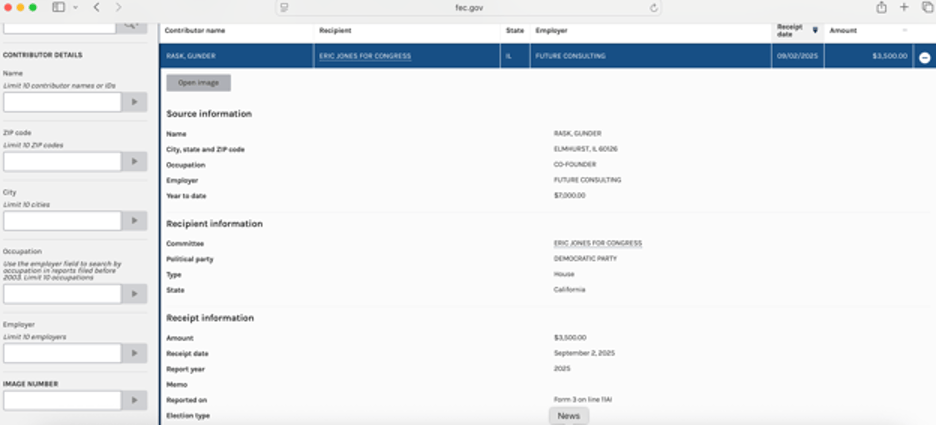
Another Dragoneer person cointributed $7,000 on 9/5/2025 — Jared Middleman of San Francisco. The same date, Veronica Middleman (“not employed”) also contributed $7,000.
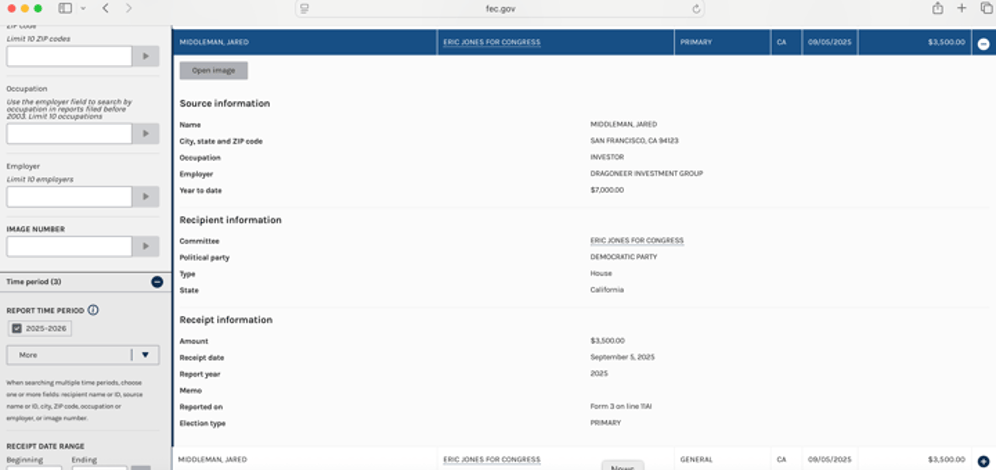
The same pattern is observed with Pat Robertson, a Partner at Dragoneer and Tina Robertson, both of San Francisco. Both contributed $7,000.00 on 9/5/2025. You can click on the + to check these and others out. Nothing “illegal” about these, just indicative of who supports Jones.
Step Fifteen: For comparison, return to where you were at Step Four; this time input “Thompson, Mike Mr.” That will take you to this page that contains information about his campaign finances:
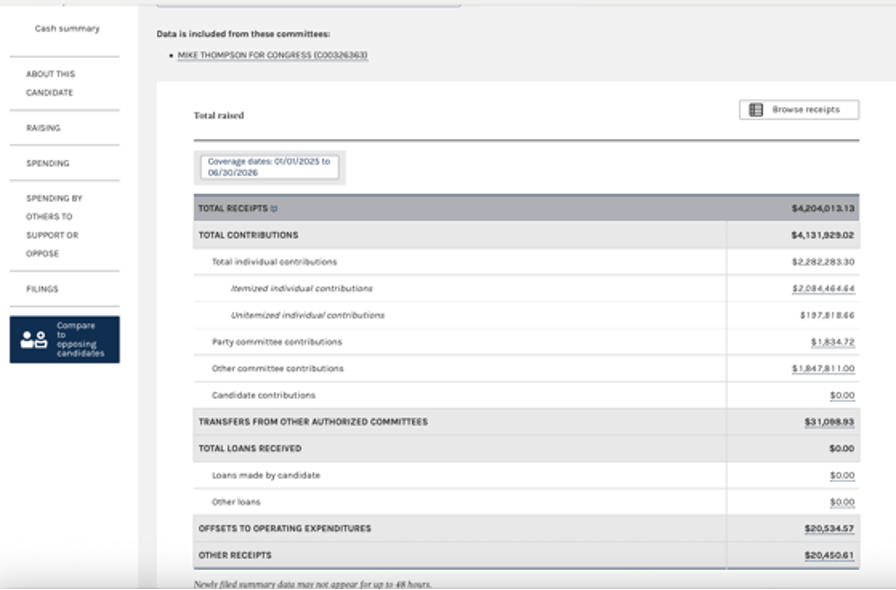
Note the substantial number of contributions that are “unitemized” and thus total less than $200 per contributor. You may perform the same types of searches to see how many contributors to Mike Thompson’s campaign have donated the maximum amount. Also, check to see how many there are in the $1 to $250 grouping. Using that filter and the “Restrict Contributions From unique individuals only” filter, we get this result:
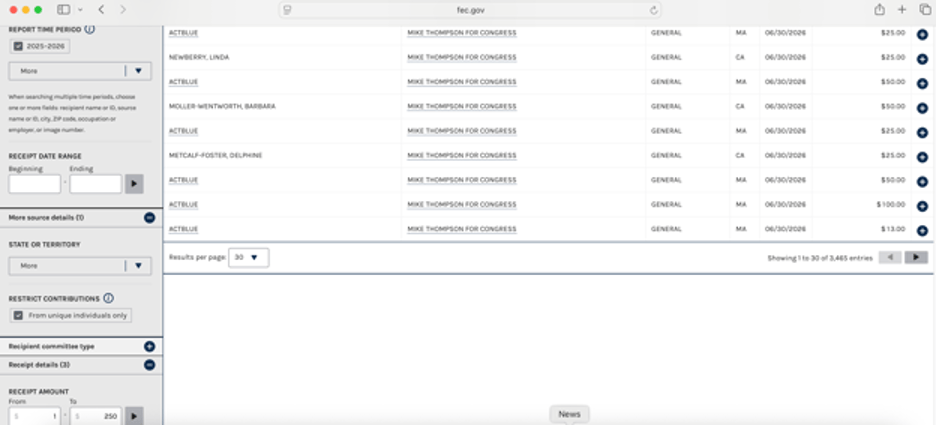
There are 3,465 contributions during this two-year election cycle to Mike Thompson’s campaign that are between $1.00 and $250.00. Eric Jones’ campaign had only about 1/50th (just 2%) as many small contributions. Draw your own conclusions.
Step Sixteen: Change things up for our final exercise of this lesson by delving into Expenditures. Return to the webpage at Step Five, and bring up Eric Jones’ basic campaign report. Instead of clicking on “click instead on “Spending” to see how Eric Jones spends all that money. Again, the data is presented in reverse chronological order, so scroll all the way to the “bottom” by clicking on the > arrow button in the bottom right corner of the first page. It will take a lot of clicks because the webpage displays ONLY TEN entries at a time. The first two expenditures (on 8/6/2025, five weeks before filing Statement of Candidacy), were for “Media Production” and appear to be one expenditure to Crescendo Creative in Maryland, which likely involved a reimbursement to himself for the payment to Crescendo. Now click the < left arrow to get to the next-to-last page. On the same date (8/6/2025) another payment was made to Precision Strategies, LLC in “D.C.” for Website & Brand Development. Then on 8/18/2025 there was the first of three expenditures to David Binder Research for “Focus Group Research” (no doubt to develop Jones’ “messaging”).
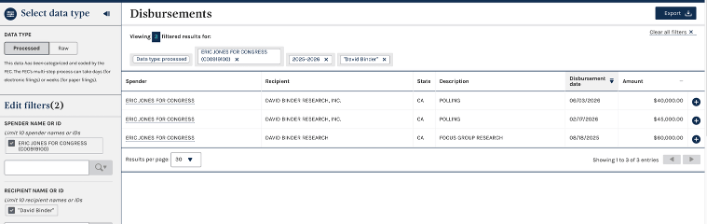
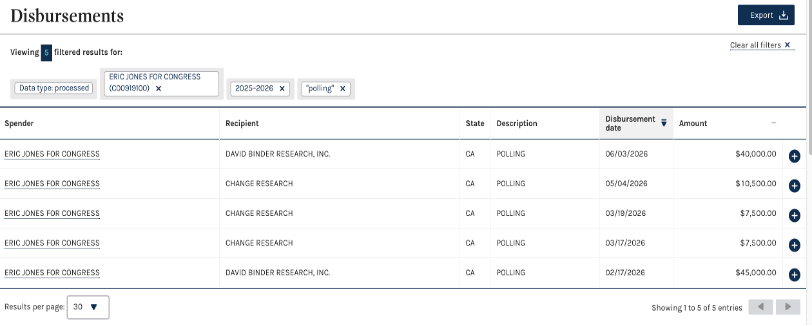
There were additional expenditures for “polling” beyond just David Binder. Eric Jones has been researching for what CD 4 voters want to hear.
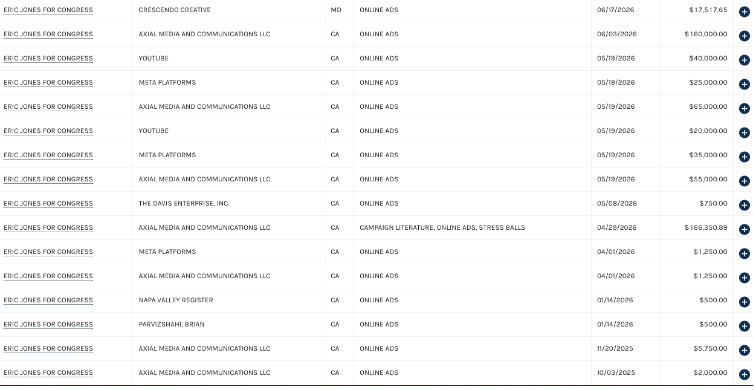
And then spending lots for “Online Ads”:
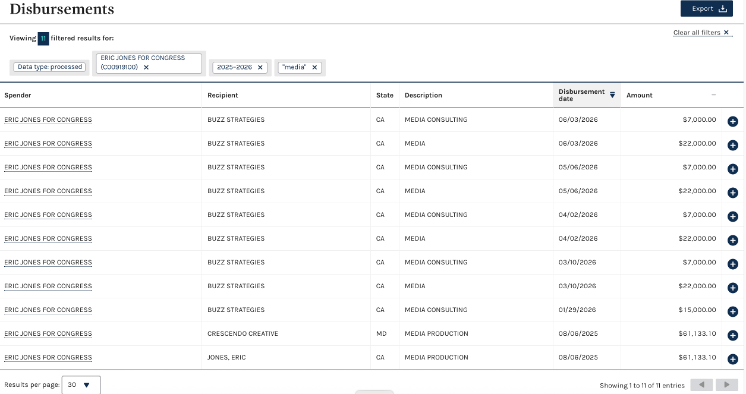
And for Media Consulting to design all those ads:
There were also 29 Expenditures that came for “ads” — most are shown here:
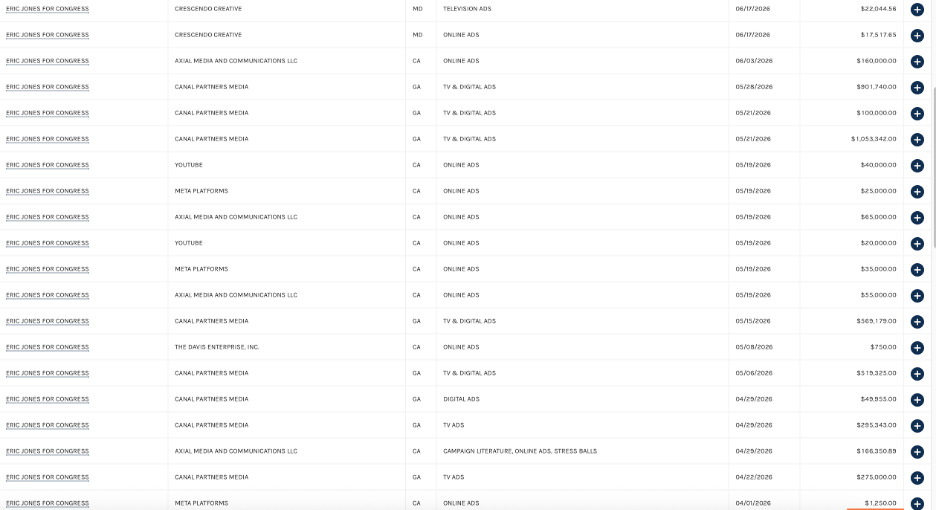
With this information in hand, go back to the link in Lesson One to the candidates’ debate on KCRA. https://kcra.com/article/congressional-district-4-debate-recap-mike-thompson-eric-jones/74070817
Fast forward to 20 minutes in and listen to Eric Jones’ response to a question about AI and Data Centers. Think for yourself! What is a “Special Interest”? Then reach your own conclusion!
If you have stayed with this so far, you should be able to peruse through not only these candidates’ contributions and expenditures about other Federal candidates’ as well; in case some other contests are of interest to you. So, this will conclude Chapter One. Soon, I will present Chapter Two, which will delve into contributions to and spending by Super PACs that produce those slick ads and mailers and text messages that inundate us all during election season.
REMINDER NOTE: The other important informational aspect of campaign finance disclosure appears in the tag-lines to ads on TV, or on the radio, or on the mailers themselves. In order to determine where to begin researching the money behind these communications, you need to gather that information. They legally have to disclose it, but they try to minimize it as much as possible. So, if you are seeing an annoying ad on TV, grab your phone and take a quick photo when that information appears, so that you can look at it carefully. If you get a campaign mailer, before you throw it into your favorite “circular file” write down or grab a photo of the “sender ID” on the mailer. This will be pertinent for our research in Chapter Two and also in Chapter Three, where I plan to elucidate how to use the State of California’s disclosure resources to learn who is funding the numerous ballot measure campaigns this year.



Leave a Reply