

[The following email by Dan Carson and Elaine Roberts Musser was sent to the Davis City Council today and is posted to the Davisite at the request of the authors]
Dear City Councilmembers,
As you move toward final action on Tuesday on the Willowgrove project, which could provide new housing our community needs, we urge you to address two significant issues (both referenced in your new city staff report) that we strongly believe will undermine its chances of winning voter approval this November.
Fourth City Fire Station
Last month, at a Planning Commission hearing on the Willowgrove project, a city planning staff member suggested the city has decided to build a fourth city fire station. For weeks city staff has since declined to answer specific questions posed to them about the city’s intentions. We believe this is an important matter for you to consider, given the findings of a city consultant in a 2018 study, that our community does not need an expensive fourth fire station the city cannot afford.
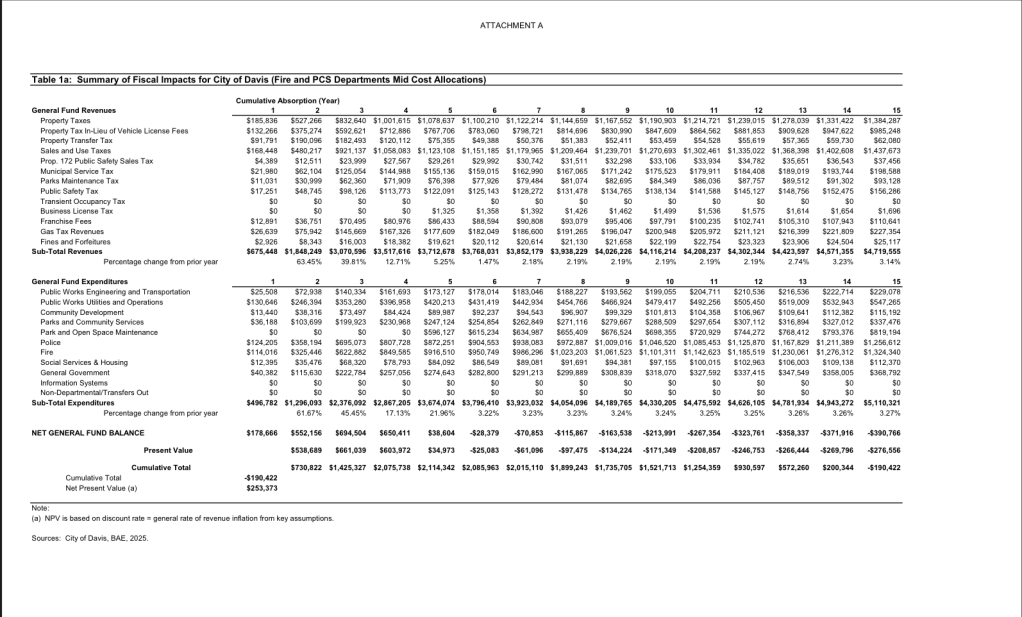
Additionally your new city staff report contains a strong hint city staff are still pursuing a four-fire station plan. Notably, it cites a fiscal analysis by BAE Urban Economics that analyzes the projected net operating costs to the city from just such a new fourth city fire station. Staff selectively cites a version of the BAE fiscal analysis that assumes the 15 year fiscal impact of such a project “would be slightly negative at $190,422”. This is based on the assumption that other city residents gained from future new development projects would shoulder most of the costs of the operation of a fourth new fire station.
Why is this matter relevant to your consideration of Willowgrove?
Without advance notice to the public at either the Planning Commission or your City Council hearings, the Willowgrove project was modified. Stripped out was a prior proposal by city staff to reserve land at the corner of the Willowgrove site for a fire station to which the existing aging South Davis fire station could someday be relocated. This option could have helped city taxpayers to avoid the annual (and ever-growing) $3.5 million cost of staffing a fourth fire station. But this option now suddenly is being blocked without explanation or justification by city staff.
The $190,422 figure, it should be noted, comes from one of three different versions of the BAE analysis of Willowgrove. The $190,422 version assumes that multiple other housing projects are built out in Davis in the future and share the cost of the fire station. The $190,422 figure staff cited is an estimate of the cumulative net fiscal impact of the project in the long term, after 15 years. And after the total revenues generated by the project over that entire time are compared to total costs of providing public services to its new residents over the same period.
Unfortunately, city staff failed to share with you other important information contained in that same BAE fiscal analysis of Willowgrove.
For example, the city staff report chose to cherry pick only one number from the version of the BAE analysis it selectively shared with you. The full summary of that scenario (see Table 1a below) shows that by the fifth year of development of the Willowgrove project, before any other significant additional housing would likely ever come on line, a project including plans for a fourth fire station would generate a annual net fiscal loss for the city of $3.5 million. That predicted result would essentially double the size of the funding crisis the city faces today and perpetuate a fiscal mess. There is zero chance that a rush of other development projects will come on line and shoulder any significant share of those costs within a few years after development of Willowgrove commences.
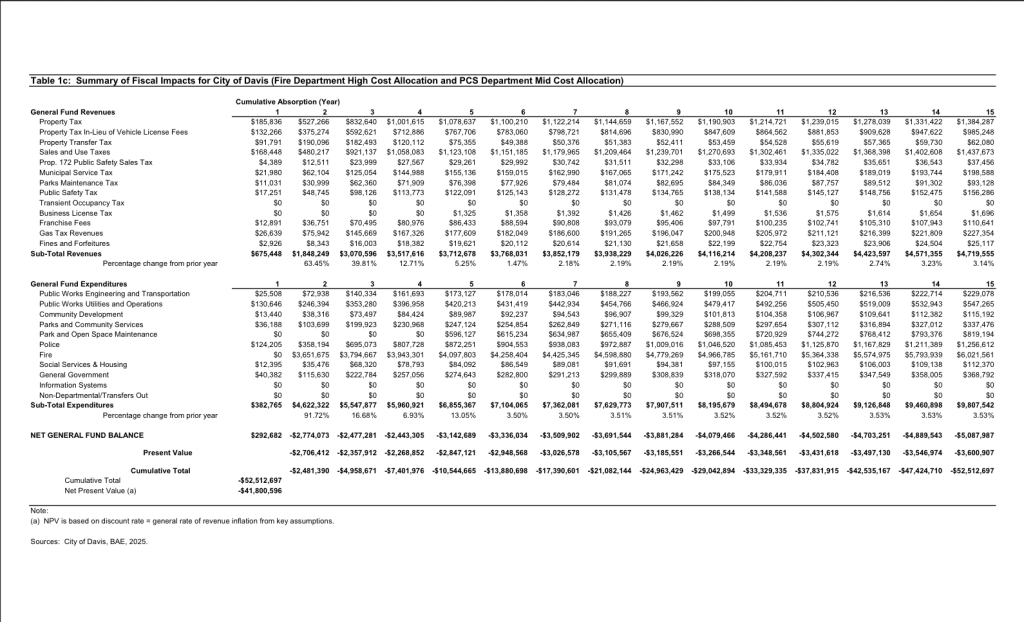
You should also take a look at a different fiscal scenario projected by BAE, one that assumes other major housing and development projects do not materialize within that same 15-year period. (See Table 1c below) Your consultant projected a frightening cumulative city deficit of as much as $52,517,697. This analysis effectively documents that multi-million dollar annual deficits are by far the more realistic prospect for the city if it blunders into a decision to build a fourth fire station.
Those increases in city operating costs simply and completely go away, however, if the city moves forward with the plan recommended to it by a national fire deployment expert to reposition two of its aging fire stations, in South Davis and West Davis, and operate only three fire stations in the future. Unfortunately city staff has declined to explain its current fire station plans and in particular whether three or four stations are planned, or where.
The city has never placed a Measure J/R/D project on the ballot with negative fiscal outlook and it should not do so now. That makes the silence by city officialdom on this subject so concerning. Please insist that city staff immediately clarify its fire station plans, and take a clear stand Tuesday night against a fourth fire station if that is indeed their intention.
Down Payment Assistance (DPA) Program
Page 05-43 of your new city staff report highlights the option of using a $1.8 million financial contribution from the Willowgrove project to establish a new city-funded and city-operated DPA program. The staff report summary of this development agreement (DA) provision states:
“The $1.8 million to the Housing Trust Fund will be used to facilitate housing ownership opportunities for moderate income buyers within the Willowgrove HDR-2 site. The City will have discretion to determine the best way to utilize the funds for affordable ownership opportunities and may utilize a portion of the $1.8 million to cover City staff time and costs to facilitate the homeownership opportunities. As an example, a homebuyer assistance program providing a loan could provide funding for an initial 20 affordable ownership Willowgrove condominiums/townhomes and then with the loan repaid at the sale, funds would return to the Housing Trust Fund to provide additional homeownership opportunities at Willowgrove or throughout the City.”
Our analysis of this proposal shows that it poses significant fiscal risks for city taxpayers. It allows, but does not require, the $1.8 million provided by the developer be used to offset the city’s considerable long-term costs, probably for decades, if the money is used for the creation of such a DPA program.
Under the approach proposed in the DA language, the city would not receive any repayment of funding from a Willowgrove homeowner who received such assistance until the date, perhaps decades in the future, when that home was sold. Moreover, the DA language proposes that any such DPA loans be interest free and thus ensures that the city’s Housing Trust Fund not share in the appreciation in the value of a Willowgrove home financed with this new assistance program. The DA language also attempts to rule out any requirements that the builder sell the home at a discounted price in order to make it more affordable.
The following scenario is thus plausible, and even likely. The Willowgrove development team insists on selling their homes to “missing middle” homebuyers at full price. As promised in the DA, the developers write a check to the city Housing Trust Fund for $1.8 million, but the city promptly pays that all or nearly all of that $1.8 million to prospective homebuyers, who immediately repay that $1.8 million back to the Willowgrove developers. The home buyers benefit from this assistance, and the developers benefit from accelerating the sales of their new homes at full price.
But the benefit to city taxpayers, if any, from these DA provisions could be a fraction of that. First, the city would have to spend unknown hundreds of thousands of dollars to create and administer such an assistance program for decades to come. The city will be under terrific pressure to spend nearly all of the $1.8 million up front so as to qualify families earning no more than 80 percent to 120 percent average monthly income for full-price homes, leaving insufficient resources for the city to operate the program in the short and long term. Second, any repayment of the financial assistance initially provided to a lucky 20 homebuyers at Willowgrove would not be forthcoming until such time as the property was foreclosed upon or sold, perhaps 30 years from now in some cases. Inflation and losses from foreclosures could dramatically diminish the value of that $1.8 million by hundreds of thousands of dollars over time.
This assistance program may not be needed at all. There will likely be a much better way in place to assist “missing middle” families to buy new homes built at Willowgrove or elsewhere in Davis. First, state down payment assistance programs already exist. Second, a statewide measure which recently qualified for the November 2026 ballot could provide DPA assistance equivalent to 17 percent of the sales price of newly built homes, such as those at Willowgrove, for families earning up to twice the average monthly income of their county. This new state program, which must be put in place by 2028, could assist the very same homeowners targeted for assistance in the Willowgrove DA with no involvement or risks for city government. This opportunity is ignored in these DA provisions, as are already existing state programs.
No independent program or financial analysis has been shared with the City Council or the public to justify these provisions in the DA, or to assess the long term fiscal costs or operational challenges to the city of such a program. It makes no sense to blindly write a DPA program into the Willowgrove DA. All references to it should be struck from the DA. The language of the DA should be modified to allow all $1.8 million paid to the city by Willowgrove to be used for housing assistance at the city’s full discretion if the fall statewide ballot measure is passed by California voters.
Dan Carson
Elaine Roberts Musser



Leave a Reply