

By Greg Rowe
The California Environmental Quality Act (CEQA) requires an Environmental Impact Report (EIR) to examine the potential impacts of a range of reasonable alternatives to the proposed project and evaluate the comparative merits of the alternatives. Under CEQA, the purpose of studying alternatives is to allow meaningful analysis and comparison of alternatives that could reduce significant environmental impacts as compared to the proposed project.
The alternatives must be feasible, meet most or all of the project objectives, and avoid or substantially lessen one or more of the project’s significant impacts. Alternatives are generally evaluated in a qualitative manner rather than to the same degree of exactitude as the proposed project. A “no project” alternative is always included. The “no project” alternative for a project that would develop vacant land would in most cases be the “Environmentally Superior Alternative (ESA),” but not building the project would fail to achieve any of the project objectives.
As a result, the alternative that best avoids or mitigates the most impacts is typically identified as the ESA, but the lead agency (the City of Davis in this case) is not obligated to substitute this alternative for the proposed project. In fact, because alternatives are generally analyzed qualitatively, a lead agency could not approve an alternative consistent with CEQA unless that alternative was also analyzed at the project-specific (i.e. detailed) level, such as the Biological Resources Preservation Alternative (BRPA) for the Village Farms project.
Alternatives are selected after the project’s impact analysis has been completed and the project’s potential impacts to the environment are known. This is a logical sequence because it is impossible to know if an alternative would produce fewer impacts if the potential project’s impacts are not yet revealed, just as a doctor cannot consider alternative treatments for a patient before the ailment and its source are known.
In my experience working with EIRs since 1984, once the impact analysis has been completed, there typically will be a meeting among the EIR consultant, the client (in this case, the City of Davis) and potentially the project proponent (in this case, the developer). For a project such as Village Farms, the EIR consultant and city planning staff would use their professional experience and knowledge of the area and CEQA to devise a range of reasonable alternatives, with which the project proponent may or may not concur. In other words, the selection of alternatives is an objective process based on impartial judgment and professional experience. It should not influenced by political or financial considerations.
A knowledgeable but now retired land use consultant once told me that in his long experience, impacts to biological resources, traffic, and air quality tend to be the primary factors that influence the identification of alternatives. Typical alternatives might include any or all of the following:
- The same footprint or area but with fewer units (meaning lower density).
- A smaller physical footprint but with the same number of units, which would typically avoid impacts on sensitive biological resources on the property.
- A reduced project area footprint that includes the same number of housing units, but with a different mix of housing types.
- A lower number of housing units on a smaller footprint.
- Developing the project at an entirely different location, if acquiring such land for an alternative is feasible.
These are just a few examples. Any number of other possible alternatives may be created based on the project’s particular location and parameters.
But it must be reiterated that the selection of alternatives typically occurs only AFTER the impact analysis has been completed, again because the purpose of evaluating alternatives is to determine if changes in the project concept could avoid or minimize anticipated impacts. “Pre-selecting” alternatives in the absence of impact data is simply not a productive exercise, nor a generally accepted CEQA standard of practice. Even if potential alternatives are discussed in advance of impact analysis, the alternatives ultimately selected should be re-evaluated to confirm that they meet the requirements of CEQA.
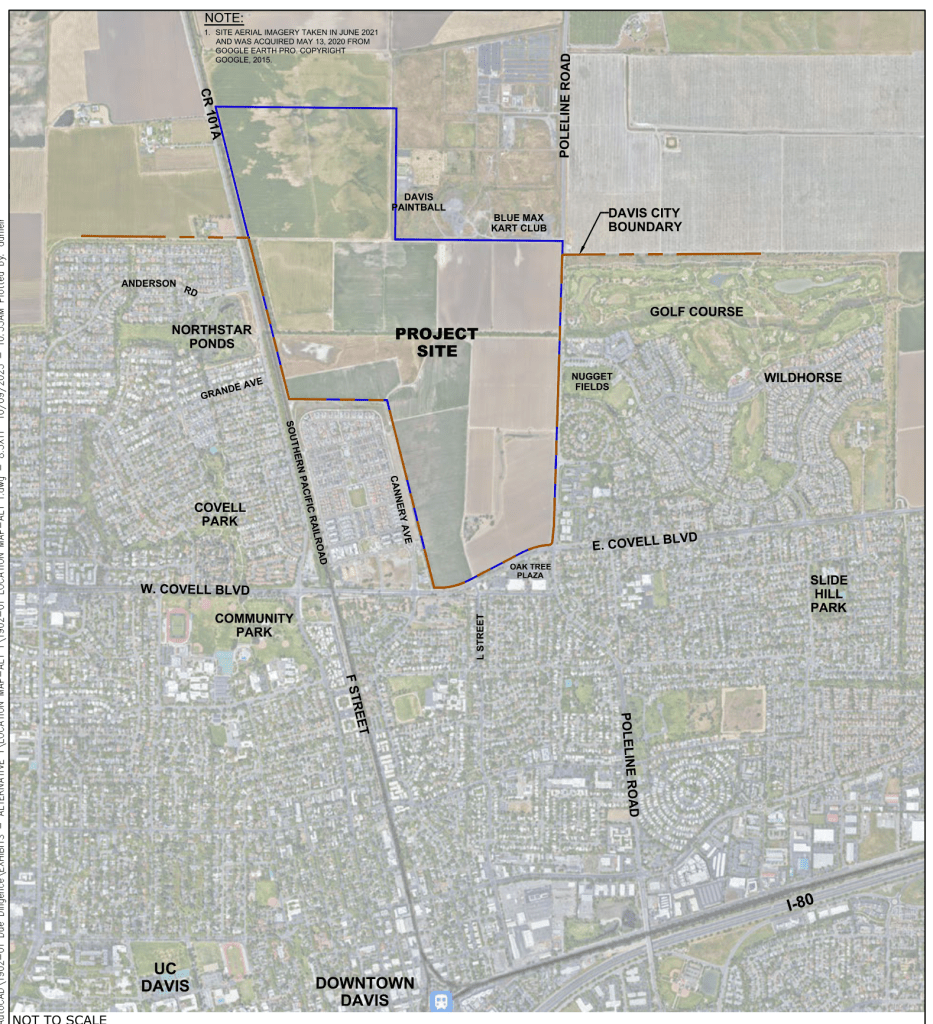
In the case of Village Farms, Council began discussing potential alternatives in October 2023, long before the environmental impact analysis had even begun. A final list of alternatives was then selected by Council at its meeting of 12 December 2023. During that meeting, Community Development Director Sherri Metzker informed the Council that by identifying alternatives at this stage of the EIR process, before the environmental impact study was even under way, the Council was “…putting the cart before the horse…” and were “kind of getting this backwards.”
Even then-Mayor Will Arnold stated that the Council would “normally not have this level of engagement at this point in the process.” To her credit, during the December 2023 meeting, Councilmember Donna Neville questioned whether it would be useful to include an alternative having less acreage and fewer housing units (i.e., a “smaller and fewer” alternative). Unfortunately, none of the other councilmembers expressed interest in Neville’s suggestion. (Please note that Linda Deos was not yet on the Council at that time.)
Council’s “pre-selection” of alternatives to be examined in the Village Farms EIR may seem like an arcane and unimportant issue except to those who understand and appreciate the fine points of CEQA, but this occurrence has significant potential implications because it implies ulterior motives could have been in play. It appears the primary intention was to include an alternative comprised of 2700 housing units, or 50% more than the developer’s proposal.
The ostensible rationale for this alternative was that the higher density associated with 2700 units on the same footprint would reduce per capita Vehicle Miles Traveled (VMT) below targeted levels, thereby helping achieve the City’s climate impact goals. In my experience, I have never seen an alternative that increased the number of housing units by this extent because in most situations an increase of this magnitude would far exceed the developer’s capacity and available financing, or would have the unintended effect of creating or intensifying other environmental impacts. I also question the legitimacy of selecting an alternative solely based on the rationale that it would greatly reduce the significance of just one impact, virtually to the exclusion of other impact considerations.
The alternatives selected by Council also ignored the fact that the “Reduced Footprint” alternative in the December 2004 draft EIR for the almost identical Covell Village project on the same site was the “Environmentally Superior Alternative” out of eight alternatives evaluated in that EIR. Because that alternative restricted development south of Channel A, it produced the fewest land use and biological impacts compared to the proposed project. (The Covell Village project would have had 1864 housing units compared to a slightly lower number of 1800 units in the current Village Farms proposal.)
I contend that selection of alternatives before the environmental impact analysis had even begun, along with the exclusion of an alternative for the same site that was previously determined to be the “Environmentally Superior Alternative,” suggests there may have been a preconceived and predetermined outcome, which injected bias into the EIR. It likewise deprived the Planning Commission and the public of the ability to consider and objectively evaluate a truly robust set of potential alternatives.
During Council’s discussion of alternatives in late 2023, one of the Councilmembers evidently asserted that choosing the alternatives at that point in time was acceptable because “we all know what the impacts will be.” Again, having worked with CEQA for most of my professional and voluntary career, I never encountered a project for which the potential environmental impacts were completely known ahead of time.
Unanticipated discoveries virtually always emerge, which is why highly experienced technical consultants are hired to carry out the numerous studies necessary for an EIR. The late discovery of the capacity limitations of the wastewater treatment plant is just one example of impacts that were unknown prior to environmental review.
I began working with EIRs in 1984, and since then have never witnessed a situation in which a lead agency (i.e., a city council) inserted itself into the alternatives selection process. During the past year I consulted with a number of highly experienced land use attorneys and CEQA practitioners, all of whom stated that our council’s selection of EIR alternatives is a practice they have not witnessed anywhere else.
It is my sincere hope that in the future the Davis City Council will refrain from manipulating the selection of EIR alternatives, and instead facilitate objectivity by allowing the process to follow the normal EIR standard of practice. As eminent CEQA attorney Nick Yost wrote in an article last year, “Like all laws, CEQA derives its social license from its good-faith application.” Good faith was unfortunately missing from the alternatives selection process for the Village Farms EIR.
____________
Greg Rowe has served on the Davis Planning Commission since January 2018. Before retiring he was Senior Environmental Analyst for the Sacramento County Department of Airports for 13 years. His previous experience includes air quality planner for a regional council of governments, air quality health educator for an affiliate of the American Lung Association, and economic development advocate for the chambers of commerce in Cincinnati OH and Oakland CA.

 Davisite
Leave a comment