

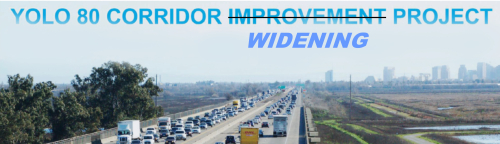
(From press release) On May 29, the Sierra Club and the Environmental Council of Sacramento (ECOS) filed a lawsuit against Caltrans alleging legally inadequate environmental analysis of the I-80 freeway widening project through Yolo County.
The lawsuit’s goal is to stop Caltrans from widening 17 miles of the I-80 freeway from six to eight lanes between Davis and Sacramento through the Yolo Bypass Wildlife Area until Caltrans conducts a valid analysis of adverse environmental impacts threatened by the project and implements appropriate mitigation for these harmful effects.
Caltrans’ Environmental Impact Report (EIR) grossly underestimates increased vehicular travel, which would emit far larger quantities of greenhouse gases (GHG) and air pollutants than claimed. The EIR fails to consider viable alternatives, such as increased public transit or alternate tolling strategies. Therefore, the project neither adequately manages demand nor produces adequate revenue to fund needed transit alternatives. Also, Caltrans’ proposed mitigation is woefully inadequate to offset the resulting increased GHG and air pollutant emissions.
Caltrans violated the California Environmental Quality Act (CEQA) by failing to acknowledge that freeway widenings do not produce less congestion but, in fact, result in increased traffic — leading to worse congestion and pollution – due to “Induced Demand”.
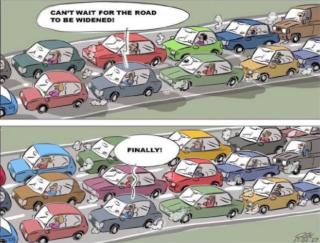 Proven by decades of research, including studies at UC Davis’ famed National Center for Sustainable Transportation, Induced Demand recognizes that as more freeway lanes are added, traffic will disproportionately increase so that 5-10 years later, congestion will be even worse.
For years, Caltrans’ answer to congestion has been to simply widen freeways. However, landmark California legislation (SB 743) requires that major roadway projects must be analyzed using “Vehicle Miles Traveled” that includes the impact of development projects on vehicle use.
Additionally, SB 32 requires California to reduce its GHG emissions by 40% by 2030. However, this freeway widening project would substantially increase GHG emissions, pushing California further towards irreversible climate change.
According to the Sierra Club Yolano Group Chair, Alan Pryor, “The EIR for the I-80 widening shows Caltrans is stuck in reverse when we need to move our region forward by investing in real alternatives to congestion that don’t just put more cars on our roads and smog in our air. Instead of spending hundreds of millions of taxpayer dollars laying down concrete and asphalt that locks us into a future of car dependency at the expense of community health and our environment, Caltrans needs to get serious about real alternatives such as improved frequency and access to public transit."
ECOS’ Climate Committee Chair, Ralph Propper, added, “The Sacramento metro area is consistently in the top ten worst in the country for unhealthy levels of ozone and particulate matter – more traffic will make this even worse! Furthermore, the increased pollution will especially impact West Sacramento residents, where almost a quarter of the population is below the poverty line. The EIR does not consider tolling existing lanes – which could be based on income – with funds used to provide clean public transit and bike/ped options along the corridor, facilitating affordable infill development. Caltrans must be called to task for its legally deficient actions. This lawsuit’s goal is to require Caltrans to change its ways, by providing sustainable transit options instead of just more pavement.”
The Natural Resources Defense Council (NRDC), representing the Planning and Conservation League along with the Center for Biological Diversity, also filed suit to challenge the Yolo I-80 highway expansion project.
__________________________________________
About the Sierra Club – The Sierra Club is a California nonprofit membership organization incorporated under the laws of the State of California in 1892. It is the nation's oldest and largest environmental organization with more than 1,000,000 members. The Sierra Club functions to educate and enlist people to protect and restore the natural and human environment, to practice and promote responsible use of the earth's ecosystems and resources, to explore, enjoy, and protect wild places, and to use all lawful means to achieve these objectives
About ECOS – For over fifty years, ECOS has worked in the Sacramento region to achieve sustainability, livable communities, environmental justice, and a healthy environment and economy for our residents – by working with individual and organizational members, neighborhood groups, businesses, and regional agencies and governments.

 Davisite
Leave a reply to Alan Pryor Cancel reply