Davisite Banner. Left side the bicycle obelisk at 3rd and University. Right side the trellis at the entrance to the Arboretum.

Does Gloria Partida’s Conviction for a Felony in 2000 Disallow Her from Holding an Elected Public Office in California?

And did Gloria Partida sign a false statement and wrongfully fail to disclose the conviction as required by law in her Statement of Candidacy in 2022?

Attestation

By Alan Pryor

The Alleged Felony Crimes, the Conviction, and the Sentencing

Based on official court records, Gloria Partida, current at-large Davis City Councilmember who is running for reelection in the newly created District 4 (East Davis and Wildhorse), was apparently charged in 1999 with four felony counts of “Forgery, Statute 470(A)” and one felony count of “Fraud to Obtain Aid, Statute 10980(C)(2)” for offenses committed in 1995 and 1996.

The following screenshot of the initial charges filed in Yolo County Superior Court was obtained from the Court’s document retrieval system (see https://portal-cayolo.tylertech.cloud/Portal/Home/WorkspaceMode?p=0, using “Partida, Gloria Jean” to search). Note that as of the evening of 10/10/2022, the records appear to have been scrubbed from the Court’s website although they were available earlier in the day:
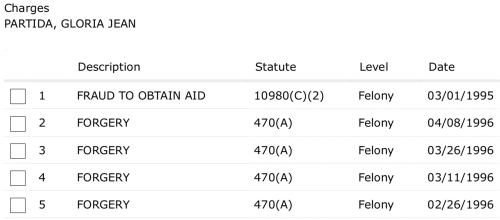
Filed Charges

The initial complaint against Ms. Partida was filed on 3/12/1999 and she was arraigned on all of the charges on 3/30/1999.

At the Preliminary Hearing on 2/2/2000, Ms. Partida entered a conditional plea of “guilty/Nolo” to the Fraud to Obtain Aid felony charge with the stipulation that no time in a State Prison would be imposed upon sentencing on the assigned date of 3/20/2000.

Disposition

Preliminary Hearing

Following the submittal of the Probation Department Report, a sentencing order was issued by the Court on 3/20/2000 ordering restitution in the amount of $6,673.42, payment of Public Defender costs, and a 5-year probation in lieu of surrendering to serve 120 days in jail, which was apparently suspended with the entry “Stayed Reason Unknown”.
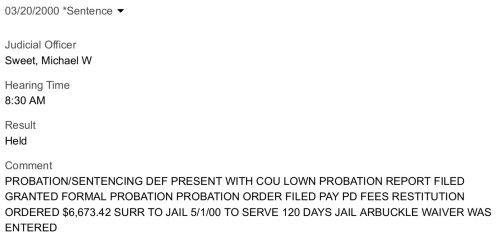
Sentencing

Sentencing_2

There was seemingly no sentencing for the four felony Forgery counts for which the Disposition Record shows “Conversion Disposition”. The basis for such disposition is unknown but is possibly due to a plea bargain when Ms. Partida pled guilty/Nolo to the Fraud to Obtain Aid charge.

The Expungement

Section 1203.4 of the California Penal Code allows for a person who has a felony conviction for which they successfully completed probation to have their conviction “expunged” from their record. This has the effect of changing a “guilty” plea or verdict to “not guilty” and the conviction is expunged from the person’s record. However, as discussed below, this expungement does not seal, destroy, or otherwise remove all records about the case; it does not remove certain penalties of the conviction; nor does it remove the responsibility to disclose this information under certain circumstances

According to the Penal Code’s language [emphasis added]:

“§1203.4. (a) (1) In any case in which a defendant has fulfilled the conditions of probation for the entire period of probation, or has been discharged prior to the termination of the period of probation, or in any other case in which a court, in its discretion and the interests of justice, determines that a defendant should be granted the relief available under this section, the defendant shall, at any time after the termination of the period of probation, if they are not then serving a sentence for any offense, on probation for any offense, or charged with the commission of any offense, be permitted by the court to withdraw their plea of guilty or plea of nolo contendere and enter a plea of not guilty; or, if they have been convicted after a plea of not guilty, the court shall set aside the verdict of guilty; and, in either case, the court shall thereupon dismiss the accusations or information against the defendant and except as noted below, the defendant shall thereafter be released from all penalties and disabilities resulting from the offense of which they have been convicted, except as provided in Section 13555 of the Vehicle Code…The order shall state, and the probationer shall be informed, that the order does not relieve them of the obligation to disclose the conviction in response to any direct question contained in any questionnaire or application for public office, for licensure by any state or local agency, or for contracting with the California State Lottery Commission.”

https://leginfo.legislature.ca.gov/faces/codes_displaySection.xhtml?lawCode=PEN&sectionNum=1203.4.

According to Yolo County Superior Court records, Ms. Partida’s probation was terminated on 9/1/2005, after which she petitioned the Court on 9/22/2005 for expungement. On 11/4/2005, the matter was heard in the Court and the motion was granted.

Expungement

California Law Does Not Allow Certain Convicted Felons to Serve as an Elected Public Official

California Election Code, Chapter 1, Section 20 specifically prohibits persons convicted of certain types of felonies from serving in an elected office in the state [emphasis added]:

Section 20 – Effect of felony conviction

(a) A person shall not be considered a candidate for, and is not eligible to be elected to, any state or local elective office if the person has been convicted of a felony involving accepting or giving, or offering to give, any bribe, the embezzlement of public money, extortion or theft of public money, perjury, or conspiracy to commit any of those crimes.(Emphasis added) 

(b) For purposes of this section, "conviction of a felony" includes a conviction of a felony in this state and a conviction under the laws of any other state, the United States, or any foreign government or country of a crime that, if committed in this state, would be a felony, and for which the person has not received a pardon from the Governor of this state, the governor or other officer authorized to grant pardons in another state, the President of the United States, or the officer of the foreign government or country authorized to grant pardons in that foreign jurisdiction”

https://leginfo.legislature.ca.gov/faces/codes_displaySection.xhtml?lawCode=ELEC&sectionNum=20.

These offenses are categorized as “violations of public trust.” Ms. Partida’s felony conviction for “Fraud to Obtain Aid” seemingly falls into the broad category of “theft of public money”; if this is correct, then it appears that Ms. Partida should not have been considered a candidate for office in 2018 nor have been eligible to be elected.

The only action that could remove this penalty would be a pardon. Expungement after serving probation is not included. This is further clarified by provisions in Section 1203.4 (a) (3) of the Penal Code that states the following regarding expungement:

Dismissal of an accusation or information underlying a conviction pursuant to this section does not permit a person prohibited from holding public office as a result of that conviction to hold public office.

https://casetext.com/statute/california-codes/california-penal-code/part-2-of-criminal-procedure/title-8-of-judgment-and-execution/chapter-1-the-judgment/section-12034-fulfillment-of-conditions-of-probation-change-dismissal-of-accusations-or-information

A reasonable interpretation of the above language seems to indicate that the prior type of felony conviction that Ms. Partida had precludes her from holding an elected office in the State of California whether or not the record of such conviction was expunged or not.

Public Misleading Statements and a False Filed Statement of Candidacy

Ms. Partida’s Campaign Manager, Tracy Tomasky, wrote the following letter and posted it on NextDoor on October 9, 2022 in response to postings showing Ms. Partida’s was charged with the five felony offenses referred to above:

The screenshot that you are showing in your post does not correctly reflect the current status of Gloria’s case. Those charges were formally dismissed by the Yolo County Superior Court more than 17 years ago. Unfortunately, due to a paperwork error, the public facing website continues to show incorrect information. Gloria is working with her legal counsel and with the court to correct this error. As soon as it is corrected the record will correctly show that any remaining charge was dismissed. If you would like more information, please contact me privately, Tracy Tomasky, Campaign Manager

It appears Ms. Tomasky is claiming that because Ms. Partida’s charges were “dismissed” by Yolo County Superior Court as a result of the expungement of her record, that she essentially has no criminal record that would affect her ability to serve as an elected official and there is thus no need to disclose this information. This ignores the provisions in the California Election Code and Penal Code requiring Ms. Partida to affirm that she has no felony convictions in her Statement of Candidacy.

California law states in Section 1203 (a) (1) of the Penal Code that such disclosures of prior convictions are mandatory regardless of if such expungements occur at a later date.

The order shall state, and the probationer shall be informed, that the order does not relieve them of the obligation to disclose the conviction in response to any direct question contained in any questionnaire or application for public office, for licensure by any state or local agency, or for contracting with the California State Lottery Commission.

The Office of the Public Defender for San Diego County explains:

“The first thing that someone who wants to apply for an expungement needs to understand is that if your petition is granted under Penal Code 1203.4, your case is not sealed. A criminal record is not actually "expunged" under this statute. That term implies complete erasure, as if the case had never occurred. A more proper term is "dismissal". The conviction remains on your record for many purposes, including sex offender registration and immigration consequences. What the statute provides is, except as elsewhere stated, the defendant is 'released from all penalties and disabilities resulting from the offense'. There are numerous limitations to this relief.”https://www.sandiegocounty.gov/public_defender/expungement.html

The State of California Courts have stated:

If you have successfully gotten a 1203.4 dismissal ("expungement"), it does NOT mean that the conviction is wiped away, sealed, purged or destroyed! The arrest is still there, charges are still there, but technically the conviction is "set aside and dismissed”.

IMPORTANT! There are a few places you still have to say yes, you have been convicted, even if it's all been expunged. Those places are: 1) the INS; 2) any state or local licensing agency (like when you're applying for a guard card or nursing license); 3) contracts with the state lottery; and 4) in an application for public office.” (emphasis added).

(https://www.courts.ca.gov/partners/documents/general_info_on_expungement.doc)

Ms. Partida signed a City of Davis Statement of Candidacy for the 2022 ballot and affirmed that she did not have any felony convictions in that filing in response to a specific question under the “Qualifications” section [red arrow inserted]:
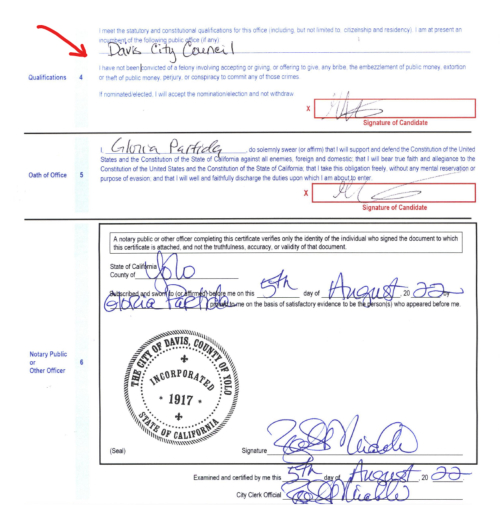
Signed Statement of Candidacy

It should be noted that in addition to apparently violating the CA Penal Code §1203.4 (a)(1) provision regarding the “obligation to disclose the conviction in response to any direct question contained in any questionnaire or application for public office,” filing a false document is in itself a felony offense in California as stated in California Penal Code §115. (a):

Every person who knowingly procures or offers any false or forged instrument to be filed, registered, or recorded in any public office within this state, which instrument, if genuine, might be filed, registered, or recorded under any law of this state or of the United States, is guilty of a felony.”

(https://law.justia.com/codes/california/2011/pen/part-1/112-117/115)

Additionally, Ms. Partida failed to disclose the prior felony conviction in a public forum for District 4 candidates hosted by Indivisible Yolo, Yolo Democratic Socialists of America, and Yolo People Power on September 26, 2022, in Davis Community Chambers and recorded by Davis Media Access.

The following exchange occurred when the Moderator asked Ms. Partida about her prior experiences with the criminal justice system:

“Moderator General Opening Question – Please tell us about your personal experience with law enforcement and the criminal justice system. Have you ever been arrested or convicted of a crime? Please tell us about that experience.

Moderator Following Question to Ms. Partida – Could you tell us Gloria about your experiences with the criminal justice system?

Ms. Partida Sure. So when I lived in LA I was handed down a 69 Impala which was actually a police magnet and I was pulled over on multiple occasions and that continued until I bought a minivan. But yes, I have been arrested and so have had that experience with the police. I still respect the police greatly.”

https://drive.google.com/file/d/13kIdxjpaGsT3s6G6_t7JV1EfNc4Ccuwt/view

Ms. Partida did not disclose her prior felony conviction and seemed to imply that her only prior interactions with law enforcement stemmed from her owning the Impala because it was a “police magnet”.

Davisite logo

Did you enjoy reading this article? Then subscribe to the Davisite for free and never miss a post again.

Comments

78 responses to “Does Gloria Partida’s Conviction for a Felony in 2000 Disallow Her from Holding an Elected Public Office in California?”

  1. Ron Glick

    Now Bob neither of us are lawyers but I think you misunderstand the language here.
    (b) Laws shall be made to exclude persons convicted of bribery, perjury, forgery, malfeasance in office, or other high crimes from office or serving on juries. The privilege of free suffrage shall be supported by laws regulating elections and prohibiting, under adequate penalties, all undue influence thereon from power, bribery, tumult, or other improper practice.
    “Laws shall be made” is not some blanket constitutional exclusion. It delegates to the legislature and the executive how to regulate certain conduct.
    We have now heard from several attorneys who have repeatedly expressed that your accusations that Partida is ineligible is unfounded but we are yet to hear from one single attorney who supports the legal theories expressed by you and your friends. My experience tells me that in a debate about the law between attorney’s and non-attorney’s the attorney’s are the one’s with a better grasp of the law.
    But keep it up and if you want to keep digging a hole for Gloria’s opponent in the court of public opinion have at it. I’m still waiting to hear from her opponent whether he supports this kind of conduct on the campaign trail. Its kind of like January 6, when will Morrill call the dogs off.

  2. Ron O

    Seems to me that those who put forth information regarding Gloria’s crime did so in a matter-of-fact manner without claiming fake “moral outrage”. And that there was sound reasoning to question it.
    Now, I’m not sure who is looking up criminal records, but apparently the city itself isn’t doing it (as they probably should for council candidates).
    A truly independent observer regarding all of this would view it in a more objective manner, without any fake “moral outrage”.
    If one were to “compare the sides” (as it were), one side plead guilty to a felony (theft of public funds), while the other side uncovered it.  I hardly think this is a “winning hand” for the political side with the undisclosed felony, regardless of who looked it up – or how it was processed afterward.
    Hopefully, Gloria made sufficient restitution to account for the theft.

  3. John Hunt

    RK – The readers can decide whether my behavior is “strange” or whether I “[gave] Mr. Raven a pass” or whether I treated “the likes of [you]” inappropriately by asking you for a citation. I’m not really interested in any of that.
    Supreme Court: There are varying theories of what “the law” is. A major (indeed, I’d say the prevailing) one, is that state law is what the state’s highest court says it is. See, e.g., Oliver Wendell Holmes, Jr. The Path of the Law, 10 Harv. L. Rev. 460-61 (1897) (“The prophecies of what the court will do in fact … are what I mean by the law”). That’s why I brought the issue up. It doesn’t have anything to do with whether any case would actually be litigated. There’s more to say here, but I’ll stop there.
    Unsettled: As far as “unsettled,” as I mentioned some time ago, AFAIK the issue has not been litigated, so I’d agree it’s “unsettled” in that sense. It’s also, as far as I know, “unsettled” in that sense whether the term of the President of the United States is actually four years or whether there’s some hitherto undiscovered ambiguity in the U. S. Constitution that makes it arguably five years.
    Put differently, “unlitigated” does not imply “ambiguous.” Here, although I recognize that some lawyer (or nonlawyer) somewhere can almost always come up with an argument that any text is ambiguous, (1) the text here is not ambiguous as far as I can tell, and (2) no one has presented an actual argument that it is.
    “For all purposes” seems to mean “for all purposes” unless there’s an applicable express exception, and in this case there appears to be none.
    I’ll conclude that, so far, nothing of substance has been added to my original two posts on this.

  4. John Hunt

    Bob Milbrodt – I don’t have time to answer at length, as I have to go to work. Briefly, I think Ron Glick has it right:
    8(a) is irrelevant because no one in the race has been convicted of the crimes it mentions.
    8(b) is irrelevant because it governs the legislature, not individual candidates. The legislature has complied with the constitutional directive by making the prescribed laws (I believe). If the legislature had not done so, I would expect that any remedy would lie against the legislature through some sort of writ of mandamus rather than against individuals (although that creates interesting constitutional questions).
    Also, AFAIK neither candidate has been convicted of forgery (certainly, Alan Pryor’s post alleges only conviction of “a felony”), and it’s unclear (to say the least) that benefits fraud is a “high crime.” So it’s not at all clear that the offenses 8(b) covers are at play here in the first place.

  5. Ron O

    John – it’s wasn’t an “alleged” felony that Gloria pleaded guilty to. It was an actual one (per the record cited), regardless of how it was subsequently changed.

  6. John Hunt

    Ron – I don’t think it’s disputed at this point that (a) there was a conviction for benefits fraud, and (b) there was no conviction for anything else, including forgery.
    If my post gave the impression that I believe otherwise, I apologize; I was writing quickly.
    If I’m wrong and either of those points is disputed, I’d welcome an explanation.

  7. Bob Milbrodt

    Ron
    Whether we are lawyers is immaterial. We both can read. The language states “laws shall be made to exclude…”
    Even lawyers can understand the importance of reading the entire sentence.
    Where you are left is to argue that Gloria was not convicted of one of the listed offenses. Hanging your hat on “for all purposes” in a subordinate statute doesn’t hold water. John’s subsequent post is picking up on this point.
    Catch me in the AM and we can discuss it then.

  8. Ron Glick

    Bob I’ll leave the legal arguments to the lawyers for a rebuttal. I’ll rest on my laurels that the law professor said I was right. I think I get to move to the head of the class. I ask you one question Bob, can you show me a single lawyer that will make the case that your claims are correct?

  9. R Keller

    It looks like JH wants to all too easily brush off what the CA Constitution says: “it’s not at all clear that the offenses 8(b) covers are at play here in the first place.”
    A reminder that California Constitution Article 7, Sec 8 (b) states “Laws shall be made to exclude persons convicted of bribery, perjury, forgery, malfeasance in office, or other high crimes from office or serving on juries…”
    The “Fraud To Obtain Aid” conviction was obtained under PC 10980(C)(2) for “willfully and knowingly, with the intent to deceive, by means of false statement or representation, or by failing to disclose a material fact, or by impersonation or other fraudulent device, obtained or retained aid under the provisions of this division for himself or herself or for a child not in fact entitled thereto.”
    JH presented no argument for why this fraud conviction shouldn’t fall under the category of “other high crimes” that perjury and forgery are explicitly stated examples of in the CC. These are all public trust violations similar in kind and severity of punishment (“filing a false document” (PC 115) would be another example.)
    8(b) is partially implemented through California Election Code, Chapter 1, Section 20 that states: “(a) A person shall not be considered a candidate for, and is not eligible to be elected to, any state or local elective office if the person has been convicted of a felony involving accepting or giving, or offering to give, any bribe, the embezzlement of public money, extortion or theft of public money, perjury, or conspiracy to commit any of those crimes.”
    Note that here “perjury” and “theft of public money” are given equal weight in terms of severity of consequences.
    Now, read that together with Section 1203.4 (a) (3) of the Penal Code that states…
    “Dismissal of an accusation or information underlying a conviction pursuant to this section does not permit a person prohibited from holding public office as a result of that conviction to hold public office.”
    … and there is very clear intent from the Constitution on down to statutes in the EC and PC that there is a special class of crimes that are considered so harmful to the public trust that they have the severe consequence of removing someone’s eligibility from public office regardless of later dismissal. This sort of penalty doesn’t even apply to most violent felonies.
    Someone might try to argue that the “for all purposes” clause in PC 17(b) trumps this, but there is no case law to support that regarding this particular class of crimes and their effect on eligibility for public office. And the clear, overarching Constitutional intent presents a formidable barrier to that as well. Simply put: these types of violations of public trust are treated differently than other crimes.

  10. John Hunt

    (Moderator – Sorry if this is a duplicate post; I can’t tell whether I posted it earlier or not. If it’s duplicate, please feel free to delete.)
    Obviously, you could argue that benefits fraud is analogous to perjury, or you could argue it’s not. That’s why I already said it’s unclear whether benefits fraud is a “high crime” under the constitutional provision. As I also already said, even if benefits fraud is in fact analogous to perjury, that doesn’t matter because a vague delegation to the legislature to “make laws” on a subject doesn’t contradict the clear statutory text of the laws the legislature actually did make on that very subject.
    Once again, nothing of substance has been added, and I think we can conclude the legal discussion at this point. The readers can review the posts and decide what they think is correct.
    A question for progressive-identifying readers here: Is it “progressive” to read a disqualification statute extremely aggressively in order to increase the penalty for a 27-year-old benefits fraud and bar a woman of color from political office?
    I’m not an expert on the history of disqualification statutes, but my general understanding is that they have a long history of being used as tools of political exclusion of less-powerful groups. I’m also not able to find anything quickly on the economic, racial, ethnic, and gender characteristics of people who were prosecuted for benefits frauds committed in 1995, but I suspect that the defendants were disproportionately less-advantaged women. Just something for people who post photographs of BLM protests and notices of Indivisible Yolo meetings to mull over.
    Also, as someone noted, I do work at UC Davis. To be clear, I am speaking as an individual and do not purport to represent the university’s or the law school’s position in any of my posts here.

  11. Alan C. Miller

    I don’t care about the law. No one is taking on a legal proceeding against GP in the next few weeks. Therefore all that matters is how this is perceived. Again the saying, “When you come at the king, you best not miss”. This isn’t literal. What it means is when you take a shot, it better be clean and definitive. I have no doubt the person trying to prove GP can’t hold office is convinced. That is irrelevant. What happened is y’all created a firestorm that created sympathy for Gloria. Your proof, no matter how much you believe it, didn’t convince everyone. You ‘missed the King’. The tactic failed. Righteousness or even being right has nothing to do with it. If the tactic fails, you miss the King. The tactic failed. You missed the King.

  12. John Hunt

    I would say something similar: If you’re going to assert that a woman of color is ineligible to be reelected to a public office she has discharged with honor for years because of benefits fraud 27 years ago, you’d better know what you’re talking about.
    It’s very, very irresponsible to make such arguments without the proper due diligence. That’s why I got involved in this; I previously hadn’t paid much attention to the race.

  13. R Keller

    JH: you are trying to all-too-quickly dismiss what the law actually says. You ignored the specific implementing statues for the Constitutional provisions, adding “nothing of substance” yourself to use your phrase
    Your abandonment of the amoral Holmesian “prediction theory of law” [“The prophecies of what the courts will do in fact, and nothing more pretentious, are what I mean by the law”; “For my own part, I often doubt whether it would not be again if every word of moral significance could be banished from the law altogether”] and subsequent move into moral accusations about “progressives” and what they should believe is “interesting”.
    Again, the California Constitution considers this issue so important that it has carved out a certain class of crimes that are antithetical to holding office (and some that need to be disclosed in any questionnaire for public office even if they don’t warrant a ban). The question about whether this should be the case is not relevant to the issue at hand. And your attempts at smearing people as being against a “woman of color” for bringing up this issue are disingenuous.
    As far as trying to minimize the seriousness of the crime, the Yolo County DA’s office was quoted as trying to do just that in the Enterprise article. However, this retraction/correction has since been published:
    “In the Friday edition of the Davis Enterprise, a representative of the Yolo County District Attorney’s Office was quoted as saying it is not uncommon among low-income individuals receiving public assistance, who are required to list household composition, including extended family members, to misrepresent those numbers in their paperwork. A representative of the DA’s office said Friday that was a misquote, that welfare fraud is not common; rather, there are different types of public assistance fraud, one of which involves household composition or individuals living in the home.”
    If we are going to talk about what progressivism is: is it “progressive” to uncritically accept what one political office has determined about another politician when they had previously conflicted themselves out of investigating the matter because of their close relationship? Are we to believe a veteran reporter misquoted them or that their accusation of a misquote is cover-up for wrong information that they provided earlier to try to provide cover for a politician?

  14. Ron Glick

    If you all really believe that Partida is ineligible why not file a lawsuit right now? She is currently serving as a City Council member so there is nothing preventing you from pursuing your ridiculous legal theories. But of course that isn’t really the point. The point is to damage Partida before the election. If I’m wrong about that go ahead and file.

  15. Colin Walsh

    Ron makes a good point. What I have learned through this process is there is no agency that determines elligability of a candidate for office and that the only way ultimately to determine if Partida or anyone else is elligable to hold public office is through litigation. Will someone decide to spend a few $100,000 to try to find out? Maybe if she was ever the swing vote against a development we would find out, but Partida voting against any development or deep pocket developer that could afford to litigate seems pretty unlikely.

  16. Ryan Davis

    I feel obligated to say at the outset that yes, I am a lawyer, although this should not be construed as legal advice. That said, John Hunt has it right.
    1. Article VII, section 8, subdivision (b), of the California Constitution definitely has nothing to do with it. It’s clear from the text itself, but in any event the courts have held that the provision isn’t self-executing. It contemplates and requires legislation to give it effect. Helena Rubenstein Internat. v. Younger (1977) 71 Cal. App. 3d 406, 420. So the question is whether any statutes (1) preclude Gloria from serving in public office, or (2) require her to disclose the conviction when asked if they’ve been convicted of a felony.
    2. Penal Code section 1203.4 also has nothing to do with it. If the conviction precluded her from serving, the expungement wouldn’t undo that. See section 1203.4(a)(3). And if Gloria has a felony conviction in the relevant sense, then the expungement wouldn’t nullify the disclosure requirement. See section 1203.4(a)(1). So just forget about section 1203.4.
    3. The fact that Gloria was convicted of a wobbler-turned-misdemeanor complicates things a bit. But just a bit. The California Supreme Court made it very clear in People v. Park (2013) 56 Cal.4th 782, 795, that the relevant rule is this: “[W]hen a wobbler is reduced to a misdemeanor in accordance with the statutory procedures, the offense thereafter is deemed a ‘misdemeanor for all purposes,’ except when the Legislature has specifically directed otherwise.” In other words, Penal Code section 17 means what it says. All purposes is all purposes. (So, for example, if the question is whether someone convicted of a wobbler-turned-misdemeanor has been convicted of a felony for purposes of a sentencing enhancement in a later criminal case, the answer is no, not unless the Legislature specifically directs otherwise.)
    4. In light of Park, the questions are really (1) whether there’s a statute that specifically directs that someone convicted of a wobbler-turned-misdemeanor is precluded from public office, and (2) whether there’s a statute that specifically directs that someone convicted of a wobbler-turned-misdemeanor is required to disclose the fact when asked if they’ve been convicted of a felony. The answer to both questions, as far as I’m aware, is “no.” Again, her wobbler-turned-misdemeanor is a misdemeanor is a misdemeanor is a misdemeanor, for all purposes except where the Legislature specifically directs otherwise.
    5. Although it doesn’t matter, one more point regarding the first question, as to eligibility for public office: it’s not at all obvious that a conviction under Welfare and Institutions Code section 10980 is actually covered by Elections Code section 20. People are assuming it is, but theft is its own crime with its own definition. See Penal Code section 484. I doubt section 20 applies here unless the conviction is actually for theft (of public money). The same conduct can often be charged several different ways and it’s not uncommon for collateral consequences to apply to some charges and not others and sometimes for no apparent reason.
    6. And now what really matters: it’s a damn good thing the law is as described above. It would be a horrible thing if candidates for public office had to disclose wobblers-turned-misdemeanors in any situation whatsoever. They probably shouldn’t have to disclose old felonies. Unless the law requires the question be asked (and it might, I don’t know), we should consider suggesting Yolo County stop asking it. I hate to be the bearer of bad news, but we live in a racist world with a racist criminal justice system run totally amok (although there have been very notable improvements in recent years). None of the above points are needed to establish that bringing any of this up was a very terrible thing to do. It deserves ridicule more than it deserves legal analysis.
    So for the reasons established by 1 through 5, or for the reason provided by 6 alone, let’s just stop.

  17. Ron O

    Why is it that those who want others to “stop” talking about this are the same ones who “keep” talking about it? 🙂
    By the way, I’ve never heard felonies describes as “wobblers”, before.
    I can envision a conversation in prison:
    “What wobbler did you commit to find yourself in here”?
    Hell, I think “wobbler” sounds even less-serious than a misdemeanor.
    How about we run through a bunch more labels, for words we don’t like?

  18. Ryan Davis

    But if you haven’t heard the term used to described the sort of crime at issue here (used in literally hundreds of published appellate opinions spanning decades), why weigh in on the law in this context?

  19. Ron O

    I can’t tell if I (still) have a comment pending, but I’ll go ahead and submit another one.
    This site is not limited to attorneys, especially those who start talking about racism in the criminal justice system (as if that translates into any individual case), or ridicules those who put forth legitimate questions regarding a council member who literally plead guilty to a felony. Those type of comments indicate bias in the first place, and creates a lack of trust regarding their “professional opinions” on here.
    I’m not one to search for criminal histories (or any other “dirt”), but once the subject was brought up – legitimate questions were asked (with sources to support it).
    In addition, the Enterprise noted that the court’s website was apparently not adequately updated until this issue was brought up, as I recall. (And yet, the crime itself still appears on there, despite the reported “expungement”.)
    I do believe that the issue has (probably) since been adequately addressed. However, I don’t support those who repeatedly attempt to shame, shut-down, or cajole others (who brought up legitimate questions) into silence. They’re not the ones who committed a crime in the first place, and have nothing to “apologize” for. (Though it shouldn’t have to fall upon citizens to conduct “background checks” in the absence of any official process.)
    So as long as Gloria’s defenders keep at it, they’re the ones inviting additional discussion. Even if all they want to do is to attack those who brought up legitimate questions.

  20. I don’t see any pending comments from you, Ron.

  21. Ron O

    Thanks, Roberta. I believe that the lack of a pending comment was a result of a “wobbler” (between submitted vs. unsubmitted).

  22. R Keller

    It’s strange that Ryan Davis states that “it doesn’t matter” but then goes onto to try to question that the public assistance fraud would even “count as “public theft” in the first place. He does this by stating that California Penal Code §484 is the statute that would apply (“theft is its own crime with its own definition. See Penal Code section 484″). However PC §484 refers to specifically to theft of PERSONAL property (” Every person who shall feloniously steal, take, carry, lead, or drive away the personal property of another…” and doesn’t include “theft of public money”.
    Davis also mistakenly states that the form that Ms. Partida signed was a Yolo County form when it was actually from the City of Davis. He also suggests that this form shouldn’t be used and the question shouldn’t be asked, which is strange since the language used on the Declaration of Candidacy under the “Qualifications” section (“I have not been convicted of a felony involving accepting or giving, or offering to give, any bribe the embezzlement of public money, extortion or theft of public money, perjury or conspiracy to commit any of those crimes”) exactly mirrors that in California Election Code, Chapter 1, “Section 20 – Effect of felony conviction. (a) A person shall not be considered a candidate for, and is not eligible to be elected to, any state or local elective office if the person has been convicted of a felony involving accepting or giving, or offering to give, any bribe, the embezzlement of public money, extortion or theft of public money, perjury, or conspiracy to commit any of those crimes.”
    This statute implements the broad California Constitution ban on being eligible for public office for specific types of crimes that violate the public trust.
    Why does Davis think that a form that copies the exact language in the Elections Code should not be used anymore and the question should not be asked? And why isn’t he aware that the form that the City of Davis uses was provided by the California Secretary of State’s office and used by many jurisdictions across the state including by the State of California itself?
    Given these and other things he managed to get wrong, it’s a good thing Davis added the disclaimer about his statements not being legal advice! 😉

  23. R Keller

    Another thing to add is that the author of the bill (Fuentes; AB2410 in 2012) that put in the strict provisions in the Election Code about felony convictions stated: “The intent of this bill is to create accountability and ensure that those seeking to represent Californians have proven to uphold the public’s trust in more ways than just serving time and probation.”
    Whether someone agrees with this or not, the clear intention and goal is to make qualification for public office much more stringent and less forgiving of certain types of previous crimes than cases like People v. Park that cover restoration of gun rights after post-conviction relief.

  24. Ryan Davis

    I didn’t mean to suggest I have a strongly held or firm view of whether the crime at issue, if a felony, would count as theft of public money. Maybe. And I just meant it doesn’t matter because we’re talking about a misdemeanor as far as the law is concerned.
    Parks is more on point than you suggest. It’s not about restoration of gun rights.
    Good point re: the form. The text of the post seemed to indicate it asks about any felonies, which I’d find questionable. But yeah, totally makes sense for it to track the language of the statute.

  25. Bob Milbrodt

    Lawyers are prone to asserting their professional status as if it magically transforms their arguments into unchallengeable and infallible positions. Like it or not, their statements are merely opinions (whether legal or otherwise). There are libraries filled with appellate decisions because lawyers have differing opinions, so that should debunk the notion that an argument is superior merely because it comes from a lawyer. So, let’s try logic instead.
    It was previously asserted that an after the fact reduction of a felony conviction to a misdemeanor status transforms that conviction to a misdemeanor “for all purposes.” The California Constitution demonstrates that such an interpretation of “for all purposes” is definitively false. Furthermore, the district attorney’s office cited a government code exception to such an interpretation for those seeking a position in law enforcement. That same code calls out those seeking public office. So, even the district attorney’s office disagrees with that fanciful interpretation of “for all purposes.”
    It is then posited that there is a new criminal status of “wobbler” that affords Gloria some sort of special treatment. This is wrong. A “wobbler” is merely legal jargon for an offense that could be charged as either a misdemeanor or a felony. The statutes do not identify a category of “wobbler” nor any special treatment such a category might receive. It is specious to introduce this notion, and even more so to suggest that Gloria not be treated as a convicted felon because there is no “wobbler” statute on the books. We follow the laws that are on the books, not the ones that live in someone’s imagination. Gloria was convicted of a felony, and she is to be treated according to her felony conviction. If her felony allows her to run for public office, then she is required to disclose her conviction per the statute already mentioned.
    Next, we have Election Code, Section 20. This statute excludes from public office those who have been convicted of a theft of public resources. A blog site is not the place to make the argument that welfare fraud falls outside of that definition. That is a question that should have been answered by our public officials. Yet, they collectively neglected to do so, and their position apparently is that the public will have to litigate the matter for clarification. That is a time consuming and expensive task that the public rightly presumes is being performed by our elected officials.
    Nevertheless, if Gloria’s supporters truly believe in their arguments, then file a motion in court. Don’t miss this opportunity to cement your position just because our elected officials won’t. You would be doing the public a favor, which is a far cry better than implying that others are “racist” for daring to disagree with your view.

  26. Ryan Davis

    I promise to let this go! Especially regarding the legal analysis. We definitely disagree there. But I want to clarify a couple things before I do:
    1. I agree that one’s status as a lawyer doesn’t prove anything. I just thought I should be up front about it. I was being genuine when I said, “I feel obligated to say . . . .” I felt the embarrassment bringing it up.
    2. I don’t think anyone’s racist here. My last point above was just an expression of my personal view as to what the law ought to be. I think we should be real cautious about referring to people’s criminal histories or creating collateral consequences for criminal histories. And systemic racism is a big reason why I think that.
    I’d be happy to talk to anyone more about the law, but would prefer one on one, maybe over coffee. I suspect we’d get along better than these posts suggest, even if we fail to agree on anything.
    Be well!

  27. John Hunt

    Thanks, Ryan, for adding some crim-law expertise here!
    I’ve just read the replies to my and Ryan Davis’s posts, and they don’t raise any points meriting a response. I invite interested readers to review the posts and decide for themselves who is right.

Leave a reply to Ron O Cancel reply