

And did Gloria Partida sign a false statement and wrongfully fail to disclose the conviction as required by law in her Statement of Candidacy in 2022?

By Alan Pryor
The Alleged Felony Crimes, the Conviction, and the Sentencing
Based on official court records, Gloria Partida, current at-large Davis City Councilmember who is running for reelection in the newly created District 4 (East Davis and Wildhorse), was apparently charged in 1999 with four felony counts of “Forgery, Statute 470(A)” and one felony count of “Fraud to Obtain Aid, Statute 10980(C)(2)” for offenses committed in 1995 and 1996.
The following screenshot of the initial charges filed in Yolo County Superior Court was obtained from the Court’s document retrieval system (see https://portal-cayolo.tylertech.cloud/Portal/Home/WorkspaceMode?p=0, using “Partida, Gloria Jean” to search). Note that as of the evening of 10/10/2022, the records appear to have been scrubbed from the Court’s website although they were available earlier in the day:
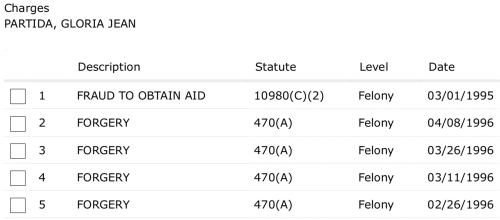
The initial complaint against Ms. Partida was filed on 3/12/1999 and she was arraigned on all of the charges on 3/30/1999.
At the Preliminary Hearing on 2/2/2000, Ms. Partida entered a conditional plea of “guilty/Nolo” to the Fraud to Obtain Aid felony charge with the stipulation that no time in a State Prison would be imposed upon sentencing on the assigned date of 3/20/2000.


Following the submittal of the Probation Department Report, a sentencing order was issued by the Court on 3/20/2000 ordering restitution in the amount of $6,673.42, payment of Public Defender costs, and a 5-year probation in lieu of surrendering to serve 120 days in jail, which was apparently suspended with the entry “Stayed Reason Unknown”.
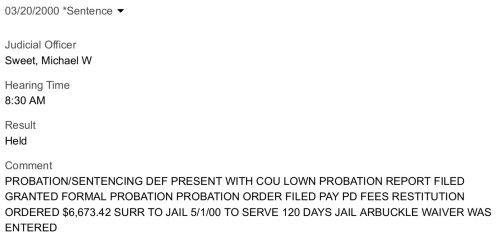

There was seemingly no sentencing for the four felony Forgery counts for which the Disposition Record shows “Conversion Disposition”. The basis for such disposition is unknown but is possibly due to a plea bargain when Ms. Partida pled guilty/Nolo to the Fraud to Obtain Aid charge.
The Expungement
Section 1203.4 of the California Penal Code allows for a person who has a felony conviction for which they successfully completed probation to have their conviction “expunged” from their record. This has the effect of changing a “guilty” plea or verdict to “not guilty” and the conviction is expunged from the person’s record. However, as discussed below, this expungement does not seal, destroy, or otherwise remove all records about the case; it does not remove certain penalties of the conviction; nor does it remove the responsibility to disclose this information under certain circumstances
According to the Penal Code’s language [emphasis added]:
“§1203.4. (a) (1) In any case in which a defendant has fulfilled the conditions of probation for the entire period of probation, or has been discharged prior to the termination of the period of probation, or in any other case in which a court, in its discretion and the interests of justice, determines that a defendant should be granted the relief available under this section, the defendant shall, at any time after the termination of the period of probation, if they are not then serving a sentence for any offense, on probation for any offense, or charged with the commission of any offense, be permitted by the court to withdraw their plea of guilty or plea of nolo contendere and enter a plea of not guilty; or, if they have been convicted after a plea of not guilty, the court shall set aside the verdict of guilty; and, in either case, the court shall thereupon dismiss the accusations or information against the defendant and except as noted below, the defendant shall thereafter be released from all penalties and disabilities resulting from the offense of which they have been convicted, except as provided in Section 13555 of the Vehicle Code…The order shall state, and the probationer shall be informed, that the order does not relieve them of the obligation to disclose the conviction in response to any direct question contained in any questionnaire or application for public office, for licensure by any state or local agency, or for contracting with the California State Lottery Commission.”
https://leginfo.legislature.ca.gov/faces/codes_displaySection.xhtml?lawCode=PEN§ionNum=1203.4.
According to Yolo County Superior Court records, Ms. Partida’s probation was terminated on 9/1/2005, after which she petitioned the Court on 9/22/2005 for expungement. On 11/4/2005, the matter was heard in the Court and the motion was granted.

California Law Does Not Allow Certain Convicted Felons to Serve as an Elected Public Official
California Election Code, Chapter 1, Section 20 specifically prohibits persons convicted of certain types of felonies from serving in an elected office in the state [emphasis added]:
“Section 20 – Effect of felony conviction
(a) A person shall not be considered a candidate for, and is not eligible to be elected to, any state or local elective office if the person has been convicted of a felony involving accepting or giving, or offering to give, any bribe, the embezzlement of public money, extortion or theft of public money, perjury, or conspiracy to commit any of those crimes.(Emphasis added)
(b) For purposes of this section, "conviction of a felony" includes a conviction of a felony in this state and a conviction under the laws of any other state, the United States, or any foreign government or country of a crime that, if committed in this state, would be a felony, and for which the person has not received a pardon from the Governor of this state, the governor or other officer authorized to grant pardons in another state, the President of the United States, or the officer of the foreign government or country authorized to grant pardons in that foreign jurisdiction”
https://leginfo.legislature.ca.gov/faces/codes_displaySection.xhtml?lawCode=ELEC§ionNum=20.
These offenses are categorized as “violations of public trust.” Ms. Partida’s felony conviction for “Fraud to Obtain Aid” seemingly falls into the broad category of “theft of public money”; if this is correct, then it appears that Ms. Partida should not have been considered a candidate for office in 2018 nor have been eligible to be elected.
The only action that could remove this penalty would be a pardon. Expungement after serving probation is not included. This is further clarified by provisions in Section 1203.4 (a) (3) of the Penal Code that states the following regarding expungement:
“Dismissal of an accusation or information underlying a conviction pursuant to this section does not permit a person prohibited from holding public office as a result of that conviction to hold public office.”
A reasonable interpretation of the above language seems to indicate that the prior type of felony conviction that Ms. Partida had precludes her from holding an elected office in the State of California whether or not the record of such conviction was expunged or not.
Public Misleading Statements and a False Filed Statement of Candidacy
Ms. Partida’s Campaign Manager, Tracy Tomasky, wrote the following letter and posted it on NextDoor on October 9, 2022 in response to postings showing Ms. Partida’s was charged with the five felony offenses referred to above:
“The screenshot that you are showing in your post does not correctly reflect the current status of Gloria’s case. Those charges were formally dismissed by the Yolo County Superior Court more than 17 years ago. Unfortunately, due to a paperwork error, the public facing website continues to show incorrect information. Gloria is working with her legal counsel and with the court to correct this error. As soon as it is corrected the record will correctly show that any remaining charge was dismissed. If you would like more information, please contact me privately, Tracy Tomasky, Campaign Manager”
It appears Ms. Tomasky is claiming that because Ms. Partida’s charges were “dismissed” by Yolo County Superior Court as a result of the expungement of her record, that she essentially has no criminal record that would affect her ability to serve as an elected official and there is thus no need to disclose this information. This ignores the provisions in the California Election Code and Penal Code requiring Ms. Partida to affirm that she has no felony convictions in her Statement of Candidacy.
California law states in Section 1203 (a) (1) of the Penal Code that such disclosures of prior convictions are mandatory regardless of if such expungements occur at a later date.
“The order shall state, and the probationer shall be informed, that the order does not relieve them of the obligation to disclose the conviction in response to any direct question contained in any questionnaire or application for public office, for licensure by any state or local agency, or for contracting with the California State Lottery Commission.”
The Office of the Public Defender for San Diego County explains:
“The first thing that someone who wants to apply for an expungement needs to understand is that if your petition is granted under Penal Code 1203.4, your case is not sealed. A criminal record is not actually "expunged" under this statute. That term implies complete erasure, as if the case had never occurred. A more proper term is "dismissal". The conviction remains on your record for many purposes, including sex offender registration and immigration consequences. What the statute provides is, except as elsewhere stated, the defendant is 'released from all penalties and disabilities resulting from the offense'. There are numerous limitations to this relief.”https://www.sandiegocounty.gov/public_defender/expungement.html
The State of California Courts have stated:
“If you have successfully gotten a 1203.4 dismissal ("expungement"), it does NOT mean that the conviction is wiped away, sealed, purged or destroyed! The arrest is still there, charges are still there, but technically the conviction is "set aside and dismissed”.
IMPORTANT! There are a few places you still have to say yes, you have been convicted, even if it's all been expunged. Those places are: 1) the INS; 2) any state or local licensing agency (like when you're applying for a guard card or nursing license); 3) contracts with the state lottery; and 4) in an application for public office.” (emphasis added).
(https://www.courts.ca.gov/partners/documents/general_info_on_expungement.doc)
Ms. Partida signed a City of Davis Statement of Candidacy for the 2022 ballot and affirmed that she did not have any felony convictions in that filing in response to a specific question under the “Qualifications” section [red arrow inserted]:
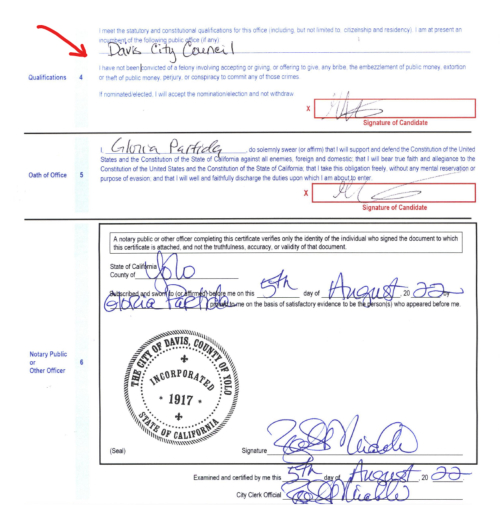
It should be noted that in addition to apparently violating the CA Penal Code §1203.4 (a)(1) provision regarding the “obligation to disclose the conviction in response to any direct question contained in any questionnaire or application for public office,” filing a false document is in itself a felony offense in California as stated in California Penal Code §115. (a):
“Every person who knowingly procures or offers any false or forged instrument to be filed, registered, or recorded in any public office within this state, which instrument, if genuine, might be filed, registered, or recorded under any law of this state or of the United States, is guilty of a felony.”
(https://law.justia.com/codes/california/2011/pen/part-1/112-117/115)
Additionally, Ms. Partida failed to disclose the prior felony conviction in a public forum for District 4 candidates hosted by Indivisible Yolo, Yolo Democratic Socialists of America, and Yolo People Power on September 26, 2022, in Davis Community Chambers and recorded by Davis Media Access.
The following exchange occurred when the Moderator asked Ms. Partida about her prior experiences with the criminal justice system:
“Moderator General Opening Question – Please tell us about your personal experience with law enforcement and the criminal justice system. Have you ever been arrested or convicted of a crime? Please tell us about that experience.
Moderator Following Question to Ms. Partida – Could you tell us Gloria about your experiences with the criminal justice system?
Ms. Partida – Sure. So when I lived in LA I was handed down a 69 Impala which was actually a police magnet and I was pulled over on multiple occasions and that continued until I bought a minivan. But yes, I have been arrested and so have had that experience with the police. I still respect the police greatly.”
https://drive.google.com/file/d/13kIdxjpaGsT3s6G6_t7JV1EfNc4Ccuwt/view
Ms. Partida did not disclose her prior felony conviction and seemed to imply that her only prior interactions with law enforcement stemmed from her owning the Impala because it was a “police magnet”.

 Davisite
Leave a reply to John Hunt Cancel reply