

 By Stephen M. Wheeler
Davis residents have begun receiving calls and mailings from backers of the so-called Davis Innovation and Sustainability Campus (DiSC 2022) in preparation for the June 7 election, when the project will be on the ballot as Measure H.
Don’t be fooled by the rosy promises and endorsements on the developer’s materials: DiSC represents neither innovation nor sustainability. It is another big piece of suburban sprawl promoted by one of Davis’ most aggressive sprawl-builders, Dan Ramos.
DiSC is essentially a greenwashed business park. Business parks are a traditional, much-discredited economic development approach in which cities designate a large area of land on their periphery for whatever commercial development they can manage to attract. These projects are highly motor-vehicle-dependent and undercut efforts to revitalize more centrally located downtown areas.
DiSC materials talk about bike and pedestrian connections, renewable energy, use of native and drought-tolerant species for landscape design, energy-efficient construction, and shuttle buses to downtown. This is greenwashing. These environmentally oriented details are nice (and many are required by existing regulations).
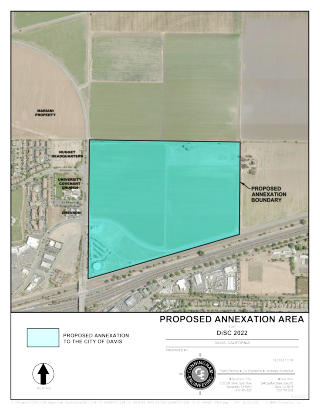
But they aren’t nearly as important as the fact that 1.34 million square feet of new commercial space would be allowed by a freeway exit far from downtown. Approving huge projects that will build out over 20-plus years — almost certainly in different ways than originally envisioned — is just not a good way for a city to move towards sustainability.
Ramos has no clients signed up for this site who will represent innovation or sustainability. If none appear once the project is approved, he will come back to the city asking for changes in previous agreements about uses and types of buildings at the site. If past history is any guide, the city’s staff and city council will let him out of any promises he has made. Indeed, five or 10 years down the line no one is likely to remember what was agreed to now.
The result 20 years from now is likely to be a motley collection of freeway-oriented retail and commercial businesses on our eastern edge, along with high-end housing catering to commuters with jobs in Sacramento or the Bay Area. The I-80 causeway will be even more congested than it is today. And with those homes and businesses attracting drivers from around the region, our greenhouse gas emissions will be higher as well.
Why has our City Council and staff signed onto this project and the previous version, which was defeated at the ballot box in 2020? Because they’re desperate for short-term revenue (fees, construction taxes, sales taxes, and property taxes), and because they’ve failed to take leadership to bring better forms of development to town.
Davis, like most California cities, is desperate for tax revenue because of Proposition 13 constraints. Prop. 13 is another discussion — the state absolutely needs to end that shortsighted limit on how local governments can raise funds. But just because local city councils are searching everywhere for revenue doesn’t mean they should make bad land use decisions locking in unsustainable patterns of development for generations.
What might better forms of development look like? There is strong international consensus that cities should seek to revitalize existing, centrally located urban land rather than sprawling onto farmland. New building should take place in walkable, transit-accessible locations near existing homes, shops, offices, and schools. For Davis this means more incremental development of our downtown, the commercial centers in each neighborhood, and opportunity areas such as the East Fifth Street corridor (which is walkable and bikable to downtown).
Yes, it takes more leadership to revitalize those areas than it does to approve greenfield developments at the urban edge. Existing, low-intensity land uses will need to be relocated, and creative new plans developed. But with leadership these things can be done.
Don’t be fooled by DiSC proponents. Ramos and his friends will use terms like “innovation” and “sustainability” as much as they can to get the initial entitlements to build. But once the project is in motion, they will work the city to let them build whatever will make the most money. And Davis will be the poorer for it.
Stephen M. Wheeler is a professor of urban planning and design in the department of human ecology at UC Davis, and author of “Planning for Sustainability, Reimagining Sustainable Cities” and “The Sustainable Urban Development Reader.”

 Davisite
Leave a reply to Roberta L. Millstein Cancel reply