

The answers might surprise you.
By Roberta Millstein
Recently on NextDoor and elsewhere, Davisites have been disagreeing about whether Davis is building enough housing or whether it needs more. The discussions have become particularly relevant in light of two potentially large projects: the University Commons project (264 residential units / 894 beds) and the so-called Aggie Research Campus (ARC), which proposes 850 units as part of the larger proposal for a massive 200 acre business park outside of Mace Curve.
But to answer the question of whether we have enough housing or not, Davisites need to know how much is in the pipeline. I suspect that most Davisites don’t know the answer to that question, even if they’ve been paying attention. This article is the result of my attempt to figure out the answer.
If you just want the answers I calculated, here they are: the housing that is now in the pipeline will accommodate more than 10,000 additional people in the City and more than 20,000 additional people in the City and UC Davis combined. The details of those answers are below.
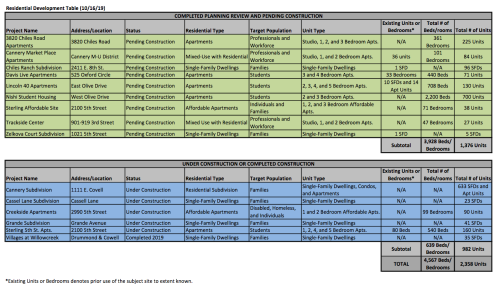
The following table from the City of Davis (see webpage here) shows the number of units and bedrooms that have completed planning review and are pending construction (3,928 beds/ bedrooms, 1,376 units) and the number of units and bedrooms that are under construction or have completed construction (4,567 Beds/ Bedrooms, 2,358 Units), for a total of 8,495 beds/bedrooms and 3,734 units in the pipeline. [1] The table was presented by Mayor Brett Lee at the October 17, 2019 public meeting between UCD, Yolo County Supervisors and the City of Davis. When presenting the table, Mayor Lee proclaimed that the Davis housing crisis was over (see coverage of the meeting here).
But that’s not the full story. Those numbers don’t include the West Davis Active Adult Community (WDAAC, now dubbed Bretton Woods) that was recently approved by the voters with a Measure R vote. According to the EIR, the project would result in the addition of up to 560 residential units in total, allowing for a maximum population of approximately 1,467 residents. To add that to our previous numbers, that’s 9,962 beds/bedrooms and 4,294 units in the pipeline.
But that’s still not the full story. There are at least eight major projects that are in process and under City review (see webpage here):
Given that at least some of these projects are sure to be approved, it is no exaggeration to say that there are more than 10,000 beds/bedrooms in the pipeline within the Davis City Limits.
There may in fact be considerably more than 10,000 beds/bedrooms coming soon, depending on which projects get approved, and some of these projects are quite large, such as University Commons and ARC as noted above. Furthermore, since bedrooms can and do hold more than one person, that could also increase the number of additional people who could be accommodated by the housing in the pipeline. But I will use 10,000 new people added to the City as a low estimate.
The most recent information estimates Davis’s current population to be 69,289. Thus, the new housing currently planned – the low-ball estimate of additional 10,000 people within the Davis City Limits – would increase the population of Davis by approximate 14.4%. Again, though, it’s likely to be considerably more than that.
But even that’s still not the full story. All the numbers above are just for people within the City limits; they do not include people living on UC Davis’s campus, who are not legally considered to be living in the City of Davis proper.
UCD is planning on building housing faster than the campus population will grow. It plans 3,400 beds for its “Green in the West Village” student housing neighborhood, projecting 1,000 of those by Fall 2020 (see this page for details). UCD’s Long-Range Development Plan (LRDP) projects an overall increase of housing for about 10,550 people (students, staff, and faculty). The LRDP projects an increase of only “about 5,000” students and “approximately 2,000 Employees” in the same time frame (LRDP p. 6). That mean’s UCD is building housing for 3,000 more people on campus than will be added to the campus in the same time frame.
UC Davis is adding housing for 10,550 people. To add to our previous numbers, that’s housing for more than, 20,550 people more people at UC Davis and in the City of Davis combined.
It is also important to note that this increase in Davis housing is coming at a time when California and Yolo County are experiencing low population growth. According to a press release from the California State Department of Finance, Yolo County’s population is projected to grow at 0.37% in 2020, down from 0.56% in 2019. This is on-trend with the rest of the state; the press release projects growth in California at a “rate of 0.35 percent, down from 0.57 percent for the prior 12 months — the two lowest recorded growth rates in state population since 1900.”
So, do Davis and UC Davis have a housing shortage? If there is a housing shortage, is it going to be addressed by the projects that have already been approved and are likely to be approved? This article has not attempted to answer these questions, but only to supply the numbers that should be used if we are to answer them in an informed way.
[1] Two of these projects are currently under litigation, but even if the plaintiffs win, it is likely that the projects would just be modified.

 Davisite
Leave a reply to John Troidl Cancel reply