Davisite Banner. Left side the bicycle obelisk at 3rd and University. Right side the trellis at the entrance to the Arboretum.

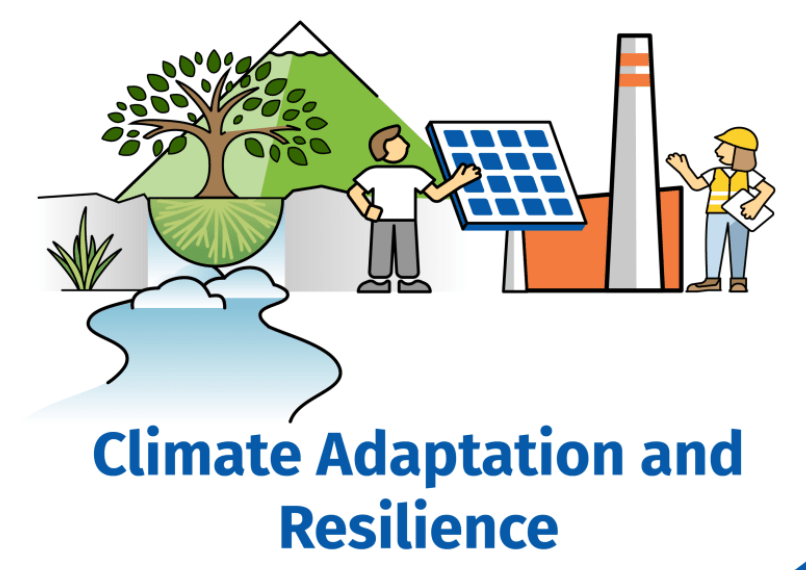
Award-Winning Climate Action and Adaptation Plan (CAAP) Presented July 7th

By Scott Steward

Kristen Wraithwall is the Manager of the Sustainability Division. The Sustainability Division operates within the Health and Safety Department of our Yolo County. Kristen will present the Update on Climate Action and Adaptation Plan (CAAP) Implementation Progress at this Tuesday’s (July 7th) Yolo County Board of Supervisors Meeting at 9:00 AM.

 Zoom meeting: By PC: https://yolocounty.zoom.us/j/84359964086

Kristen, her staff, the Climate Action Commission, and the County have made consistently strong progress in climate action despite very difficult budget circumstances. This Sustainability work continues to provide our county with grant-funded programs that Yolo County cities and other California counties look to as models for what can be accomplished in their own jurisdictions. Yolo County’s Climate Action and Adaptation Plan received the Sacramento Valley Section APA Award of Excellence in Resilience and Sustainability (May 2025) and the Beacon Award from the Institute for Local Government (November 2025). 

Vehicle use remains the #1 source of greenhouse gas emissions in Yolo County, so it is no surprise that 2026-2027 CAAP priorities emphasize transportation, including the implementation of countywide Zero-Emission Vehicle (ZEV) programs. Transportation is followed by building energy efficiency in coordination with Valley Clean Energy, Natural & Working Lands water conservation and carbon soil enhancement, recycling, and public cooling infrastructure.

The Yolo County Climate Action Commission meets monthly and will hold its first meeting as the newly reformed Commission on July 21st.

We can all take pride in the success of the Yolo Climate Action and Adaptation Plan. Our County Supervisor, Sheila Alan, is one of the commission’s liaisons, and Mike Webb, County Administrator (formerly the City of Davis City Manager), is part of the broad leadership support for implementing our county’s action plan. 

From 1,500 linear feet of hedgerows across 389.87 acres of farmland to zero-emission vehicle grant programs, from farmworker transportation to optimizing school recycling programs, we are seeing full integration of a just climate policy in our county, and it is working.

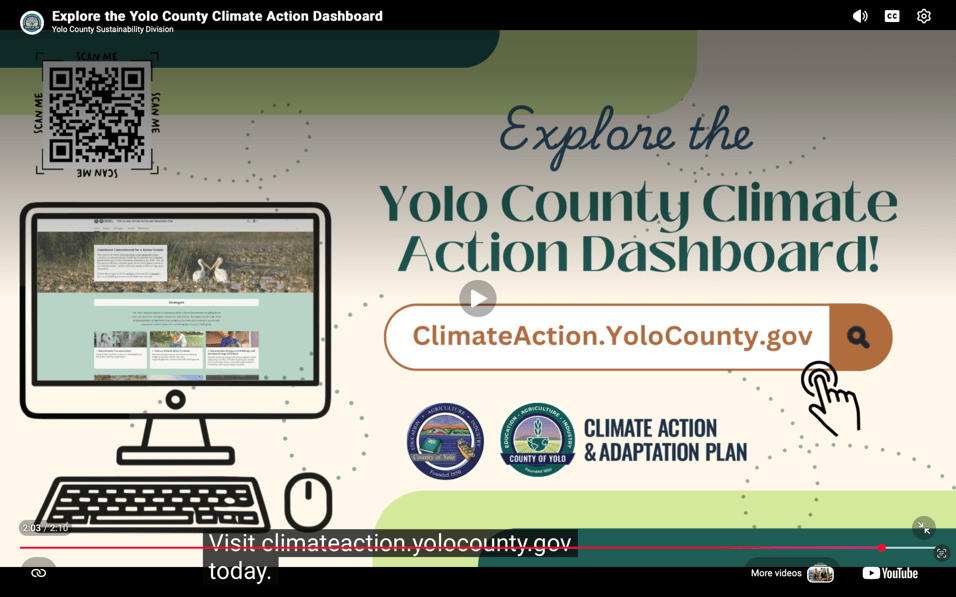
Come listen to how we make a healthy, nurturing world possible at the county presentation this Tuesday, and check out the Yolo County Climate Action Dashboard for regular updates and ways to benefit from energy efficiency grant programs: ClimateAction.YoloCounty.gov

Davisite logo

Did you enjoy reading this article? Then subscribe to the Davisite for free and never miss a post again.

Comments

8 responses to “Award-Winning Climate Action and Adaptation Plan (CAAP) Presented July 7th”

  1. Alan C. Miller

    Hedgerows, water conservation, soil health, recycling, energy efficiency, cooling infrastructure, and farmworker transportation — all good stuff. They improve the local environment, may save money in the long run, and can help make Yolo County a better place to live. Those are things worth doing regardless of anyone’s politics.

    What gets tiresome is the odd contemporary ‘need’ to package everything as “climate action.” This increasingly feels like branding rather than substance. Hedgerows are good because they reduce erosion, support pollinators, and help agriculture. Recycling conserves resources. Efficient buildings lower utility bills and waste less energy. We’d be doing these things even if climate change had never didn’t exist — at least I hope we would. But why does every local environmental project have to be sold as saving the planet?

    There’s also the unfathomable mismatch of scale. Climate change is presented as an existential global crisis, then we’re expected to celebrate Yolo County as though it’s moving the needle. The county’s emissions are not even worth a rounding error in the global total. China could wipe out years of local reductions before lunch. That doesn’t mean local environmental work isn’t worthwhile. It means we should stop pretending these programs are changing the course of the planet when what they’re really doing is improving conditions here at home. That’s how it used to be — when you could talk to an environmentalist without existential buzz terminology required.

    The transportation section is a perfect example. Transportation is correctly identified as the largest source of emissions, and the big solution is (du du du dah!): more electric cars. Those are still cars. They still require sprawling development, massive highways, acres of parking lots, and endless road construction. Swapping what’s under the hood doesn’t magically fix a transportation system built around driving everywhere.

    Where are the ideas that would actually reduce car dependence? Where’s the push for massive investment in public transit? Billions for the Capitol Corridor so it becomes a true regional transportation backbone? Even on a tinier scale the long-promised half-hourly expansion of the 42 route that quietly vanished? Those ideas rarely get the same enthusiasm because they require changing the system instead of putting a different drivetrain into it.

    And then there’s the elephant in the room, or in this case the donkey in the room. Local leaders praise themselves for climate leadership while supporting projects like widening I-80, one of the most environmentally destructive transportation investments imaginable. If climate is really the guiding principle, that contradiction deserves a lot more attention than another ribbon-cutting for an EV grant. Oh, but that widening brought in a lot of federal bucks, eh, donkeys? And who cares about the environment when we can have DC dollars?

    What really stands out about pieces like this is the framing. It’s less a report on environmental policy than a celebration of government itself. Politicians are praised. Department heads are praised. Staff are praised. Commissions are praised. Awards are praised. Awards praise rewards. Praise praises praise. The whole thing reads like an extended performance review written by the people being reviewed. When that’s the starting point, criticism disappears. Except by that a-hole Alan Miller, Master Seer of Reality. There’s little room here to ask whether priorities are wrong, whether better ideas were ignored, or whether the county is congratulating itself for doing the easy, politically popular things while avoiding the harder ones. And praising itself. Don’t forget the praise donkey.

    Good environmental policy deserves support because it improves Yolo County, not because it lets politicians wrap themselves in the latest fashionable slogan. The county has done real, worthwhile work. It should also be fair game to ask whether the “climate action” label has become more about political marketing and self-congratulation than honest discussion about what actually works. Ok, it’s been asked. And now I will answer: Yes, it has.

    But I appreciate hearing the word ‘hedgerow’ outside of Led Zeppelin’s ‘Stairway to Heaven’ for the first time in my life. Oh, and the hedgerow itself is aces too.

    1. I find your perspective interesting, Alan. In my circles, a lot of people concerned about climate change are saying, shhh, *don’t* say it’s about climate change, just talk about the common sense environmental changes that people can get on board with regardless. They are saying this as a matter of tactics, as a way to get people on board who don’t believe in climate change. It’s the exactly opposite of what you are saying that people have to make everything about climate change. Arguably, this is all an issue of audiences. Some audiences want to hear about climate change and will be motivated by that (especially if that’s how the grant is written or the ordinance is written). Other audiences are anti-motivated by hearing about climate change. Your mileage may vary (pun intended?) is all I am saying.

      As for hedgerows, we talked about those a fair bit when I was on the Open Space & Habitat Commission and presumably they still are. Aldo Leopold was talking about them in the early 20th century. Good stuff, hedgerows, even when they have a bustle in them.

      1. Alan C. Miller

        “They are saying this as a matter of tactics, as a way to get people on board who don’t believe in climate change. It’s the exactly opposite of what you are saying that people have to make everything about climate change. ”

        Tactics. Yes, we can get a duck rather than a giraffe in office and it may seem like we ‘won’, but in the long run, if the president tells you ‘if you take this shot you can’t get or spread Covid-19’, and a week later you do both, tactics don’t much matter. The government and our allies lying to us does. And by the way, I do believe in climate change. How much is caused by humans that is arguable, but a lot. But, what is clear is that it is too late. There no chance we are turning this oil tanker around in the Straight of Hormuz — the whoman race ran aground 100 years ago and we are just now realizing it. Yes, it’s important to get it off the rocks in 2200 or 2300 and encourage China and the Congo to burn less coal (good luck with that), but in the meantime, we need to learn to live with our mutual creation. So all I’m saying is yes, more hedgerows. But do it for Yolo, not the world.

      2. Agreed, I don’t think our leaders or even our climate activists should say false or misleading things. I just thought it was interesting that you read things where it seems like people are making everything about climate change in order to mobilize people at the same time I keep reading things that say we would better mobilize people if we didn’t talk about climate change so much. As I suggested, I think which “tactic” is better depends on the audience, but if the question is whether we should do it for Yolo or do it for the world, my answer is both, since both are relevant.

        Human-caused climate change is already occurring — the evidence is all around us — so in that sense you can say it is “too late.” However, it’s not as though the harm we are causing has stopped — it is ongoing. So it is not too late to stop making things worse. It’s also not too late to try to reverse some of the damage as we can.

        China is in a weird state right now. Its renewable use is way up, its coal use is down, and yet has been approving new coal plants at a rapid rate, plants that are currently being underutilized. So it could go in a lot of directions. But I don’t think we can point to them and say, well, they aren’t doing anything about climate change so we don’t have to either. They are, right now, doing better at reducing their carbon contributions than we are.

        Hedgerows, though. Yes. They even get a few mentions in my book, and not in the context of climate change. 🙂

  2. Alan C. Miller

    I think we are basically saying the same thing. But I’d not let China, Congo, India off the hook. The actual numbers are staggering in what they contribute and how much more in recent years, to air pollutants that contribute to even more global harming. I wouldn’t give king kong candy for killing fewer people by tearing up less subways. Doing good Yolo things won’t hurt the world. But what I think we are most agreeing on is the climate change tactic for all good environmental things is basically a lie, and at some level people see through that, and people who already see through it are turned away. I don’t feel kinship to environmentalists anymore due to the extremist politics woven into every cause, instead of just ‘this is good to do for the environment’ and leave it there.

    1. Right, let’s not let China and the Congo off the hook, and let’s not let ourselves off the hook either. I think that change at all the levels (local, state, national) are important, and I think it’s important to talk about the local environmental effects as well as the global ones. All the things. So maybe we disagree a bit on that, but we aren’t miles apart.

  3. Ron O

    What “award-winning” Yolo county program? Last time I checked, there were plenty of people driving around (including me). And using natural gas for stoves, furnaces, etc.

    Am I am hallucinating as a result of carbon monoxide poisoning – or is this yet another fake program/claim?

  4. Scott

    Ron, I guess you should avoid this kind of content, since there is nothing about it you are familiar with. I believe I recall that you had argued pretty hard for abolishing the requirement that new homes have all-electric appliances. Careful what you wish for, I guess.

    I think the adage “if you are not part of the solution, you’re part of the problem” applies generally to the cynicism expressed in some of the comments above.

Leave a comment