

By Elaine Roberts Musser and Dan Carson
At the April 15, 2025 City Council meeting, four of the five Davis City Council members declared their support for immediately committing significant additional amounts of upfront funding to fix city roads and bike paths. The funding would come from the recently approved Measure Q sales tax increase and be incorporated into the two-year 2025-27 city budget that will be adopted this June.
A spending plan labeled as “Scenario 2” was presented at the meeting to Council and recommended for approval by city staff. It would have held pavement spending flat for at least five years and then, in theory, begun accelerating city spending for that purpose in 2030-31 through 2034-35.
Vice Mayor Donna Neville and Councilmembers Chapman, Partida and Deos made it very clear they found the idea of backloading pavement funding, and putting off any significant increases until five years from now, unacceptable. Mayor Bapu Vaitla proposed a much different approach to adding money for roads that we discuss below, that would involve asking Davis voters to approve another new tax measure.
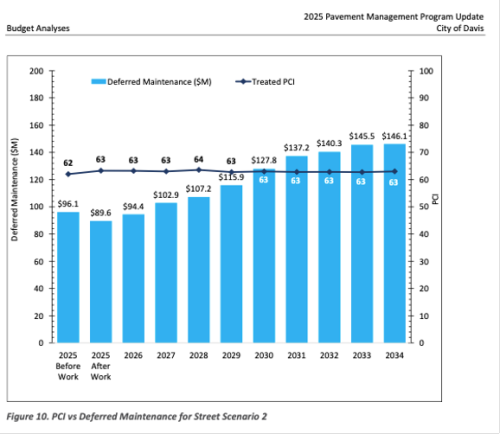
We are grateful four Councilmembers took to heart our warning against approving Scenario 2. The report staff provided to Council documenting this scenario would escalate the roughly $100 million backlog of city road pavement projects that now exists to almost $150 million, an increase of approximately $50 million over the next decade (see the chart below, on page 07-50 of city staff report).
In our testimony to Council, we recommended instead that $5.6 million per year of additional funding from Measure Q be allocated towards pavement management. This sum would be added to the $8.4 million per year city staff was proposing be allotted for this purpose for the next several years. Our recommendation would bring the total amount budgeted for road and bike path repair funding to $14 million per year from all funding sources for 2025-26 and 2026-27.
The current average Pavement Condition Index (PCI) for the City’s street network and bike paths is 62, which is considered to be “fair” condition. However, the California Statewide Local Streets and Roads Needs Assessment Final Report April 2023 considers a PCI of 65 “at risk”. In the American Society for Testing and Materials (ASTM) table, “fair” is below a “satisfactory” rating. As a city’s PCI declines, it means the cost to maintain its roads will grow exponentially as they fall into disrepair.
Our funding recommendation is based on the fact that our city’s roads are already less than satisfactory and at risk of further deterioration. They are in fact the worst roads of any city in Yolo County, and worse than many other cities in California. Failure to act now means that the costs to repair them will keep increasing more and more rapidly.
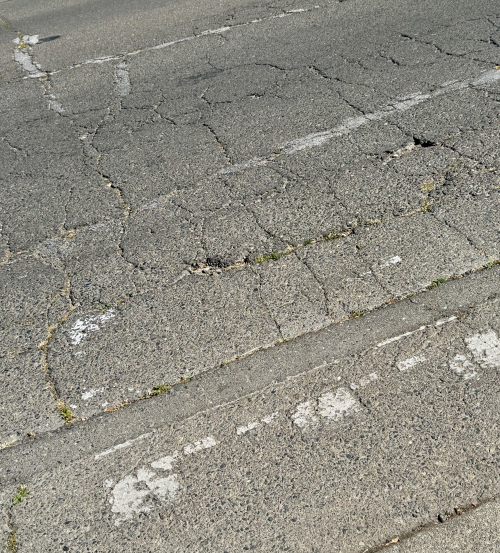
5th Street arterial in front of Post Office

W. Covell Blvd arterial
Our analysis shows that front-loading spending for this work, starting now, would allow the city to exceed its existing PCI targets for improving pavement quality, which are 63 for roads and 68 for bike paths. Our strategy would significantly reduce overall pavement maintenance costs. And, Scenario 2 would never have worked. Locking up Measure Q funds for various other programs now, while providing no additional funding upfront for pavement needs, would make it all but impossible to ramp up spending for pavement work by $4 million to $6 million annually in later years
Councilmembers did not approve any specific funding levels for pavement work on Tuesday night. However, they did give general direction to city staff and the Pavement Council Subcommittee (Councilmembers Partida and Deos). This Subcommittee will recommend how much of the newly available Measure Q dollars should be provided to the Pavement Maintenance Program in the two-year budget plan up for adoption this June.
Thankfully, the four allied Council members voiced their support for immediately front-loading city investments of the Measure Q sales tax dollars to fix our pavement. They also want to target extra dollars for particular neighborhoods with badly deteriorated streets. In addition, they want to raise the quality standards (PCI) for the condition of Davis pavement to try to catch up with other cities in Yolo County and California. Their comments reflected their serious commitment to addressing the problem:
Councilmember Partida: “How much are we willing to put into the roads to hit (a particular) PCI? I think we do expect, a lot, because people are intimately involved with our streets because of the biking that we do, because of all of the mobility devices that people use….So if we could bring the PCI up above this level, it would be great….I am 100 percent agreed that we said to people that we are going to put money from this new tax measure (Q) into the streets. And I think that we are obligated to do that.”
Vice Mayor Neville: “You just look at the deferred maintenance cost, and you just see that, the sooner we do things, the better. That’s just so clear from everything presented to us…how much more cost-effective it is to do things sooner rather than wait until it’s in poor or failing condition….Having smooth roads isn’t just for cars. It’s for the bicyclists on the side [of the roads] as well…I wanted to know how complicated it is, to run another scenario where you look at a higher PCI”
Councilmember Deos: “I think it’s important that we front-load monies to the roads and to our bike paths, as much as we can, (with) as much money as can go to that, be it Measure Q funds or other funds. I think that’s a good investment into the community…”
Councilmember Chapman: “I think that we (should) step back and look at the challenge in front of us around this. I don’t want…eight years from now to be in that $140 million deferred maintenance category….I would really like to see…a more aggressive approach over the course of the next five or six years….”
Other local residents testified in support of the city undertaking an accelerated effort to fix Davis pavement.
Russell Snyder, a Davis resident and the Executive Director of the California Asphalt Pavement Association, told the Council, “If you don't make those investments now… it’s also costing your friends and neighbors today to ride on rough roads. There’s been gobs of studies that show that diminished fuel economy, car repairs, other things, could cost each person that drives hundreds, even in some cases up to a thousand dollars a year.” This is a good opportunity to … preserve this very important asset that you have… so we can move people, goods, and services around our town, be connected to our greater community. But it also saves our residents money, and uses the money as they intended with their taxes they voted for.”
Several South Davis residents said to the Council they remain dissatisfied with the condition of local roads. One described his section of Albany Street as having “large cracks, potholes, alligator cracking, trip hazards. We had a neighbor trip and break her shoulder… A lot of subsidence from the original. I’ve been there 24 years and I’ve seen a couple of potholes fixed.”
During the hearing, Vaitla took issue with prioritizing the expenditure of Measure Q tax revenues for the pavement program. He said he rejected the idea that roads were more important than putting “a roof overhead, or [a] family that [is] struggling with severe mental illness, or climate resilience and (the) environment becoming less and less suitable for human life. ”
We think this misses a very basic point. If the backlog of city pavement projects is allowed to grow as it has, with pavement on some streets degrading to unsafe levels, this huge fiscal burden that will result will inevitably overwhelm the ability of the city to address its other policy challenges.
At one point, Vaitla acknowledged that fixing city roads and bike paths would help further the city’s policy goal of reducing greenhouse gases and addressing climate change. To “get… people out of vehicles…[and] increase the use of micro-mobility vehicles and bikes…we’re going to need to have roads in a good state,” he said.
Nonetheless, Vaitla insisted that if Council wanted to front-load spending on roads, it should go back to city voters and “look… at bond measures, parcel taxes” rather than Measure Q funds.
Fortunately, his Council colleagues embraced a contrasting perspective, remembering the promises they made to voters to use Measure Q dollars to fix roads and bike paths.
The official support ballot argument stated: “Yes on Measure Q will help improve park infrastructure, greenbelts, and landscaping, and support upgrades to our aging public infrastructure (filling potholes, and repaving streets and bike paths).” The rebuttal to the argument against Measure Q, signed by the mayor and all other sitting Council members, likewise warned voters, “In 2020, the City adopted a comprehensive plan to address our unmet infrastructure needs. Even then, we identified the need for additional revenue to improve and maintain city roads, sidewalks, and bike paths. Costs have only increased since then.”
Our analysis shows that implementing such new taxes would be highly problematic, for several reasons.
- The California Constitution (Proposition 13) prohibits using bond funding generated through an increase in property taxes for pavement maintenance. It can only be used for capital improvements.
- Local revenue bonds could be issued for pavement work if approved by local voters. However, the State Constitution (Article XIX Section 6) says no more than a fourth of a city’s state motor vehicle tax revenues can be committed to pay off such bonds — a small fraction of the money the city needs for pavement repairs.
- A proposed 2018 parcel tax for roads, requiring a two-thirds majority under the State Constitution to pass, has already failed with Davis voters. As the mayor himself noted , “It needed a super majority and got 57 percent. The majority of the community was willing to vote for it, but we're in this position partially because of that.”
As noted above, our recommendation to Council is that $14 million per year be budgeted for the pavement program in 2025-26 and 2026-27. We note that our proposal is consistent with one that was contained in a city staff presentation to the Council in December 2024 to discuss how the new Measure Q funds should be spent.
In that presentation, City staff detailed a series of budget shortfalls and budget cuts over the prior five years that had left spending on pavement maintenance about $10 million short of planned funding levels. The harsh realities of our road and bike path maintenance backlog were placed front and center for all to see. Staff’s recommended allocation to catch up on road and bike path repairs and maintenance was $14 million per year over the next four years.
Staff has now changed its position, proposing to allocate only $8.4 million per year when, by its own accounting, $14 million per year is needed for the next four years. This is necessary to reverse a recent period in which the city underspent for pavement maintenance by a total of $10 million. Four City Councilmembers obviously understood that staff’s original position was the correct one, and directed staff to allocate more Measure Q funds to pavement management. This is precisely what voters approved Measure Q for, and it is exactly how Measure Q funds were promised to be used.
Help us convince the City Council and its subcommittee that it needs to commit to spending $14 million a year on roads and bike paths for the next two year budget cycle. Write to them at: citycouncilmembers@cityofdavis.org, or speak out during general public comment at a City Council meeting, or record a general public comment the day of a City Council meeting: 530-757-5693.
Elaine Roberts Musser is an attorney who has served on county and city commissions as well as various task forces. She was given the award of Davis Citizen of the Year in 2014. Dan Carson is a former Davis City Council member and city commissioner with a 45-year career in journalism and state and local government service.

 Davisite
Leave a reply to Donna Provenza Cancel reply