

Missing funds may continue to compromise transit
By Alan Hirsch
This is a report on the untalked about short falls in funding on I-80Yolo projects (plural), changes to the freeway from Dixon across the Sacramento River bridges for both US 50 and I-80. We are told the freeway here is in crisis (Like the climate crisis?)
Other have noted the short thinking of funding highway widening continue to “crowd out” funding of substantial transit improvements and that keeps us from addressing climate change and providing travel choices to driving.
For example, on I80 Yolo the total bill is a jaw dropping $745 million- 40 times the Yolobus budget.
Caltrans and freeway proponent all through the decision-making process on I80 have not make clear its full cost and long term impacts. They have instead levered an initial $86 Million federal grant – which we are told we dare not give back – to lock us into spending hundreds of million more. A sum that effectively crowd out investment in transit.
Let me begin with fact most people are confused about what’s happening with the work they see on the freeway now and its relationship to the I-80 widening project. I will try to make this clear before I talk about its implications for public transit, and what can be done by Davis voters in November.
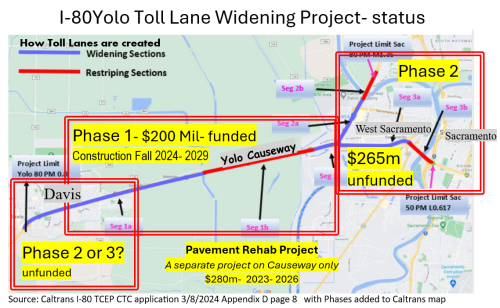
- Construction Project 1: Drivers on US 50 to and from Sacramento currently face a changing and frustrating experience. Caltrans is just 1/2 of the way through finishing the Road Surface Rehab project ( $280 Million) that began in July 2023 and won’t be completed until May 2026. This paved the way (excuse the pun) for a simple restriping to add a toll lane on the causeway and into Davis in the next step…. .
- Construction Project 2: On July 8th YoloTD Board approved funding $200 million for Phase I: restriping the causeway to convert the center shoulder to one toll lane in each direction. Because these new lanes will only be to the 50/80 split to Mace (eastbound), this will likely create “new” bottlenecks. Construction will begin October 2024 and continue until winter 2028-29.
- Construction Project 3 (and 4?): Funding and thus the timing for $265 million phase II to add the missing 17 miles of toll lanes both in west Davis and from the 50 and 80 split to the two Sacramento River bridge are unknown and undescribed in any official document- and Caltrans has not returned my calls. It is likely that construction, if funding can be obtained, won’t be completed until the mid-2030s. This is the first part of Sacramento region’s 20-year plan to spend over a billion on build more lanes and convert currently free HOV lane to toll lanes. Thy market these toll lanes by labeling them “express lanes” in the Bay Area.
- Long term Vision: UC Davis Institute of Transportation Studies estimates that the I-80 freeway will recongest within 10 years due to induced demand and cut through traffic in Davis likely will reappear.
- $10 Commutes in Your future. Even though the 3 existing lanes will recongest in ten years, 10-20% of the drivers who can afford to pay the toll will still be able to enjoy I-80 congestion free. The toll will be raised and lowered dynamically to ration use—and are estimated by YoloTD in 10 years to be $1 a mile for a trip to Sacramento at peak hour/$10 for a one-way commute to Sacramento. Lucky Tahoe travelers, who typically go 3+ in a car, will have free use of the congestion free toll lanes under current plans. Prioritizing their free use of lane will drive up tolls for others as the reduced remaining road capacity is “auctioned off” to the highest bidder in the dynamic tolling setup. This is in the plan for the entire Sacramento region freeway system, allowing the richest to opt out of congestion via a region-wide toll lane network that Davis City and other Yolo County leaders are proud to be doing on I-80.
- Additional Funding Uncertainty: YoloTD and Caltrans have yet to identify ongoing funding for the 50% GHG mitigation promised in the EIR, a core issue for the lawsuit. Caltrans has a onetime payment of $28 million for phase 1 of the mitigation, but the funding of GHG mitigation must go on into perpetuity. Who will pay? Who is accountable if there is insufficient money as toll revenue is forecast to fall woefully short, a funding shortage because of the decision to allow 3+ Tahoe travelers to ride toll free.
So, at this point we are left with two unfunded financial liabilities for the I-80 widening: a) $265Mil to complete construction b) and an unfunded liability for the ongoing GHG mitigation. These will be added to the climate crisis legacy we leave our children and grandchildren, particularly if Davis & Yolo County elected officials continue to look for yet more funds for the I-80 widening project rather than invest in transit.
But there is an alternate vision.
Local officials should resurface a Caltrans plan to upgrade the Capitol rail corridor to 110 mph and every 30-minute service that they themselves said would be 15 times as cost-effective as freeway widening. The SACOG MTP Plan for 2040 affirmed this vision of improving rail transit in concept, but it will be forgotten if we commit additional funds to freeway widening instead.
In a way, I-80 is on the ballot this November in Davis. Ask the candidates running for city council if they prioritize finding the still missing $265 million to lengthen toll lanes into West Sacramento and support more widening to build a toll lane system through the Sacramento region. Or do they prioritize funding improved transit.
The Davis Council has been split on this, at it’s March 5, 2024 meeting ignored 30+ letters and public comment and let stand its March 2021 written policy to “strongly support” funding for the widening of the I-80 freeway.

 Davisite
Leave a comment