Davisite Banner. Left side the bicycle obelisk at 3rd and University. Right side the trellis at the entrance to the Arboretum.

Zero Sum Game? Council Member Vaitla on Commissions & Community Engagement

by Alan Hirsch

Transcribed remarks from  02 20-1924 Council Meeting… Link to Video:  https://davis.granicus.com/player/clip/1665?view_id=6&redirect=true   Time stamp begins at 1:40:06.
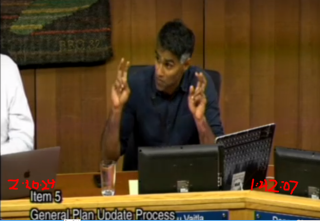
Davis counicl Bapu Vaitla

Councilmember Bapu Vaitla

Council Member Bapu Vaitla comments on community engagement he envision for the General Plan, and his plan to consolidate commission have been in the news including a paraphrased  interview in  Enterprise 2/24 and a critique by Elaine Roberts Musser.  I present this word for word transcript of his remarks. This is a more complete transcript than appeared in Vanguard.

1:40:26…  I mostly want to talk about the community engagement piece .(for general plan a process).  But I want to say a few words about the staff involvement…. Both during the commission restructuring process, of which there was extension staff engagement in fact,  and the council retreat, It became apparent to me that there actually aren’t that many opportunities for staff to participate in long term visioning. That primarily because they are working so hard all the time in an understaffed city to try to get the work done day after day after day.  So when you provide some space, given their professional experience, given their expertise, what could Davis look like, in our most ambitious vision, 20 years into the future. 50 years in to the future That’s a rare opportunity.

And I don’t think the community, the community (air quotes)  at large  is that worried about transparency about staff, I think  there is a small group of people who are always pointing fingers at staff, that is  not a community wide concern, I think when you do surveys about satisfaction with staff they regularly receive very high marks for their performance and their transparency. And their collegiality, their willingness to interact and answer questions to the community.

So, This is a piece I want to speak about in relation to community engagement. And I want to really caution us against being steered away from using the creativity of and time of staff and prioritizing that in this visioning process.  I think an (ad hoc closed-door council) subcommittee is on way to do it, but think it is  really really important they be involved and free the freedom. . I think a subcommittee (of council for public engagement)  maybe there are other ways to do it, But for me it very  very important for staff  to be centrally involved and feel the freedom to play one of the leadership roles here.

1:42:59 So with respect to community engagement, I had the pleasure of giving a lecture today…(at UCD Professor Catherine) Dr. Brinkley’s Community Development class. .I came out of their energized, can out of there inspired by students.  They had such great questions, such great ideas, fresh idea we don’t usually hear in public spaces, about institutions and polices we have right now, Who are they serving, and who are they not serving, Questions that are difficult to pose. I  am very grateful for their energy and hope you will stay engaged in the general plan process.

I want to also say two students who spoke today, it very hard to speak in this kind of setting  with all these eyes at you, I want to thank you  for your courage in standing up and speaking, and I want to say to Cady situations like you and your friends is why we are up here so If you need anything in terms of resources, if you ever feel any sense of threat we are here to help.

1:44:22 I bring all this up in the sense as this is your home, this is your community, a lot of time comments get prefaced by “I’ve been in Davis 20 year,” or “I’ve been a homeowner for 30 years” And its great, its fine, its your home, yes. But you don’t have no more of a voice than someone who, say, just moved here yesterday. All of you (points at students in audience) have equal rights and equal voice and equal worth no matter how long you have been here. Because this is your home, and this is your community. 

1:44:58  The larger point about community involvement and participation is I want us to be very intentional what community participation, what public participation, what inclusivity means. To me, it means as many people, as many different people , as many diverse people as possible. Diverse in terms of class, in terms of resources, age, sex, gender, race, are in the process and participating.

It doesn’t mean, that  once again, the quote unquote, leading citizens of Davis are monopolizing the policy conversation again, and again, and again.

 But more that new people need to enter the policy conversation and feel this to be enough of their home., enough of their home they have the feeling they are entitled to participate, because it is their home. To me, really,  that is what is it means to have public participation. It does not mean having 14  committee of people who are privileged and already have power and voice it means inviting new folks into the conversation.

Like Gloria said, like my colleague said, its not just about creating forums for people to comment, but going to where they are and understanding the constraint in their lives and making it easier for them to participate.

I want to stop there, there is a lot more to decide about this (general plan) process. I feel it very important we are clear about out methodology for inclusivity. Think, partially, it can be worked out with commissions and try to recruit and build capacity in our commission to go out and do that broad-based outreach I also think there is a place for a (close door ad hoc council) subcommittee to do that. So, I am kind of agnostic on if subcommittees can be formed tonight…in advance of hiring the consultant.

Davisite logo

Did you enjoy reading this article? Then subscribe to the Davisite for free and never miss a post again.

Comments

10 responses to “Zero Sum Game? Council Member Vaitla on Commissions & Community Engagement”

  1. I’ve already commented on this issue on other pages, but this point of Councilmember Vaitla’s in particular needs to be called out:
    “And I don’t think the community, the community (air quotes) at large is that worried about transparency about staff, I think there is a small group of people who are always pointing fingers at staff, that is not a community wide concern, I think when you do surveys about satisfaction with staff they regularly receive very high marks for their performance and their transparency. And their collegiality, their willingness to interact and answer questions to the community.”
    I think Councilmember Vaitla is conflating two things here. One is the interactions that your average Davisite has with City staff — if any — for things like mowing weeds or streetlights out or getting help in the office. The other sort of staff interaction that occurs is far more behind the scenes: what happens in the commission meetings and how that information is brought — or fails to be brought — to Council meetings. That on some commissions (not all) staff misrepresent what happens at meetings is a perennial problem.
    That is a problem was brought to the fore in this 2020 letter, signed by a number of past and then-present commissioners: https://www.davisite.org/2020/07/improving-city-of-davis-decision-making-an-open-letter.html
    Quoting from the letter: “When commissions do have the opportunity to give input, commission perspectives are often given less weight than staff perspectives. This is evidenced in part by the fact that staff representatives regularly participate in Council deliberations on key items, but commission representatives are rarely invited or allowed to participate.”
    So, maybe your average Davisite doesn’t know about this problem. But that’s not the real question. The real question is whether your average Davisite wants to have its expert citizens’ opinions heard by City Council, or whether it is satisfied to have City staff (many of whom do not live in Davis, and so lack the vested interest in what happens) giving input that contradicts the expert opinions of Davisites without telling Council about those alternative views. I think it’s likely to be the former.
    So yes, one has to be “in the know” to see that this is a problem. That doesn’t make it not a problem.

  2. Ron O

    “The real question is whether your average Davisite wants to have its expert citizens’ opinions heard by City Council, or whether it is satisfied to have City staff (many of whom do not live in Davis, and so lack the vested interest in what happens) giving input that contradicts the expert opinions of Davisites without telling Council about those alternative views.”
    Leaving aside “experts” such as [name deleted], I’d note that there’s more than one way someone can have a “vested interest” in Davis. I’d argue that city staff have a vested interest regardless of where they live (as do business/property owners, etc.). And truth be told, decisions in Davis impact surrounding communities, as well. For example, maintaining an oversized school district does exactly that.
    But that’s not what I wanted to comment on, here. Instead, I want to focus on this quote from David in today’s Vanguard, in regard to this topic:
    David Greenwald Post authorFebruary 27, 2024 at 7:42 am
    I guess we’ll see what happens. To me the most important thing that council has to do is fix the housing situation and I see this as a major distraction for that.

    So, David is opposed to the council’s proposed consolidation of commissions, because he thinks it will distract from the “housing situation”.
    And again, I’d ask – what “housing situation”, and how will we know when it’s “fixed”? Put forth some numbers, e.g., size of the city, prices, etc., so that we know when you think it’s “fixed”. And while you’re at it, put forth your theories regarding any direct relationship between increased Davis supply (new housing), in regard to the resulting housing prices. (Assuming that you’re referring to housing prices in the first place.)
    For sure, Davis is FAR-FROM the most expensive place in California in which to live. Not even close.
    But perhaps more importantly, I’d ask the following question: Should all locales throughout the country be priced “the same” – given our capitalistic system? And more to the heart of it, is a “high price” (e.g., in some coastal or other desirable communities) a “reasonable outcome” to protect it – even if prices could be lowered by building “more”? (I’d argue that it is exactly that. More than “reasonable”, actually.)
    This latter paragraph is the heart of the difference between my view, and someone like David Greenwald. To me, the “place” is more important, even if I never have a “vested interest” in it. (Though truth be told, pretty-much anyone can ultimately live in/near a desired area, if they’re determined to do so.)
    But it is interesting to see how the YIMBY-types have somehow turned this result on its head, arguing that it’s those who want to protect a given locale are the “selfish ones”. And some folks actually believe that, apparently.

  3. Tuvia ben Olam

    Roberta, love all of your comments but “vested interests” feints a whiff of e.g. “I’ve been a homeowner in Davis of x number of years” — at the very least – and I suppose I’m not implying more than an essence – it may enable such thinking as proof of self-mportance.

  4. Colin Walsh

    Vaitla states “This can be worked out with commission and try to build capacity in our commission to go out and do the broad-based outreach”
    This is a perfect example where Vaitla’s words do not match his policy proposals. Vaitla talks about building capacity in the commissions but is actually shrinking the commissions and eliminating about 25% of the community positions on the commissions. That is not just a handful of people who will no longer be directly involved, because every commissioner has a multiplying effect. Every commissioner is also a point of community contact in their neighborhoods, social circle, family network and beyond. Every commissioner brings with them a basket of other community voices.
    What’s more, because commissions have stable slowly shifting membership, discrete subject areas, regular meetings and members with expertise in commission subject matter they are able to go deep on the topics they cover in a way one time feel good meetings or the council just cannot.
    Vaitla is now attempting after the fact of his proposal to wrap it in feel good words about diversity and involvement, but the actual policy put forward shrinks community involvement. It is a sad display of typical politics. Remember don’t look at what the politician says. look at what they actually do. Vaitla is shrinking community involvement opportunities.
    If Vaitla was at all good to these words they would come with proposals for HOW to get more people involved, not policies that shrink community involvement.
    The last general plan had over 200 community members working on it in committees in ADDITION to commissions, council and staff. Vaitla is not serious about community engagement, and he is just trying to scramble out of a PR nightmare of his own making from trying to limit community involvement. If he was serious, he would be proposing something other than just shrinking avenues of engagement.
    Our community deserves better than Vaitla’s attempt at feel good words about inclusion. It deserves true community involvement in a commissions PLUS new avenues for involvement model. That community involvement starts with the Council subcommittee that appoints new commissioners. Vatla serves on that subcommittee. His criticisms of Commission composition are criticisms of himself for not doing more to recruit a diversity of commissioners. Instead Vaitla’s subcommittee has failed repeatedly now to recruit and appoint new commissioners. Just look at the work the previous subcommittee did – they did so much better than Vaitla.
    Even the way Vaitla came to the commission shrinking proposal without ever discussing the proposal with commissioners or staff or in any open community meeting before dropping it on the council agenda with no notice shows the real way Vaitla likes to work.

  5. Tuvia ben Olam

    Perhaps it would be useful to figure out a way to objectively measure the actual interest in the town, especially amongst senior staff members. StaffScore?

  6. “”vested interests” feints a whiff of e.g. “I’ve been a homeowner in Davis of x number of years” ”
    It was not at all my intention to imply that. I was a renter for many more years than I was a homeowner and I would never say something like that.
    All I meant to imply was that someone who lives here — however they live here — is most affected by the actions that the City Council takes. Of course, others are affected, too, but to a lesser extent.

  7. In any case, I feel like my parenthetical remark has inadvertently distracted from the main point I was making, which is that staff has a history of misrepresenting or failing to represent commission opinion, and that even though most Davisites are not aware of this, I think they would be concerned if they were aware.

  8. Ron O

    Of course, others are affected, too, but to a lesser extent.
    I’d argue that property and/or business owners (regardless of residence) tend to have the longest-lasting connection to Davis (or any other locale) on average, and are often impacted by the same type of decisions as residents are. (I can think of examples.) But (unlike residents) they can’t vote in local elections -as it should be, probably.
    It’s not simple nor cheap to enter/exit a market for business/property owners, compared to any other category (including normal homeowners). Though the latter would (also) be subject to enormous realtor and other fees, if they sold and purchased elsewhere.
    A local plant nursery owner comes to mind, regarding someone who is impacted within two categories (business and property owner). Though he has been pretty consistent at making his thoughts known (and the council seems to value input from him).
    I’m also not so sure that it’s easy for city staff to find a job “elsewhere”, and probably comes with its own set of complications regarding retirement benefits, etc. But their personal interests are somewhat “different” compared to residents’ interests.

  9. South of Davis

    Ron wrote:

    But their personal interests are somewhat “different”
    compared to residents’ interests.
    Does anyone know if the city reports the percentage of people that “work” for the city of Davis that actually “live” in Davis?

  10. Alan C. Miller

    Alan H. — I love how you used the “finger quotes” photo of “the community” as your photo. As you said when the Council (Will Arnold) banned you, and all of us, from using “pictures” in public comment (), “a picture is worth a thousand words”. This particular moment captured the essence of BV’s speech and is indeed worth a thousand words.
    (
    ) – and offered you a teddy bear in “compensation” or “apology” or “something”. I kid you not people — that actually happened in a Davis City Council meeting.

Leave a reply to Ron O Cancel reply