

by Alan Hirsch
Transcribed remarks from 02 20-1924 Council Meeting… Link to Video: https://davis.granicus.com/player/clip/1665?view_id=6&redirect=true Time stamp begins at 1:40:06.
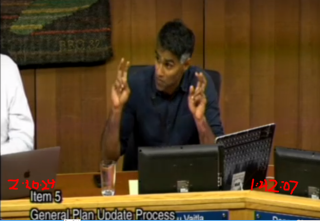
Council Member Bapu Vaitla comments on community engagement he envision for the General Plan, and his plan to consolidate commission have been in the news including a paraphrased interview in Enterprise 2/24 and a critique by Elaine Roberts Musser. I present this word for word transcript of his remarks. This is a more complete transcript than appeared in Vanguard.
1:40:26… I mostly want to talk about the community engagement piece .(for general plan a process). But I want to say a few words about the staff involvement…. Both during the commission restructuring process, of which there was extension staff engagement in fact, and the council retreat, It became apparent to me that there actually aren’t that many opportunities for staff to participate in long term visioning. That primarily because they are working so hard all the time in an understaffed city to try to get the work done day after day after day. So when you provide some space, given their professional experience, given their expertise, what could Davis look like, in our most ambitious vision, 20 years into the future. 50 years in to the future That’s a rare opportunity.
And I don’t think the community, the community (air quotes) at large is that worried about transparency about staff, I think there is a small group of people who are always pointing fingers at staff, that is not a community wide concern, I think when you do surveys about satisfaction with staff they regularly receive very high marks for their performance and their transparency. And their collegiality, their willingness to interact and answer questions to the community.
So, This is a piece I want to speak about in relation to community engagement. And I want to really caution us against being steered away from using the creativity of and time of staff and prioritizing that in this visioning process. I think an (ad hoc closed-door council) subcommittee is on way to do it, but think it is really really important they be involved and free the freedom. . I think a subcommittee (of council for public engagement) maybe there are other ways to do it, But for me it very very important for staff to be centrally involved and feel the freedom to play one of the leadership roles here.
1:42:59 So with respect to community engagement, I had the pleasure of giving a lecture today…(at UCD Professor Catherine) Dr. Brinkley’s Community Development class. .I came out of their energized, can out of there inspired by students. They had such great questions, such great ideas, fresh idea we don’t usually hear in public spaces, about institutions and polices we have right now, Who are they serving, and who are they not serving, Questions that are difficult to pose. I am very grateful for their energy and hope you will stay engaged in the general plan process.
I want to also say two students who spoke today, it very hard to speak in this kind of setting with all these eyes at you, I want to thank you for your courage in standing up and speaking, and I want to say to Cady situations like you and your friends is why we are up here so If you need anything in terms of resources, if you ever feel any sense of threat we are here to help.
1:44:22 I bring all this up in the sense as this is your home, this is your community, a lot of time comments get prefaced by “I’ve been in Davis 20 year,” or “I’ve been a homeowner for 30 years” And its great, its fine, its your home, yes. But you don’t have no more of a voice than someone who, say, just moved here yesterday. All of you (points at students in audience) have equal rights and equal voice and equal worth no matter how long you have been here. Because this is your home, and this is your community.
1:44:58 The larger point about community involvement and participation is I want us to be very intentional what community participation, what public participation, what inclusivity means. To me, it means as many people, as many different people , as many diverse people as possible. Diverse in terms of class, in terms of resources, age, sex, gender, race, are in the process and participating.
It doesn’t mean, that once again, the quote unquote, leading citizens of Davis are monopolizing the policy conversation again, and again, and again.
But more that new people need to enter the policy conversation and feel this to be enough of their home., enough of their home they have the feeling they are entitled to participate, because it is their home. To me, really, that is what is it means to have public participation. It does not mean having 14 committee of people who are privileged and already have power and voice it means inviting new folks into the conversation.
Like Gloria said, like my colleague said, its not just about creating forums for people to comment, but going to where they are and understanding the constraint in their lives and making it easier for them to participate.
I want to stop there, there is a lot more to decide about this (general plan) process. I feel it very important we are clear about out methodology for inclusivity. Think, partially, it can be worked out with commissions and try to recruit and build capacity in our commission to go out and do that broad-based outreach I also think there is a place for a (close door ad hoc council) subcommittee to do that. So, I am kind of agnostic on if subcommittees can be formed tonight…in advance of hiring the consultant.

 Davisite
Leave a reply to Roberta L. Millstein Cancel reply