

 I-80 Widening rated last for funding by Caltrans.
By Alan Hirsch
Preface: Just 46 hours after Davis Council was forced into a shot gun wedding with Caltrans on the Yolo80 freeway widening, the gate keeper organization on transportation projects, the California Transportation Commission (CTC) staff made public a: “do not fund” recommendation. The next chance for making up these state matching funds is in 18 months. It would be unusual if the staff recommendations are overturned at the June 28th CTC meeting.
* * *
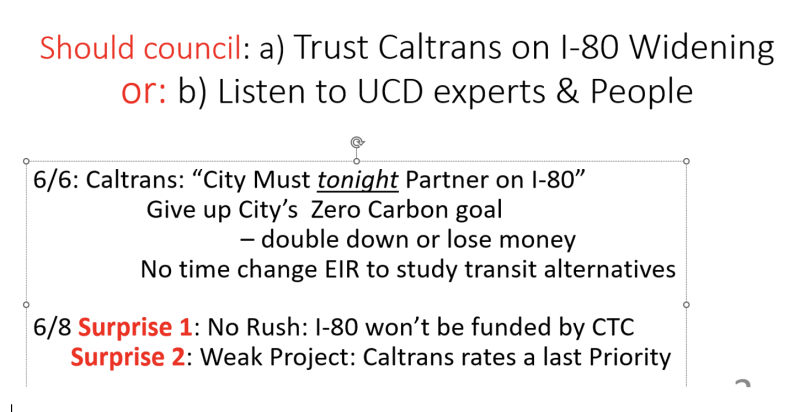
On January 6th, ignoring 21 public comments unanimously opposing it, the Davis City Council voted 3-1 to take the first step to go along with the I-80 widening project. The majority decided to listen to YoloTD Vice Chair Josh Chapman and it’s staff. This vote supports the city partnering with Caltrans to sell out our goal of zero carbon for Davis: Caltrans will get to use our “good” GHG-reducing projects to justify the additional GHG caused by the freeway widening. Caltrans’ carrot was to offer funding (amount unknown) to help developers of both the Nishi housing development and the housing proposed in downtown Davis.
As reported in the Enterprise article 6/10, the council voted this way even though they were uncomfortable with how the widening undercuts our local climate change plan. Among the complaints made by public were calls to remember the city’s climate emergency resolution.
Only Councilperson Bapu Vaitla remained skeptical of what was represented to council and voted no — i.e. to protect the city’s plan to go to zero carbon.
At the meeting, Yolo Transportation District (YoloTD) Executive Director Autumn Bernstein largely presented the widening project as a done deal, saying it was too late in the process to fully examine transit alternatives to a widen in the EIR. She also shared Caltrans’ forecast that the widening would not fix congestion for long, noting that even opening the new lane as a carpool lane, this lane would still be congested on day one. She said by making the new lane a “variable toll lane” they can ration its use at congestion times so at least that one lane won’t be congested– at least for those willing and able to pay the toll.
Council members were told if they did not agree to partner with Caltrans, that very evening, that Davis would likely lose an opportunity for the “free” mitigation money.
Funding Short Fall downplayed.
In framing the widening as inevitable, Bernstein did not highlight the importance of a key fact: the project has only 40% of needed funds needed even for phase 1 and the project needed a state match from the California Transportation Commission (CTC). She instead held up the threat that we would lose the $87 million in money we already had if Davis tried to slow things down. In creating a sense of inevitability, she failed to note the project was in competition before the CTC for $103 million in missing funds with 48 other projects from around the state and there was only enough money for half of these projects in this 2-year cycle. It is unclear at the time if she knew that the I-80 project was rated last in priority for funding by Caltrans, or why that was the case. I have made a public records request to learn more, but no information on this has yet been shared with me or the public.
It seems CTC staff made itself clear: it was best to walk away from the $87 million partial funding this cycle rather than double down on a project rated last by Caltrans itself among its 24 other projects statewide.
Policy Discussion held behind Closed Doors?
It was surprising that the Board of YoloTD did not discussion the CTC refusal to fund at its 6/12 meeting. When the refusal to fund was announced by Exec Director Bernstein, not a single board members asked a question. Maybe this was related to fact Bernstein also suggested the topic- and next steps, would be vetting behind closed door at a meeting of the I-80 Toll Subcommittee.
The legality of discussion of this topic — and most of policy decisions on I-80 behind doors has been questioned by members of the public in that past, as well as failure to respond to public records requests in a timely manner. This lack of disclosure has been noted in Enterprise news stores. State law make it clear subcommittee that discussing on going matter must meet in open even if they are made up of less than a quorum- and the intention of I-80 and it toll lanes to be a permanent project of YoloTD is clear. (see this link to California Attorney General opinion courtesy First Amendment Coalition),
Many argue maximum transparency, not the legal minimum, best serves the public, and it is certainly is the best way to develop trust. Transparency is also one of YoloTD Board’s stated values. YoloTD board policy seems instead to stick to the legal minimum they can get away with.
An Opportunity to Fix Things
If the CTC approves the staff recommendation to nix the funding, we will have time to reopen the EIR to study transit options for the entire I-80 corridor as alternative to the widening. The current EIR study is a “setup’ for transit not to relieve congestion as the transit improvements are only in the Yolo County section of I-80. The EIR alternatives don’t consider studying improvement in the full Capitol Corridor rail service or bus rapid transit service down the entire length of I-80 to Carquinez Bridge and beyond.
Most of the congestion on the causeway comes from outside Yolo County, so transit improvement has to happen outside Yolo if the project can be successful in relieving congestion.
Local elected officials should embrace this second chance to address climate change. The city of Davis should immediately write a letter to both Yolo TD and Caltrans to ask for them to reopen the EIR alternatives to include robust transit alternatives as well as congestion pricing alternative on the existing lanes to optimize their flow without adding capacity and creating more GHG’s.
 Davisite
Leave a reply to Tuvia Cancel reply