Davisite Banner. Left side the bicycle obelisk at 3rd and University. Right side the trellis at the entrance to the Arboretum.

Yolo County Needs a “Just Transition” Climate Action Plan

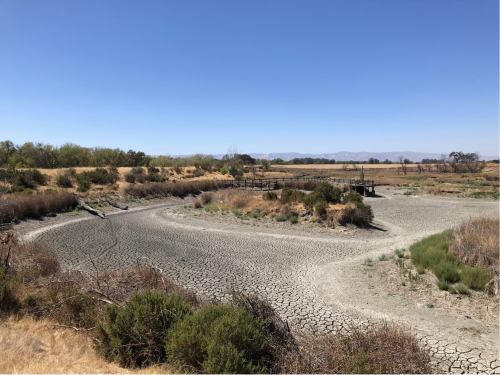
Wetlands
Wetlands at the Patwin-Wintun Tending and Gathering Garden are the keystone project for Yolo County’s plan to turn 30 former gravel pits into 900 acres of recreational lakes and habitat. The feasibility study for the Cache Creek Parkway was conducted by economic consultants now hired for Yolo County’s Climate Action and Adaptation Plan


By Marlen Garcia, Anuj Vaidya, and Juliette Beck

Yolo County has a lot at stake in how we address the climate crisis. In September 2020, the Board of Supervisors passed a visionary resolution calling for a Just Transition approach to climate action and community resilience planning.  Just Transition is a critical policy framework for ensuring that historically marginalized communities are centered and empowered to actively participate in the development of climate solutions. It is deeply relevant to Yolo County, which has the deepest levels of inequality in California. 

Unfortunately, Yolo County’s recent choice of a Climate Action and Adaptation Plan (CAAP) consultant team that did not include a Just Transition approach in their proposal is squandering a critical opportunity to address worsening socio-economic disparities.  As members of a team that also submitted a proposal, we are intimately familiar with the process and motivated to share our concerns by a sense of moral obligation to our community and future generations.

Yolo County’s houseless, BIPOC, rural communities, outdoor workers, and youth are already being hit first and worst by climate breakdown. Summer temperatures in Woodland and West Sacramento average ten degrees hotter than in greenbelt-lined Davis; air pollution has worsened along the 1-80 corridor; eviction rates have increased by 57% since last year. Alarmingly, multinational companies are mining groundwater to feed thousands of acres of perennial orchards, while small, family farms and the wetlands at the Patwin-Wintun Tending and Gathering Garden in the heart of Yolo County have gone dry.

Drywell

Dry well hotspots in Yolo County as of Nov, 21, 2022 (Yolo County Office of Emergency Services)


Just Transition provides a way of addressing these inequities ensuring that decision-making drives racial and social justice, builds a diverse, equitable local economy and advances a healthy, community-based food system. Focusing on equity, like healing the climate itself, will help us all. 

How has the County gotten off the Just Transition track?

First, Yolo County appears to have misused American Recovery Plan (ARP) funds intended to serve the neediest communities most impacted by the pandemic. In the $600k contract with Southern California-based Dudek Engineering, ARP funding is allocated to transportation and greenhouse gas emission consultants with no background in equitable climate planning. Other climate projects recently funded with ARP money are valuable and necessary, but they do not directly benefit frontline communities. An equitable approach ensures that the lion’s share of the benefits flows to the neediest communities. 

Second, the county has hired a CAAP consultant team with no experience in Just Transition  – it’s not even mentioned in their proposal – and is compromised by conflicts of interest with extractivist industries, namely the aggregate industry whose business strategy is wedded to mega-development projects such as highway expansion and urban sprawl.

Third, the county’s approach undervalues local knowledge and inefficiently duplicates completed work including communications and outreach strategies already designed by local community members.

Fourth, instead of using the best available science including watershed/groundwater modeling, soil science and traditional ecological knowledge, the County is pursuing a flawed carbon offset scheme that is essentially a permit to pollute that perpetuates environmental injustice by allowing big polluters to evade real cuts in greenhouse gasses.

How can we get back onto a Just Transition track? 

Yolo County needs to re-evaluate their approach to climate planning, centering equity in every aspect of the process, beginning with the CAAP.

  • Apply Just Transition principles to all decision making: and set clear equity goals
  • Fund climate experts and local community organizers experienced in equitable climate planning  
  • Dedicate staffing and resources for the Yolo Climate Action Commission’s Equity and Engagement Working Group
  • Focus on real fossil fuel reductions, not speculative offsets
  • Consider canceling the Dudek contract
  • Invest in a planning process guided by watershed science, soil science, traditional ecological knowledge and a participatory, inclusive vulnerability assessment
Valuesfilter

Graphic design credit: Our Power Campaign, Movement Generation


If we make these changes now, at the end of this two year planning process, we could have a Just Transition roadmap that stems the county’s rapidly increasing inequality and builds resilience from within our community. A truly equitable approach to climate planning uplifts, centers and empowers the people that are being harmed the most by climate breakdown to engage in identifying, prioritizing and developing transformational solutions such as:

  • Community land trusts for permanently affordable housing, local businesses, growing food, and supporting biological and cultural diversity
  • Public banking to finance regional economic development projects with local benefits
  • Climate justice K-12 education and curriculum with service-learning opportunities
  • Community-owned solar that allows renters and neighbors to financially benefit from shared solar energy installations
  • Improved public transit with low-cost or free bus fare with more frequent, reliable service
  • Ecological, community-based farms and urban gardens 

Let’s use the $600,000 in taxpayer money to attend to the climate vulnerabilities of underserved residents and communities and thereby strengthen climate resilience for us all. Let’s focus on our own residents, our real needs, and our considerable local expertise to lead a Just Transition that aims at wellbeing for all of Yolo County.

–Marlen Garcia is a UC Davis Community and Regional Development undergraduate student and co-founder of the local Climate Strike and Sunrise Movement hub; Anuj Vaidya, Yolo County community member and climate, equity and inclusion artivist; and Juliette Beck, co-founder of the Yolo Interfaith Alliance for Climate Justice and former director of California Water for All and Fair Trade campaigns

Davisite logo

Did you enjoy reading this article? Then subscribe to the Davisite for free and never miss a post again.

Comments

16 responses to “Yolo County Needs a “Just Transition” Climate Action Plan”

  1. Ron O

    From article: “Summer temperatures in Woodland and West Sacramento average ten degrees hotter than in greenbelt-lined Davis;”
    This is factually incorrect.
    If you look at the average high temperatures in West Sacramento and Davis (on Wikipedia), you’ll see that they’re about the same.
    Though Woodland has somewhat higher temperatures, likely/primarily due to being further from the Delta (and its “breeze”).
    If you really want to see this effect, try spending a summer in Redding.
    I realize that everything is “couched” in terms regarding equity these days, but I believe that this is an increasingly-ineffective argument for most people. At some point, this will run its course.
    In any case, is anyone actually surprised regarding the misuse of ARP funds?

  2. I am not sure how up-to-date Wikipedia is, but these sort of effects (“heat island effects”) can be fairly localized (not always though) and thus not represented by the averages. Still, though, the localized temperatures are what people will be experiencing. In any case, heat island effects are well documented.

  3. Ron O

    If you’re not in the shade, you’re going to be pretty hot in the summer – even in Davis.
    Personally, I’ve never waited for “someone else” to plant a tree for me. For that matter, there’s volunteer organizations which plant trees for others – no charge.
    I trust Wiki (and the sources they generally use) a lot more than anyone who claims there’s a 10 degree (average) difference between Davis and other nearby towns. Or that this is (somehow) related to “equity”.
    There is a definite (but not large) difference in the amount of Delta breeze between Davis and Woodland. Probably no difference between Davis and West Sacramento. In fact, the records show that West Sacramento is a fraction of a degree cooler than Davis in the summer, on average. (Probably depends upon where the weather stations are located, as well.)
    There’s an enormous difference between Davis and Redding, or Davis and Modesto (or on the east side of Sacramento.) But again, due to the influence of the Delta breeze – not due to “equity”, or misuse of government funds.
    For that matter, there’s some pretty wealthy places (like Palm Springs or Scottsdale) which are quite a bit hotter than anywhere in this region.
    Not sure where to look up “official” records, but I strongly suspect that this is what Wikipedia uses.

  4. Since you like Wikipedia – I do too – I suggest you check out this web page on the urban island effect:
    https://en.wikipedia.org/wiki/Urban_heat_island
    It describes the difference as being between urban areas and less urban areas, but it makes it clear that it’s really between more green and less green (more asphalt, more concrete). Davis is lucky to have more trees, to have had the money to invest in more trees, then its neighboring cities.
    Quoting from the article:
    “The difference in temperature between an inner city and its surrounding suburbs is frequently mentioned in weather reports, as in “68 °F (20 °C) downtown, 64 °F (18 °C) in the suburbs”. “The annual mean air temperature of a city with 1 million people or more can be 1.8–5.4 °F (1.0–3.0 °C) warmer than its surroundings. In the evening, the difference can be as high as 22 °F (12 °C) .”
    So it is not at all implausible to me to think that there are parts of Davis that are 10° cooler than Woodland and West Sac.
    As for being able to just plant a tree, surely you recognize that many people rent, don’t own property, and are thus not in the position to plant anything.

  5. As for inequality, this is from the same article:
    “ In recent years, researchers have discovered a strong correlation between neighborhood income and tree canopy cover. In 2010, researchers at Auburn University and University of Southern California found that the presence of trees are “highly responsive to changes in [neighborhood] income.”[74] Low-income neighborhoods tend to have significantly fewer trees than neighborhoods with higher incomes. They described this unequal distribution of trees as a demand for “luxury,” rather than “necessity.”[75] According to the study, “for every 1 percent increase in per capita income, demand for forest cover increased by 1.76 percent. But when income dropped by the same amount, demand decreased by 1.26 percent.”[75]
    Trees are a necessary feature in combating most of the urban heat island effect because they reduce air temperatures by 10 °F (5.6 °C),[76] and surface temperatures by up to 20–45 °F (11–25 °C).[77] Researchers hypothesized that less-well-off neighborhoods do not have the financial resources to plant and maintain trees. Affluent neighborhoods can afford more trees, on “both public and private property.”[78] Part of this is also that wealthier homeowners and communities can afford more land, which can be kept open as green space, whereas poorer ones are often rentals, where landowners try to maximize their profit by putting as much density as possible on their land.”

  6. Ron O

    Roberta: By that same measure (“heat islands”), there are likely parts of Woodland and West Sacramento that are cooler than parts of Davis. I’m not as familiar with West Sacramento, but I know that parts of Woodland have a more full canopy than parts of Davis. (So do parts of Sacramento.)
    The average temperature is officially recorded, and Wikipedia refers to those official temperatures. Those recordings would include any (overall) heat island effect. They don’t measure the temperature on each and every block, but they’re not differing by 10 degrees – unless perhaps one is comparing shaded areas vs. non-shaded areas. That’s not “weather”, and those differences would be found within ANY town.)
    If anyone is going to use that definition of “weather”, the “weather” inside of a parked car with the windows rolled-up is usually quite a bit higher than outside of the car.
    As far as wealthier people having more land (and therefore less “heat island” effect), I’m pretty sure that Davis has “less” land (per capita) – and more dense urbanization than either West Sacramento or Woodland. Despite Davis likely being “wealthier”, overall.
    As far as being able to “afford trees”, they aren’t that expensive in the first place. And again, Woodland (for example) provides free street (and/or front yard trees) for anyone who makes an effort to call the applicable phone number.
    Perhaps people “weather” they’re wealthy or not need to take some responsibility for their own neighborhoods, and stop waiting for others to do things for them.
    Again, there’s volunteers who plant trees for others, not themselves. I’ve seen these crews, generally including happy high-school age folks.
    Alternatively, I suppose that they can wait for the “equity crew” to show up and make things right.

  7. Ron O

    From article: “Summer temperatures in Woodland and West Sacramento average ten degrees hotter than in greenbelt-lined Davis”
    So again, this would be just as accurate if it stated:
    “Summer temperatures in Davis average ten degrees hotter than in greenbelt-lined (or well-canopied) Woodland or West Sacramento”.
    (And in the case of West Sacramento, they already have a “head start” – given that their average temperature is a fraction of a degree cooler than Davis to begin with.)
    But I have also seen vast areas in many valley towns with very little canopy. (And it is true that they’re generally industrial and/or poorer areas.) South Sacramento comes to mind, in general. (And that’s probably the least of their problems.) But a “shortage of land” (“high density”) is usually not one of the problems holding them back. They’ve got plenty of space to plant trees, but no apparent interest. (Again, probably due to “other” problems in those areas.)

  8. Ron O

    Another issue with trees is that you generally can’t just plant them, and do nothing for them afterward.
    You’ve got to care for them – at least for a few years (if not longer, depending upon the species).
    And if folks who live in the adjacent houses or apartments don’t care about trees in the first place (or believe it’s entirely “someone else’s job”), you can be pretty sure that the trees won’t survive. City crews can’t do this entirely on their own, without interest and help from those who benefit from them. (And it’s pretty difficult to drum-up empathy or interest in regard to those who don’t care in the first place.)

  9. What matters is the temperature that one experiences on the ground, so to speak — not any “average” temperature or the temperature that gets called “weather” or the temperature at the sensor. And the heat island effect is well documented, whether localized or over a large area.
    People with low incomes are often working strenuous jobs, jobs with long or unusual hours, and/or multiple jobs. They don’t have the time and money to plant and maintain trees, they don’t own property that they can plant trees on, and they don’t have the time and money to petition their electeds for more trees in public spaces (and if they did, they are less likely to be listened to, since electeds typically listen to those who have money). This is why — and again, this is also well-documented — you typically find far fewer trees in low income neighborhoods and rental properties.
    In Davis, the City maintains the street trees and trees in public areas. Not as well as they should, but they do maintain them.

  10. Ron O

    Roberta: Again, the “heat island” effect (of which I was well-familiar with) is not impacting the average temperature (as claimed in the article above). If it were, you’d see forecasts stating that it’s “10 degrees hotter” in Woodland and West Sacramento than it is in Davis.
    The claim in the article (which specifically mentions “average temperature”) is factually and demonstrably false.
    As far as renters not owning the property in which they live, that’s true of all renters – including “rich” ones. Either way, nothing is preventing them from speaking with their property managers, asking them to check out “free” trees, is there?
    And if you’re stating that those who live in apartments are “hopelessly without trees”, are you advocating that they do-away with apartment buildings as a solution?
    How do you know whether or not those with “low incomes” have no time? Some of them aren’t working at all. Some of them (no doubt) spend hours on social media, as well (as do many of us).
    Get off your lazy arse and volunteer with one of the organizations that plants trees (says I to anyone complaining about a lack of trees).
    And stop finding ways to bring “equity” into every single societal/environmental concern. It’s tiring, boring, often times false, and isn’t helping.
    No one cares what skin color you have. Not even those who share your skin color.

  11. You seem to be concerned whether the authors’ article dovetails with a particular number on a particular website. That is not of interest to me, given that there is ample reason to think that people in lower income areas in Yolo County typically experience and suffer higher temperatures. The detail is not important, IMO.
    Now, you can say “let them eat cake” all you want and insist that they do what they clearly (statistically, demonstrably) are unable to do — thinking that people just have gobs of free time and sufficient money at their disposal, and that property managers are oh-so-responsive to landscaping requests — but that just says to me that you are unconcerned about the situation and think they should just pull themselves up by their bootstraps. If that is the case, then there is no reason to discuss the temperature with you, since regardless you think that the rest of us have no obligation to do anything about it. And if that is right, then you simply don’t accept the ethical premise of what the authors are talking about. No point in discussing this further with you, then.

  12. Ron O

    Roberta: None of what you allege is what I stated.
    The reason for my initial comment was to point out a factually-incorrect claim. Including those type of claims weakens what might otherwise be legitimate concerns.
    I agree with most of the other points, though I also believe that just about everyone can do more to mitigate climate change, on a personal level. (Including planting trees.)
    The use of ARP funds is actually the most important concern regarding the entire article. Personally, I think that tying everything to “equity” obscures that, as well.
    But if anyone has any “cake” to share, I’m definitely interested. 🙂

  13. Ron O

    Roberta: I’ll add this, as well:
    I sincerely appreciate all you’ve done in regard to (what I view) as “slow growth” (and climate change concerns).
    Ultimately, the “team” is far-more important than any comments on here.
    I also don’t particularly care about my own ego, in regard to those goals. That can take a back-seat, as far as I’m concerned.
    I’m also not excessively concerned about “equity”, though I recognize this as a broader societal concern.
    I recognize that environmental concerns are not “white” concerns, and will be even less-so going forward. In fact, I’m looking forward to that, and believe that it’s already occurred to some degree, at least.

  14. Keith

    When the climate activists turned their crusade into making it about race and equity handouts that’s where they lose steam. They should keep it about the climate, period.

  15. The environmental movement has learned, from experience, that it doesn’t have much “moral authority” if it proposes policies that harm, rather than help, those who are already suffering the worst environmental harms. And proposing policies that are equitable, that ensure that some do not suffer while others benefit, should not be controversial.

  16. Ron O

    Rich Rifkin (whom I rarely agree with) just pointed out the exact same facts as I did:
    “Of course they have the right to that opinion. They don’t have the right to support their positions with fabrications.
    They state that “Summer temperatures in Woodland and West Sacramento average ten degrees hotter than in greenbelt-lined Davis.” Never mind there are also shady trees and parks throughout Woodland and West Sacramento. Their “10 degree” claim is curious.
    My lifelong experience tells me it’s a little hotter in Woodland (and possibly in West Sacramento) in the summer due to the Delta breeze.
    To know for sure if my experience matches the data, I reached out to Michael Anderson. He is the California State Climatologist, having earned his PhD in atmospheric sciences at UC Davis.
    Anderson compared the summer max and mean temperatures for Davis and Woodland for a dozen years. (He could not find those numbers for West Sacramento.) He emailed the data to me and concluded, “A quick glance at the climatologies shows Woodland being about one or two degrees warmer during summer months.”
    That fits my perception. One or two degrees, not 10.”

    Rifkin also points out other some unsupported (and misleading) claims regarding some other issues, as well (including local eviction rates). (But not related to the article, above.)
    https://www.davisenterprise.com/forum/opinion-columns/rich-rifkin-fake-facts-undermine-an-honest-debate/

Leave a reply to Roberta L. Millstein Cancel reply