Davisite Banner. Left side the bicycle obelisk at 3rd and University. Right side the trellis at the entrance to the Arboretum.

Does Gloria Partida’s Conviction for a Felony in 2000 Disallow Her from Holding an Elected Public Office in California?

And did Gloria Partida sign a false statement and wrongfully fail to disclose the conviction as required by law in her Statement of Candidacy in 2022?

Attestation

By Alan Pryor

The Alleged Felony Crimes, the Conviction, and the Sentencing

Based on official court records, Gloria Partida, current at-large Davis City Councilmember who is running for reelection in the newly created District 4 (East Davis and Wildhorse), was apparently charged in 1999 with four felony counts of “Forgery, Statute 470(A)” and one felony count of “Fraud to Obtain Aid, Statute 10980(C)(2)” for offenses committed in 1995 and 1996.

The following screenshot of the initial charges filed in Yolo County Superior Court was obtained from the Court’s document retrieval system (see https://portal-cayolo.tylertech.cloud/Portal/Home/WorkspaceMode?p=0, using “Partida, Gloria Jean” to search). Note that as of the evening of 10/10/2022, the records appear to have been scrubbed from the Court’s website although they were available earlier in the day:
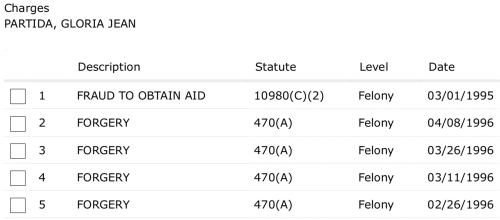
Filed Charges

The initial complaint against Ms. Partida was filed on 3/12/1999 and she was arraigned on all of the charges on 3/30/1999.

At the Preliminary Hearing on 2/2/2000, Ms. Partida entered a conditional plea of “guilty/Nolo” to the Fraud to Obtain Aid felony charge with the stipulation that no time in a State Prison would be imposed upon sentencing on the assigned date of 3/20/2000.

Disposition

Preliminary Hearing

Following the submittal of the Probation Department Report, a sentencing order was issued by the Court on 3/20/2000 ordering restitution in the amount of $6,673.42, payment of Public Defender costs, and a 5-year probation in lieu of surrendering to serve 120 days in jail, which was apparently suspended with the entry “Stayed Reason Unknown”.
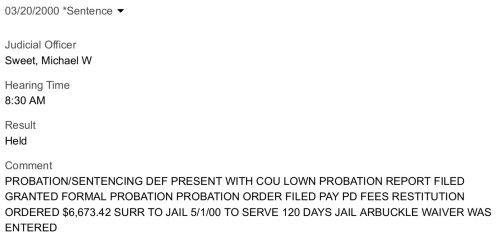
Sentencing

Sentencing_2

There was seemingly no sentencing for the four felony Forgery counts for which the Disposition Record shows “Conversion Disposition”. The basis for such disposition is unknown but is possibly due to a plea bargain when Ms. Partida pled guilty/Nolo to the Fraud to Obtain Aid charge.

The Expungement

Section 1203.4 of the California Penal Code allows for a person who has a felony conviction for which they successfully completed probation to have their conviction “expunged” from their record. This has the effect of changing a “guilty” plea or verdict to “not guilty” and the conviction is expunged from the person’s record. However, as discussed below, this expungement does not seal, destroy, or otherwise remove all records about the case; it does not remove certain penalties of the conviction; nor does it remove the responsibility to disclose this information under certain circumstances

According to the Penal Code’s language [emphasis added]:

“§1203.4. (a) (1) In any case in which a defendant has fulfilled the conditions of probation for the entire period of probation, or has been discharged prior to the termination of the period of probation, or in any other case in which a court, in its discretion and the interests of justice, determines that a defendant should be granted the relief available under this section, the defendant shall, at any time after the termination of the period of probation, if they are not then serving a sentence for any offense, on probation for any offense, or charged with the commission of any offense, be permitted by the court to withdraw their plea of guilty or plea of nolo contendere and enter a plea of not guilty; or, if they have been convicted after a plea of not guilty, the court shall set aside the verdict of guilty; and, in either case, the court shall thereupon dismiss the accusations or information against the defendant and except as noted below, the defendant shall thereafter be released from all penalties and disabilities resulting from the offense of which they have been convicted, except as provided in Section 13555 of the Vehicle Code…The order shall state, and the probationer shall be informed, that the order does not relieve them of the obligation to disclose the conviction in response to any direct question contained in any questionnaire or application for public office, for licensure by any state or local agency, or for contracting with the California State Lottery Commission.”

https://leginfo.legislature.ca.gov/faces/codes_displaySection.xhtml?lawCode=PEN&sectionNum=1203.4.

According to Yolo County Superior Court records, Ms. Partida’s probation was terminated on 9/1/2005, after which she petitioned the Court on 9/22/2005 for expungement. On 11/4/2005, the matter was heard in the Court and the motion was granted.

Expungement

California Law Does Not Allow Certain Convicted Felons to Serve as an Elected Public Official

California Election Code, Chapter 1, Section 20 specifically prohibits persons convicted of certain types of felonies from serving in an elected office in the state [emphasis added]:

Section 20 – Effect of felony conviction

(a) A person shall not be considered a candidate for, and is not eligible to be elected to, any state or local elective office if the person has been convicted of a felony involving accepting or giving, or offering to give, any bribe, the embezzlement of public money, extortion or theft of public money, perjury, or conspiracy to commit any of those crimes.(Emphasis added) 

(b) For purposes of this section, "conviction of a felony" includes a conviction of a felony in this state and a conviction under the laws of any other state, the United States, or any foreign government or country of a crime that, if committed in this state, would be a felony, and for which the person has not received a pardon from the Governor of this state, the governor or other officer authorized to grant pardons in another state, the President of the United States, or the officer of the foreign government or country authorized to grant pardons in that foreign jurisdiction”

https://leginfo.legislature.ca.gov/faces/codes_displaySection.xhtml?lawCode=ELEC&sectionNum=20.

These offenses are categorized as “violations of public trust.” Ms. Partida’s felony conviction for “Fraud to Obtain Aid” seemingly falls into the broad category of “theft of public money”; if this is correct, then it appears that Ms. Partida should not have been considered a candidate for office in 2018 nor have been eligible to be elected.

The only action that could remove this penalty would be a pardon. Expungement after serving probation is not included. This is further clarified by provisions in Section 1203.4 (a) (3) of the Penal Code that states the following regarding expungement:

Dismissal of an accusation or information underlying a conviction pursuant to this section does not permit a person prohibited from holding public office as a result of that conviction to hold public office.

https://casetext.com/statute/california-codes/california-penal-code/part-2-of-criminal-procedure/title-8-of-judgment-and-execution/chapter-1-the-judgment/section-12034-fulfillment-of-conditions-of-probation-change-dismissal-of-accusations-or-information

A reasonable interpretation of the above language seems to indicate that the prior type of felony conviction that Ms. Partida had precludes her from holding an elected office in the State of California whether or not the record of such conviction was expunged or not.

Public Misleading Statements and a False Filed Statement of Candidacy

Ms. Partida’s Campaign Manager, Tracy Tomasky, wrote the following letter and posted it on NextDoor on October 9, 2022 in response to postings showing Ms. Partida’s was charged with the five felony offenses referred to above:

The screenshot that you are showing in your post does not correctly reflect the current status of Gloria’s case. Those charges were formally dismissed by the Yolo County Superior Court more than 17 years ago. Unfortunately, due to a paperwork error, the public facing website continues to show incorrect information. Gloria is working with her legal counsel and with the court to correct this error. As soon as it is corrected the record will correctly show that any remaining charge was dismissed. If you would like more information, please contact me privately, Tracy Tomasky, Campaign Manager

It appears Ms. Tomasky is claiming that because Ms. Partida’s charges were “dismissed” by Yolo County Superior Court as a result of the expungement of her record, that she essentially has no criminal record that would affect her ability to serve as an elected official and there is thus no need to disclose this information. This ignores the provisions in the California Election Code and Penal Code requiring Ms. Partida to affirm that she has no felony convictions in her Statement of Candidacy.

California law states in Section 1203 (a) (1) of the Penal Code that such disclosures of prior convictions are mandatory regardless of if such expungements occur at a later date.

The order shall state, and the probationer shall be informed, that the order does not relieve them of the obligation to disclose the conviction in response to any direct question contained in any questionnaire or application for public office, for licensure by any state or local agency, or for contracting with the California State Lottery Commission.

The Office of the Public Defender for San Diego County explains:

“The first thing that someone who wants to apply for an expungement needs to understand is that if your petition is granted under Penal Code 1203.4, your case is not sealed. A criminal record is not actually "expunged" under this statute. That term implies complete erasure, as if the case had never occurred. A more proper term is "dismissal". The conviction remains on your record for many purposes, including sex offender registration and immigration consequences. What the statute provides is, except as elsewhere stated, the defendant is 'released from all penalties and disabilities resulting from the offense'. There are numerous limitations to this relief.”https://www.sandiegocounty.gov/public_defender/expungement.html

The State of California Courts have stated:

If you have successfully gotten a 1203.4 dismissal ("expungement"), it does NOT mean that the conviction is wiped away, sealed, purged or destroyed! The arrest is still there, charges are still there, but technically the conviction is "set aside and dismissed”.

IMPORTANT! There are a few places you still have to say yes, you have been convicted, even if it's all been expunged. Those places are: 1) the INS; 2) any state or local licensing agency (like when you're applying for a guard card or nursing license); 3) contracts with the state lottery; and 4) in an application for public office.” (emphasis added).

(https://www.courts.ca.gov/partners/documents/general_info_on_expungement.doc)

Ms. Partida signed a City of Davis Statement of Candidacy for the 2022 ballot and affirmed that she did not have any felony convictions in that filing in response to a specific question under the “Qualifications” section [red arrow inserted]:
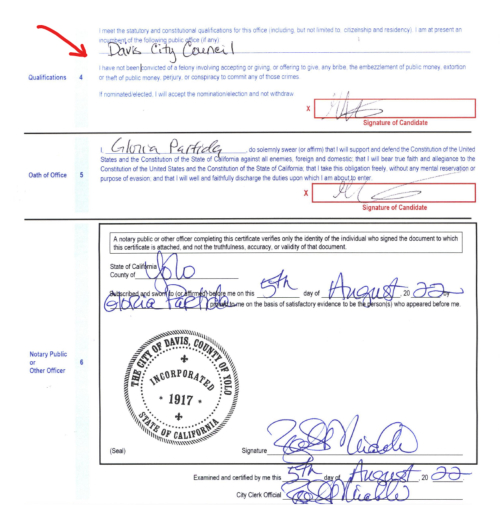
Signed Statement of Candidacy

It should be noted that in addition to apparently violating the CA Penal Code §1203.4 (a)(1) provision regarding the “obligation to disclose the conviction in response to any direct question contained in any questionnaire or application for public office,” filing a false document is in itself a felony offense in California as stated in California Penal Code §115. (a):

Every person who knowingly procures or offers any false or forged instrument to be filed, registered, or recorded in any public office within this state, which instrument, if genuine, might be filed, registered, or recorded under any law of this state or of the United States, is guilty of a felony.”

(https://law.justia.com/codes/california/2011/pen/part-1/112-117/115)

Additionally, Ms. Partida failed to disclose the prior felony conviction in a public forum for District 4 candidates hosted by Indivisible Yolo, Yolo Democratic Socialists of America, and Yolo People Power on September 26, 2022, in Davis Community Chambers and recorded by Davis Media Access.

The following exchange occurred when the Moderator asked Ms. Partida about her prior experiences with the criminal justice system:

“Moderator General Opening Question – Please tell us about your personal experience with law enforcement and the criminal justice system. Have you ever been arrested or convicted of a crime? Please tell us about that experience.

Moderator Following Question to Ms. Partida – Could you tell us Gloria about your experiences with the criminal justice system?

Ms. Partida Sure. So when I lived in LA I was handed down a 69 Impala which was actually a police magnet and I was pulled over on multiple occasions and that continued until I bought a minivan. But yes, I have been arrested and so have had that experience with the police. I still respect the police greatly.”

https://drive.google.com/file/d/13kIdxjpaGsT3s6G6_t7JV1EfNc4Ccuwt/view

Ms. Partida did not disclose her prior felony conviction and seemed to imply that her only prior interactions with law enforcement stemmed from her owning the Impala because it was a “police magnet”.

Davisite logo

Did you enjoy reading this article? Then subscribe to the Davisite for free and never miss a post again.

Comments

78 responses to “Does Gloria Partida’s Conviction for a Felony in 2000 Disallow Her from Holding an Elected Public Office in California?”

  1. George Galamba

    I am supporting Adam Morrill for a variety of reasons, but I think digging up this crap from the distant past is bull shit. I don’t think Gloria is a particularly effective representative, but I have no reason to assume she is a criminal. I assume her to be a decent, honorable person, but I think it is time for change. Why can’t we focus on the issues of the day instead of ad hominem attacks? Let’s base our votes on whom we think has the best ideas for our community, not on character assassination.

  2. C.T.

    I am very sympathetic to Gloria about having her past criminal proceedings brought up. I am sure it is very uncomfortable even if it is old and on a human level I find this all unfortunate.
    Sadly, this criminal record appears to be relevant because she does not seem to have accurately filled out her declaration of candidacy and may not even be eligible for the office she currently holds or the one she now seeks.
    That legal question is pretty important to our City. It seems like every vote of a council with an ineligible member could be challenged in court. Having a council member who is not eligible on council is a major problem for our city and raises many questions.
    Was this issue vetted by the city attorney 4 years ago? Has the felony ever been revealed to the city? Was there no background check? What happens now? It is too late for her name to be taken off the ballot. Do votes for an ineligible candidate count?
    What a mess. An avoidable mess had Partida been forthright about her past.
    I hope Gloria can provide more information soon.

  3. Sharla Cheney

    This has got to be the lowest that Davis politics has ever reached. It is pure evil. Gloria Partida has served us well and doesn’t deserve this treatment from the community.

  4. Ron Glick

    Pryor’s attack is so sleazy. I get he is still running against Measure H but hopefully the rest of the electorate wants to look forward instead of back. The question this raises for me is if Adam Morrill is going to repudiate this kind of campaigning by his supporters?
    Just like with Colin Walsh digging into Carson’s emails it seems that these No on H supporters are willing to go so low that they should be ashamed of themselves and apologize or at least the candidates they are supporting should if they won’t.

  5. Ron, I fail to see how this has anything to do with the Measure H campaign.

  6. Alan C. Miller

    Bad dog.
    Bringing up something from 20 years ago has no relevance. People change, and I believe in forgiveness. 7 years is commonly accepted timeline in many spiritual practices for cleansing of the soul and a new direction to be grounded. I accept GP’s explanation that she was given legal advice that she did not have to disclose this. That’s why we have the ability to expunge convictions.
    Some hay has been made of the fact it involved taxpayer money so is relevant. Nothing GP does is invisible — it takes four other votes, nor is there any insinuation or evidence she has forged city documents or committed fraud with city funds. So just stop it.
    I do not know what happened and GP called it ‘painful and personal’ and I believe that. A possible scenario is that she was on hard times, had people she associated with decades ago who suggested she could get away with getting money by doing X. She did X, got slapped down by the law, realized this was a very bad idea, and never did that or anything like it again. If she had a repeating and recent pattern of monetary crimes I’d be concerned. This sounds like someone who learned a lesson and changed. That’s how it’s supposed to work. And they can even go into politics. Are any of us so perfect that we don’t want to be forgiven for something we did twenty years ago? I’d like to be forgiven for what I did yesterday.
    The real tragedy in this may be the word of Alan Pryor. He is incredible at doing in-depth investigations and digging up many important facts. And in that sense is a Davis treasure. However, this is coming across as dirty political mud-slinging to do anything to get candidates who are less into growth on the ballot. And I’m afraid this is going to come across as such a low blow that it will only tarnish anything that Pryor brings up in the future. And for the current campaign, a backfire on the level of what Carson did for Measure H.
    This reminds me of Clinton getting nailed for lying to congress about his affair, when the affair itself was tawdry but not illegal. Except in this case Gloria didn’t lie to anyone as she has a perfectly good and legal explanation as to why she did not disclose.. And actually she did have a conviction unlike Clinton. So actually its not a good metaphor at all as its more like completely backwards. Why didn’t I just erase this paragraph?

  7. Colin Walsh

    Ron, Carson’s misues of public resources to campaign for Measure H (which he admitted was totally inappropriate) has nothing to do with Gloria Partida’s old felony fraud conviction (which she claims she has no obligation to tell votesr about).
    And that is a sentence I never thought I would write about Davis City Council members.

  8. Ron O

    Alan M. – it does have an ugliness to it, but it seems that she may not be able to remain on the council – regardless of whether or not she discloses it – as noted in Alan P’s article:
    “(a) A person shall not be considered a candidate for, and is not eligible to be elected to, any state or local elective office if the person has been convicted of a felony involving accepting or giving, or offering to give, any bribe, the embezzlement of public money, extortion or theft of public money, perjury, or conspiracy to commit any of those crimes.”
    Dismissal of an accusation or information underlying a conviction pursuant to this section does not permit a person prohibited from holding public office as a result of that conviction to hold public office.”
    “A reasonable interpretation of the above language seems to indicate that the prior type of felony conviction that Ms. Partida had precludes her from holding an elected office in the State of California whether or not the record of such conviction was expunged or not.”
    One would think that background checks would be conducted automatically for all candidates, but it seems this isn’t the case.
    I don’t think that Alan P. is the one with any “explaining” to do, nor do I think he’s the one who discovered it or first brought it up on social media. Again, it seems like something that should come up if a background check was actually required to be on the council. Perhaps the law itself is “unreasonable”, but that’s apparently what it says.

  9. Nikki

    People can change for the better. What happened in the 90s should not be held against someone. But, it’s disingenuous to not full disclose this previously in campaigning and in discussing her past encounters with police. The truth always comes out and it’s so much better for everyone to fully disclose and be truthful. Even when being truthful is hard, the energies of the universe honor truth. People honor truth and I think that’s very much true for our community. There’s no easy way to regain trust once you experience it being broken. For her diehard supporters this will probably not matter. For people on the fence, this could possibly influence them. Unfortunately only people in her district get to vote. I wish all Davis citizens could weigh in.

  10. Sharla Cheney

    Nikki – The truth is that the felony convictions were expunged – changed to misdemeanors and then dismissed. That is the relief that our justice system offers people. So currently, there are no felony convictions. I don’t see how Gloria’s conduct as a City Council person or as a community member would make her suspect or that she has an obligation to disclose something that she resolved in the 1990’s. I don’t understand how this is relevant to the upcoming election, when she was advised by legal professionals that she was under no obligation to disclose this information.

  11. Dan Cornford

    Some of the responses to Alan’s wonderfully detailed and well argued article are positively Trumpian both here and on that other developer blog. It is unarguably that GP in running for CC did not disclose her conviction, and that alone, aside from the conviction itself, should require morally and legally that she withdraw her candidacy for re-election immediately!
    I am truly shocked that so many should accuse Alan of engaging in a personal sleaze attack given the importance of the issue and Alan’s meticulous documentation.
    What next? If it were, hypothetically, the case that a CC member was found to be taking bribes from developers, a la Bell city, CA, I suppose many of these same people would rush to their defense.

  12. Alan Pryor

    To be clear, I do not question Ms. Partida’s character or values. I know she deeply cares about the poor, the disabled, the LGBT community , the homeless, and the disenfranchised and has worked tirelessly for many years on their behalf. My article had nothing to do with any of that and the issue of her character and values was not raised nor disparaged anywhere in any way in the article.
    My article was simply a factual representation of the law as it currently exists on the books and as it pertains to her ability to continue to serve on the City Council in light of that current law.
    The facts speak for themselves

  13. Alan C. Miller

    “Just like with Colin Walsh digging into Carson’s emails it seems that these No on H supporters are willing to go so low that they should be ashamed of themselves and apologize or at least the candidates they are supporting should if they won’t.” — RG
    Oh stop it, RG. This is NOTHING like CW, THIS YEAR, checking on the current possible misuse of public emails. Going back a few months is nothing like going back 22 years, and for Carson it was AS a public office holder and current. What is your reason for being so defensive of the criticism of Carson? I look forward as I believe your reason will only sink the ship deeper on the ocean floor, toppling into an undersea canyon. And no candidate need apologize for their supporters — they only ‘should’ if they believe it is hurting their candidacy (and indeed it may be — but that’s up to the candidates).
    “I don’t think that Alan P. is the one with any “explaining” to do” — RO
    It’s not a matter of explaining, it’s a matter of perception. If most Davis citizens (in this case District 1 citizens) see this as a “Dirty Deed Done Dirt Cheap” this will only hurt the very cause one is seeking.
    Similar to how progressives and Davis Vanguard fail to see their radical ways actual hurt any chance at compromise and actual fuel the possibility of another term of Trump. I don’t want Trump! That’s why being so fucking self-righteous and demonized Republicans as the spawn of Satan is so dangerous. They come to fear that all Democrats are radical progressives and vote for Trump as a reaction. I criticized TDS not because I wanted Trump, but because those with TDS were too blind to see they were strengthening the object of their fear.
    As for District 4 I really don’t know how I’d vote if I lived there. I am much more concerned about District 1. Some say I shouldn’t be, because I don’t live there. Go away “some”. I do care, and I can care, and district elections are stupid.
    If GP got bad legal advise, she will pay the price. But the intent seems to be to tarnish her for not disclosing properly, which is a legal matter, so that a growth candidate is harmed. And I think from a strategic political point-of-view, all this is doing is bringing sympathy and votes to GP.
    I’m not saying what AP did was as evil as what Carson did. What I am saying is that it is likely as serious of a strategic backfire.

  14. Robert Canning

    In a comment on the Vanguard, Alan Pryor says: “To be clear, I do not question Ms. Partida’s character or values. I know she deeply cares about the poor, the disabled, the LGBT community and the disenfranchised and has worked tirelessly for many years on their behalf. My article had nothing to do with any of that and the issue of her character and values was not raised nor disparaged anywhere in any way in the article. My article was simply a factual representation of the law as it currently exists on the books and as it pertains to her ability to continue to serve on the City Council in light of that current law. The facts speak for themselves.”
    It seems to me that Alan wants to have it both ways – i.e. to both deny that the article is about someone’s values and character, AND then state that the person was not honest with the public and that he “seemed to imply that her only prior interactions with law enforcement …” were infractions.
    It seems to me that honesty, forthrightness, and transparency in public statements go directly to someone’s values and character. And given the context of the article (e.g., the timing of his recitation of facts vis a vis the election, recent Council votes on developments, etc.) it would seem that Alan is (IMHO) definitely questioning Ms. Partida’s character. One way to think about this revelation is to wonder what the discussion would be like if Alan had published this a year ago, six months ago, or even six months from now.
    Facts, in this context, are never JUST the facts. And if you don’t believe that, I have a bridge (or maybe a research park in East Davis) to sell you

  15. Ron O

    Alan M: Per his comment on the Vanguard, Bob Milbrodt noted that there were rumors of this going around for some time (a year or so). Apparently, no one bothered to look into it because it was assumed that Gloria might not run again. (You can see what he said about this on the Vanguard.)
    As such, that might help explain “why” it’s coming out, now.
    I do wish that someone had looked into this a year or so ago, when the allegations apparently first surfaced. (Had that occurred, it might be viewed differently.) Or even better – how about if cities were required to do background checks in the first place, for a council position? Why is this responsibility even falling upon citizens to investigate in the first place? What if a candidate committed a more serious crime, for example? Do they just take candidates’ word for it, on a form?
    Regardless of any “explaining” by Gloria, the law that Alan P. cited apparently states that the crime itself prevents her from serving on the council – even if expunged/dismissed. As such, it seems that she might be removed – even if she “wins” again. (I don’t know “who” would do the removal, or “how” it would be done. Nor do I know how likely any of that would be.)
    Regarding the “politics”:
    Even if the “messenger” (or message) is viewed in a negative light, the facts remain. And if Gloria remains on the council despite what the law seems to state, she’s going to be weakened (politically) by this.
    If both Dan Carson and Gloria Partida remain on the council, it’s likely that their (combined) advocacy for developments will also be weakened. These two were the leading proponents for DISC, for example.
    So politically, I don’t think it actually has a net detrimental impact on the “cause” – as you put it.

  16. Ron O

    For what it’s worth, I do believe that Gloria likely got some professional advice stating that she did not have to disclose this.
    It appears that the advice might have been wrong, per the law that Alan P cited.
    Again, cities should probably be the ones conducting background checks in the first place. And if an issue that’s found which is potentially “disqualifying”, it could then be settled before a candidate is even seated.
    It’s unreasonable to set up a situation in which citizens conduct background checks on their own (and research applicable laws) as a result of a failure by cities to do so in the first place – as it’s inevitably going to encourage opponents (in particular) to “look into” a candidate’s criminal record. And it will then inevitably be viewed as a political, rather than a legal issue.
    I’m surprised that something like this hasn’t occurred before (that I know of, at least). Maybe there aren’t that many candidates with the unique circumstances surrounding Gloria’s situation?
    As a side note, I still don’t actually know who “Deep Throat” is, in this case.

  17. Ron Glick

    “I am truly shocked that so many should accuse Alan of engaging in a personal sleaze attack given the importance of the issue and Alan’s meticulous documentation.”
    From the film Casablanca:
    Rick: How can you close me up? On what grounds?
    Captain Renault: I’m shocked, shocked to find that gambling is going on in here!
    [a croupier hands Renault a pile of money]
    Croupier: Your winnings, sir.

  18. Ron Glick

    Roberta: “Ron, I fail to see how this has anything to do with the Measure H campaign.”
    I’m surprised by your failure to to see the connection. Is it a lack of the ability to infer what is going on or an inability to engage in inductive reasoning?

  19. Ron Glick

    It’s a pity that so many non-lawyers are offering legal opinions that conflict with the legal opinion of the Sac D.A. who was asked to study this by the Yolo D.A. and found nothing. I’m yet to see one lawyer come forward and say Partida did something wrong but I’ve seen several who have said she did nothing wrong.

  20. Ron, I rarely refer to the fact that I have a PhD in philosophy and have taught logic and critical thinking many times, but yes, that. Nothing wrong with my powers of inference.
    I fail to see a connection because there is absolutely no connection between Alan Pryor’s article on Gloria Partida’s felony conviction (etc.) and the campaign to defeat Measure H. These are two completely separate issues.

  21. Ann Block

    Yes, Alan, the facts DO speak for themselves. Your own screenshot indicates the conviction was reduced to a misdemeanor in 2005 – how did you “forget” to notice that? A motion was granted BOTH to reduce the 20 year old conviction to a misdemeanor pursuant to Calif. P.C. 17(b)(3), as noted above, AND to allow withdrawal of the prior plea and dismissal. So clearly Gloria answered the question correctly and is and was always eligible to serve on the City Council. The vitriol and false allegations of the “No on H” campaign has gotten completely out of control.
    As to the 20 year old prior conviction itself, this county (Yolo) under the current D.A. and his mentor and predecessor, has long charged as felonies what neighboring Solano and Sacramento normally charge as misdemeanors. In addition, “welfare fraud” cases, are often unfortunately brought against obviously low-income people unable to hire a fancy, unlimited time, expensive defense attorney — for misunderstandings and miscommunications often caused by their benefits caseworker. And public defenders usually believe there is “no defense” in these cases – benefits were overpaid, so they think its cut and dried. (I advise public defenders on pleading every day as part of my job, and hear this all the time). But that is far from the reality, and I am presently in the process of collaborating on a practice advisory targeted to public defenders, with a Legal Aid attorney who is expert in these matters, to help public defenders understand there are often quite strong defenses in these cases where there was no intent to commit fraud.
    I myself have recently had a client so charged with the exact same “felony” – who I had actually pushed to apply for benefits due to her lupus diagnosis, inability to work and having the need to support two young children. She was charged due to an asset she didn’t realize she needed to disclose, that she could not sell, and that she was not asked about. The conservative D.A. (in another northern Calif. county) charged her, nevertheless, when the county reported what they thought was an overpayment, despite the fact that she immediately began making restitution. It took FOUR attorneys that I recruited — including myself, a private pro bono criminal defense attorney and two Legal Aid attorneys (one of which is the expert in mischarged “welfare fraud” cases), plus another asset expert, to overcome these charges, including appealing the denial of ongoing benefits. She ultimately won on all counts, the benefits were restored, her restitution reimbursed, the D.A. dropped the charges, but nothing compensated for the shame and embarrassment she experienced in the process. Most are not so lucky, and just plead out and pay back the benefits, in order to avoid the worst consequences of a jail sentence, to protect family members or similar reasons. Obviously this old matter was very painful for Gloria, involved family issues, and had she been able to afford counsel that had the time to investigate what happened and vigorously defend her, she may well not have ended up with any conviction at all, not even a misdemeanor.
    Reply

  22. Ann Block, I see you make the same false accusation that Ron Glick has made — that Alan’s article has something to do with the No on H campaign.
    In both cases I wonder, why? What advantage do people hope to gain by claiming things to be connected that are not connected? Hmm….

  23. Ron Glick

    Roberta one does not need to lean on a Ph.D to claim they have the power of inference. As Piaget observed most people have this power by the time they become teenagers. But as the Wizard told the Scarecrow “I know plenty of people who have no more brains than you but they have one thing you haven’t got, a diploma.
    Anyway since you claim the power of inference there is no need to explain to you the linkage I inferred from Alan’s hit piece on Gloria. In my mind the implication is obvious. The question is whether your inability to see it is willful or not?

  24. Ron, I worked on the No on H campaign. This letter did not come from the No on H campaign. Period. Any connection you see is in your mind only. Sling all the insults you want (I am letting this violation of the Davisite policy go because the insults you make are against me) but you’re drawing a connection where none exists. And again I have to ask, why? What is your motivation and what do you hope to gain by making this false claim for which you have no evidence?

  25. RonGlick

    Just Calling it as I see it Roberta.

  26. Ron, what you see is all in your head. It is completely baseless. If you had evidence you would have provided it already, but that would be impossible — you can’t provide evidence of a connection that does not exist. The No on H campaign is not connected to Alan’s article concerning Gloria Partida’s felony. Period. And your stating that there is one does not make it so.

  27. Ron Glick

    I went back and looked at the phrasing you find objectionable Roberta. I said “I get he is still running against Measure H but hopefully the rest of the electorate wants to look forward instead of back.”
    I wasn’t writing about the Measure H campaign I was writing about my belief that Alan is still fighting the last campaign. Most of the people I speak to want to know about roads, homelessness, affordable housing, crime, parks and other things.
    Its sad you continue to smear Gloria in your above post when it has been established that Gloria does not have a felony conviction.

  28. Ron Glick

    “Ron, what you see is all in your head. ”
    Yes Roberta, that is where most people make inferences.

  29. Ron, ok, fine. I don’t see how this is Alan continuing to fight the last campaign either, but again, you can make up whatever in your head that you like. I am content that you not claim any connection between the campaign and Alan’s article.
    “Most of the people I speak to want to know about roads, homelessness, affordable housing, crime, parks and other things.” Sure, I agree — although as I wrote about already, Measure H was about many many things: https://www.davisite.org/2022/09/why-disc-matters-for-the-city-council-election.html
    I’m not going to get sucked into a hair splitting debate over whether Gloria was convicted of a felony or not.

  30. “Ron, what you see is all in your head. ”
    Yes Roberta, that is where most people make inferences.

    Yes, but they are groundless if they lack any connection to reality, as your inferences do here.

  31. Ron Glick

    “I’m not going to get sucked into a hair splitting debate over whether Gloria was convicted of a felony or not.”
    Its not hair splitting its a smear. The honorable thing to do would be to issue a retraction.

  32. Although Gloria Partida has responded, she has not responded with respect to some central issues. Quoting Rik Keller’s comment on her response:

    Ms. Partida stated that “I did not have any legal obligation to disclose this when I filed my papers for candidacy. At that point, I was asked if I had a felony conviction, and I did not have one.”
    However this seems to directly contradict the statement in Mr. Pryor’s article concerning expungement that:
    “California law states in Section 1203 (a) (1) of the Penal Code that such disclosures of prior convictions are mandatory regardless of if such expungements occur at a later date.
    “The order shall state, and the probationer shall be informed, that the order does not relieve them of the obligation to disclose the conviction in response to any direct question contained in any questionnaire or application for public office, for licensure by any state or local agency, or for contracting with the California State Lottery Commission.”
    Ms. Partida’s statement seems to contradict this provision in State law described in Mr. Pryor’s article regarding the ban on public office for certain types of felonies:
    “The only action that could remove this penalty would be a pardon. Expungement after serving probation is not included. This is further clarified by provisions in Section 1203.4 (a) (3) of the Penal Code that states the following regarding expungement:
    “Dismissal of an accusation or information underlying a conviction pursuant to this section does not permit a person prohibited from holding public office as a result of that conviction to hold public office.”
    Ms. Partida states that “I have been assured by my legal counsel and the District Attorney’s office that my response was in full compliance with the law.”
    But it is unclear whether these specific provisions in State Law, among others, were addressed by that “assurance” and Ms. Partida avoided directly addressing them in her response.
    Release of those communications would seem warranted to provide transparency on this issue. Otherwise this has the appearance of someone saying the law does not apply to them, with no further explanation provided.

  33. Alan C. Miller

    Who is this “Alan” of which you all speak?
    The RG-RM back-‘n-forth is up there in “No YOU suck more” glory than your average RO-DG debate on the ‘other’ blog.
    I’m not going into the ‘it says here X’ debate on whether there was wrongdoing or whether a removal from office is warranted. Legal statements in isolation often paint an incomplete truth — one reason I would never consider being a lawyer. Is there a path to anyone lifting a finger on this? If not, it doesn’t matter — and I have no opinion since I’m not a lawyer. What my point was is I believe this will backfire politically. That is all.

  34. Ann Block

    Roberta, are you also ignoring, as did Alan Pryor, the clear screenshot, as well as Gloria’s response, as well as my comment, all indicating that her conviction from over 20 years ago was reduced to a misdemeanor in 2005, pursuant to Penal Code 17(b)(3)? And did you read the Election code provision cited by Alan P and entitled “Effect of felony conviction” which refers to candidates for public office convicted of certain FELONY convictions as prohibited from holding office? And the 1203.4 expungement provision that clearly states that public officer holders must still disclose past convictions that “prohibit” them from holding public office. So perhaps you can now see the connection between these statutes and that Gloria is and always was, eligible for elected office since 2005? And under no obligation to disclose an old prior that was reduced to a misdemeanor and dismissed – as it had no bearing at all on the election code prohibition? I realize that understanding statutes is difficult and confusing for non-lawyers, and even for some lawyers as well — but this should be fairly straightforward: (1) Gloria had a conviction over 20 years ago based on a no contest plea to one charge (related as she says to a painful family matter) (2) that conviction was clearly reduced to a MISDEMEANOR in 2005 (according to Alan P’s own screenshots) and then expunged — she was allowed to withdraw her no contest plea from that then misdemeanor and the charges were then dismissed (3) the election code prohibits candidacies for public office for those with certain FELONY convictions (4) when Gloria first ran for office in 2018 and then again now, she had no felony conviction from her past, only a past misdemeanor that was expunged — so the election code prohibition and the related expungement code requirement to disclose DID NOT AND DO NOT APPLY (5) this is an ongoing false smear campaign, and frankly bordering on libelous. Stop!

  35. Ann Block, I have already said that I am not going to get into this. I similarly (and repeatedly) said that I wasn’t going to take a stand on Adam vs. Gloria, yet you continued to send me about a dozen emails and call me out here on the Davisite and on NextDoor, not to mention the odd DMs I received from your fellow Gloria supporters. I find this focus on me to be obsessive and harassing, and I ask you to stop. (To be clear, I am not using legal terms here, in case these have any legal meaning). As you for this new issue you are insisting I weigh in on, I am not a lawyer. So no, this doesn’t seem clear-cut to me, but I’m not going to weigh in on it because I don’t have the expertise to do so. I am not in office and I am not running for office, and I don’t owe you or anyone else an accounting of my personal beliefs. When I say that I am not going to take a stand on something, I expect people to take that at face value and not try to harangue me until I give the answer that they like. Please leave me alone.

  36. Ron Glick

    Legend has it that LBJ, in one of his early congressional campaigns, told one of his aides to spread the story that Johnson’s opponent fucked pigs. The aide responded “Christ, Lyndon, we can’t call the guy a pigfucker. It isn’t true.” To which LBJ supposedly replied “Of course it ain’t true, but I want to make the son-of-a-bitch deny it.”

  37. John Patrick Hunt

    I’m not an expert in criminal or election law, I don’t take a position on the candidate people should support in this race, and this is not legal advice to any entity.
    With that said, here are my thoughts. I present here a more detailed analysis of the relevant statute that supports what Ann Block has asserted: Gloria Partida appears eligible to hold office.
    The key provision, ignored in Alan Pryor’s post, is Penal Code Section 17(b)(3).
    Penal Code Section 17(b)(3) provides that a crime “is a misdemeanor for all purposes” when three conditions are met: (a) the offense can be punished either by (1) imprisonment in a state prison or imprisonment in a county jail under Penal Code 1170(h), or (2) fine or imprisonment in a county jail; (b) the court grants probation; and (c) the court later declares the offense to be a misdemeanor upon the defendant’s motion. There are other parts to it, but I’ve excerpted what’s relevant here.
    Let’s take these one by one:
    (a) As I read Alan Pryor’s post, the offense to which Gloria Partida pled guilty is described in Penal Code 10980(c)(2). That provision prescribes punishment “ by imprisonment pursuant to subdivision (h) of Section 1170 of the Penal Code for a period of 16 months, two years, or three years, by a fine of not more than five thousand dollars ($5,000), or by both that imprisonment and fine; or by imprisonment in a county jail for a period of not more than one year” . Thus, the provision calls for imprisonment in a county jail under Penal Code 1170(h) or imprisonment in a county jail, so the first condition appears to be met.
    My understanding is that the complicated language of Penal Code 17(b)(3), with its seemingly redundant reference to imprisonment in a county jail, describes what criminal lawyers call a “wobbler”: a crime that can be charged as a misdemeanor or a felony. I believe criminal lawyers who’ve posted on this matter have said that the offense of which Gloria Partida was accused is indeed sometimes charged as a misdemeanor and sometimes charged as a felony.
    Why the confusing distinction between jail imprisonment under 1170(h) and simple jail imprisonment? Penal Code 1170(h) prescribes imprisonment for more than one year in a county jail; I understand it’s a substitute for prison time and therefore is felony punishment. I understand that garden-variety jail imprisonment is limited to one year and is misdemeanor punishment. Hence the reference to both 1170(h) (felony) jail time and unmodified (misdemeanor) jail time. That’s my understanding, anyway. I could be wrong about that, but it doesn’t really matter. The point is that 10980(c)(2) refers to both types of jail time.
    (b) Again based on Alan Pryor’s post, Gloria Partida was sentenced to probation. The second condition appears to be met.
    (c) According to Gloria Partida, her conviction was reduced to a misdemeanor upon her application in 2005. Alan Pryor does not contradict this assertion. The third condition appears to be met.
    Thus, all three conditions seem to be met, and Gloria Partida’s conviction was, “for all purposes,” a misdemeanor conviction starting in 2005. Moreover, the record Alan Pryor posted states, “Motion granted per 1203.4 and 17(b)(3) PC.
    As Alan Pryor recognizes, Elections Code Section 20(a) bars only persons “who have been convicted of a felony” from public office. Because Gloria Partida’s conviction apparently was for a misdemeanor, not a felony, Elections Code Section 20(a) does not appear to apply. Thus, Gloria Partida appears eligible to hold public office.
    Alan Pryor’s argument that a felony conviction dismissed under Penal Code 1203.4 disqualifies the offender from elected office does not address the situation where the felony is reduced to a misdemeanor. The reduction to misdemeanor, rather than the “expungement” (technically a dismissal, as I understand it), seems to be the critical issue here.
    There may be some statutory ambiguity around the retroactive effect of Penal Code 17(b) and/or the relevant time frame for “has been convicted of a felony” under Penal Code 20(a). The courts do not appear to have addressed the issue. However, I expect that the California Supreme Court would resolve any ambiguity in favor of rehabilitated persons with felony convictions.
    On the other side, I’m actually not sure the conviction was “reduced” to a misdemeanor; there may be a more accurate way of describing it. I don’t have time to pursue that right now.

  38. Colin Walsh

    John,
    I did some research on this yesterday too and I think it dovetails with yours pretty well.
    I contacted Jesse Salinas the County Clerk and Chief Election Officer for yolo county and he provided this information, “The County Counsel has advised that a local elections official has no legal duty to review a candidate’s alleged criminal history or omit a candidate with a past conviction from the ballot, even it appears their conviction prevents them from holding office.” I received similar responses from Yolo Chief Deputy DA Jonathan Raven and Davis City Clerck Zoe Mirable.
    Salinas goes on to show how murky the matter is, “In fact, state law is unclear as to whether a local elections official can properly review such matters at all.” And Salina provided me with a 3 page County Council opinion from August 31 supporting his statement.
    Further, Salinas suggests the path for determining a candidates eligibility to hold office, “As with many other election matters, a concerned voter may pursue a state or federal court action to resolve candidate eligibility issues.”
    So, as you suggest there is some uncertainty here and to the extent there is we are not going to get any solid answers without litigation. What I discovered in my correspondence with the Davis City Clerk, the Yolo Chief Deputy DA and the Yolo County Chief Elections Officer and from the Yolo County Council’s opinion is that there is no agency that is arbiter of determining candidate eligibility for office.
    Further, the suggestions on the Vanguard and Next Door that the Sac DA has cleared Partida and determined that she is eligible to hold public office is not true according to the Yolo Chief Deputy DA Jonathan Raven, “As I stated in an earlier email, the District Attorney does not determine whether or not someone is eligible to run for or hold office and Sac DA did not do so in this case.”
    In short, there has been no determination of eligibility or ineligibility for Partida, nor is it likely that there will be before the election, but her name is on the ballots and ballots are in the mail so she absolutely will be an option for people to vote for.

  39. R Keller

    JPH: I agree that there is ambiguity about competing and possibly contradictory provisions in the Penal Code and Election Code. I looked around for case law regarding reduction of sentencing and expungement and their effect on eligibility of public officials, and didn’t find anything (though there is case law on restoration of gun rights and eligibility for some professional credentials). There are specific provisions in the Penal Code and Election Code regarding the scrutiny applied to past actions of potential public officials that could outweigh those in the PC regarding sentence reduction.
    The CA Constitution makes some strong statements that would also have to be taken into account in weighing the matter, because they indicate extra attention paid to previous convictions of would-be public officials for certain offenses and the much higher standard applied in these cases than to the general public.
    CA Constitution art VII § 8.
    “(b) Laws shall be made to exclude persons convicted of bribery, perjury, forgery, malfeasance in office, or other high crimes from office or serving on juries. The privilege of free suffrage shall be supported by laws regulating elections and prohibiting, under adequate penalties, all undue influence thereon from power, bribery, tumult, or other improper practice.”
    The larger point is that it is not cut-and-dry, and also that it appears no entity has done the vetting required to make a determination of eligibility. Mr. Pryor appears to have raised valid and germane questions that speak to unsettled legal issues, as well as larger questions about ethics and transparency.

  40. John Hunt

    My own read is that “for all purposes” indicates a clear preference for full rehabilitation, so I don’t actually think it’s all that unclear. So I don’t personally think the statutes are ambiguous, in the sense of reasonably susceptible to two interpretations.
    If one does think the statute is ambiguous, then policy concerns come into play to resolve the ambiguity. If we were to think about the issue, “Should rehabilitated people with past felony convictions that have been reduced to misdemeanors and dismissed be able to hold public office?” on its own, rather than in the context of supporting or opposing a particular candidate, I suspect most Davis voters would come down the side of full rehabilitation.
    As I mentioned, I suspect the California Supreme Court also would resolve the ambiguity – if there is one – in favor of eligibility.
    On the last point of my previous post, given that the offense was a wobbler and a misdemeanor punishment was imposed (and may have been a term of the plea bargain), perhaps there is an argument that there never was a felony conviction at any time, and that the 2005 proceeding merely resolved an ambiguity on that question. I’ll leave further discussion of this idea to those who are more familiar with the ins and outs of the California criminal justice system.

  41. R Keller

    JH: as you have no doubt found out, the “for all purposes” language for sentence reduction has specific exceptions, including attorneys and peace officers.
    And keep in mind that the issue isn’t noneligibility for public office based on any kind of previous felony conviction, but specific types of felony convictions that are considered injurious to public trust and called out specifically in the Constitution and in State Code. Cross-reading the statutes with the Constitution makes this a interesting question and in my opinion, one that is not settled. It seems not to have been explored directly in case law and a prediction of outcome by any of us is conjecture.

  42. Ron O

    This is a complicated issue. In my opinion (after reading everything on here), there isn’t enough reason to remove Gloria from office.
    However, I do have a question (regarding “morality”, perhaps?)
    Did Gloria subsequently “pay back” the public funds she pleaded guilty to stealing?
    And if not, is she planning to do so now?

  43. Colin Walsh

    The only thing I plan on asserting is that based on the answers I have received from the City of Davis Clerk, the Chief Deputy DA, and the Yolo Chief Elections officer and after reading the opinion of Yolo County Council is that likely the only final way to determine eligibility or ineligibility for any candidate for public office is through litigation. The more a candidate or elected official seams vulnerable to being ineligible, coupled with the more contentious decisions they make are, the higher the risk of litigation.

  44. R Keller

    JH: I don’t think it’s worth more of our time idly speculating about what the CA Supreme Court might or might not rule (which in itself implies that the case would not be settled at lower levels in the first place).
    Your statement that “it’s customary when making legal claims to provide citations” is ironic when referencing the statement that Yolo County Chief Deputy District Attorney Jonathan Raven made in an email on 8/15/2022 without providing any citations himself: “That being said, there are exceptions where one would have to disclose one was convicted of a felony (e.g., applying to be a peace officer).”

  45. Ron Glick

    I got it wrong on the Sac DA opinion. That is often what happens when non-lawyers engage in in legal opinions.
    Anyway I encourage you all to keep up your sleazy attacks. People all over town are talking about this and the consensus is that you are shooting yourselves in the foot.
    I was talking with one guy in particular who voted no on H but is quite upset about the way Partida is being treated. In fact I haven’t heard from one person outside of the usual suspects that thinks raising this issue is good politics in Davis.
    I think the problem for people who are trying to smear Partida is that people know her and her long history of honorable service in the community. My guess is that the undecided voters the one’s that decide elections will see this for what it is and they will return Partida to the Council for another term. So have fun talking to yourselves the rest of the community is listening.

  46. Moderator’s note: Due to a software glitch, John Hunt’s post beginning “As I suspect you’re aware…” was given a time stamp of 6:32 PM, when actually it posted around 2 PM. So, the comments are a bit out of order. It should appear before Colin Walsh’s comment beginning, “The only thing I plan…”

  47. John Hunt

    As I suspect you’re aware, it’s customary when making legal claims to provide citations. If you were to do that, I could consider evaluating your assertions and responding (although I may not have time).
    As it is, I don’t know about the accuracy of any of what you say and don’t have time to research it. I note that it’s quite possible that the exceptions you assert – assuming they exist – actually undermine the case against Gloria Partida.

  48. John Hunt

    It’s not really so much about speculating about what the Supreme Court would do as about seeing what the law actually says. I do have to say, though, that I’d love to see someone argue to the current court that a disqualification statute should be read expansively at all, much less on these facts, given the deeply problematic history of such statutes.
    On the law itself, there are no exceptions to the “for all purposes” language in the provisions we’ve been discussing, except an irrelevant one relating to registration of certain sex offenders. The existence of that exception suggests that the legislature knows how to create an explicit exception to “for all purposes” when one is needed. And it didn’t create one in Elections Code 20.
    I have no reason to doubt that Mr. Raven is correct that there’s an exception for peace officers. But without knowing specifically what he’s talking about, it’s impossible to analyze the relevance of the exception – assuming it exists – to the matter at hand. I suspect that if it does exist, it strengthens the case for Gloria Partida’s eligibility to hold office, just as the sex-offender-registration exception does.
    To recap, at this stage, no case has been presented that Gloria Partida is ineligible to hold office. No one has explained how that any exception to the clear “for all purposes” language (other than the sex-offender one) even exists, much less that it would apply here.

  49. R Keller

    JH: If “it’s really not so much about speculating what the Supreme Court would do,” then it is strange that you speculated multiple times about exactly that. In any case, it’s considerate of you to give Mr. Raven a pass about his lack of citation—a luxury that is too rich for the likes of me I suppose.
    By suggesting that the issue would be decided at the Supreme Court, you are both acknowledging that litigation is the path to determining eligibility for elected office, and acknowledging that it is unsettled law that would ultimately need to go to the highest state court to be decided. I don’t think we have any disagreement.

  50. Bob Milbrodt

    This is not a complicated issue, it’s really simple. California statutes are subordinate to the California Constitution which provides:
    California Constitution Article 7, Sec 8.
    (a) Every person shall be disqualified from holding any office of profit in this State who shall have been convicted of having given or offered a bribe to procure personal election or appointment.
    (b) Laws shall be made to exclude persons convicted of bribery, perjury, forgery, malfeasance in office, or other high crimes from office or serving on juries. The privilege of free suffrage shall be supported by laws regulating elections and prohibiting, under adequate penalties, all undue influence thereon from power, bribery, tumult, or other improper practice.
    Shall is not permissive. It doesn’t matter if Davis voters or any voters would like to “include” such persons in public office, the Constitution mandates that such persons be excluded. To change that standard requires a Constitutional amendment. To interpret a statue as permitting something that the Constitution excludes is wrong. Where the referenced statute provides “for all purposes,” it must be narrowly construed within the context of that particular statute. It can’t be construed as “full” rehabilitation because that would clearly violate the unambiguous language in the California Constitution.
    To recap, the case was already established, and now summarized, that Gloria Partida is excluded from public office and no case to the contrary has been presented.

Leave a reply to John Patrick Hunt Cancel reply