

Myths and Facts about Impacts of Freeway Lane Expansions on Traffic Congestion and Adoption Rates of Electric Vehicles
By Alan Pryor
Executive Summary
Proponents of the proposed DISC project claim that the projected traffic congestion associated with the project will be solved soon in the future by the hoped-for I-80 freeway HOV lane expansion easing roadway congestion. The proposed freeway expansion project envisions the addition of one HOV lane on each side of the I-80 freeway freeway from from Hwy 113 on the west to the I-5/I-50 interchange in Scaramento and the I-80/Reed Ave interchange to the east.
Proponents also claim that the associated vehicular greenhouse gas (GHG) emission from the increased traffic to and from the DISC site will be substantially eliminated by the mass adoption of electric vehicles reducing tailpipe GHG emissions
Unfortunately, science shows us that the proposed addition of the two HOV lanes on the 20.8 mile stretch of the I-80 freeway expansion (one HOV lane on each side of the freeway) will actually induce further traffic and Vehicle Miles Traveled (VMT) on this stretch of the freeway. Methodology developed by the UC Davis National Institute of Sustainable Transportation (NIST) shows this phenomena is due to both short and long-term driver behavioral changes including taking longer and more frequent automobile trips, route shifts, and transportation mode shifts away from public transportation. The cumulative impacts will result in no relief from the current plague of I-80 freeway congestion.
Further, mass adoption of electric vehicles will take decades to substantially replace existing aging fossil fuel-powered vehicles resulting in no near term decreases of the additional GHG emissions resulting from new traffic associated with the DISC project. These emissions directly threaten the Davis goal of carbon neutrality by 2040 and Yolo County's goal of net negative carbon emissions by 2030.
Myth #1 – The Proposed I-80 Expansion will Greatly Reduce Freeway Congestion for DISC Commuters Leading to Decreased Congestion for Local Drivers on Mace and Covell Blvd.
Facts – The following are excerpts from a Policy Brief issued by the UC Davis National Institute of Sustainable Transportation (NIST) entitled "Increasing Highway Capacity Unlikely to Relieve Traffic Congestion" authored by Professor Susan Handy of the Department of Environmental Science and Policy on October 1, 2015 (https://ncst.ucdavis.edu/research-product/increasing-highway-capacity-unlikely-relieve-traffic-congestion).
"Issue
Reducing traffic congestion is often proposed as a solution for improving fuel efficiency and reducing greenhouse gas (GHG) emissions. Traffic congestion has traditionally been addressed by adding additional roadway capacity via constructing entirely new roadways, adding additional lanes to existing roadways, or upgrading existing highways to controlled-access freeways. Numerous studies have examined the effectiveness of this approach and consistently show that adding capacity to roadways fails to alleviate congestion for long because it actually increases vehicle miles traveled (VMT).
An increase in VMT attributable to increases in roadway capacity where congestion is present is called “induced travel”. The basic economic principles of supply and demand explain this phenomenon: adding capacity decreases travel time, in effect lowering the “price” of driving; and when prices go down, the quantity of driving goes up. Induced travel counteracts the effectiveness of capacity expansion as a strategy for alleviating traffic congestion and offsets in part or in whole reductions in GHG emissions that would result from reduced congestion."
"Key Research Findings
Increased roadway capacity induces additional VMT in the short-run and even more VMT in the long-run. A capacity expansion of 10% is likely to increase VMT by 3% to 6% in the short-run and 6% to 10% in the long-run. Increased capacity can lead to increased VMT in the short-run in several ways: if people shift from other modes to driving, if drivers make longer trips (by choosing longer routes and/or more distant destinations), or if drivers make more frequent trips. Longer-term effects may also occur if households and businesses move to more distant locations or if development patterns become more dispersed in response to the capacity increase. One study concludes that the full impact of capacity expansion on VMT materializes within five years and another concludes that the full effect takes as long as 10 years.
Capacity expansion leads to a net increase in VMT, not simply a shifting of VMT from one road to another. Some argue that increased capacity does not generate new VMT but rather that drivers simply shift from slower and more congested roads to the new or newly expanded roadway. Evidence does not support this argument. One study found “no conclusive evidence that increases in state highway lane-miles have affected traffic on other roads” while a more recent study concluded that “increasing lane kilometers for one type of road diverts little traffic from other types of roads”.
Increases in GHG emissions attributable to capacity expansion are substantial. One study predicted that the growth in VMT attributable to increased lane miles would produce an additional 43 million metric tons of CO2 emissions in 2012 nationwide.
Capacity expansion does not increase employment or other economic activity. Economic development and job creation are often cited as compelling reasons for expanding the capacity of roadways. However, most studies of the impact of capacity expansion on development in a metropolitan region find no net increase in employment or other economic activity, though investments do influence where within a region development occurs."
Related research by the UCD NIST have produced an Induced Traffic Calculator whereby the increased VMTs resulting from a freeway expansion can be calculated. Using 2019 freeway usage data with the Sacramento-Roseville-Arcade Metropolitan Statistical Area (MSA) which includes Yolo County, the following result was obtained for two additional HOV lanes added in the proposed 20.8 mile stretch of I-80 work.

Source: https://travelcalculator.ncst.ucdavis.edu/
Further Information about the Induced Traffic Calculator can be found at https://travelcalculator.ncst.ucdavis.edu/about.html
The result of this calculation show that the addition of two HOV lanes on I-80 over the proposed 20.8 miles of the freeway will result in an additional 217.6 million miles per year of vehicle miles traveled! So much for relieving congestion.
Caltrans now recommends in its Transportation Analysis Framework (TAF) that the calculator be used where possible to estimate – or at least benchmark – induced VMT: “In cases where the NCST Calculator can be directly used, it should either be used exclusively or used to benchmark results from a [travel demand model]” (Caltrans, 2020, p. 14). Caltrans’ recommendation is supported by the report of a panel of experts convened by Caltrans to guide its choice of induced travel estimation methods for the TAF (Deakin et al., 2020).
Myth #2 – Electric Cars Will Dominate New Vehicle Sales Soon and Combined with Increased Usage of Public Transportation Will Mostly Eliminate Additional Auto Emissions Resulting from New DISC Commuters.
Facts – DISC advocates claim rapid expansion of electric vehicle use by future DISC commuters combined with increased use of mass transit will dramatically reduce vehicular emissions associated with the project allowing the City and County to reach their carbon neutrality goals within the decade despite the additional of 14,000+ vehicular trips per day associated with the project. This is an unsubstantiated and misleading claim.
Despite advances in battery storage capacity and decreased cost, the overwhelming majority of drivers still rely on fossil fuels to power their vehicles and will likely do so for decades. Of course, electric cars are the future and I'm not arguing that point. They emit no greenhouse gases and air pollutants compared to gasoline or diesel-powered vehicles and the life-cycle costs of operating such vehicles are compelling even now. And governments around the world are pushing for this switch.
But the truth is that electric vehicles won't replace pollution-producing gas-guzzling vehicles for a long time. The number varies, but the U.S. vehicle fleet turns over about 7% per year. That means it would take about 15 years to replace all the vehicles on the road today. So even if every single car owner swapped out his or her gas- or diesel burning vehicle for a new electric model, it would take at least that long for the vast majority of vehicles on the road to be all-electric.
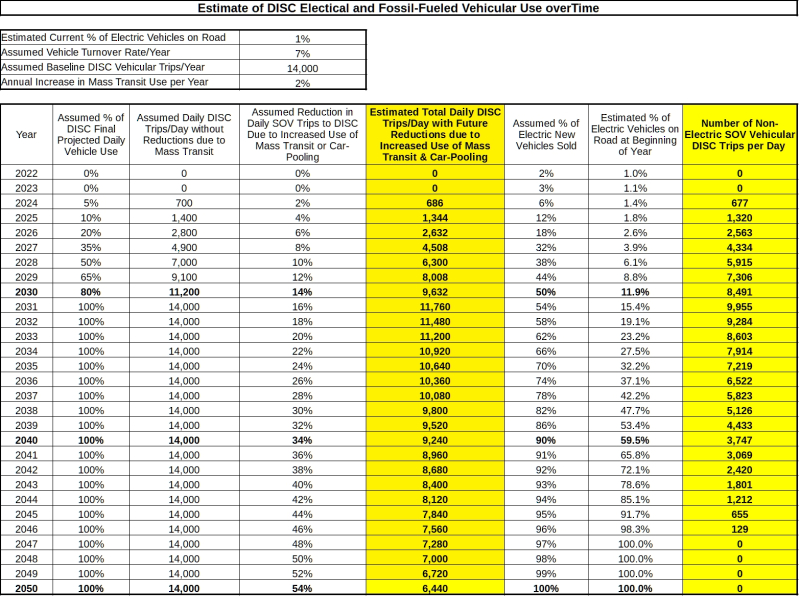
But electric cars are nowhere close to 100% of new cars sold. Currently, they account for only about 2% of new vehicle sales. Electric vehicles' market share will increase, of course. One optimistic set of projections puts electric vehicle sales at about 50% of the market in California by 2030 and 90% by 2040. But even with a 50% new electric vehicle market share by 2030 and a 90% market share by 2040, it would take until mid 2039 to get us to where 50% of the vehicles on the road would be electric and until 2047 for 90% of all vehicles on the road to be electric(see attached Appendix A). According to the recent UN Report on Climate Change, we will have by then already far surpassed the goal of limiting planetary temperature increases to 1.5° C and it's game over for the planet as we know it.
Conclusions
Despite the hyperbole from DISC proponents, the facts belie their rosy projections of reduced congestion on I-80 and local roadways resulting from the proposed I-80 freeway expansion. If VMTs are substantially increased as a result of the planned expansion of I-80 through the addition of HOV lanes as proposed, there will be little to no reduction of congestion on I-80 and the DISC project can be expected to substantially increase the congestion on Mace and Covell Blvd. by almost 12,000 vehicular trips per day further exacerbating an already unacceptable traffic condition. This congestion will be occurring far into the future even if the majority of commuters elect to use public transit to get to the DISC complex.
Further, if adoption and use of electric vehicles occur at projected rates and as many as 50% of commuters eventually elect to use public transit (an exceedingly highly optimistic and probably unattainable objective), substantial increases in Davis' GHG emissions from fossil fuel burning vehicles will still be occurring at least through the early 2040s.
The only logical choice to limit future traffic congestion and GHG emissions resulting from the DISC project is thus to deny build-out of the DISC project until stringent and enforceable limits on single occupancy vehicle (SOV) traffic are acheived – particularly by non-electric, fossil-fuel-powered vehicles. The potential future failure of the City to impose such restrictions on this project would be a de facto renunciation of their very own Emergency Climate Resolution calling for carbon neutrality by 2040.
Appendix A

 Davisite
Leave a comment