

By Roberta Millstein
What do trees being cut down at Sutter Davis Hospital, the Mace Mess, and Cannery traffic safety have to do with one another?
At first glance, not much. They are in three entirely different parts of town. Two of them do have to do with traffic and safety in part, but each has its own features. For example, residents near Mace Boulevard are concerned about the addition of over-engineered road structures they were not consulted on, and in light of increased traffic and other problems, would like them removed. And neither traffic safety at the Cannery nor the Mace Mess seems to relate to the removal of mature trees done without any input from the relevant City Commissions.
But those who have been following the Davisite might have noticed a commonality: in all three cases, citizens felt strongly enough about the issue to create a petition, as described in the following articles:
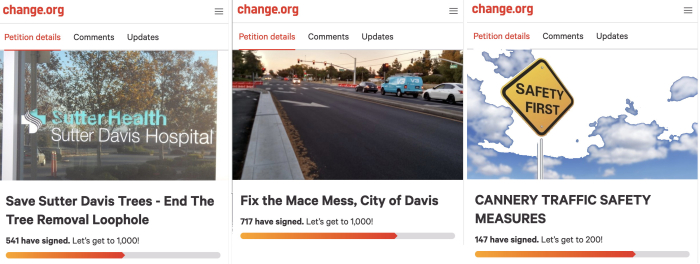
- Tree cutting at Sutter Hospital petition – currently at 541 signatures
- Mace mess petition – currently at 717 signatures
- Cannery traffic safety petition – currently at 147 signatures
When citizens are moved to create and sign petitions, it’s a signal that they feel that their voices aren’t being heard through normal channels, such as comments at the City Council or letters to the editor of the local newspaper. With a petition, citizens are trying to speak loudly, with one voice.
Consider, for example, these excerpts from the Mace Mess petition:
As two years’ experience has demonstrated, if we don't tell the City what we want, heaven only knows what they'll do. If you are a south Davis resident and want the Davis City Council to fix Mace, please sign.
and
I have advised the City that south Davis residents require adequate lead time before this meeting, that is, at least a week advance notice. It is not reasonable to expect residents to study and understand a cryptic road diagram during a 2-hour in-person or Zoom meeting, then comment on it in two minutes. In addition to posting on Nextdoor and the City webpage, the City should email people from the email addresses on the sign-in sheets from public meetings from the last two years. The City must post copies of the plans to be presented on the City webpage, on Nextdoor, on Facebook, and attach them to the emails sent out to the mailing list at least a week before meetings, so people will have time to understand what is proposed.
These are words of frustration, of not feeling informed and included, of not feeling heard.
The truth is it is always difficult to get many people to speak with one voice – people want to quibble over the wording, or it’s too strong or not strong enough, or they disagree with one part, or one part is missing. So to see hundreds of people speaking with one voice about each of these issues should really make us pay attention. Something is going on.
A slightly less recent, but still ongoing example of citizens not feeling heard: the growing calls for police reform and the establishment of a department of community safety, which represents a fourth group that formally petitioned the City Council (in April 2021: link).
This is not the first time that there seems to be a number of issues concerning which citizens feel unheard. I venture to say that it is an ongoing problem with the City Council that has persisted across several changes of personnel.
It might be tempting to dismiss online petitions, but we should remember that the right to petition the government for redress of grievances is a fundamental component of democracy. Its origins can be traced in England to the 1689 Bill of Rights and the even earlier 1215 Magna Carta. In the United States it is included in the First Amendment: “Congress shall make no law respecting an establishment of religion, or prohibiting the free exercise thereof; or abridging the freedom of speech, or of the press; or the right of the people peaceably to assemble, and to petition the Government for a redress of grievances” (emphasis added). A series of court decisions has made it clear that this right applies at all governmental levels, including local government.
In today’s world – especially during yet another COVID surge – online petitions are the best way for citizens to exercise that right. And the City Council should respect these expressions of democracy with the seriousness that they deserve.
Will these be the issues that finally wake the City Council up to the problem? Will the City Council work with citizens on these issues, or will it just barely pay attention to a stream of recorded comments – the 2 minutes each of us gets – and then continue business as usual?

 Davisite
Leave a reply to Colin Walsh Cancel reply