

A response to Ash Feeney
 By Roberta Millstein
A few days ago I learned of a new policy from City staff concerning the 25 acres outside of Mace curve, aka Mace 25, prime farmland that was purchased with citizen tax dollars from the open space fund. According to this new policy, the City will not be mowing areas in which burrowing owls are already nesting, instead allowing the owls to be “naturally displaced from the site… by allowing tall dense vegetation to grow along the western edge.” By not mowing, the City will be “doing what it can to prevent the owls from using the site.” Burrowing owls prefer short grasses (e.g., native short prairie grass or grass that is kept short through mowing) so that they can see their predators coming, and they will leave an area if the grasses aren’t short.
At Tuesday’s City Council meeting, I along with a number of other citizens attended to protest this new policy and to ask the City Council to direct staff to promote burrowing owl habitat at that site. Burrowing owls, it should be noted, have been designated as a Species of Special Concern by the State of California, and their numbers have been declining dramatically over the past 10 years in the Davis area. No action was taken at the meeting, although I have since learned that at least one Councilmember is in favor of taking up this issue at a future meeting.
What did happen at the meeting was that Assistant City Manager Ash Feeney defended the new policy. He has apparently issued a statement summarizing his views, published on the Davis Vanguard (staff could not confirm this by the end of yesterday’s business day). Unfortunately, this response contains false and problematic statements.
First, some background. The Mace 25 has been in limbo for quite a number of years (see here for history). It was part of the withdrawn “Mace Ranch Innovation Center” proposal, and it is part of the new and revised 200 acre ARC business park proposal, also on prime farmland. The ARC developers have proposed to use 6.8 acres of the 25 acres along its southern and eastern edge to satisfy the City’s agricultural buffer ordinance. (That in itself is problematic – that they are proposing to use the City’s farmland to buffer the rest of the City’s farmland – but that topic is for another day).

In the meantime, the land is been leased to a farmer, and for a number of years now, burrowing owls have been living along its western edge. There are even signs noting the presence of the burrowing owls and urging drivers to drive slowly. 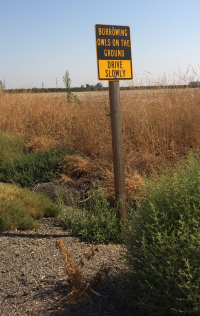
It is also worth noting that policy has not been presented to the Open Space and Habitat Commission (OSHC), and consequently, the OSHC has not had an opportunity to discuss or weigh in on the policy, much less the City Council. City staff developed this policy entirely on their own without outside input.
Back to Ash Feeney’s statement. Feeney points out that “There is no habitat easement or official destination for the property.” That much is true. Back in January 2019, the OSHC recommended: “The Mace 25 Open Space Site should be used for a community farm, or wildlife habitat (i.e., for burrowing owls and Swainson’s hawks), or open space public access/recreation, or a combination of these uses.” However, the City failed to act on the OSHC’s recommendations (and earlier, similar recommendations from the OSHC), leaving Mace 25 in limbo.
He further claims that “It would be irresponsible to promote a sensitive wildlife species to use a site where they could potentially be placed in harm’s way (i.e. an adjacent development application is under review where, though not agreed to, a portion of the property is being sought for an ag buffer.” That the burrowing owls would be in danger from ARC, as currently proposed, contradicts what I was told in January (while on a site visit to the Wildhorse ag buffer to discuss grass lengths for burrowing owls) by the City’s wildlife biologist, John McNerney, and it makes sense – there would still be more than 18 acres of the Mace 25 remaining. That is quite a bit of space, certainly far more space than the owls have at the Wildhorse Ag Buffer.
It should also be pointed out that Feeney is saying that the owls should be given a “passive deterrent through not mowing the property” because of a possible business park that is still under review – the Supplemental Environmental Impact Report is still being prepared, numerous commissions need to review it, and the City Council needs to place it on the ballot for a Measure J/R vote. So, he is proposing to keep the owls “safe” by “passively” ejecting them from their burrows… to have them go… somewhere? Where? The Wildhorse Ag Buffer that Feeney mentions is not very close, and is (according to what I was told by John McNerney) poor burrowing owl habitat because of the adjacent orchard, walking path used by humans and dogs, and golf course. The reality is the loss of their current burrows might mean that the owls die or fail to reproduce this season, further stressing an already very challenged population.
Most egregiously, he states that “The area the owls have been using is right next to Mace, which is a terrible place for young chicks.” This is false. The owls have been using burrows that are adjacent to a county road that gets very little traffic and is a considerable distance (from an owl’s point of view) from Mace Blvd. No part of Mace 25 borders on Mace Blvd. As noted previously, the owls have been doing fine in this area for a number of years.
So yes, although the City should act to protect the Mace 25, perhaps through an easement with the Yolo Habitat Conservancy, there is no legitimate justification for deliberately urging the owls away from the western border of the Mace 25. Keeping that area mowed – whether by done by the City, the farmer, the County, or the Burrowing Owl Preservation Society – is not that big an ask for a Species of Special Concern who is rapidly disappearing from Davis.
Now that City staff’s no-mow policy has come to light, I will be looking for the OSHC to agendize it as soon as possible and make a recommendation. In the meantime, staff needs to preserve the status quo – to protect the homes and health of the owls – by keeping the grass in the area short enough (4-6 inches).
If you are concerned about this issue, I urge you to email the City Council at CityCouncilMembers@cityofdavis.org to let them know your thoughts.
Roberta Millstein is Chair of the Open Space and Habitat Commission; however, the views expressed here are her own and should not be taken to be the views of other members of the Commission.

 Davisite
Leave a comment