

By Greg McPherson and Larry Guenther
On a global scale, planting billion of trees to combat climate change will be for naught if we don’t stop clearcutting the Amazon and other forests. The same idea applies on a local scale. Tree Davis’s upcoming planting of 1,000 trees will matter very little if healthy, mature trees are removed from development sites. Large amounts of carbon dioxide stored in these big, old trees is rapidly released after removal, whereas it takes many years for young trees to acquire biomass and accumulate carbon.
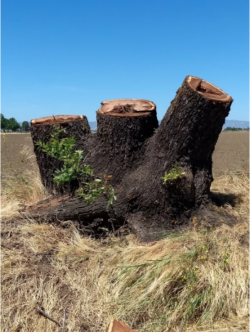
In November Davis voters approved Measure L, which established Baseline Project Features to guide development of the West Davis Active Adult Community (WDAAC) property, which is located west of the Sutter-Davis Hospital and north of Covell Blvd. In early June we noticed that 14 large, old California black walnut trees were among a host of trees removed from the site. We wondered why these veteran trees were not protected in a greenspace buffer along Covell Blvd.
Davis has a progressive policy toward conservation of trees on private property. Its Tree Ordinance identifies trees over 5” diameter at breast height (dbh) as “trees of significance” and requires that residents obtain permits prior to removal. In the case of development projects like WDAAC, the Ordinance states that, “the design and placement of development should attempt to incorporate existing healthy trees into the site design.” It requires an arborist report and one or more of the following when a project requires removal of trees: onsite replacement, offsite replacement, and/or payment of in lieu fees. Onsite replacement requires no net loss in tree dbh, 1” planted for each 1” lost. The Ordinance does not state that these replacement trees are above and beyond trees required to be planted along streets, in parking lots, parks and other public spaces.
The WDAAC Report found 103 trees of significance, including the 14 walnuts. Ten walnut trees had crowns that spread 40 feet or more. Many had multiple trunks from the base and five had an adjusted dbh greater than 24 inches. Of these 14 trees, 4 were recommended for removal because of poor health and structure. The remaining 10 trees were recommended for removal because of conflicts with site development. In fact, ALL 103 trees of significance were to be removed, regardless of their health or location. Conveniently, this finding eliminated need for a tree preservation plan.
After reviewing other documents related to the project we found that Mitigation Measure 3.4-11 in the certified Environmental Impact Report requires that a tree modification permit be submitted to the City prior to the removal of a tree, and in lieu fees assessed and paid by the project proponent. Also, we found that the City Tree Commission did not review the development plan, while other Commissions did (Natural Resources, Open Space & Habitat, Recreation and Parks).
Several questions have emerged:
- Why wasn’t the plan forwarded to the Tree Commission for review?
- Did City staff and the developer explore ways to preserve healthy veteran trees by incorporating them into buffers?
- Did the city receive and process a permit for removal, prior to tree removal?
- What form of mitigation is required? If mitigation is onsite, where will the 1,004 15 gal trees (each 1” dbh) be planted to offset the 1,004 inches of dbh removed? Will these replacements be in addition to the street, parks, and parking lot trees required by ordinance? Or did the city receive the in-lieu fee payment? If so, is the payment in the amount cited in the report ($126,420 for all 69 healthy trees removed)?
Changes in staffing and on-going negotiations with the developer have made it difficult for city staff to answer these questions. City policy provides the power required to protect our canopy, but the will to do so appears lacking. One suggestion is to strengthen criteria for preservation (or removal) of existing trees used by staff during review of Planned Developments. For example, questions to ask include;
- Have General Plan policies regarding trees and tree preservation been followed?
- Have existing healthy trees of significant value, as an existing condition on the site, been incorporated in the proposed site plan? If not, have the values of preserving existing trees been reasonably balanced with the general objectives of the project?
- Can the existing trees be incorporated in proposed open space areas such as parks, neighborhood greenbelts, ag buffer areas, natural open space areas, greenstreet spaces, and private open spaces?
- For those trees that cannot reasonably be preserved in the project, has their loss been acceptably mitigated?
Our mature tree canopy is a valuable historic, cultural, aesthetic, and environmental resource. It contributes to the richness of life we experience every day in Davis. Destruction of healthy old trees makes each of us poorer. Let’s make sure that these “residents” aren’t clearcut again without a thought.
Dr. McPherson is a retired US Forest Service urban forest researcher and Mr. Guenther is a recent member of the Davis Tree Commission. Both are members of the Tree Davis Board of Directors.

 Davisite
Leave a comment