

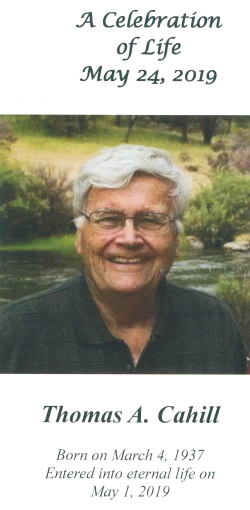
 A man whose outstanding science was matched by his humanity
By Roberta Millstein
On Saturday, a packed St. James Catholic Church paid their respects to one of Davis’s most esteemed and well-loved sons, Dr. Thomas Cahill, better known to his friends and family as “Tom.”
Tom’s achievements were many; they are outlined in the obituary in the Davis Enterprise. What most impresses me about his record was his dedication to doing science that mattered. Trained as a nuclear astrophysicist, he quickly turned to the issue of air quality in California and was one of the small team that successfully advocated for the lead- and sulfur-free gasoline in the early 1970s. His work on air quality continued throughout his career, even after his “retirement,” working on ultra-fine aerosols (including their impact on first-responders to the 9/11 World Trade Center attack) and aerosol impacts on global climate.
A few years ago, I was visiting at another university and met another faculty member who worked on air quality. I asked him if he had heard of Tom Cahill. The answer? “Of course, yes! Tom is the person to talk to about air quality issues.”
It used to be that people thought that science and values should be kept separate. That view is slowly (and thankfully) changing, a change that many in my academic field (philosophy of science) have been urging for some time. I think with radical climate change, with biodiversity loss, with the impact of pesticides – not to mention “older” issues like radiation from atomic weapons, we are realizing that it has to change. Tom was at the vanguard of that change, always working to better the human condition.
And he did so right up until the very end. In April, he penned a goodbye to friends on his Facebook page, noting that there was no longer any hope that the doctors could treat his advanced bone marrow cancer, but saying that he had “agreed to try to stay alive for 4 weeks for the sake of the Clinical Study” that he was a part of. He knew that the scientific findings of the study could help others and he made a sacrifice, perhaps his final sacrifice, so that others could be helped even after he was gone.
I had the fortune of meeting Tom during the first Nishi campaign. He and his wife Virginia had taken out an “ad” in the Davis Enterprise, outlining the terrible health impacts at the Nishi site and offering to send anyone who asked for the peer-reviewed evidence (much of which he had produced himself) to support his claims. On the fence about Nishi, I took him up on his offer, and found my email deluged with convincing and damning scientific evidence that Nishi was not suitable for housing. We struck up a friendship that continued through the first Nishi campaign and into the second.
What I quickly learned was that Tom was knowledgeable, sharp, detail-oriented, articulate, and careful in his assessments. The consummate scientist. But I also quickly learned that he was kind, generous with his time and his knowledge, honest, sincere, passionate, and caring. When he fought for Nishi, he fought for a cause he believed in, and he was deeply disappointed in how things turned out. Even after the result, he wanted to continue to study the site and learn more in the hope that it could help future residents.
In lieu of flowers, Tom’s family has suggested donations to the UC Davis Foundation for support of the Cahill Riparian Preserve, Catholic Relief Services, the Jesuit Volunteer Corps, Loaves and Fishes/Maryhouse, Sacramento, or a charity of the donor’s choice.
I’d like to suggest that we can further honor his memory by supporting science that works for the betterment of humankind and the natural environment. Having lost a true champion and an outstanding human being, others will need to step in and take up the banner. They will need our help.

 Davisite
Leave a reply to Ron O Cancel reply